Browsed by
Category: Vintage Treasures

The Digest Enthusiast #2 Now on Sale

The Digest Enthusiast #2 Now on Sale

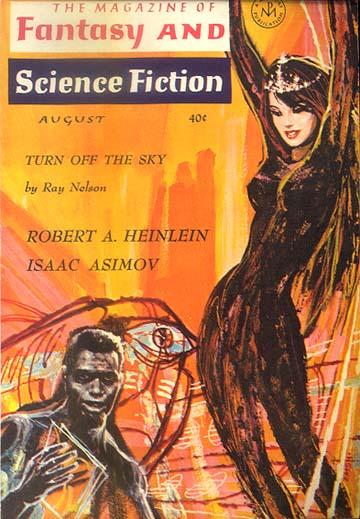
The Digest Enthusiast 2-smallI love a lot of aspects of the fantasy and science fiction genres — books, movies, TV shows, comics, conventions, board games, video games. But it was digest magazines like Analog, Asimov’s, and F&SF that first brought me into the field, and which formed the heart of the genre for me. It was in the pages of those magazines that I first discovered my favorite authors, and was exposed to the news, reviews, interviews, art and gossip that gradually taught me just how rich the field was — and taught me to love it.

I share this experience with a lot of older fans, and that’s why you see so many reviews of old digest magazines like Galaxy, Venture, Amazing and Fantastic here at Black Gate. It’s not just that they contain great old fiction, but because the magazines are so vital to the history of the field. (And, let’s face it, because of the great cover art.) SF, fantasy and mystery digests are inexpensive and easy to collect, and at every decent-sized convention or trade show, there’s sure to be a few fans selling, buying, and swapping digest magazines.

So I was delighted to see the first issue of The Digest Enthusiast in January of this year. The debut issue was 116 pages and packed with articles on Galaxy, protective sleeves, Walter Gibson’s The Big Story, and much more, including interviews with F&SF editor Gordon Van Gelder, Phyllis Galde, editor and publisher of Fate magazine, and more.

But before I could get around to ordering it, the second issue arrived — and this one’s even bigger. Weighing it at a whopping 151 pages, it contains articles on Borderline, the Astounding Trading Cards, The Mysterious Traveler Magazine, H.L Gold’s Beyond Fantasy Fiction, Archie Comics Digests, and much more. There’s also reviews of current magazines, including Monster! #15, Asimov’s July 2015, and the July issue of Analog. There’s even four pieces of original short fiction!

Needless to say, I ordered a copy of the second issue as soon as it was available. It arrived yesterday, and I’m thoroughly enjoying it. I especially appreciated the reviews of current digests, which I found well written and enthusiastic. Here’s Rudolph Schmidt on Black Gate blogger Derek Kunsken’s novella “Pollen From a Future Harvest,” in the July issue of Asimov’s.

Read More Read More

Discovering Robert E. Howard: Howard Andrew Jones and Bill Ward Re-Read “The Phoenix on the Sword”

Discovering Robert E. Howard: Howard Andrew Jones and Bill Ward Re-Read “The Phoenix on the Sword”

The Phoenix on the Sword Weird Tales-smallOver at Howard Andrew Jones’ blog, Bill Ward and Howard Andrew Jones continue their re-read of the first Del Rey Conan volume, The Coming of Conan, with the very first Conan story, “The Phoenix on the Sword,” originally published in the December 1932 issue of Weird Tales magazine. Here’s Howard:

Look at the story’s opening quote. That’s practically the gold standard of quotes from imaginary historical sources. That fabulous “Know, O Prince” and all that follows has been imitated but rarely, if ever, equalled. This, fellow fantasy fans, is the way it’s done. Admittedly, there are a few phrases in the middle of the paragraph that are less inspired. I’m looking at “Zingara with its chivalry, Koth that bordered on the pastoral lands of Shem.” Most of the rest of the quote paints lovely word pictures, but those phrases don’t remotely approach the poetic majesty of the rest — what does Zingara look like? What does Koth look like? But the rest is lovely, and the quality picks right back up with “dreaming west” and powers on to that fantastic finish, “Hither came Conan…”

Look at the opening line of the story: “Over shadowy spires and gleaming towers lay the ghostly darkness and silence that runs before dawn.” Damn. Why doesn’t anyone write like that any more? Howard sets the scene with sharp, sensory laden description. He’s a film director guiding the camera with a fantastic establishing shot.

Their first post on this topic discussed Howard’s “The Hyborian Age.” Read the complete exchange here.

Read More Read More

Martian Pirates, Brain Creatures, and Hive Minds: Rich Horton on Ray Cummings and John Brunner

Martian Pirates, Brain Creatures, and Hive Minds: Rich Horton on Ray Cummings and John Brunner

Wandl the Invader-small I Speak For Earth-small

Brigands of the Moon-smallRich Horton’s personal blog, Strange at Ecbatan, is a great place to hang out if (like us) you love vintage paperbacks and magazines. In addition to his reviews here at Black Gate (not to mention his editing duties for The Year’s Best Science Fiction & Fantasy, the 2015 Volume of which just arrived last month), Rich also reviews forgotten bestsellers, neglected classics, and obscure books by writers who later became highly regarded. This week he takes a look at an Ace Double from 1961.

This week’s Old Bestseller post is on a book that was by no means a bestseller — it’s another Ace Double review, this time a new one (for me) — the 1961 pairing of a rather dreadful 1932 pulp serial by Ray Cummings (Wandl the Invader) with one of John Brunner’s better early short novels (I Speak For Earth), written as by “Keith Woodcott.”

Wandl the Invader was serialized in Astounding in 1932. It was a sequel to Brigands of the Moon, which began its serialization in the third issue of Astounding, in 1930. It is set in a future in which space travel is well-established within the Solar System, and essentially human civilizations have been discovered on both Venus and Mars. (Interbreeding is possible, for instance.) A small planet called Wandl has appeared in the Solar System, and Gregg Haljan (hero of Brigands of the Moon) is recruited to captain a spaceship to resist the evil intentions of the planet’s inhabitants.

Read More Read More

Vintage Treasures: The Plantagenet Novels by Allen Andrews

Vintage Treasures: The Plantagenet Novels by Allen Andrews

The Pig Plantagenet-small Castle Crespin-small

Allen Andrews is the author of a number of fine British histories, including Kings and Queens of England and Scotland, The Whiskey Barons, The Air Marshals, and Wonders of Victorian Engineering. But for genre fans, he’s chiefly remembered for two light fantasy novels he produced in the 1980s: The Pig Plantagenet (1980) and Castle Crespin (1982), both reprinted in paperback by Tor with a pair of fine covers by Victoria Poyser.

The Pig Plantagenet is the tale of Plantagenet, a pig on a 13th century farm in Poitou, France, who schemes to ruin a great hunt that will slaughter all the wild pigs and other creatures surrounding the farm. The sequel focuses more on Fulgent the Fox, who has “fairly traditional designs on a local farmer’s poultry,” and who is also part of the local animal aristocracy. One thing leads to another, and soon two very different societies are locked in deadly conflict.

Both books drew strong comparisons to Watership Down and Animal Farm, which was doubtless inevitable with any fantasy featuring farm animals, but more astute reviewers saw more in these books, especially the rather clever way in which the author depicts a class-based animal society with surprising complexity.

Read More Read More

Vintage Treasures: Fantastic Stories: Tales of the Weird & Wondrous, edited by Martin H. Greenberg and Patrick L. Price

Vintage Treasures: Fantastic Stories: Tales of the Weird & Wondrous, edited by Martin H. Greenberg and Patrick L. Price

Fantastic Stories Tales of the Weird & Wondrous-small Fantastic Stories Tales of the Weird & Wondrous back-small

Dungeons & Dragons publisher TSR acquired Amazing Stories, the longest running science fiction magazine in the world, in 1982, as a vehicle to help promote their family of games to SF readers around the world. By the mid-80s, TSR had their first fiction bestseller on their hands with the first Dragonlance trilogy by Margaret Weis and Tracy Hickman, which sold well over three million copies worldwide and spawned dozens of sequels, and TSR quickly became very adept at leveraging all aspects of publishing to support their properties. If publishing D&D novels helped introduce millions of young readers to their products, why not try the same with Amazing Stories?

So TSR contracted Martin H. Greenberg to produce five mass market anthologies, mining six decades of Amazing fiction. The results weren’t particularly big sellers (and they didn’t save Amazing from eventually folding), but they were nonetheless a fabulous boon for collectors. Best of all, they included the most comprehensive survey ever done of the pulp Amazing Stories, a three-volume set containing nearly 1,000-pages, covering 1926 to 1955. I looked at all five volumes in 2012, in a Vintage Treasures article on TSR’s Amazing Science Fiction Anthologies.

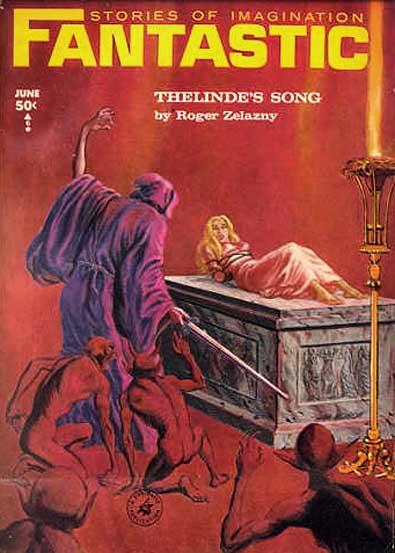
The long-running companion magazine to Amazing, Fantastic — which published some of the finest early sword & sorcery in the field, including stories by Fritz Leiber, John Jakes, Poul Anderson, Avram Davidson, James Tiptree, Jr., John Brunner, George R. R. Martin, Philip K. Dick, Roger Zelazny, Michael Moorock, and Dean Koontz — merged with Amazing in 1980, and the rights fell to TSR. As part of their initiative to promote their magazine properties, TSR also commissioned Greenberg and new Amazing Stories editor Patrick L. Price to compile a deluxe anthology collecting 30 years of Fantastic fiction, with new artwork and an 8-page color section reproducing some of their most famous covers. The result was a fine collection, and one of the only anthologies dedicated to one of the all-time great S&S magazines.

Read More Read More

Vintage Treasures: Lyrec by Gregory Frost

Vintage Treasures: Lyrec by Gregory Frost

Lyrec Gregory Frost-smallGregory Frost is the author of the popular Shadowbridge novels (Shadowbridge and Lord Tophet) and the World Fantasy Award nominee Fitcher’s Brides, among others.

But I admit the the novel I still give to friends to introduce them to Frost is his debut Lyrec, a fantasy romp about a long-lived space traveler, his talking cat Borregad, and the evil menace they’ve tracked across countless star systems, the ruthless Miradomon. Lyrec was published as a paperback original by Ace in 1984, and went through multiple reprintings. This one was on a lot of reading lists in the 80s.

Lovelorn Lyrec and wise-cracking Borregad have been companions through world after world, adventure after adventure. They seek Lyrec’s lost lady, and vengeance for the obliteration of their homeworld. But the evil Miradomon is always one step ahead, leaving a dark trail of destruction behind him.

Crossing a chain of parallel universes, our heroes must take on new identities in each new world. In his latest incarnation, Lyrec has done quite well for himself. He is young, strong, handsome, skilled in the arts of war and song. Poor Borregad blew it. He’s stuck in the body of a cat. And Miradomon?

This time, he’s a god.

Lyrec was published in February 1984 by Ace Books. It is 267 pages, priced at $2.75 in paperback. The cover is by Romas. It was released in digital format in 2011, and is currently available for $4.99.

See all of our recent Vintage Treasures here.

Vintage Treasures: The Books of Outremer by Chaz Brenchley

Vintage Treasures: The Books of Outremer by Chaz Brenchley

Outremer 1 - The Devil in the Dust-small Outremer 2 - The Tower of the King's Daughter-small Outremer 3 - A Dark Way to Glory-small

Back in 2002, Ace Books tried an unusual experiment with Paul Kearney’s The Monarchies of God novels. They were originally published in the UK starting in 1995, but when Ace brought them to the US, they released the books just one month apart.

As I noted in my April article, the experiment wasn’t a success, and the books went out of print fairly quickly. At the time, however, I said that Ace never repeated the experiment, and that’s not actually true. They attempted the same thing at least one more time, with Chaz Brenchley Books of Outremer, originally published in three fat volumes in the UK in 1998-2002, and reprinted as six paperbacks in the US, one every month, between June and November 2003, with covers by John Howe and Barbara Lofthouse.

Near as I can figure out, this experiment wasn’t any more successful. The books were never reprinted, and are now long out of print.

Read More Read More

Vintage Treasures: The Torin Trilogy by Cherry Wilder

Vintage Treasures: The Torin Trilogy by Cherry Wilder

Cherry Wilder The Luck of Brin's Five-small Cherry Wilder The Nearest Fire-small Cherry Wilder The Tapestry Warriors-small

Cherry Wilder had a relatively short career as fantasy writers go. Her first novel was The Luck of Brin’s Five (1977), which won the 1978 Ditmar Award for Best Australian Science Fiction Novel, and was the first novel in The Torin Trilogy. She produced two other series, The Rulers of Hylor (four novels, published between 1984 and 2004) and two novels in the Rhomary Land series (in 1986 and 1996), several short stores, and that was it. She died in 2002.

Still, she is very fondly remembered as one of the shining lights of 80s fantasy. Although The Torin Trilogy has all the trappings of fantasy — including sorcerers, far-flung kingdoms, and mystical powers — at heart it’s actually science fiction. It’s the tale of Scott Gale, a space traveler from Earth who finds himself shipwrecked on the world of Torin, where he’s accepted as a family member by Brin’s Five. Before long he finds himself embroiled in a desperate battle against the feared man who rules much of the land, Strangler Tiath Pentroy.

Read More Read More

Vintage Treasures: The Best of Frank Herbert

Vintage Treasures: The Best of Frank Herbert

The Best of Frank Herbert 1952-1964-small The Best of Frank Herbert 1965-1970-small

Sidgwick & Jackson released The Best of Frank Herbert in hardcover in the UK in 1975. The book was edited by Anugs Wells, with a fairly drab cover by an unknown artist (see below). It was 302 pages.

For the paperback edition the following year, Sphere split the book into two volumes, both around 160 pages. The cover artist was uncredited in both cases, but it sure looks to me like Bruce Pennington. (Click the images above for bigger versions.)

The book was never released in the US, and the UK paperbacks have now been out of print for almost 40 years. The UK editions can be a little tricky to track down in the US, but they’re fairly common in the UK. As of this writing, half dozen copies are listed on eBay, priced at $10 and up per volume.

Read More Read More

Discovering Robert E. Howard: Wally Conger on “Rogues in the House”

Discovering Robert E. Howard: Wally Conger on “Rogues in the House”

BG_RoguesComicOne of the cool things about being an active member in the Sherlock Holmes community is that I run across a broad spectrum of people with other common interests outside of the world’s first private consulting detective. Wally Conger and I have had back and forth conversations on versions of The Hound of the Baskervilles and other topics.

We may not agree on season three of Sherlock, but we do both enjoy reading Conan. So, I asked him to review “Rogues in the House,” which I knew he had just read. He was kind enough to do just that…


By the time Robert E. Howard launched into writing “Rogues in the House” in January 1933, he already had 10 Conan tales under his belt. He was very comfortable with the character.

In fact, upon publication of the story in the January 1934 issue of Weird Tales, Howard wrote to fellow writer Clark Ashton Smith:

Glad you liked ‘Rogues in the House.’ That was one of those yarns which seemed to write itself. I didn’t rewrite it even once. As I remember I only erased and changed one word in it, and then sent it in just as it was written. I had a splitting sick headache, too, when I wrote the first half, but that didn’t seem to affect my work any.

I wish to thunder I could write with equal ease all the time. Ordinarily I revise even my Conan yarns once or twice, and the other stuff I hammer out by main strength.

Read More Read More