Browsed by
Category: Vintage Treasures

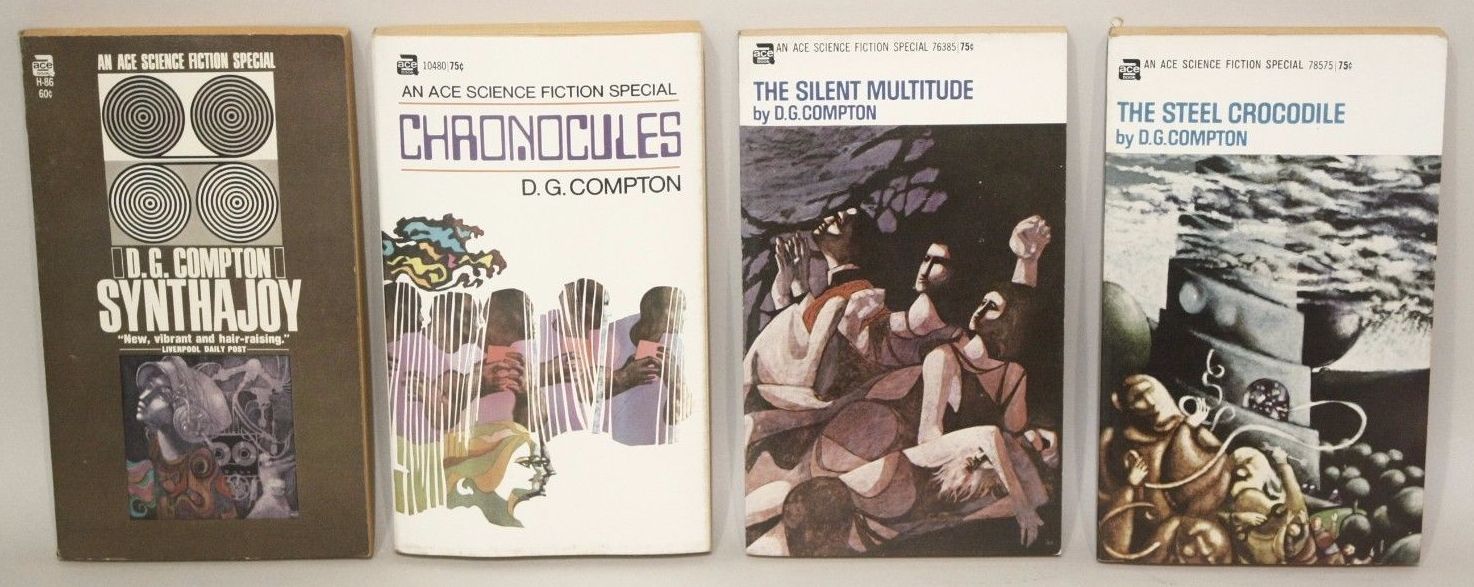
Collecting (and Selling) Ace Doubles

Collecting (and Selling) Ace Doubles

black-gate-booth at Worldcon 2012

Selling vintage paperbacks at the Chicago Worldcon, 2012.
That’s Peadar O’Guilin and Kristin Janz in the background,
and David Kyle’s hand at left

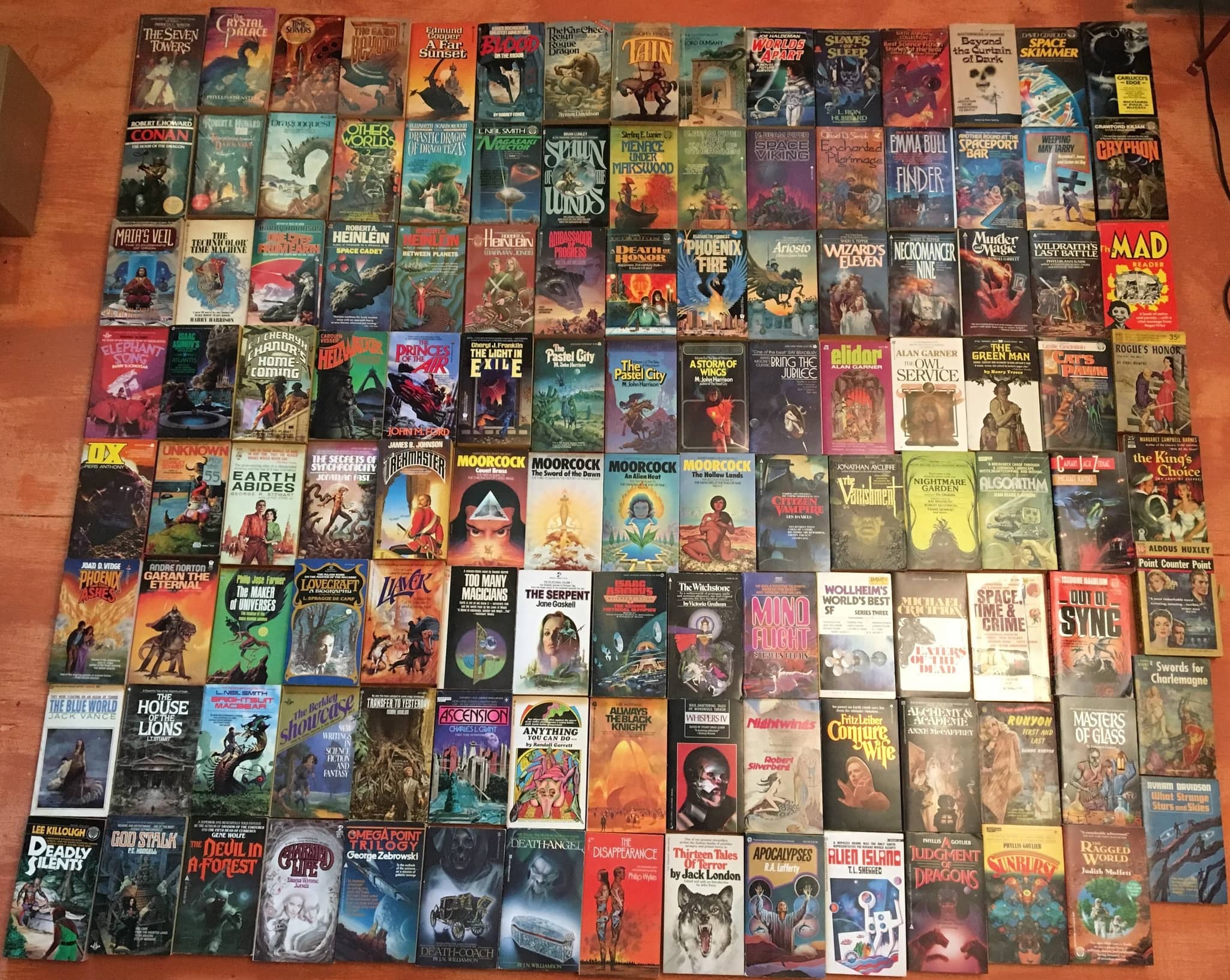
I’ve been collecting science fiction paperbacks for around forty years, and attending SF conventions for roughly the same period. So it’s natural to eventually combine the two. About fifteen years ago, after I’d started selling Black Gate magazine at conventions, I decided to package up some of the older duplicates sitting in my basement and bring them along too.

That quickly became the biggest draw at our booth. As I learned the hard way, struggling in vain to launch a new fantasy magazine, the audience for short fiction in this field gets smaller every year. But interest in vintage science fiction seems to sharpen and grow with each passing month.

It was especially gratifying to see young SF readers approach the booth, eyes wide, taking in the colorful rows of hundreds of paperbacks published before they were born. Sometimes they’d make appreciative comments like, “I can’t believe you have such an incredible collection… it seems a shame to sell it!” Of course, if four tables stacked with books seemed unbelievable, the truth (that this wasn’t my collection, but just a small fraction of the duplicates from my collection) would probably tax their fragile credulity to the limit, so in those moments I’d usually just smile and say, “Shucks. Thanks.”

Read More Read More

I’ve Got You Covered

I’ve Got You Covered

Frank Frazetta The Death Dealer

In my last post I took a look at SF cover art, and how the fashion in covers changes over the decades. As with fashion in clothing or hairstyles, you can make a pretty accurate guess about time periods and genres just from a book’s cover. Whether you’re influenced in your purchases by that cover is a personal thing. In the spirit of leaving no stone unturned, today I’m looking at Fantasy cover art.

Since I’m a writer and not an art critic, I avoided discussing the work of any particular SF artist – I was looking at how covers change, not how an artist evolves. However, I don’t think we can talk about Fantasy cover art without at least a brief look at Frank Frazetta. In a way, his covers are the perfect example of what I’m talking about. When you look at a Frazetta cover, you know what time period, and what genre you’re looking at.

Read More Read More

Evil Wizards, Robot Guardians, and the Maze of the Minotaur: Rich Horton on The Reign of Wizardry by Jack Williamson

Evil Wizards, Robot Guardians, and the Maze of the Minotaur: Rich Horton on The Reign of Wizardry by Jack Williamson

Unknown March 1940-small The Reign of Wizardry Lancer The Reign of Wizardry Sphere-small

Jack Williamson’s novel The Reign of Wizardry was originally published in three installments in the grand old pulp magazine Unknown, beginning in the March 1940 issue (above left, cover by M. Isip). Its first complete appearance was as a 1964 Lancer paperback (middle), with a cover by none other than Frank Frazetta. It’s been reprinted nearly a dozen times since, including a 1981 paperback edition from Sphere in the UK (right, artist uncredited), and most recently in the 2008 Haffner Press collection Gateway to Paradise.

Jack Williamson was a SFWA Grand Master. His first story appeared in Amazing Stories in 1928 when he was 20 years old and, in a remarkable career than spanned nearly eight decades, he was still winning major awards in his 90s, including a Hugo and a Nebula for his novella “The Ultimate Earth” (Analog, December 2000). He died in 2006, at the age of 98.

The Reign of Wizardry enjoyed multiple editions over the decades, and last year it was nominated for a Retro Hugo for Best Novel of 1941 (it lost out to A.E. van Vogt’s Slan). Recently Rich Horton gave it a warts-and-all review at his website Strange at Ecbatan.

Read More Read More

Vintage Treasures: Famous Fantastic Mysteries, edited by Stefan R. Dziemianowicz, Robert Weinberg, and Martin H. Greenberg

Vintage Treasures: Famous Fantastic Mysteries, edited by Stefan R. Dziemianowicz, Robert Weinberg, and Martin H. Greenberg

Famous Fantastic Mysteries Weinberg-smallI spent yesterday and Friday at the Windy City Pulp and Paperback show in Lombard, Illinois, about 30 minutes from my house. And as soon as I finish this article, I’m going to scoot over there again.

I found a great many treasures at this show this year. More than usual, even. And I’m looking forward to reporting on them here. One of the more interesting was a copy of Famous Fantastic Mysteries, a 1991 pulp reprint anthology from Gramercy edited by Stefan R. Dziemianowicz, Robert Weinberg, and Martin H. Greenberg, in terrific shape, which I bought for just $5.

Famous Fantastic Mysteries was a much-beloved fantasy pulp which ran from 1939 to 1953. The publisher was Frank A. Munsey, a name well known to pulp fans. The first bi-monthly issue was cover-dated September-October 1939, and contained A. Merritt’s “The Moon Pool,” Ray Cummings’ “The Girl in the Golden Atom,” and stories by Manly Wade Wellman, Donald Wandrei, and many others. The magazine was a success, and it quickly switched from bi-monthly to monthly.

While the magazine relied chiefly on reprints, especially in the early days, it commissioned original art from many of the top artists of the day, especially Virgil Finlay and Lawrence Sterne Sevens, and today is treasured as much for the fabulous covers and interior art as the fiction.

In its 81 issues, Famous Fantastic Mysteries offered reprints of SF and fantasy pulp stories by Max Brand, E. F. Benson, Robert W. Chambers, William Hope Hodgson, Lord Dunsany, Bram Stoker, H. P. Lovecraft, Robert E. Howard, Arthur Conan Doyle, Jack London, and countless others, as well as brand new fiction from Henry Kuttner, C. L. Moore, Murray Leinster, Theodore Sturgeon, William Tenn, Margaret St. Clair, Arthur C. Clarke, Donald A. Wollheim, Robert Bloch, Ray Bradbury, and many more. See the complete issue checklist at Galactic Central.

Read More Read More

Total Pulp Victory: Windy City Pulp & Paper, Part II

Total Pulp Victory: Windy City Pulp & Paper, Part II

Horror on the Asteroid at Windy City Pulp 2016-small

Horror on the Asteroid, and other fabulous treasures

Happy Saturday morning everyone!

I leaped out of bed this morning, and hastily started packing up to head out to the Windy City Pulp and Paperback show in nearby Lombard, IL. I spent most of the day there yesterday, catching up with Jason Waltz, Arin Komins, Rich Warren, David Willoughby, Bob Garcia, Doug Ellis, and many other old friends… and more than a few fellow happy buyers and sellers.

I also found more than a few treasures, including a seller in the back with an absolutely gorgeous collection of 1970s and 80s science fiction paperbacks that looked glossy and flawless. He was asking $2 each, in many cases less than the original cover price, so it was like stepping back in time and plucking brand new books by Roger Zelanzy, Sherri Tepper, H. Beam Piper, P.C. Hodgell, Gene Wolfe, and Robert E. Howard off the shelves. I even found a complete set of M. John Harrison’s Viriconium sequence, which Fletcher Vredenburgh enthusiastically wrote up here at Black Gate. I spent a small fortune at that booth alone, and it took a few trips back to the car to carry all my bags.

Windy City has the kind of treasures I cannot find anywhere else, like rare Arkham House collections and early issues of Weird Tales, and even a copy of the first collection by my favorite pulp writer, Edmond Hamilton’s The Horror on the Asteroid and Other Tales of Planetary Horror, published in hardcover by Philip Allan in 1936. I’ve only seen one copy in my entire life, and that was at last year’s show, resting on a table among dozens of other near-priceless volumes, like early first editions of Stephen King, H.P. Lovecraft, Robert A Heinlein, Fritz Leiber, C.L. Moore, Robert E. Howard, Clark Ashton Smith, and lots more (click the image above for a closer look).

Read More Read More

Books and Craft: World Building and the Importance of Setting

Books and Craft: World Building and the Importance of Setting

Tigana Anniversary Edition-small Tigana Anniversary Edition-back-small

After a longer hiatus than I had a intended, I am back with the second in my Books and Craft series of articles on the elements of story telling that make “classic” and “must-read novels”… well, classic and must-read. In my first entry, I wrote about Nicola Griffith’s science fiction masterpiece, Slow River, and Griffith’s innovative use of point of view.

Today, I turn to one of my favorite fantasy novels: Guy Gavriel Kay’s Tigana, a stand-alone epic fantasy (that rarest of all things), which first appeared in print in 1990. I actually referred to this book in my first column, while making a point that bears repeating. As with Slow River, there is no one craft element of Tigana that makes it a successful novel. Kay displays here the command of language and pacing, character development and narrative arc his readers have come to expect. Another observer might focus on one of these, or some other facet of his work, to explain why they love this novel — or any of the others he has penned in a spectacular career that now spans more than three decades.

But to my mind, the defining characteristic of Tigana, the one that established it as my favorite fantasy when I first read it so many years ago, is its magnificent world building. In creating the Palm, a hand-shaped landmass of rival kingdoms that is somewhat reminiscent of medieval Mediterranean Europe, Kay has blended religion and ritual, history and politics, cuisine and viticulture and music and art, into something so rich, so alive, so compelling, that the reader cannot help but be transported with each cracking of the book’s spine. All that unfolds in Tigana’s pages flows from this sense of place.

Read More Read More

The Pride of Chanur by C.J. Cherryh

The Pride of Chanur by C.J. Cherryh

oie_172136AgOgCew8My first encounter with C.J. Cherryh was in Merchanter’s Luck, a short, action-packed story set in Cherryh’s super-dense Alliance-Union Universe. While the plot could have been drafted by any number of skilled space opera purveyors, I’d never before encountered one who wrote with Cherryh’s level of near contempt for explaining things to the reader. She writes in what she’s variably called  “very tight limited third person” and “intense internal voice.” This means characters only think or talk about what actually interests them. Descriptions will not be forthcoming when a character is observing what is commonplace to him. Exposition, well, don’t count on her books having much.

While Merchanter’s Luck, with its thrilling races through hyperspace and deadly mysteries, is quite good, what made me a lifelong fan of Cherryh is a slim volume from 1982, The Pride of Chanur. The title refers to the merchant ship of the same name, one of several operated by the Chanur clan. The Chanur are hani: an alien, leonine race of which only females travel into space, the males being considered too violent and psychologically unstable. The title takes on a second, humorous meaning when the crew of the Pride find themselves harboring and protecting a lone human male.

Since then, I’ve read Pride and its sequels three or four times. They are among the very best space opera stories I have ever read. Cherryh’s writing demands you keep up and are as willing as her heroes to leap into the dark of the cosmos at times. The payoff is a tale of incredible thrills in a highly complex and believably detailed universe.

Read More Read More

Smoke and Mirrors by Jane Lindskold Released as an eBook!

Smoke and Mirrors by Jane Lindskold Released as an eBook!

Smoke and Mirrors Jane Lindskold-smallJane Lindskold is in the process of re-releasing some of her out of print books as ebooks, and the first of these, Smoke and Mirrors is out now. Below I’ve included the cover copy, but if you want to read more about this re-release, check out Jane’s release day post.

How do you fight an enemy who can, literally, change your mind?

From the moment she first senses the whispers of the alien mind within the thoughts of her current client, Smokey – touch telepath, industrial spy, and high-end prostitute – becomes an unwitting player in a conflict that may be as old as humanity.

Determined to protect herself and her young daughter, Smokey soon realizes that the stakes are much, much higher.

After millennia of setting up the field, the aliens may be making their final move. If Smokey is to defeat them, she must win the respect and trust of people who despise her – perhaps at the cost of those she loves the most.

This reprint of the 1996 science fiction novel features an original afterword by the author.

The book is available from Amazon, Barnes and Noble, iBooks, Google Play, and Kobo.


Emily Mah is a writer and the owner of E.M. Tippetts Book Designs, a company that provides formatting and cover design services for independent authors and publishers. Her last interview for Black Gate was with German author Emily Bold.

Cover to Cover

Cover to Cover

Heinlein Door 1 Heinlein Door 2 Heinlein Door 3

Until relatively recently, I never looked at cover art. I bought books because of a review, or, more likely, because of a personal recommendation. There was art I liked, and some I didn’t like, and some that embarrassed me for one reason or another. But, the art in and of itself didn’t influence my purchasing of any book.

It was recently brought to my attention, however, that the style of cover art comes in and out of fashion, like anything else. Many of us can tell, just looking at the clothing in a photograph, in what decade the photo was taken. Hairstyle is a great indicator, as are necklines, width and length of collars and cuffs, of hemlines and sleeves. Shoulder pads anyone? Thirty years from now, someone looking at today’s photos are going to think of the 2010’s as “the decade of the beard.”

There are many people better qualified than I to talk about cover art as art. I just want to talk about it as covers. My examples are completely arbitrary, and usually come from my own shelves. Keep in mind that in order to look at changing fashion in covers over decades, I have to look at works that have been in print for that long.

Read More Read More

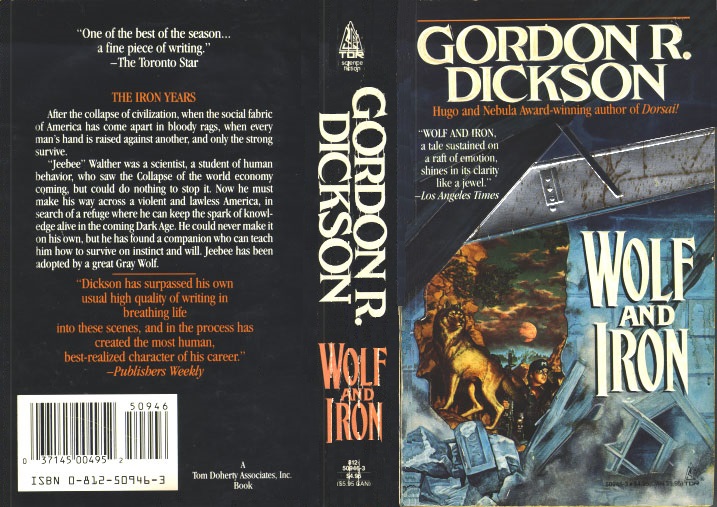
New Treasures: The Best of Gordon R. Dickson, Volume 1 edited by Hank Davis

New Treasures: The Best of Gordon R. Dickson, Volume 1 edited by Hank Davis

The Best of Gordon R Dickson Volume 1-smallOver the last four years we’ve spent a lot of time and energy covering Del Rey’s 1970s-era Classic Science Fiction line, also know as the Best of…. series. In the process we may have angrily shaken our fists at the entire publishing industry once or twice, shouting “You don’t have the guts or the imagination to do something like this any more, do you??”

And of course, along comes Baen Books to prove us wrong.

Last week Baen Books released The Best of Gordon R. Dickson, Volume 1, the first in a two-volume set collecting a generous sample of science fiction and fantasy from one of the most popular and celebrated SF writers of the 20th Century. It follows The Best of Bova, a planned 3-volume set, and their recent omnibus collections of Andre Norton, Murray Leinster, and James H. Schmitz.

The Best of Gordon R. Dickson, Volume I, gathers together fourteen stories, predominantly from the first half of legendary science fiction and fantasy writer Gordon R. Dickson’s career, ranging from the early 1950s through the 1960s, including tales dragons, dolphins, aliens, werewolves, mutants and humans trying to make sense of an infinitely bewildering universe. A maiden aunt is suddenly given superpowers. An alien who looks like a large, sentient rabbit makes ominous announcement which make no sense from behind an impenetrable force shield. Humans besieged by an alien enemy refuse, against all reason, to give up fighting. And much more, in stories running the gamut from exciting adventure to stark tragedy to hysterical comedy. Plus the never before published “Love Story,” written for Harlan Ellison’s legendary, but never published anthology, The Last Dangerous Visions. And stay tuned for The Best of Gordon R. Dickson, Volume II, with another generous display of Dickson’s virtuosity, covering his brilliant career from 1970s to the century’s end.

I was especially pleased to see that editor Hank Davis managed to pry another unpublished tale from Harlan Ellison’s clutches, where it has been languishing in the submission pile for The Last Dangerous Visions since 1973.

Read More Read More