Browsed by
Category: Vintage Treasures

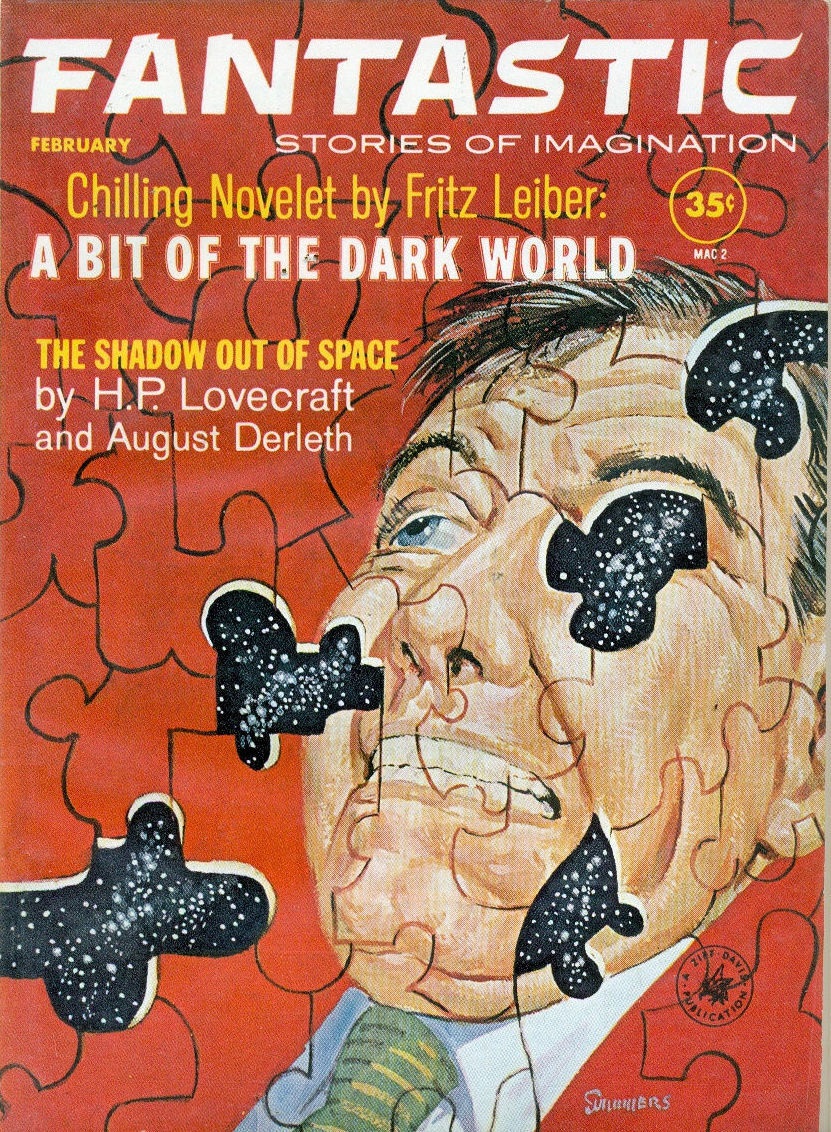
Fantastic Stories of Imagination, February 1962: A Retro-Review

Fantastic Stories of Imagination, February 1962: A Retro-Review

Fantastic February 1962-small Fantastic February 1962-back-small

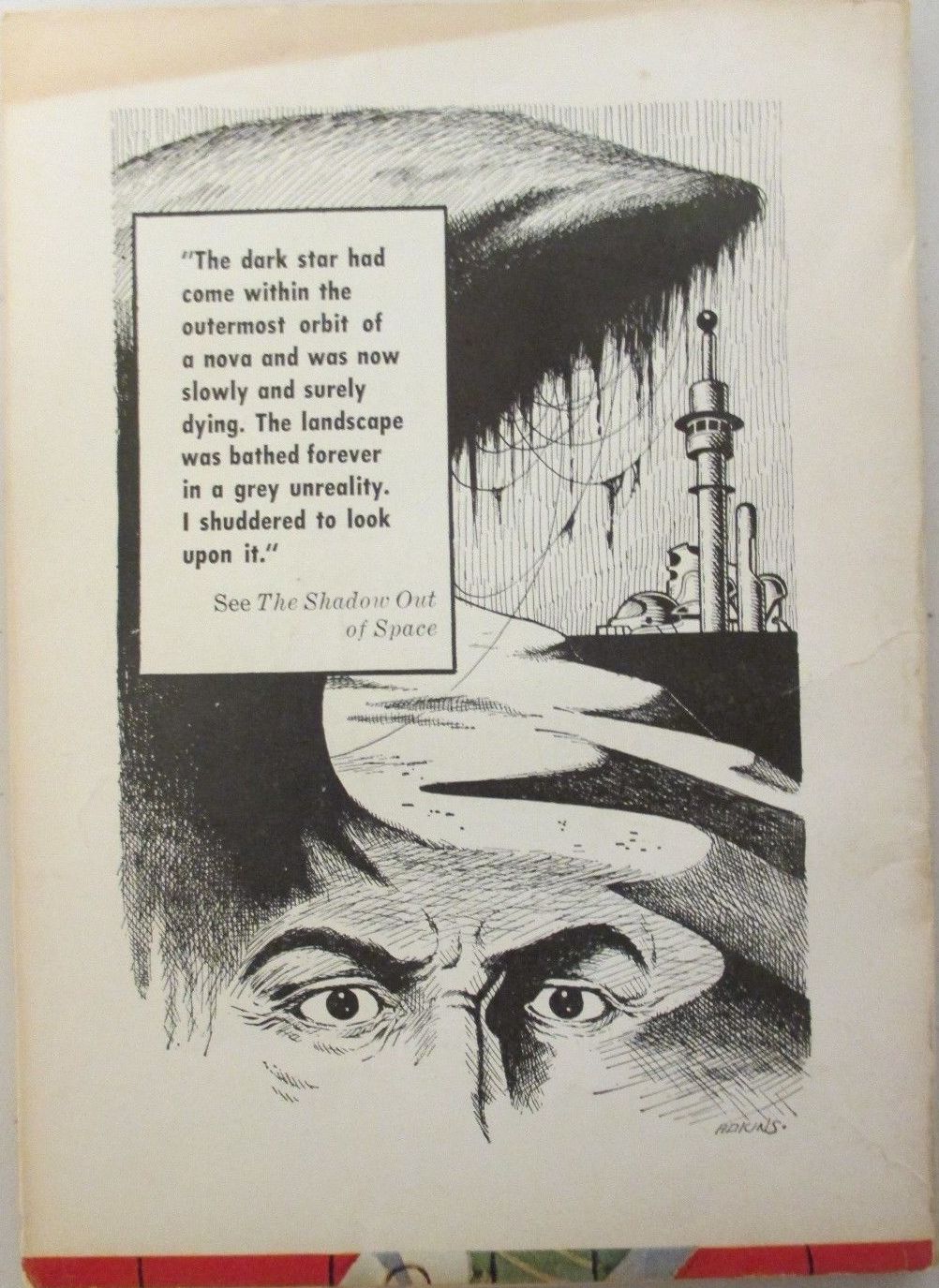
The cover for this issue is by Leo Summers. Interior illustrations are by Dan Adkins (who also contributes the back cover) and Walker. The editorial recounts two recent cases of apparently fantastical occurrences in real life — with, in both cases, pretty straightforward mundane explanations. The letter column features letters from Leo A. Brodeur (a professor of French Literature at Laurentian University), discussing SF writers as “the poets of science”; and R. Martinkivi, praising the magazine.

The stories are:

Novelets

“A Bit of the Dark World,” by Fritz Leiber (12,500 words)
“A Silence of Wings,” by Daniel F. Galouye (10,500 words)

Read More Read More

Vintage Treasures: The Ace Novels of D.G. Compton

Vintage Treasures: The Ace Novels of D.G. Compton

D.G. Compton Ace paperbacks-small

I don’t know nearly as much about D.G. Compton as I thought I did.

Yeah, I have a few of his novels, mostly because I collect early Ace editions. Synthajoy, Chronocules, The Silent Multitude, and his 1970 Nebula nominee The Steel Crocodile, sure. I thought that was about it, until I recently stumbled on a few others.

Curious, I did a quick ISFDB search, and discovered D.G. Compton produced no less than 20 SF novels between 1965 and 1996. Holy cats! Not only am I missing the vast majority of his work, I don’t even have half of his Ace novels. Just to rub salt into the wound, I found out he’s also had successful careers as a crime writer (under the name Guy Compton) and a writer of Gothic romances (under the name Frances Lynch).

Read More Read More

Wolves, Bears, Cats & Dragons: The Best Animal Sidekicks in Fantasy

Wolves, Bears, Cats & Dragons: The Best Animal Sidekicks in Fantasy

Wolf and Iron Gordon R Dickson wrap

From the OED:

sidekick, n.
…3. orig. U.S. slang. A companion or close associate; esp. a loyal assistant of a more important or powerful person; (also) a partner in crime, an accomplice.

Last spring I published my first novel, Guile. It’s a YA fantasy in which the main character, Yonie, has a talking cat named LaRue for her best friend and quasi-sister. Writing their scenes together made me think about other animal sidekicks I’ve loved in fantasy literature.

Human sidekicks (or humanoid, like Chewbacca) tend to have defined roles such as friend, colleague, or employee. With animal sidekicks the relationship is often closer. They may enjoy a unique bond with their human, sometimes even sharing their thoughts. Their emotional closeness is often reflected physically — an animal sidekick may act as a steed for a human, or if it’s small it may ride on the human’s shoulder.(*)

Here are some of my favorite books that have animal sidekicks, broken down roughly by intelligence level of the animal. I’m focusing on sidekicks, but please take it as given that these books also have wonderful settings, original ideas, and main characters to cheer for!

Read More Read More

I Became a Science Fiction Fan at Exactly the Right Time: The Sixties

I Became a Science Fiction Fan at Exactly the Right Time: The Sixties

A Treasury of Great Science Fiction-small

I’m convinced I became a science fiction fan at exactly the right time, the 60s. That was just long enough ago that there was so little science fiction (compared to now), that a young fan had to read the “classics” because there wasn’t the flood of new stuff appearing each month.

I don’t know how, exactly, I started reading E.E. Doc Smith, for example. His books originally appeared in the 30s and 40s. I bought the Skylark and Lensmen books in paperback, though, so they were still being reprinted. I read all of Edgar Rice Burroughs, also a writer who started in the early 1900s. Both the Tarzan and Barsoom stories started in 1912. Yet in the early 60s, the books were still coming out in reprints (with really cool covers).

I read H.G. Wells and Jules Verne because they were among the relatively few science fiction choices in our public library. At this time, I read science fiction exclusively. I read Edgar Allan Poe, Ambrose Bierce and Sir Arthur Conan Doyle because they scratched the science fiction itch without always exactly being science fiction. I didn’t discover H. Rider Haggard and Robert E. Howard until later. I also joined the Science Fiction Book Club in the 60s. One of my first purchases was the double-volume A Treasury of Great Science Fiction, edited by Anthony Boucher and published in 1959 (I bought it because it counted as a single choice–I think it’s possible that part of my love for short fiction started with that awesome collection).

Read More Read More

Galaxy Science Fiction, October 1953: A Retro-Review

Galaxy Science Fiction, October 1953: A Retro-Review

Galaxy October 1953-smallGalaxy Science Fiction began its fourth year of publication with the October, 1953 issue. Editor H. L. Gold kept up a great pace of monthly issues, each one containing all original stories, many of which were later reprinted. I applaud Gold for his efforts as I do editors of today’s fiction markets, who, like Gold, are striving to deliver great works of fiction to the world.

The Caves of Steel (Part 1) by Isaac Asimov — Lije Baley is a police detective in New York — an immense city spread over two thousand square miles (compared to the mere 300 of the early 21st century). Covered by a roof and walled in, like all other Cities, it’s like a cave.

Those who had ventured into space to colonize beyond Earth are known as Spacers. Over time, their technology advanced beyond the people on Earth, and when some of them returned to establish their own territory on Earth called Spacetown, no one on Earth had the power to stop them.

The police commissioner summons Baley to inform him that a Spacer was murdered in Spacetown. If they can’t find the murderer, the Spacers could ask Earth to pay indemnity fees, which would only fuel further outrage toward Spacers. Or if Earth refuses to pay, the outer world governments could use their advanced technology to harm the Earth in other ways.

Baley agrees to investigate, but the commissioner tells him the Spacers will only keep the murder confidential if one of their agents helps on the case — a robot named Daneel Olivaw.

Asimov has created an amazing world with this novel — imaginative yet gritty with tension. I can’t wait to see how the story continues to unfold. It’s been a great ride so far.

“The Model of a Judge” by William Morrison — A colony on one of Saturn’s moons holds a baking contest. The judge is a reformed carnivore named Ronar whose sense of taste is well beyond that of any human. He’s confident in his ability to choose a winner, but he’s amused by the varying ramifications in choosing each of the three finalists.

Read More Read More

How to Assemble an Instant Science Fiction Collection

How to Assemble an Instant Science Fiction Collection

Windy City Pulp and Paper 2017 Science Fiction Paperbacks-small

I came home from the 2017 Windy City Pulp & Paper Show with a lot of books.

The 120 SF & fantasy paperbacks books above represent the bulk of my purchases this year. I found plenty of additional treasures — including early issues of Hugo Gernsback’s Science Wonder Stories, a handful of hardcovers, art books, bargain graphic novels, and plenty of magazines — but this year, it was mostly about the paperbacks.

And man, what a haul. As I mentioned in my brief report Saturday morning, one of the highlights of the convention was discovering a vendor in the back of the room selling mint condition, unread SF paperbacks from the 70s and 80s at cover price (about $2 each). It was like stepping back in time 30 years into a well-stocked bookstore. You can’t reasonably expect someone to keep their head under circumstances like that.

Read More Read More

Spacial Delivery by Gordon R. Dickson

Spacial Delivery by Gordon R. Dickson

oie_84350M5i9fCBeSpacial Delivery (1961), a slight and slender book, is a relic of a past age when not every new book by an author had to be some sort of masterpiece. The same year this book came out, Dickson published two other novels and ten short stories. Over the course of fifty years of published writing, he wrote 55 novels and nearly 200 short stories. I can’t say for sure, but that sort of volume seems to have given him the freedom to write whatever sort of stories he wanted, whether high-concept space opera like his Childe Cycle, pulp fare like Hour of the Horde, comic stories like his Hoka collaborations with Poul Anderson, or middle-of-the-road standalones like this book.

When my friend Carl tossed me this back in the early eighties, he told me it was a comedy. I trusted him and gave it a read. It was funny, not in the laugh-out-loud style of the Hoka stories (which if you haven’t read, are about teddy bear-like aliens who have trouble distinguishing fact from fiction, and act out human stories, including Sherlock Holmes and The Jungle Book), but good for a chuckle or two. On rereading, the humor’s a little thin, but it’s a decent enough way to spend a couple of hours.

Out in a crucial sector of space between regions of human and Hemnoid hegemony, lies Dilbia, a planet of high mountains and deep forests. The Dilbians have a rugged, frontier-style civilization, with people living in small towns or with their clans in forests. The Dilbians themselves, well, the cover gives it away. They sort of look like bears — very big bears.

Read More Read More

Pellucidar Break: The Monster Men by Edgar Rice Burroughs

Pellucidar Break: The Monster Men by Edgar Rice Burroughs

monster-men-original-dust-jacketI’ve reached the halfway point on my retrospective of Edgar Rice Burroughs’s Pellucidar novels — and if I’ve learned one thing from having done two other complete ERB retrospectives (aside from never get in a flying vehicle with Carson Napier), it’s that I should take a break before plunging forward into the second half. Or maybe plunging down into the second half. Once a Burroughs series enters the late 1930s, the drop off in quality can get frightfully steep.

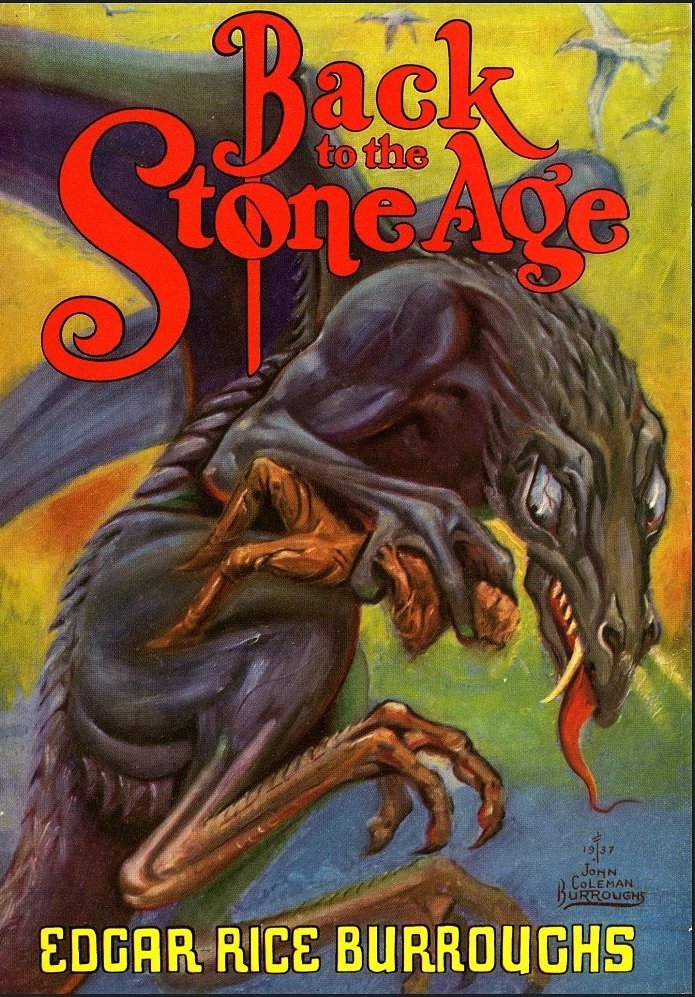
So before going Back to the Stone Age, I’m rewinding to the salad days of ERB’s career and exploring a lesser-known work: a take on Frankenstein and The Island of Dr. Moreau filtered through the pulp jungle adventure; a book of great promises and great frustrations.

The story that would eventually become The Monster Men is an ambitious thematic and character experiment that explodes with the exuberance of early Edgar Rice Burroughs. It’s also a misfire where generic pulp elements and a terrible ending undermines the potential for one of its author’s most intriguing works. The ebullience of youthful ERB bursts through, but the control and follow-through with complex ideas seem to have been left to the concurrent Tarzan, Mars, and Pellucidar series.

Burroughs wrote the novel in April 1913 during a feverish period between The Cave Girl and The Warlord of Mars. He may have devised the idea in late 1912 as a short story. But he soon discovered the short story wasn’t his medium and expanded the idea into a full-length book titled “Number Thirteen.” It appeared as “A Man without a Soul” in the November 1913 issue of All Story. For its first book publication in 1929, the name was changed to The Monster Men, by far the weakest of the trio of titles, but the one we’re stuck with. “The Man without a Soul” had been used as the title for the U.K. book publication of The Mucker, which probably accounts for the change. The title coincidence between these two books, however, isn’t exactly a coincidence, something I’ll examine later.

Read More Read More

Why You Should Go to Conventions

Why You Should Go to Conventions

The Dray Prescot series 3-small

The Dray Prescot series, by Alan Burt Akers

Last month, I posted in a couple of Facebook groups a piece of new art that Deb and I had bought. In response to the post, one person asked how to go about acquiring illustration art, and I mentioned that one good venue was going to conventions such as The Windy City Pulp and Paper Convention (shameless plug) or PulpFest for vintage art, or IX or Spectrum Fantastic Art Live for new stuff. And many of the larger comic conventions also have some dealers who specialize in vintage illustration art, or artist attendees doing current work. And several SF/fantasy conventions, such as World Fantasy, Boskone or Worldcon still have good art rooms (and Boskone in particular has strong vintage art components to their art shows), though in most cases SF cons are not what they used to be when it comes to art. In addition to conventions, I also mentioned various auction houses, eBay and dealers, which are more typical day-to-day places to find illustration art, as cons are scattered throughout the year and most of us can’t attend all of them.

Of course, this is only my opinion, and others may have different experiences, particularly when it comes to collecting newer illustration art. Our focus is on older illustration art, and while we do have several pieces that have been created in the past few years, the bulk of our collection is illustration art that’s at least 30 years old, with the majority of it at least 60 years old and some over 100 years old.

Read More Read More

Trader to the Stars by Poul Anderson

Trader to the Stars by Poul Anderson

oie_221517P0i26eYZI have no idea which Poul Anderson book I picked up first. It might have been The Winter of the World or Hrolf Kraki’s Saga. Whichever it was, I enjoyed it. It was enough to get me grabbing books at random from the big stack of his work my dad had bought. I’ve read a ton of his books, but with nearly seventy novels and sixty short story collections to his name, I still have plenty to go.

I’d venture a guess that Poul Anderson, multiple Hugo- and Nebula-winner, is probably better remembered for his fantasy than for his science fiction. Since his death in 2001, it seems his fantasy writing, the seminal swords & sorcery novel The Broken Sword in particular, has acquired a much greater reputation than his sci-fi.

While he wrote many standalone sci-fi novels, a large number were part of a specific future history. The Technic Civilization covers humanity’s spread across the stars, beginning, chronologically, with the story “The Saturn Game” set in the year 2055 and ending with “Starfog” in 7100. The majority of the stories take place during the second half of the third millennium and feature Falstaffian merchant prince Nicholas van Rijn, his agent David Falkayn, or Imperial secret agent Dominic Flandry.

Anderson’s future history stories are a mix of pulp space opera and hard sci-fi. At the heart of many of the stories is an explicit scientific conundrum that needs to be answered. Each puzzle, though, is couched in adventures with alien barbarians, enemy planets, or galactic empires.

Trader to the Stars (1964) collects three van Rijn adventures, “Hiding Place,” “Territory,” and “The Master Key.” Each features van Rijn working out evolutionary puzzles, usually in the face of some grave danger and always in hopes of making a profit. The first two throw the trader into the middle of danger, while the third lets him, Nero Wolfe-like, get to the bottom of a native uprising from the luxurious surroundings of his penthouse.

Read More Read More