Browsed by
Category: Vintage Treasures

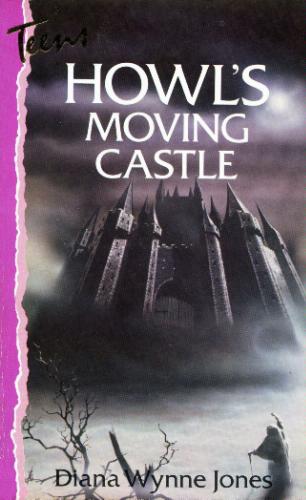
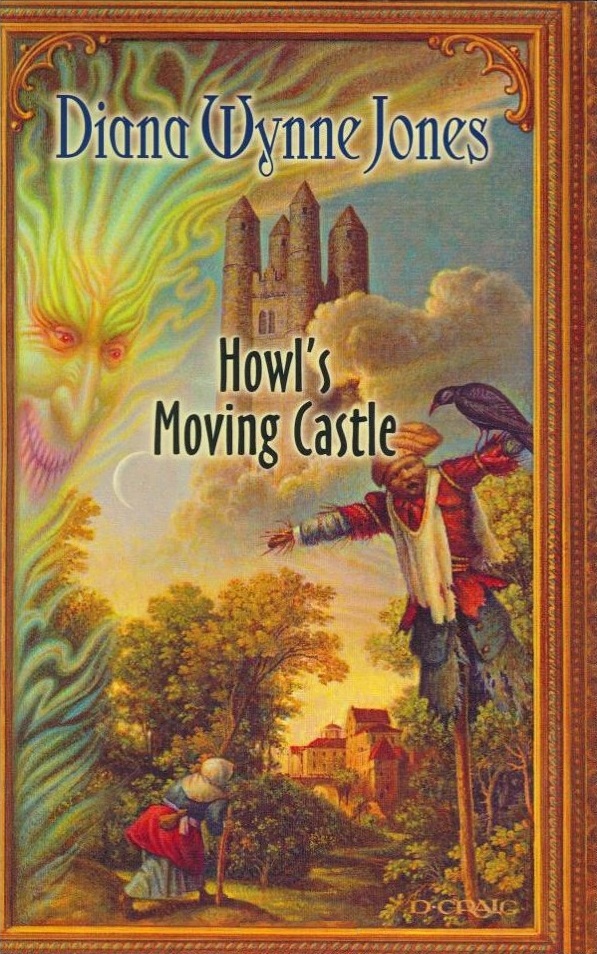
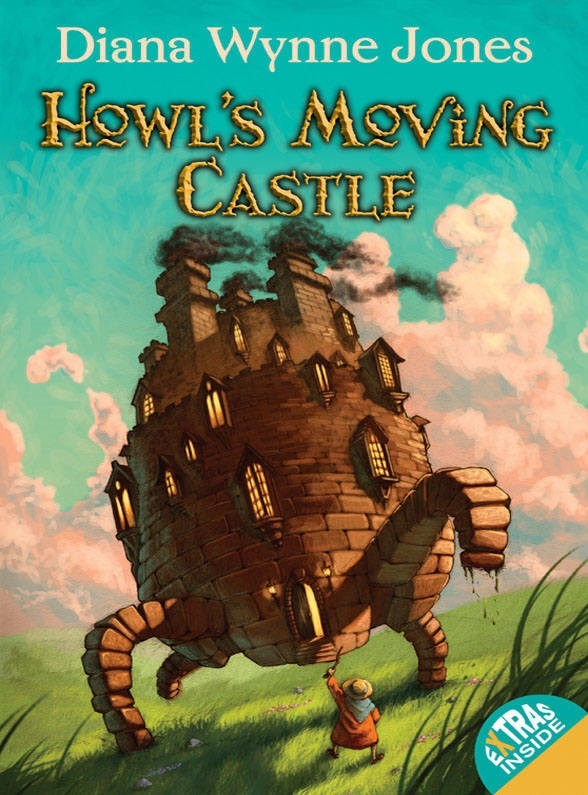
There’s Something Magic About a House: Howl’s Moving Castle by Diana Wynne Jones

There’s Something Magic About a House: Howl’s Moving Castle by Diana Wynne Jones

Howl's Moving Castle-big Howl's Moving Castle Greenwillow-smaller Howl's Moving Castle Eos-smaller

There is something magic about a house, or there should be. There are hints of this in James Stoddard’s The High House, in which the house is a universe unto itself, or in the Professor’s home in The Lion, the Witch, and the Wardrobe, in which the house is a gateway to universes. We realize in some way that every house holds secrets, that every house is in some sense a castle, and that the portals of every house open either into a wider world without or an inner world within.

This ineffable something about houses motivates Diana Wynne Jones’s Howl’s Moving Castle, which despite the title isn’t really about a castle but rather a house and the family that gets collected inside it. My kids and I are big fans of Studio Ghibli, so the 2004 animated film adaptation by Hayao Miyazaki was our first exposure to the work. Before seeing the film, I had not heard of the late British fantasy author Diana Wynne Jones. Howl’s Moving Castle remains the only work by her I’ve read, though she wrote at least two other novels in which these characters also appear.

Read More Read More

Vintage Treasures: Dark Harvest by Norman Partridge

Vintage Treasures: Dark Harvest by Norman Partridge

Dark Harvest Norman Partridge-small Dark Harvest Norman Partridge-back-small

We got, I dunno, a month or two (or six) before Halloween? But that doesn’t mean you can’t start your spooky Halloween reading a little early this year. My recommendation? Dark Harvest, by Norman Partridge.

Norman Partridge is the author of five collections of horror stories, including The Man with the Barbed-Wire Fists (2001) and Lesser Demons (2010). His short novel Dark Harvest is the tale of Sawtooth Jack, who rises from the cornfields every Halloween and relentlessly makes his way towards town, where gangs of teenage boys await their chance to face off against a creature of nightmare. It was nominated for a World Fantasy Award, and won both the International Horror Guild Award and the Bram Stoker Award for Best Long Fiction. It was also selected as one of Publishers Weekly‘s 100 Best Books of 2006.

Dark Harvest was published in hardcover by Cemetery Dance in October 2006, and reprinted by Tor Books on September 4, 2007. It is 171 pages, priced at $16.99 in trade paperback and $7.99 for the digital edition. The fabulous cover is by Jon Foster. It is still in print.

Julius Schwartz on A. Merritt, Amazing Stories, and the First Worldcon

Julius Schwartz on A. Merritt, Amazing Stories, and the First Worldcon

sfcon08 - darrow - williamson signing - schwartz - unknown - ruppert-small

The first Worldcon, July 1939. Left to right: Jack Darrow, Jack Williamson,
Julius Schwartz, unknown, and Conrad Rupert. Photo by Bill Dellenback

While letters from and to Otto Binder made up the majority of the correspondence I acquired from the estate of Clifford Kornoelje (aka in science fiction circles as Jack Darrow), Binder wasn’t the only science fiction notable that Darrow corresponded with. One of his other correspondents was Julius Schwartz, remembered today for his roles in both the science fiction and comics fields. I thought I’d post two of those letters from Schwartz — along with some related material — today.

The first letter from Schwartz to Darrow is dated December 12, 1932. The Mort that he refers to in several places is their mutual friend, Mort Weisinger. It has a mention of Astounding, a mention of a dinner that Schwartz (and presumably Weisinger as well) will be having with pulp author David H. Keller. And most particularly, it has an interesting bit resulting from an interview that Schwartz had conducted with A. Merritt two weeks earlier. I don’t know if Merritt actually sued Amazing, as Schwartz claims, or whether he just threatened them, but Amazing did run an apology in their June 1933 issue.

Read More Read More

Edgar Rice Burroughs’s Pellucidar Saga: Tarzan at the Earth’s Core

Edgar Rice Burroughs’s Pellucidar Saga: Tarzan at the Earth’s Core

tarzan-at-the-earths-core-first-edition-j-allen-st-johnYou’ll believe a Stegosaurus can fly!

In the time I’ve written about Edgar Rice Burroughs for Black Gate, only once have I examined one of his Tarzan books. That was eight years ago. This lack of Tarzan representation isn’t because I dislike the character. A number of the early Tarzan adventures rate among my favorite Burroughs novels, and I’ll defend Tarzan of the Apes as one of the twentieth century’s Great Books. But since there’s more information available about Tarzan than any other Burroughs series, my literary adventuring was more interesting when it stayed in hinterlands of ERBiana.

However, it’s a thrill to have the ape-man swing in through the side door during one of my series retrospectives. Let’s welcome Tarzan onto the stage of Pellucidar. Ladies and gentlemen, boys and girls, Sagoths of all ages … it’s crossover time!

Our Saga: Beneath our feet lies a realm beyond the most vivid daydreams of the fantastic … Pellucidar. A subterranean world formed along the concave curve inside the earth’s crust, surrounding an eternally stationary sun that eliminates the concept of time. A land of savage humanoids, fierce beasts, and reptilian overlords, Pellucidar is the weird stage for adventurers from the topside layer — including a certain Lord Greystoke. The series consists of six novels, one which crosses over with the Tarzan series, plus a volume of linked novellas, published between 1914 and 1963.

Today’s Installment: Tarzan at the Earth’s Core (1929–30)

Previous Installments: At the Earth’s Core (1914), Pellucidar (1915), Tanar of Pellucidar (1929)

The Backstory

Although most of Edgar Rice Burroughs’s novels occur in the same universe, linked through the author’s fictional surrogate version of himself, Tarzan at the Earth’s Core is the only point where a character from one series leaps to another as the protagonist. It’s the fourth Pellucidar novel and the thirteenth Tarzan novel — full crossover achieved for the first and last time in the ERB canon.

Read More Read More

Vintage Treasures: Zimiamvia: A Trilogy by E.R. Eddison

Vintage Treasures: Zimiamvia: A Trilogy by E.R. Eddison

Zimiamvia a Trilogy E R Eddison-small Zimiamvia a Trilogy E R Eddison-back-small

There’s an awful lot of bestselling fantasy on the market these days, and sometimes it seems it’ll be around forever. But I know from hard experience that the vast majority of it will be gone in five years. It’s the rare fantasy indeed that remains in print for a decade — much less 20, 30, or 50 years.

E.R. Eddison’s Zimiamvia trilogy has been in print, off and on, for an astonishing eight decades, since the first volume appeared in 1935. J.R.R. Tolkien called Eddison “The greatest and most convincing writer of invented worlds that I have read,” and in the decades that followed his reputation has only grown among serious students of fantasy. The three volume in the trilogy are:

Mistress of Mistresses (1935)
A Fish Dinner in Memison (1941)
The Mezentian Gate (1958)

Eddison was also the author of the fantasy classic The Worm Ouroboros, to which the Zimiamvia trilogy is a loose sequel.

Read More Read More

Galaxy, October 1968: A Retro-Review

Galaxy, October 1968: A Retro-Review

Galaxy October 1968-small Galaxy October 1968-back-small

An issue of Galaxy from fairly late in Fred Pohl’s tenure. There’s one fairly notable story here, and a couple more good ones, but to me the most interesting feature was Algis Budrys’ book review column.

But let’s begin at the beginning. The cover is by Douglas Chaffee. Interiors are by Jack Gaughan, Joe Wehrle, Jr., Dan Adkins, Virgil Finlay, Larry S. Todd illustrating his own piece (not surprising, as Todd, then just 20, became fairly well-known later for his comics work), and two artists whose full names I didn’t know: Brand and Safrani. Buddy Lortie identified them for me: Brand was Roger Brand, a fan artist who became a pro, and did comics work as well; and Safrani was Shehbaz Safrani, who seems to still do fine art. I should note that the magazine was very thick in this era — 196 pages (including covers). My copy has staples: I don’t know offhand if that was normal.

The features include Willy Ley’s long-running science column, “For Your Information,” discussing Explorer-1. Fred Pohl contributes an editorial, discussing the upcoming Presidential election (the one in which Nixon beat Humphrey and Wallace), and speculating about computerized voting from one’s home (even on laws, declaration of war, etc. — i.e. direct democracy). There is a Bio feature, Galaxy’s Stars, giving tidbits about a few of the authors. One piece, “The Warbots,” by Larry S. Todd, is designated a “Non-Fact Article,” and it discusses the history of tanks, basically, far into the future.

Read More Read More

Keith West on the Ballantine Best of Series and Why We Need it More Than Ever

Keith West on the Ballantine Best of Series and Why We Need it More Than Ever

The Best of Leigh Brackett 1977-smll

Over at Adventures Fantastic, the distinguished Keith West visits a topic near and dear to our hearts: the Ballantine Best of series, perhaps the most important line of paperback collections the genre has ever seen. The 21 volumes of the Ballantine Best of series introduced thousands of readers to the best short fiction by the greatest SF and fantasy writers of the 20th Century — and more than a few writers who have now been forgotten. Here’s Keith:

I’ve already written about how the Leigh Brackett volume I bought through the [Science Fiction Book Club] was a game changer for me. The authors I first encountered through the SFBC editions were Pohl (the first I bought through the club), Kornbluth, Hamilton, Brown, del Rey, Campbell, plus Brackett, but the one that really blew my mind was Kuttner. His was the second Best of I bought through the club. Something about Kuttner’s wit and cynicism, plus his imagination captured me and has never really let me go…

So why did I say we need the Ballantine series more than ever? Because of the way it captured the literary history of the field. There’s no one today who writes like Cordwainer Smith. Or Stanley G. Weinbaum. Or Eric Frank Russell. These writers were the trail blazers and pioneers of the genre, folks for whom an entertaining story wasn’t just a good thing. It was how they made a living.

James McGlothlin has been reviewing the series for us, one book at a time. Our previous coverage includes the following 16 volumes (listed in order of publication).

Read More Read More

Mission of Gravity by Hal Clement

Mission of Gravity by Hal Clement

Astounding Science Fiction April 1953-smallOnce upon a time, there was a strand of science fiction called hard science fiction, dedicated to the exploration of scientific puzzles and more-or-less accurate studies of the physical sciences. The roots of this strand would seem to lie in the technology-focused stories of Jules Verne. Sometimes there’s an adventure involved (Larry Niven’s Ringworld), sometimes not so much (Robert Forward’s Dragon’s Egg). Whatever the type of story, in hard sf it was the science that occupied center stage. One of the foremost practioners of this style of science fiction was Hal Clement (1922-2002).

Hard science fiction still exists, obviously. Cixin Liu, Vernor Vinge, and Greg Bear are all writing science-heavy stories. Now, though, there’s less of the puzzle-solving variety, and a greater emphasis on exploring the effects of science on people and society. Larry Niven won a Hugo for the story “Neutron Star,” which hinges on its hero understanding how tides work. I’d be curious if anyone’s written a story like that in the last ten or twenty years. In his overview of The Best of Hal Clement, John O’Neill examined the possible causes for the decline in popularity of hard sf.

Clement published his first story, “Proof,” in 1942, while still an astronomy student at Harvard. After the Second World War (during which he flew 35 bombing missions as a B-24 pilot and co-pilot) he taught astronomy and chemistry at Milton Academy for many years. His first novel, Needle (1950), the story of a symbiotic space detective, was written in response to William Campbell’s claim that a true sci-fi mystery couldn’t be written. His third novel, and today’s subject, Mission of Gravity (1954), is an exemplar of hard science fiction at its diamond-hardest.

Read More Read More

The Digest Enthusiast #5 Now Available

The Digest Enthusiast #5 Now Available

The Digest Enthusiast January 2017-small The Digest Enthusiast January 2017-back-small

Unplug the phone and cancel my Netflix subscription. The Digest Enthusiast #5 is finally in the house.

Okay, maybe it seems strange to some of you that there’s a magazine out there devoted to collectors of vintage digest magazines. (But it can’t have escaped you that a healthy percentage of Black Gate‘s contributors are obsessive digest magazine collectors, right? Right?) Though I think the thing that might really surprise you is just how fascinating this magazine is to anyone with an interest in 20th Century genre fiction.

Last issue my favorite feature was Steve Carper’s affectionate and detailed look at The Galaxy Science Fiction Novels, and so this time I turned with high anticipation to his 20-page survey of Ellery Queen Selects, a line of 10 novels and collections published between 1947-1950, including work by Dashiell Hammett, John Dickson Carr, O. Henry, and others. And I was not disappointed — it’s a lively behind-the-scenes look at an interesting chunk of literary history. But the article that really grabbed my attention was Peter Enfantino’s insightful issue-by-issue examination of Robert A.W. Lowndes’ Magazine of Horror, one of the most collectible pulp horror periodicals of the 20th Century.

Read More Read More

Reading for the End of the World

Reading for the End of the World

The Dead Zone-small The Dead Zone-back-small

Back in 1977, near the high water mark of an earlier age of apocalyptic expectations, Elvis Costello crooned a song about “Waiting for the End of the World.” It seemed to make sense in that era of turmoil and unrest at home and abroad, but the American landscape of the last year or so makes the turbulent 70’s seem like an age of cool, good humored rationality. (It wasn’t — trust me.)

I, along with Little Orphan Annie and MacBeth, still expect the sun to come up tomorrow and tomorrow and tomorrow, but even so, it does indeed feel as if we have arrived at the end of something, and business as usual just won’t do anymore; adjustments are called for in many aspects of our lives, including (of course!) reading. Extraordinary times call for extraordinary literary measures. Therefore… to the barricades — uh, bookstores!

In the spirit of the incipient panic, withered expectations, and rampant paranoia that seem to dominate our current national life, I offer twelve books to get you through the next four years (however long they may actually last): a reading list for the New Normal.

Read More Read More