Browsed by
Category: Vintage Treasures

Amazing Stories, December 1964: A Retro-Review

Amazing Stories, December 1964: A Retro-Review

Amazing Stories December 1964-smallThe cover to this issue is by Robert Adragna. Interiors are by Adragna and George Schelling. The editorial concerns Sam Moskowitz’ series of Profiles of SF writers, and signals a change to essays by Moskowitz addressing SF’s treatment of certain themes, beginning in this issue with a discussion of Philip Jose Farmer and — you guessed it! — sex and SF.

The article — a fairly long one — begins with a review of some of the SF stories that occasioned controversy by brushing up against sexual issues, and continues with a detailed look at Farmer’s career to date (1964), including of course the controversy surrounding “The Lovers,” but also mentioning I Owe For the Flesh, the first version of To Your Scattered Bodies Go, which had been written for a contest in the early ’50s, and won, and was lost (I understand) after the contest sponsor (Shasta) ran out of money. On the whole, it’s an interesting and worthwhile piece, one of the better things I’ve seen from Moskowitz.

Robert Silverberg’s book review column covers Alfred Bester’s collection The Dark Side of the Earth, Fritz Leiber’s novel The Wanderer, and The Astounding Science Fiction Anthology, edited by John W. Campbell, Jr. Silverberg approves of all three books, and reserves especial praise for The Wanderer — a book which, I would suggest, has not retained much of a reputation (I myself have not got through it on two tries, though it has been a long time, and I suppose I should give it another chance.)

The stories are:

Short Novel

“The Further Sky,” by Keith Laumer (20,000 words)

Read More Read More

Future Treasures: The Complete Psychotechnic League, Volume 1 by Poul Anderson

Future Treasures: The Complete Psychotechnic League, Volume 1 by Poul Anderson

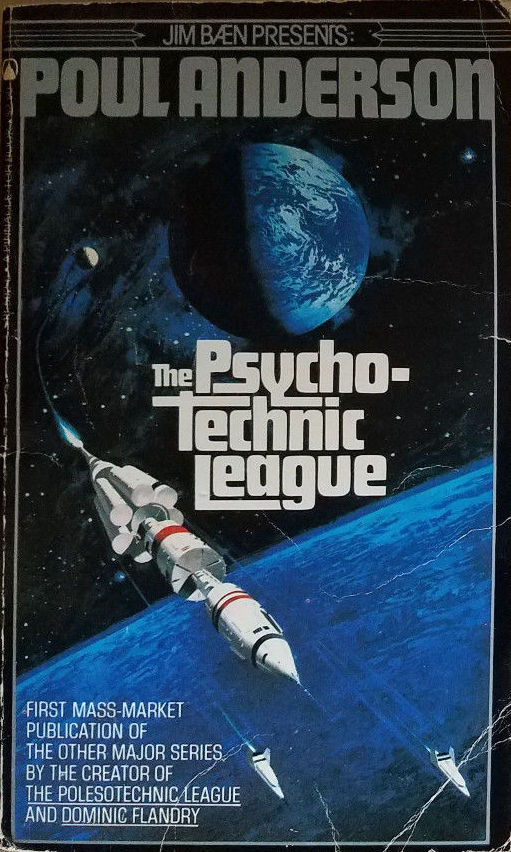
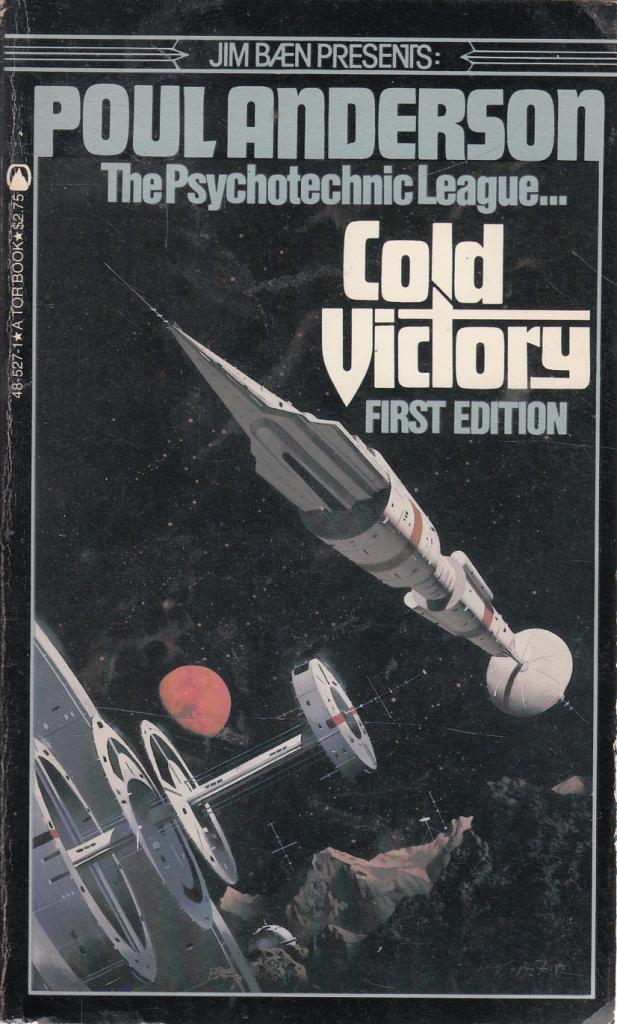
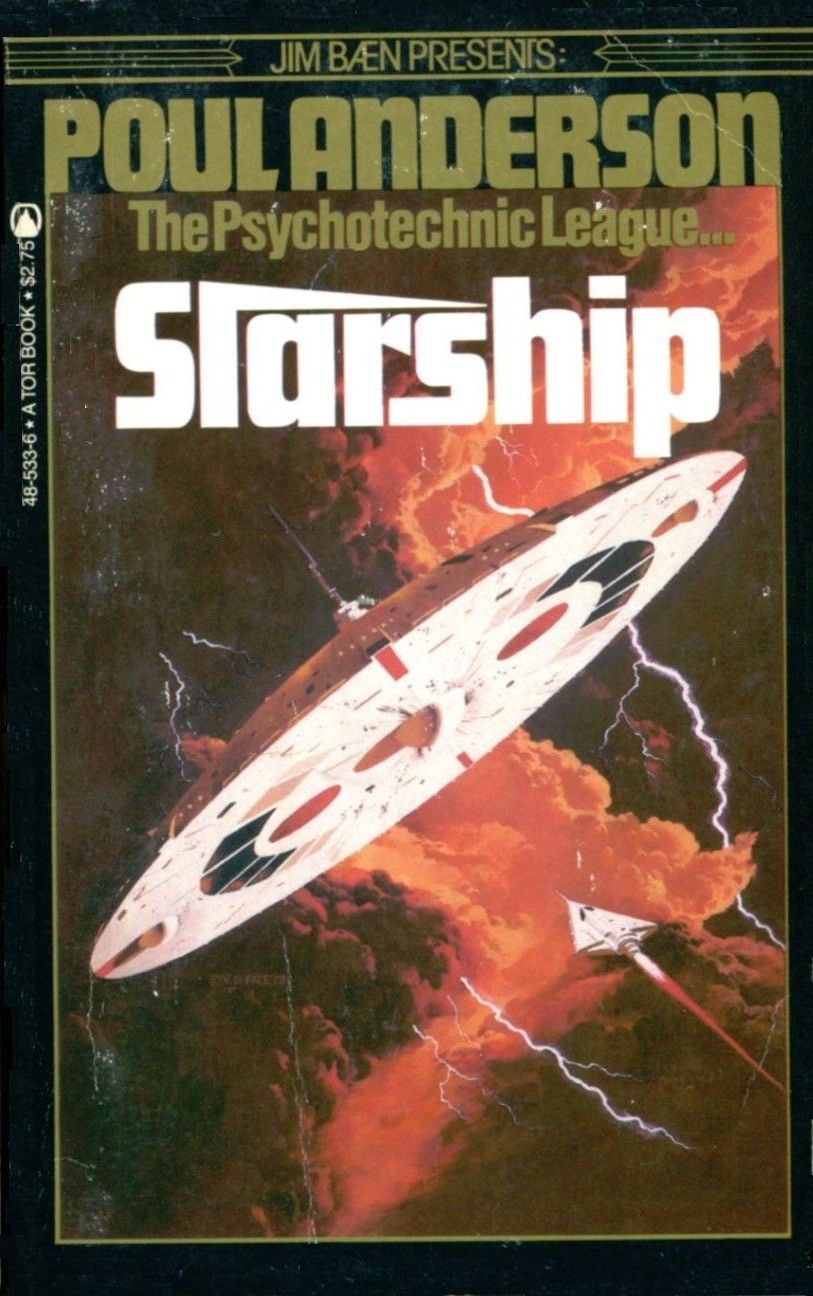
The Psychotechnic League-small Cold Victory-small Starship Poul Anderson-small

Poul Anderson was one of the most acclaimed and prolific science fiction writers of the 20th Century, and one of his most popular series was The Psychotechnic League, which told the story of the rise of a new civilization after a devastating nuclear war in the late 1950s that very nearly obliterated mankind.

The Psychotechnic League began as a Future History, a popular beast among short SF writers of the 40s and 50s. Anderson published the first story, “Entity,” in the June 1949 issue of Astounding Science Fiction, and set the opening of his series a decade in the future. The series continued for the next two decades, (appearing in Astounding, Planet Stories, Worlds Beyond, Science Fiction Quarterly, Cosmos, Fantastic Universe, and other fine magazines), eventually extending into the 60s. In the process, his “Future History” gradually became an “Alternate History,” as actual history trampled all over his carefully constructed fictional timeline.

That didn’t seem to bother readers though, and the tales of the Psychotechnic League remained popular well into the 80s. The series included some 21 stories, including three short novels: The Snows of Ganymede (1955), Star Ways (1956), and Virgin Planet (1957). The short stories and one of the novels were collected in a trilogy of handsome Tor paperbacks in 1981/82, with covers by Vincent DiFate (above). Now Baen books is reprinting the entire sequence in a series of deluxe trade paperbacks, starting with The Complete Psychotechnic League, Volume 1, on sale next month.

Read More Read More

Dilvish, the Damned by Roger Zelazny

Dilvish, the Damned by Roger Zelazny

“Have you given any thought to what you are going to do if — rather, when — you make it to the top?”

“Look for trouble,” Dilvish said. “Defend myself at all times. Strike instantly if I see the enemy.”

Black and Dilvish to each other in “Tower of Ice”

oie_1271358c5k3rMonDilvish, the Damned (1983), by Roger Zelazny, had been on my list of books and stories to avoid because of who recommended them. With this book, it was someone I played D&D with. In fact, he introduced me to the original D&D rules back in 1977 or ’78.

He was, and remains, the most voracious reader I’ve ever known, though he rarely reads outside of sci fi and fantasy. He would always tell me about whatever book he was reading — often read while he walked the mile and half to my house. When he’d describe a book to me, though, it was always about how cool and awesome the most powerful characters were. Big cowls and fancy wizardly skullcaps were symbols of greatness. The more absurdly godlike the protagonists were, the better.

A few years ago, he told me he was disappointed that the Twilight books didn’t end in an epic all out vampires vs. werewolves war. That Stephenie Meyer wouldn’t do that really didn’t make sense to him. It’s that sort of take on books that led me to take for granted that any book he suggested was going to annoy me as much as it excited him. I’ve overcome that block slowly. It took me nearly thirty years and a lot of positive recommendations to read Roger Zelazny’s Amber Chronicles. Even loving those — which I do — it took me another decade to pick up Dilvish, the Damned.

Dilvish is heir to both a Human house and an Elvish house, and a heroic warrior of great prowess. Two centuries ago, he came up against the powerful, evil sorcerer, Jelerak. The wizard, far stronger than Dilvish knew, turned the half-elf to stone and imprisoned his soul in Hell. It is only when Portaroy, a town once saved by Dilvish, comes under a new attack, he is freed to return to the mortal world with a metal horse named Black, and a desire to avenge himself on Jelerak.

Dilvish is part of the rebirth of swords & sorcery in the mid-60s alongside Elric and the Lancer Conan. Several of Zelazny’s stories were reprinted in S&S anthologies from the 1970s. Some of the stories are at least equal to those of Moorcock and Leiber, and way better than most by Lin Carter and John Jakes. Dilvish, the Damned is a 1983 fixup of all eleven Dilvish short stories. The first was originally published in Fantastic in 1965, and the last two first saw light of day in this collection.

Read More Read More

How I Spent My Summer Vacation

How I Spent My Summer Vacation

A Scanner Darkly Dick-small The Deep Range Arthur C Clarke-small The Killer Inside Me Jim Thompson-small

On May 25th I finished my thirteenth year at the small private school where I teach fourth grade. I love my job and I love my students, but remember the transports of joy that you felt when you were a kid, when the dismissal bell finally rang on that last day of school? I can assure you that your happiness was as nothing compared to the incandescent elation teachers feel on that final afternoon of the second semester.

At my school, we get eight weeks off, and I spend them much as I did when I was in school myself — I make a big stack of paperbacks and I read as many of them as I can before the next school year begins. Last summer, for some perverse reason I no longer remember, I changed my routine a bit; instead of tearing through the usual pile of science fiction/fantasy/mystery yarns, I decided to take on a different kind of book: David Foster Wallace’s postmodern magnum opus, Infinite Jest. Though it is itself marginally science fiction, Wallace’s massive novel is about as far removed from the kind of genre reading that usually fills my vacation as it is possible to get. I originally had some notion of doing a fair amount of my “normal” summer reading alongside of Infinite Jest, but it didn’t work out that way. I’m glad I read the novel, but it absolutely exhausted me; after hewing my way through thirty or forty pages I barely had enough physical and mental energy to hoist myself out of my chair, much less crack open a gaudy-covered Ace reprint of Radium Raiders of Deneb by Lester Cragwell Griggs.

If you’ve never tackled it, reading Infinite Jest is like driving coast-to-coast on a state of the art superhighway… that has a speed bump every fifty feet, for three thousand miles. I did manage to get Son of Tarzan read in between bouts with Wallace’s knotted prose, but the two books didn’t mix well, and left me feeling slightly seasick, not to mention somewhat confused about the nature of reality.

In any case, this year I was determined to return to sanity and my standard procedure and see if it’s possible to overdose on the heady fumes that waft from the pages of forty year old paperbacks. I now submit the results of my experiment for your edification… or, if you wish, to act as a grim warning.

Read More Read More

Vintage Treasures: Dragonfly by Frederic S. Durbin

Vintage Treasures: Dragonfly by Frederic S. Durbin

Dragonfly Frederic Durbin-small Dragonfly Frederic Durbin-back-small

Dragonfly was published in 1999 by Arkham House — the last novel the legendary publishing house produced in the 20th Century, and very nearly their last novel, period (they published one subsequent novel, John D. Harvey’s The Cleansing (2002), and about a dozen collections and anthologies, before effectively shutting down in 2010.)

It was an extraordinary coup for a debut novelist to win a contract from the publisher behind the earliest collections of H.P. Lovecraft, Clark Ashton Smith, Robert E. Howard, and numerous other major American fantasists. But Dragonfly was an extraordinary novel. The International Horror Guild nominated it as Best First Novel of the year, and Weird Tales called it “A marked success… makes us marvel that if could be a first novel.” Rambles labeled it “The perfect book for the Halloween season.”

Ace Books reprinted Dragonfly in paperback six years later, with a cover by Merritt Dekle (above). The paperback is becoming harder and harder to find these days, so when I stumbled on a new copy at Half Price Books this summer, I snapped it up immediately.

Read More Read More

A Not So Trimphant Ending to The Atlan Saga: Some Summer Lands by Jane Gaskell

A Not So Trimphant Ending to The Atlan Saga: Some Summer Lands by Jane Gaskell

Orbit Futura Edition

“The Fourth Book in the Hitch-Hiker Trilogy” proclaimed the cover blurb on the Pan version of So Long and Thanks for All the Fish, by Douglas Adams. And many smiled and thought this was very clever and funny. The fourth book in a trilogy wasn’t actually a new idea, even back in the 1984. Now a fifth book in a trilogy is a little more unusual, and indeed when one appeared (Mostly Harmless, in 1992) the updated blurb proclaimed: “The Fifth Book in the Increasingly Inaccurately Named Hitchhikers Trilogy”.

What has Douglas Adams got to do with Jane Gaskell?

Well, she did the same thing. She wrote a pretty good trilogy – albeit one which some publishers stretched into four books – and then, by all appearances, decided to tack on another volume some years later. This is of course my opinion, but if you’ll indulge me a bit you will see why I reached that conclusion.

Now there are plenty of authors who have tacked books on to a successful trilogy — and some who have even added a whole follow up series. To be fair to Mr Adams, his additional books were pretty good, though not up to the standard of the original series. To me, they still felt like they were more of an afterthought than a specifically planned and executed conclusion.

Some Summer Lands also does not quite fit. Sadly, that is not the only issue. I cannot in honesty give this book the same recommendation I gave to the other books in the Atlan Saga, which were pretty good, with occasional flashes of brilliance. Some Summer Lands was published in 1977, roughly ten years after The City. My Orbit Futura edition weighed in at 360 pages split into three parts of varying length.

Some Summer Lands is not pretty good. Dismally disjointed, maybe. Rambling, definitely. Misguided, certainly. One of the few positives I had from the experience was that it helped me realize why I had taken on re-reading the series with such trepidation. The first three (or four) books surprised me, as I did not have fond memories of the series when I read it in my youth.

Anyone who has read my earlier reviews may remember me marveling at certain aspects and wondering why I had disliked them as a teenager. Now I know why! It’s this last book which casts a dark shadow.

Read More Read More

Frontier Guard, Robot Ships, and Rascal Traders: Rich Horton on Space Service, edited by Andre Norton

Frontier Guard, Robot Ships, and Rascal Traders: Rich Horton on Space Service, edited by Andre Norton

Space Service Andre Norton-big

Andre Norton is one of the most revered science fiction writers of the 20th Century. True, much of her work is out of print these days, and she seems to have more or less fallen out of favor with modern readers (except Fletcher Vredenburgh, naturally), but there are still plenty of SF fans who credit her with their introduction to science fiction.

Many readers don’t know that Norton made a name for herself as an editor before she became acclaimed for her own writing. Her three SF anthologies for World Publishing Co., all published between 1953-56, remain some of her most collectible work. Party that’s due to their relative rarity, but the Vigil Finlay covers are also a big factor. These are gorgeous books, eagerly sought by collectors, especially in good condition.

Over at his website Strange at Ecbatan, Rich Horton reviews the first one, Space Service. It appeared in hardcover in 1953 and, like the other two, has never been reprinted.

Read More Read More

Lore of the Witch World by Andre Norton

Lore of the Witch World by Andre Norton

By the western wall of Klavenport on the Sea of Autumn Mists — but you do not want a bard’s beginning to my tale, Goodmen? Well enough, I have no speak-harp to twang at all the proper times. And this is not altogether a tale for lords-in-their-halls. Though the beginning did lie in Klavenport right enough.
— from “Legacy from Sorn Fen”

oie_2962753vGY7eZ66I’ve written before that Andre Norton’s Witch World books is a series I avoided for way too long. There were two things that kept me away from them over the years. The first, when I was younger, was their name: Witch World. It seemed a little too twee. When I was older there were so many other things I wanted to read that it never crossed my mind to investigate Andre Norton’s catalogue. If she ever occurred to me at all, it was as the author of Starman’s Son and several other books shelved in the children’s section at my local library. Later, I found a few scattered Norton volumes in the boxes of paperbacks my dad kept in the attic but, again, nothing prompted me to read them. At the time, the cover of “Witch World” turned me off. (Today I love the goofy looking thing.)

Not until I started contemplating blogging about swords & sorcery did I actually read anything by Andre Norton. When I started expanding my library of S&S books, there were several anthologies I finally picked up, one being Flashing Swords #2, edited by Lin Carter. I had read some of its stories before, but not Norton’s Witch World story, “The Toads of Grimmerdale.”

I was surprised by the darkness of the story. Like I said, I had assumed the Witch World stuff was light and airy and my first encounter with it was a story of revenge for rape, set in a country savaged by years of war. Well I was hooked, and I scanned my shelves for any other Witch World stories. I found “Spider Silk” in Flashing Swords #3, and “Falcon Blood” in Amazons!, edited by Jessica Amanda Salmonson. I rooted through boxes in the Vredenburgh attic and dug out my dad’s ancient copy of the first novel, Witch World, and devoured it. Its inventiveness, fast pacing, and the sheer fun of it made me an instant fan.

Read More Read More

Galaxy Science Fiction November 1969: A Retro-Review

Galaxy Science Fiction November 1969: A Retro-Review

Galaxy Science Fiction November 1969-small Galaxy Science Fiction November 1969 back cover-small

This is Part 2 of a Decadal Review of vintage science fiction magazines published in November 1969. The articles are:

Amazing Stories, November 1969
Galaxy Science Fiction, November 1969
The Magazine of Fantasy & Science Fiction, November 1969
Worlds of If, November 1969
Analog Science Fiction/Science Fact, November 1969

Cover by Gaughan, the TOC notes that it was “Suggested from Downward to the Earth.”

Editorial, “Brain Pollution” by Ejler Jakobsson. This delves straight into race issues, in a kind of winking/new-wavy way. There was, it would seem, an article or articles on IQ tests between blacks and whites making waves, with Jakobssen quoting an editorial by John W. Campbell.

If they, (the blacks) basic intelligence pattern is of a different type — naturally it’s harder for them to fit into the Scholarly type that Caucasoids developed — with unquestionable and world-shaking success — so that although they’ve been working into Western culture for as long as time as the Scots, they haven’t been able to fit in anywhere near as well.

Jackobsson doesn’t agree, or at least I don’t think he does. His weird addled-fanboy style makes it hard to tell if he disagrees with the fundamental IQ test issue, or just the way J.W.C. stated it. The former… I think.

Read More Read More

An Incomparable Voyage Through Dreamland: The Forgotten Beasts of Eld by Patricia A. McKillip

An Incomparable Voyage Through Dreamland: The Forgotten Beasts of Eld by Patricia A. McKillip

The Forgotten Beasts of Eld-smallThe Forgotten Beasts of Eld
Patricia A. McKillip
Tachyon Publications (240 pages, $14.95 in trade paperback, September 19, 2017)
Reprint edition (originally published by Atheneum, August 1974)

The moment you begin The Forgotten Beasts of Eld, the World Fantasy Award-winning novel by Patricia A. McKillip, you understand you have put yourself in the hands of a masterful wordsmith. McKillip has no peer when it comes to incantatory prose, and her wizardry spells you into a waking dream in this breathtaking tale.

The young wizard Sybel comes from a legendary lineage of animal keepers. After calling a magisterial bounty of magical beasts to her castle, she protects them with the unwavering love of a lioness. When a knight entrusts an infant boy into her care, unbeknownst to the so-called ice-hearted wizard, her life unravels into the pursuit of true love, justice, and the attainment of one’s free will.

Though the animals play a prominent role in the tale, the action mainly revolves around Sybel and the two men who love her. Tam, the babe given to her not long after leaving the womb, cares for her throughout the story. Through the numerous hardships that befall Sybel in her quest for justice in a troubled world, he remains steadfast in his love for the woman he considers his mother.

Read More Read More