Browsed by
Category: Vintage Treasures

Galaxy Science Fiction, November 1953: A Retro-Review

Galaxy Science Fiction, November 1953: A Retro-Review

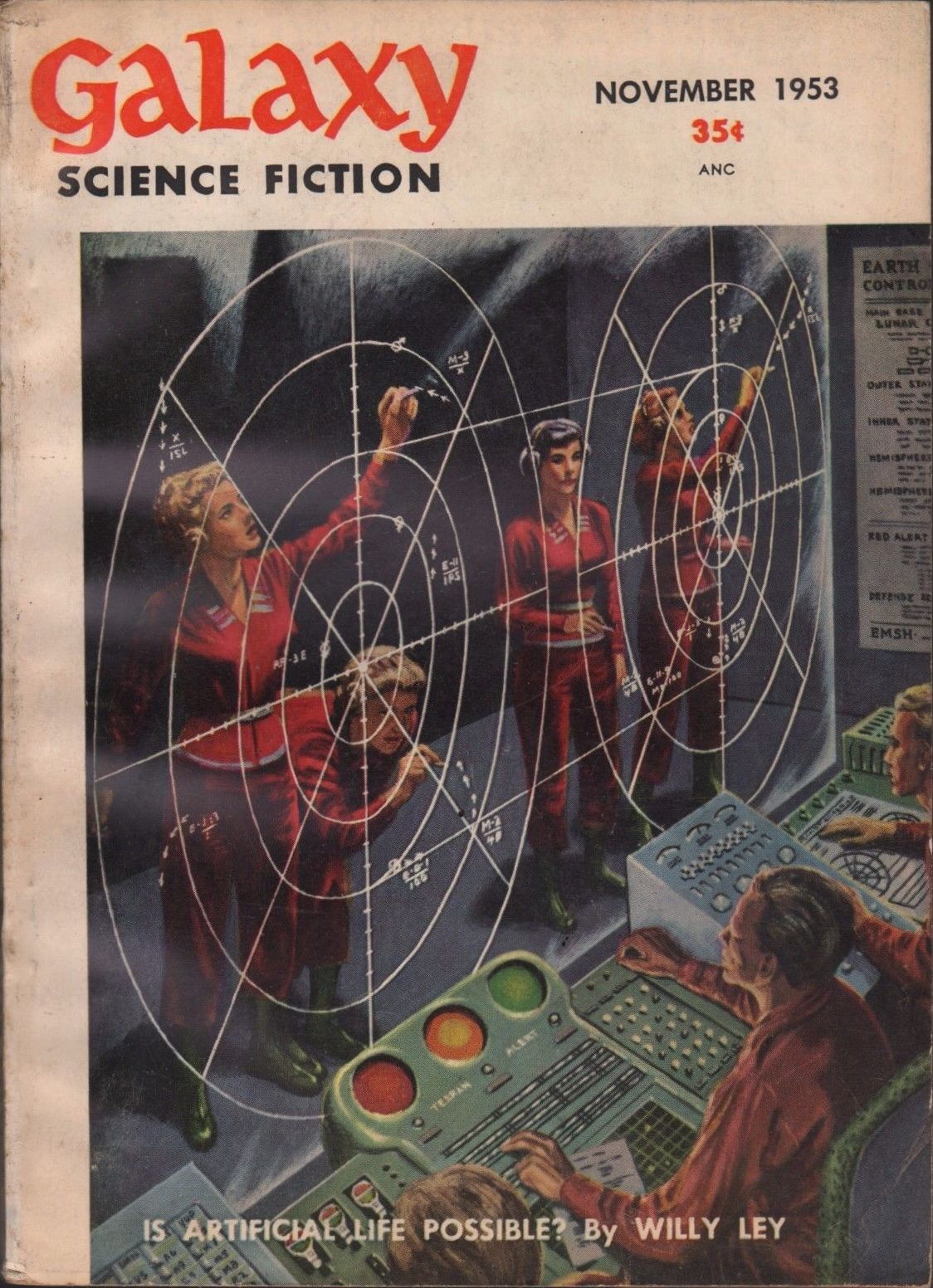
Galaxy Science Fiction November 1953

The November, 1953 issue of Galaxy Science Fiction is one of the better ones, from my perspective. Aside from the continuation of The Caves of Steel by Asimov, Michael Shaara and Roger Dee contributed a pair of good tales.  (The cover art is by Ed Emshwiller.)

“Keep Your Shape” by Robert Sheckley – Pid and his crew arrive on Earth to prepare for a mass invasion. All previous teams failed in their missions for unknown reasons. The Grom (a race of shape-shifters), conquer new worlds as a course of survival. The dangers of Alterationism and Shapelessness are at the forefront of Pid’s mind, but he’s determined to succeed where all other teams failed.

Sheckley does a good job with the Grom, who aren’t very close to humans but still have motives and ideas that I can understand. It’s a fun read.

Read More Read More

Amazing Stories, July 1964: A Retro-Review

Amazing Stories, July 1964: A Retro-Review

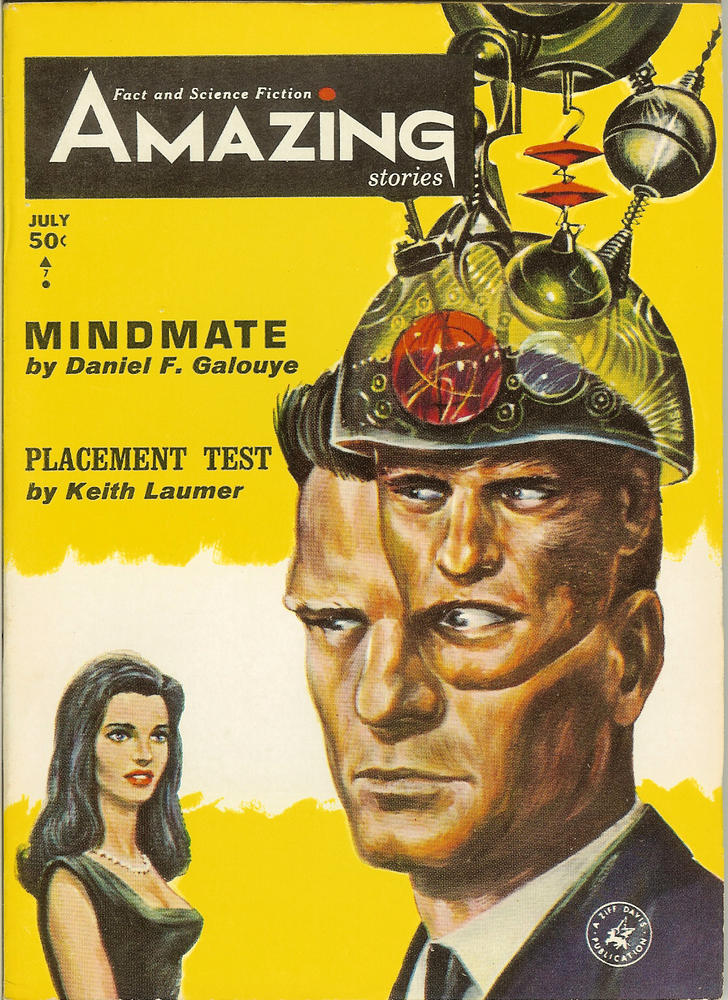
Amazing Stories July 1964-smallThis was the last issue edited by Cele Goldsmith — with the next issue she became Cele Lalli, after her marriage.

Ed Emshwiller contributes the cover this time, to my taste not one of his best. Interiors are by Virgil Finlay, George Schelling, and a couple I don’t recognized, identified in the magazine only by their last names: McLane and Blair. Norman Lobsenz’ editorial discusses the effects of space and alien environments on humans, and goes on to wonder how we can justify terraforming planets on which other species live. Ben Bova’s science article, “Operation Shirtsleeve,” then discusses exactly that — how to terraform other planets so that humans can live comfortably there (in “shirtsleeves”).

Robert Silverberg’s book review column, The Spectroscope, first takes on Edgar Rice Burroughs, both on his own (The Cave Girl) and via a slavish imitator (Otis Adelbert Kline, with Prince of Peril). Silverberg’s verdict: “unmitigated trash, subliterate claptrap barely worth the time of children.”

(My verdict, based on a very limited sample (ERB’s first novel, A Princess of Mars aka “Under the Moons of Mars“) is a bit more forgiving — claptrap and trash it may be, but it’s definitely mitigated — at least early in his career Burroughs offered an energetic glee that made him worth reading despite the silliness.)

Next he reviews a couple of collections by major writers — one is an SFWA Grand Master, the other died too young to be named a Grand Master but would certainly have been one eventually, and one of the very best. So: Silverberg finds James Gunn’s Future Imperfect somewhat disappointing next to the best of Gunn’s work; but he finds Sturgeon in Orbit surprisingly better: even though it features uncollected early ’50s stories it manages to surprise with some good stuff, particularly “The Incubi of Parallel X,” a wild piece full of cliches from Planet Stories in 1951 that Sturgeon redeemed with his panache. (I read that story in the Planet Stories issue it appeared in (not in 1951 though!) and I completely agree!)

Read More Read More

Purity of Blood by Arturo Pérez-Reverte

Purity of Blood by Arturo Pérez-Reverte

oie_822641406YLopEI closed out my review of Captain Alatriste last summer by stating I would be reading more of Arturo Pérez-Reverte’s series in “short order.” That did not happen. Only now, over a year later, have I plunged back into the grimy, deadly underside of Golden Age Madrid. Even more than its predecessor, Purity of Blood (1997) explores the darkest heart of imperial Spain as she, only 130 years after her emergence as the world’s leading power, is collapsing in on herself; collapsing due to endless war, unsustainable debt, corruption at all levels, and unyielding religious fanaticism. Still, Spain remains a mighty empire; if not feared, still respected in all corners, and her subjects proud:

But at the time of this tale, our monarch was still a young man, and Spain, although already corrupt, and with mortal ulcers eating her heart, maintained her appearance, all her dazzle and politesse. We were still a force to be reckoned with, and would continue to be for some time, until we bled the last soldier and last maravedi dry. Holland despised us; England feared us; the Turk was ever hovering ’round; the France of Richelieu was gritting its teeth; the Holy Father received our grave, black-clad ambassadors with caution; and all Europe trembled at the sight of our tercios — still the best infantry in the world — as if the rat-a-tat-tat of the drums came from the Devil’s own drumsticks. And I, who lived through those years, and those that came later, I swear to Your Mercies that in that century we were still what no country had ever been before.

Purity of Blood picks up shortly after Captain Alatriste, in the year 1623. Like that book, this one is narrated by Íñigo Balboa, the son of one of Alatriste’s slain comrades. Íñigo tells the story from late in life, but during its events he is thirteen.

Read More Read More

By Crom: The Tor Conan – Quality May Vary…

By Crom: The Tor Conan – Quality May Vary…

Conan_RogueEvery so often, I get the hankering to read a tale of Conan the Cimmerian (better known as ‘The Barbarian’ thanks to Ah-nuld Schwarzenmuscles).

I usually grab one of the three excellent Del Rey volumes (which Howard Andrew Jones and Bill Ward entertainingly went through – here’s the first installment) and get a quick fix. For a little more reading, I snag one of the Ace/Lancer series edited by L Sprague De Camp (with some help from Lin Carter). And less often, I find one of the Tor paperbacks that I haven’t gotten around to yet and try one of them.

As I mentioned in this post on what qualifies as Conan Canon (say that five times fast!) back in 2015:

‘From 1982 through 2003, eight authors (though primarily four) cranked out 43 new Conan novels for Tor. At two per year, the quality varied wildly, as you can imagine. John M. Roberts’ Conan the Rogue is an homage to Dashiell Hammett’s Red Harvest and one of my favorite Conan books. Steve Perry’s Conan the Indomitable is one of the worst fantasy books I’ve ever read (even though it is a direct sequel to Perry’s Conan the Defiant, which I liked).’

I have maybe two-thirds of the Tor books and have read two-thirds of those (What: I’m channeling Yogi Berra now?). Some of the Tor titles give you at least a bit of an idea what the story is about, such as John M. Roberts’ Conan and the Treasure of the Python and Leonard Carpenter’s Conan of the Red Brotherhood.

But the majority are all titled Conan the (insert vague word here). It’s a litany of titles like Conan the Valorous, Conan the Defiant, Conan the Great, Conan the Formidable: you get the idea. You’ve got to read the back cover to get some clue what the story is about.

The Tor books, pushed out at a punishing pace, are very much a mixed bag. And my experience so far is that more often than not, they fall into the “meh” or worse category.

Read More Read More

Dune by Frank Herbert

Dune by Frank Herbert

oie_3171159srWv2GrQIt’s been called the greatest science fiction novel of all time. Maybe, maybe not, but it’s one of the best I’ve ever read. Published all the way back in 1965, it’s the best-selling science fiction novel of all time. The first half of Dune made its debut as “Dune World,” starting in the December 1963 Analog. The second half, “The Prophet of Dune,” began in the January 1965 issue.

I read Dune for the first time in 1981, at the age of 14. From the very first pages I was hooked.  I was house sitting for my grandfather, and the only things I had to do were let the dog out and feed her and myself, and that meant I barely put the book down all day. Like Dune’s hero, Paul Atreides, I was wondering what the heck is a gom jabbar? Who are the Bene Gesserit? What is melange? My dad’s paperback, at 544 pages, is one of the longest books I’ve read in a single day (beat only by Terry Brooks’ The Sword of Shannara).

I’m not sure what triggered it, but something called out from the depths telling me it was time to reread Dune again. The last time (which was the fourth time) I read it was nearly 20 years ago. A friend wanted to get into science fiction, so a few of us started rereading the classics and tossing them his way. Among the books I revisited were Asimov’s Foundation Trilogy and The Gods Themselves, Clarke’s Rendezvous With Rama, Heinlein’s Orphans of the Sky, and Herbert’s Dune.

Read More Read More

Vintage Treasures: A Sense of Wonder, edited by Sam Moskowitz

Vintage Treasures: A Sense of Wonder, edited by Sam Moskowitz

A Sense of Wonder John Wyndham-small A Sense of Wonder John Wyndham-back-small

Here’s a great example of the kind of book I miss most in today’s market: A Sense of Wonder, a three-novella anthology published in 1967, and reprinted in paperback multiple times in the UK by New English Library.

Why do I miss it? Because it collects three classic pulp tales from three famous pulp authors, and it introduced new readers to the great writers of the pulps in a handsome and inexpensive format. It’s exactly the kind of impulse purchase I would have snatched off the racks in 1987, the year the edition above was released.

Mass market anthologies are virtually gone from today’s shelves — and especially anthologies that showcase authors like John Wyndham, Murray Leinster, and Jack Williamson.

Read More Read More

Edgar Rice Burroughs’s Pellucidar Saga: Land of Terror

Edgar Rice Burroughs’s Pellucidar Saga: Land of Terror

land-of-terror-john-coleman-burroughs-first-edition-coverHere we are. The sixth book in the Pellucidar series, about which its author had this to say: “Perhaps the trouble is that it is one of a series which should have been concluded with the last story instead of trying to carry on without any logical reason.”

Oh boy. What I do next I take no pleasure in. I want to like Edgar Rice Burroughs novels. Sometimes it’s fun to shred up a terrible movie or book, and sometimes it’s simply the easier analytical path. But kicking writers you love when they’re down … that feels ugly. If you’ve never read an Edgar Rice Burroughs novel before, maybe go try this, or this, or how about this, and skip what I’ve written below. Seriously, I would never, ever, want to discourage someone from reading the works of one of the twentieth century’s great imaginative spinners of tales.

For those of you sticking around, hey, thanks plenty for wanting to read my analyses of ERB. Whenever we want to feel good about Edgar Rice Burroughs, we have a dozen or so classics we can pick up and — bam! — transported to wondrous realms of infinite adventure. So after reading this article, I recommend you pick one of your personal favorite Burroughs novels. I’m feeling the urge to return to The Land That Time Forgot. I adore that book, and I haven’t read it in a few years.

Yes, I’m stalling.

Our Saga: Beneath our feet lies a realm beyond the most vivid daydreams of the fantastic … Pellucidar. A subterranean world formed along the concave curve inside the earth’s crust, surrounding an eternally stationary sun that eliminates the concept of time. A land of savage humanoids, fierce beasts, and reptilian overlords, Pellucidar is the weird stage for adventurers from the topside layer — including a certain Lord Greystoke. The series consists of six novels, one which crosses over with the Tarzan series, plus a volume of linked novellas, published between 1914 and 1963.

Today’s Installment: Land of Terror (1944)

Previous Installments: At the Earth’s Core (1914), Pellucidar (1915), Tanar of Pellucidar (1929), Tarzan at the Earth’s Core (1929–30), Back to the Stone Age (1937)

Read More Read More

A Tale of Two Robert E. Howard Biographies

A Tale of Two Robert E. Howard Biographies

Dark Valley Destiny The Life of Robert E. Howard-small Blood & Thunder The Life and Art of Robert E. Howard-small

Not so long ago, in a galaxy really close by (in fact, our galaxy), there was a tale of two biographies of the same writer. This is how the story goes. Or at least, this is what I have gathered.

Once upon a time there was a Jedi-in-training (also known as a sci-fi writer) who, tempted by the Dark Side of the Force, figured out that he could make quite a bit of money in the fantasy genre. Tolkien was selling like gangbusters at the time, so why not? Robert E. Howard (REH), a long dead Golden Age pulp writer, had all of that Conan stuff just lying around begging to be exploited utilized. So off to work the Jedi went.

But, in pursuing this decades-long venture, said sci-fi writer unfortunately and eventually went completely over to the Dark Side — full Sith Lord territory. In time, by his own reckoning, he became the de facto spokesperson for what counted as canonical Conan. And further, as a self-made REH authority, he published his own biography of Howard. The Force was strong with this one.

Fortunately though, so the tale goes, the Force eventually balanced out. A small but growing band of Jedi — fully committed to the Light Side — fought vigorously against this Sith Lord, trying to demonstrate who the true REH actually was. In time, the evil Sith Lord was defeated, and died of natural causes. But the task of undoing his dark damage against REH’s legacy would take years. And eventually a very able Jedi warrior would come along and write a new REH biography that would, among other things, hopefully undo all the damage done by the first bio.

Read More Read More

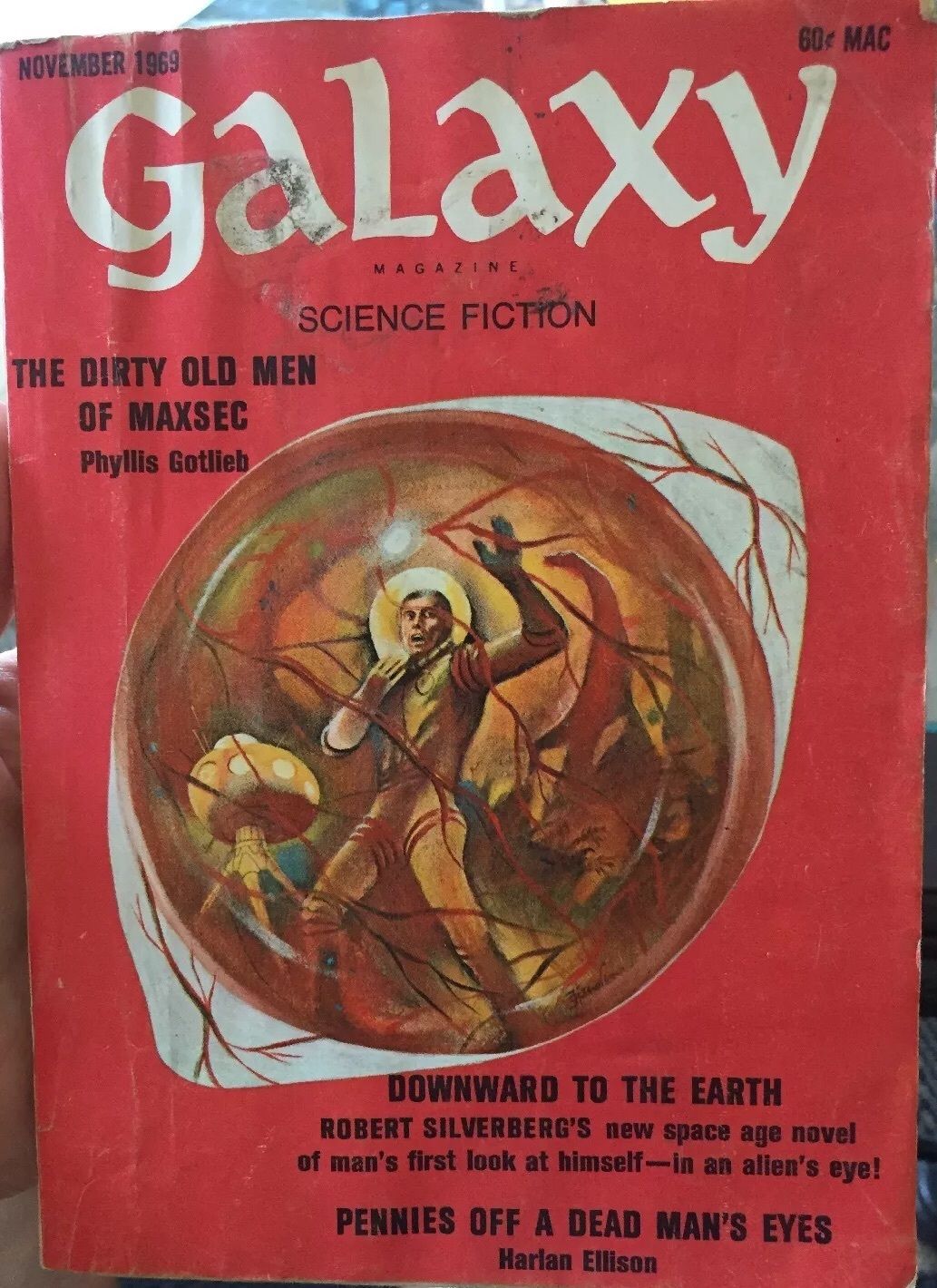
No Slimy Monsters, No Princesses: The Bantam Spectra Omnibus Robert Silverberg

No Slimy Monsters, No Princesses: The Bantam Spectra Omnibus Robert Silverberg

Robert Silverberg The Masks of Time Born With the Dead Dying Inside-small Robert Silverberg Three Novels The World Inside Thorns Downward to the Earth-small

Robert Silverberg practically introduced me to science fiction. His novel Collision Course was one of the first SF novels I ever read, and he’s one of the first authors I collected. Like a lot of Campbell-era SF, Collision Course is about humans thrusting out into space in an aggressive age of empire-building, and our first encounter with an equally aggressive alien race with the same dreams. The copy I read was the 1977 Ace edition with a cover (by an uncredited artist) that casually gave away the ending.

Ace Books, run by Jim Baen and publisher Tom Doherty, was Silverberg’s paperback publisher in the US for many years. By the 80s, however, Silverberg had been lured over to the Bantam Spectra line under Lou Aronica. Bantam pulled out all the stops for Silverberg, reprinting much of his vast backlist with gorgeous new artwork by Welsh artist Jim Burns. My collection includes over a dozen Bantam Silverberg’s, including his Majipoor novels, Gilgamesh the King (1984), To Open the Sky (1984), and many others,

But it was only a few months ago that I discovered that Bantam produced two omnibus Silverberg collections in 1988. It was purely by luck, as I was hunting down a copy of Downward to the Earth, and instead found a seller offering something called Three Novels: The World Inside, Thorns, Downward to the Earth for just $3. I quickly searched around and found there was a least one earlier volume, collecting The Masks of Time, Born With the Dead, and Dying Inside. I expect they had very low circulation, because I’ve never seen them before.

Read More Read More

Super-Intelligent Cats, Shape-Shifting Aliens, and Mysterious Footprints in the Snow: Rich Horton on 9 Tales of Space and Time, edited by Raymond J. Healy

Super-Intelligent Cats, Shape-Shifting Aliens, and Mysterious Footprints in the Snow: Rich Horton on 9 Tales of Space and Time, edited by Raymond J. Healy

9 Tales of Space and Time-small 9 Tales of Space and Time-back-small

Earlier this week I wrote a brief Vintage Treasures piece about Raymond J. Healy’s groundbreaking anthology New Tales of Space and Time. Groundbreaking because it virtually invented the original science fiction anthology, way back in 1951. I was inspired to write that article by Rich Horton’s review of Healy’s follow-up, 9 Tales of Space and Time, at his blog Strange at Ecbatan. Here’s Rich.

Raymond J. Healy (1907-1997) is primarily remembered within the SF field for his role as co-editor (with J. Francis McComas, one of the founding editors of The Magazine of Fantasy and Science Fiction) of the absolutely seminal 1946 anthology Adventures in Time and Space, with was the first introduction in book form to short SF for many post-War readers. It was reprinted numerous times, including a Modern Library edition in 1957.

Healy edited three other SF anthologies, one more reprint book with McComas, the much shorter and less good More Adventures in Time and Space (1955); and two original anthologies on his own: New Tales of Space and Time (1951) and the book at hand, 9 Tales of Space and Time (1954)… Both books are very good, and both seem to have been quite significant at the time, but I don’t think they are much remembered. The first book had two major stories, Kris Neville’s “Bettyann” and Anthony Boucher’s “The Quest for Saint Aquin,” as well as contributions from the likes of Asimov and Bradbury. The second book has no story as good as those, but it is still quite interesting.

Like Rich, I consider Healy’s first book, Adventures in Time and Space, to be enormously important, perhaps the most important SF anthology of the Twentieth Century.

Read More Read More