Browsed by
Category: Vintage Treasures

A Treasure Trove of Classic Ursula K. Le Guin: The Hainish Novels and Stories from the Library of America

A Treasure Trove of Classic Ursula K. Le Guin: The Hainish Novels and Stories from the Library of America

The Hainish Novels and Stories Library of America

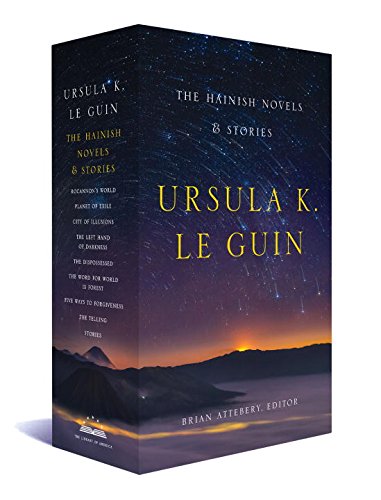
Here’s a delightful find: buried in all the usual news on forthcoming books and new releases I get every week was an understated announcement about this massive compilation of all of Ursula K. Le Guin’s Hanish novels and stories, to be published in the attractive slip case above by the Library of America.

And I do mean massive. The two volume set is a whopping 1,921 pages. It contains 8 complete novels (include her Hugo and Nebula Award-winning volumes The Left Hand of Darkness and The Dispossessed) and 17 stories, including the complete story cycle Five Ways to Forgiveness, plus several appendixes. It will be edited by Brian Attebery, and both volumes include new introductions by Le Guin. It arrives in hardcover on September 5, 2017.

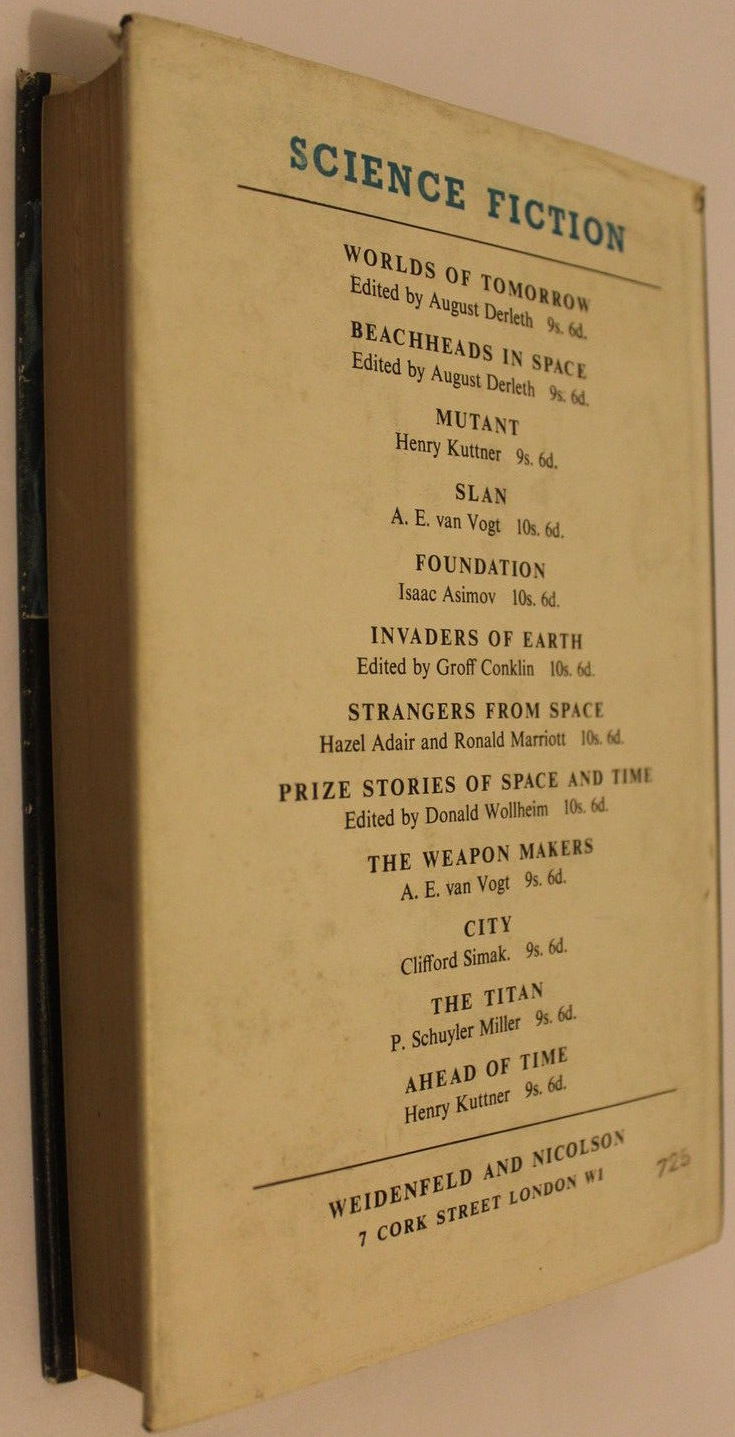
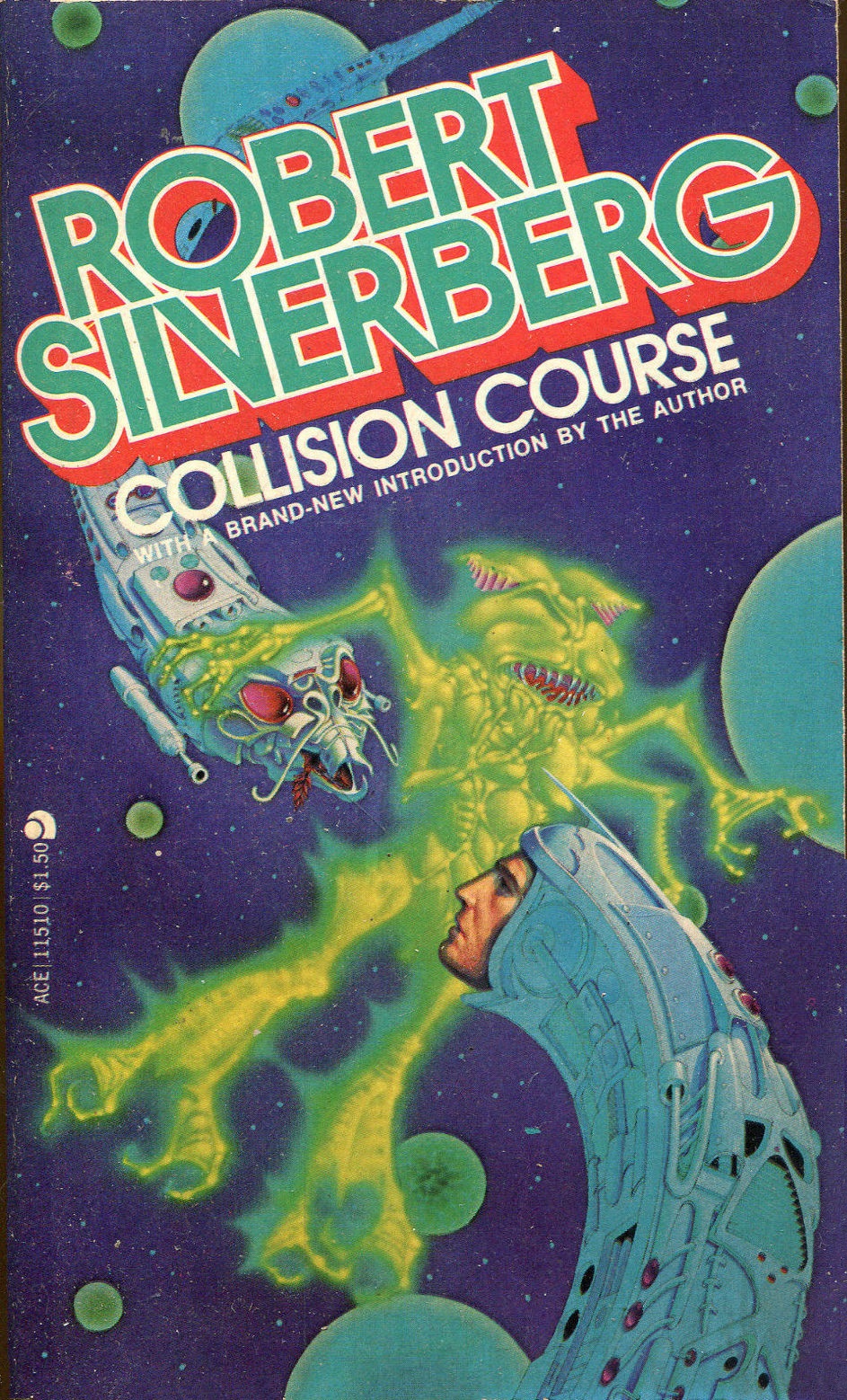
Now you know one of the reasons I’m excited about this book is that it contains the complete text of over half a dozen vintage paperbacks, including a pair of the most acclaimed science fiction novels of the 20th Century, in handsome archival-quality hardcovers. And you know what that means — I can’t resist showing you the original paperback covers (front and back). Here they are.

Read More Read More

The Best of Cordwainer Smith, edited by J. J. Pierce

The Best of Cordwainer Smith, edited by J. J. Pierce

Do not read this story; turn the page quickly. The story may upset you. Anyhow, you probably know it already. It is a very disturbing story. Everyone knows it. 

from “The Crime and the Glory of Commander Suzdal”

oie_18116595RsWNL8gWhere to begin with Paul Linebarger, aka Cordwainer Smith? Son of a lawyer with ties to the Chinese Revolution of 1911, and godson of Sun Yat-sen, Linebarger, before World War II, was a professor of Eastern Studies at Duke. During the war, he served in the US Army and helped set up the first psychological warfare unit, and became an advisor to Chinese president Chiang Kai-shek. After the war, he was recalled to service to advise the British during the Malayan Emergency, and American forces during the Korean War. Later, he would serve in various intelligence capacities, calling himself “visitor to small wars,” though he avoided Vietnam, thinking it was a bad situation all around. Somehow, between the year 1950 and his death in 1966, he found the time and energy to create one of the most original, complex, and strange science fiction universes.

As part of their “Best of” series, Ballantine published The Best of Cordwainer Smith in 1975, edited by J. J. Pierce. I picked it up in around 1984 at the Forbidden Planet in Manhattan, based on something I’d read recommending the story “Scanners Live in Vain.” Strange as I found it, “Scanners” was nothing compared to the mad, almost hallucinogenic stories that followed it. It contains twelve of of his most important stories, all set in the future history which he called the Instrumentality of Mankind. The Instrumentality is the group of supremely powerful humans who rule over humanity.

Cordwainer Smith (as I’ll call him from now on) first appeared in 1950 with the publication of the story “Scanners Live in Vain” (1950). Its frenetic start warns readers they are in for something strange.

Martel was angry. He did not even adjust his blood away from anger. He stamped across the room by judgment, not by sight. When he saw the table hit the floor, and could tell by the expression on Luci’s face that the table must have made a loud crash, he looked down to see if his leg was broken. It was not. Scanner to the core, he had to scan himself. The action was reflex and automatic. The inventory included his legs, abdomen, chestbox of instruments, hands, arms, face and back with the mirror. Only then did Martel go back to being angry. He talked with his voice, even though he knew that his wife hated its blare and preferred to have him write.

“I tell you, I must cranch. I have to cranch It’s my worry, isn’t it?”

Foremost from this opening is the word cranch. What can it possibly mean and why must Martel do it?

Read More Read More

Vintage Treasures: New Tales of Space and Time, edited by Raymond J. Healy

Vintage Treasures: New Tales of Space and Time, edited by Raymond J. Healy

New Tales of Space and Time-small New Tales of Space and Time-back-small

Raymond J. Healy is one of the most important editors in the history of science fiction. Although he has a scant four books to his credit, he did as much to popularize and establish the field as editors with dozens more. His first book, Adventures in Time and Space (1946), edited with J. Francis McComas, is arguably the most important SF anthology of the Twentieth Century. Although it wasn’t the first true SF anthology (that honor belongs to Donald A. Wollheim’s The Pocket Book of Science-Fiction, 1943), it was enormously successful, and that success paved the way for the SF reprint anthology market as we know it today.

Before Healy and McComas, no major publisher would take a risk on the unproven genre of science fiction, which at the time was the province of low-paying pulp magazines. Adventures in Time and Space, a massive 1,013-page survey volume which reprinted the best early science fiction from Astounding Science Fiction and other magazines, found its way into libraries and schools across the country, and remained in print for decades. Its success virtually created the SF reprint anthology, which brought countless writers into permanent editions for the first time, and introduced them to a host of new readers. In 1952 the readers of Astounding/Analog voted Adventures in Time and Space the All-Time Best Book, beating out Slan, The Green Hills of Earth, and The Martian Chronicles.

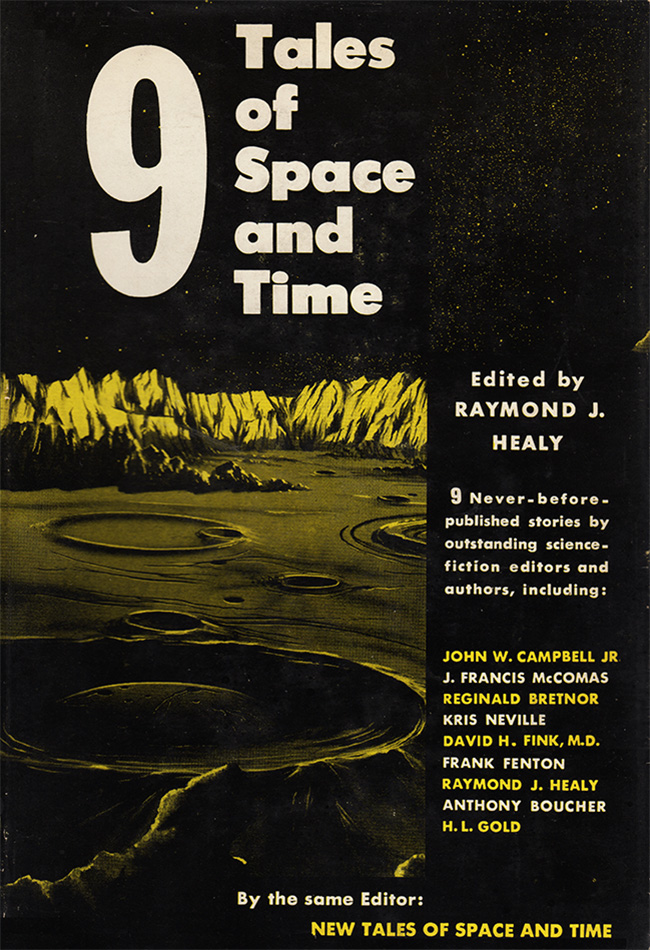
After his enormous success with Adventures in Time and Space, Healy made one more major innovation. Instead of filling his next book with reprints, he bought brand new stories from the top writers in the field — and in the process invented the original science fiction anthology. The result was New Tales of Space and Time (1951). He did it again three years later with 9 Tales of Space and Time (1954). Both books were successful… and needless to say, highly influential, spawning thousands of imitators through the decades.

Read More Read More

Classic SF from One of the Twentieth Century’s Great Masters: The Best of John W. Campbell

Classic SF from One of the Twentieth Century’s Great Masters: The Best of John W. Campbell

The-Best-of-John-W-Campbell-mid The-Best-of-John-W-Campbell-back-small

The Best of John W. Campbell (1976) was the seventh installment in Del Rey’s Classic Science Fiction Series. Lester Del Rey (1915–1993) is again the editor; he also provides the introduction. H. R. Van Dongen (1920–2010) did the attractive cover art, and it seems in line with the artistic feel set by Dean Ellis, Darrell Sweet, and The Brothers Hildebrandt on the previous volumes. For those books, unless the author was deceased, the afterword was usually written by the author being celebrated. Since Campbell had passed a few years before this publication, his widow (also now deceased) provided an interesting afterword.

John W. Campbell (1910–1971) was more than just one of the greatest science fiction writers of the twentieth century. Probably more importantly, as editor of Astounding Science Fiction (later renamed Analog) from 1937 until his death, he is generally credited with being the primary shaper of the Golden Age of science fiction. He tutored such giants in the field as A. E. van Vogt, Theodore Sturgeon, and the great Robert A. Heinlein. And everyone from Isaac Asimov to Robert Silverberg credited him with being a major influence on their writing.

As I’ve said before, I’m not generally a big fan of science fiction; I tend to lean more towards horror and fantasy. And thus I know I tend to caricature classic sci-fi as being sometimes tedious and outmoded. But as with some previous writers in Del Rey’s Classic Science Fiction Series, I continue to be pleasantly surprised by some of these Golden Age (and later) science fiction writers. Since we’ve covered this volume once before (back in 2013), this time, rather than simply giving an overview of selected stories, I will primarily focus on some recurring themes and give some overall thoughts.

Read More Read More

New Treasures: Sisters of Tomorrow: The First Women of Science Fiction, edited by Lisa Yaszek and Patrick B. Sharp

New Treasures: Sisters of Tomorrow: The First Women of Science Fiction, edited by Lisa Yaszek and Patrick B. Sharp

Sisters of Tomorrow-small Sisters of Tomorrow-back-small

While I was at Wiscon in May, I didn’t just attend readings (although it probably seemed like it). I also hung out in the Dealer’s Room, where I bought a whole bunch of vintage paperbacks, most of which remain unpacked on the floor of my library. With luck, I can steal some time this weekend to photograph them for upcoming Vintage Treasures columns.

I haven’t unpacked them because all the time I would normally be spending with them, I’ve been spending instead with a fabulous anthology I bought from Greg Ketter: Sisters of Tomorrow: The First Women of Science Fiction. It’s packaged as a scholarly tome (and is even published by Wesleyan University Press), but don’t be fooled — this is a top-notch collection of pulp-era SF by women, which also doubles as a very compelling argument that “women have always been part of the genre” (to quote the back cover copy.) One of the great things about this volume — in addition to the fabulous (and rarely reprinted) pulp tales by Clare Winger Harris, Leslie F. Stone, C. L. Moore, and others — is that it also includes poetry, articles by women, editorials, and even a gorgeous selection of pulp covers in color.

Read More Read More

Disasterville U.S.A. :The Shockwave Rider by John Brunner

Disasterville U.S.A. :The Shockwave Rider by John Brunner

If there is such a phenomenon as absolute evil, it consists in treating another human being as a thing.

Nick Halflinger in The Shockwave Rider


oie_1023133dHcFYNm5Cyberpunk appeared as a description of a sub-genre in the early eighties. The word first appeared in print in 1983 as the title of a story by Bruce Bethke and it was quickly adopted to cover the works of near-future science fiction by William Gibson, Bruce Sterling, Pat Cadigan, and others. The general connection between books like Gibson’s Neuromancer (1984) and Neal Stephenson’s Snowcrash (1992) was the depiction of high technology mixed into a crumbling, corrupt society.

Cyberpunk as a named thing might date to only 1983 or so, but as a movement in science fiction its roots are deeper. For years prior to the appearance of Neuromancer, usually thought of as the first cyberpunk novel, sci-fi authors had been writing about the dangerous effects — on society and individuals — of computers, communications, cybernetics, and related fields. In the UK, J.G.Ballard, and in the US, Philip K. Dick, laid a lot of the groundwork for the genre in books featuring rebels, man-machine interfaces, often lots of psychoactive drugs, and a general dystopian atmosphere. It’s little wonder that Dick’s 1968 novel, Do Androids Dream of Electric Sheep?, should become the basis for the film Blade Runner, easily one of the first cyberpunk movies.

English author John Brunner (discussed at great length here at Black Gate) started his writing career creating fairly standard space opera. In the mid-sixties he began writing stories in more contemporary settings, such as the 1965 novel, The Squares of the City. In it, a traffic engineer is hired to work in the newly-built capital of a South American nation (echoes of Brasilia). While there he becomes a piece, quite literally, in game of chess being played between two of the country’s power brokers.

This move to contemporary and near-future sci-fi culminated in the appearance of Stand on Zanzibar in 1968. Its portrayal of a wildly over-populated Earth, conveyed in the snapshot style of Dos Passos’ USA Trilogy, won Brunner the Hugo award for best novel. It also marks the start of what’s been called his Catastrophe Quartet.

Read More Read More

A Book That Makes You Yearn to be Stranded on a Desert Island: Modern Classics of Fantasy edited by Gardner Dozois

A Book That Makes You Yearn to be Stranded on a Desert Island: Modern Classics of Fantasy edited by Gardner Dozois

Modern Classics of Fantasy-small Modern Classics of Fantasy-back-small

Like most of you folks, I used to have more reading time. Like, a ton more reading time. Whole summer vacations just lazing around with my feet on the furniture and my nose in an epic fantasy. Nowadays I’m lucky to negotiate a three-day weekend and, believe me, that kind of reading time is much too precious to devote to a single author. Yes, reading vacations still tend to be devoted to big books — I haven’t broken that habit– but these days more often than not they’re thick anthologies that let me sample a wide range of writers. And usually anthologies curated by an editor who’s earned my trust.

That’s why I’m so partial to Gardner Dozois. He’s got great taste, for one thing. For another, he produces big books, the kind you can plan a vacation around. One of my favorites is his massive survey anthology Modern Classics of Fantasy, which is the kind of book that makes you wish you could be stranded on a desert island. Sure, I’d probably go hungry and miss the internet. But if it meant I finally had 15 uninterrupted hours to read this thing cover to cover, it’d totally be worth it.

Read More Read More

Any Sufficiently Advanced Technology…

Any Sufficiently Advanced Technology…

saturn rukh cover

I know this is a fantasy blog, but for this one I want to appeal to the third (and most famous) of Clarke’s laws, which is “Any sufficiently advanced technology is indistinguishable from magic,” because I want to talk about the scienciest, most extrapolatey, most out there science fiction, which isn’t overtly different from fantasy except in aesthetic.

This comes from my musings about writing a story set in orbit of a neutron star, and also because I was recently discussing with a friend where to find the hardest SF.

I get a lot of ideas when I read other authors. I love seeing what science people know and transform into story, and I love seeing that unique kind of creative ambition.

Some caveats: When I looked in my book shelf for examples to show a friend, I came up with three authors and six titles. My shelves don’t have every book, and so I’ll certainly miss some stunning works.

Read More Read More

Vintage Treasures: Starship/Non-Stop by Brian Aldiss

Vintage Treasures: Starship/Non-Stop by Brian Aldiss

Brian Aldiss Starship Signet-small Brian Aldiss Starship Avon-small Brian-Aldiss-Non-Stop-Pan-small
Brian Aldiss Non-Stop Grafton-small Brian Aldiss Non-Stop Carroll and Graf-small Brian Aldiss Non-Stop Masterworks-small

Joe Wehrle’s terrific review of Brian Aldiss’ Hothouse short story cycle in the latest issue of The Digest Enthusiast piqued my interest in other Aldiss classics. There’s certainly a lot to consider — Aldiss has written some thirty novels, including The Dark Light Years (1964), Report on Probability A (1968), Barefoot in the Head (1969), The Eighty-Minute Hour (1974), The Malacia Tapestry (1976), and The Helliconia Trilogy, just to mention a few. His most recent novel Finches of Mars was published in 2012, and his short story “Abundances Above” appeared in Postscripts 36/37 last year, shortly before the author’s 91st birthday (!!).

But any serious study of Brian Aldiss should probably start with his first novel Non-Stop, published in 1958. The tale of a generation ship whose inhabitants have degenerated into near barbarism, it was an instant classic, and remained in print for over five decades. The novel was re-titled Starship for its 1959 appearance in the US; that title stuck through multiple editions. I’ve collected a sample of a half-dozen of my favorite covers above, starting with the 1963 Signet paperback (top left, cover by Paul Lehr) and progressing through the decades to the 1989 Carroll & Graf edition (bottom middle, art by Tony Roberts) and the SF Masterworks edition (2000, cover by Fred Gambino).

Read More Read More

Star Punk Story Building in Interplanetary Hunter

Star Punk Story Building in Interplanetary Hunter

Interplanetary Hunter Barnes
I caved and bought some old Pulp.
Interplanetary Hunter Barnes
Monster Manual-style insets describing the various creatures.

I caved and bought some old Pulp.

I couldn’t help it. I was at Eastercon and in the dealers room, and there was Durdles Books with shelves and boxes that took me back to my early teens trawling used bookstores and charity shops for volumes with spaceships on the cover.

And since I started writing my The Eternal Dome of the Unknowable series, I’ve been exploring the roots of what I call Star Punk, the covers were cool… so I came home with some faded paperbacks of yesteryear.

One of these was Interplanetary Hunter by Arthur K Barnes.

What hooked me was the lovely Monster Manual-style insets describing the various creatures. It was actually published before roleplaying was thing in 1956 (mine is the 1972 Ace reprint), and compiled from stories that went out in magazines from 1937-1946, making it technically Golden Age.

And it tells.

It’s definitely in the category of classics you shouldn’t recommend to young people (I talked about this in my first ever BG article!). It’s a good light read, the style and lead-in may be fast and furious — pulpy goodness — but it suffers from Quaint Future and some Quaint Delivery, including excruciatingly detailed science and pseudoscience, complete with equations.

Read More Read More