Browsed by
Category: Vintage Treasures

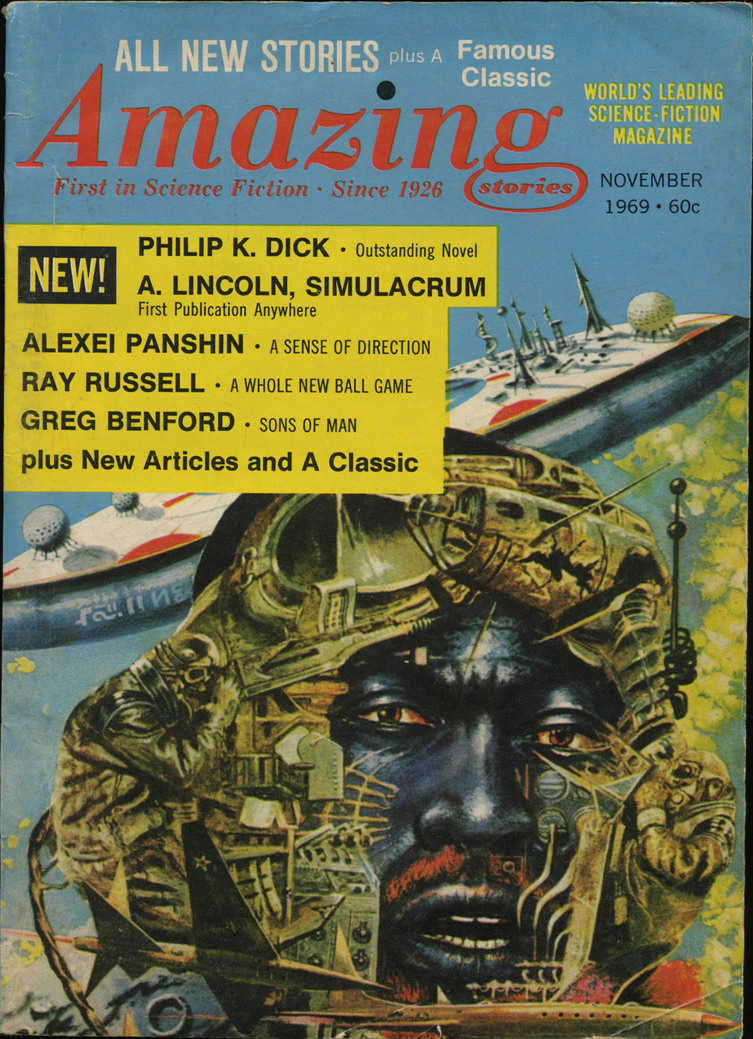
Amazing Stories November 1969: A Retro-Review

Amazing Stories November 1969: A Retro-Review

Amazing Stories November 1969-smallThis is Part 1 of a Decadal Review of vintage science fiction magazines published in November 1969. The articles are:

Amazing Stories, November 1969
Galaxy Science Fiction, November 1969
The Magazine of Fantasy & Science Fiction, November 1969
Worlds of If, November 1969
Analog Science Fiction/Science Fact, November 1969

Almost every year I go to a small sci-fi conference in Lawrence Kansas called The Campbell Conference. The people who run the Campbell Conference have a lot of sci-fi magazines and books; boxes and boxes of them. In fact, they have them out in the common area and sell them for like a dollar apiece. I was there last year and pulled out, completely at random, an Amazing Stories from November 1969 — which is remarkable because that was the year and month I was born.

And it occurred to me that, truth be told, I actually haven’t read all that much science-fiction. I read a Larry Niven short story collection in high school, and The Science Fiction Hall of Fame, Volume 1 off and on in early college. The majority of my science fiction reading has been novels; I didn’t really return to the short-form until the early 2000’s — and mostly because that’s when I first started going to the Campbell Conference!

When I saw that ’69 Amazing I was struck with the idea that I’d raid those boxes, gather the magazines from November ’69, read ‘em, and review ‘em. Then, because a decade is a nice number, I figured that I’d add ’79, ’89, and ’99, possibly (depending on how this all goes over) I may do ’09. Yes, a Quatro-Decadal Review!

I’m going to delve fairly deep into these works, so if you’ve got an issue with spoilers for 47 year old stories, you have fair warning! Also, I’m gonna end the reviews with my thoughts on the general ‘vibe’ of the magazine.

And away we go!

Read More Read More

Vintage Treasures: The Hormone Jungle by Robert Reed

Vintage Treasures: The Hormone Jungle by Robert Reed

The Hormone Jungle Robert Reed-small The Hormone Jungle Robert Reed-back-small

Robert Reed is one of the most acclaimed and prolific writers at work in SF today. He was nominated for the John W. Campbell Award for Best New Writer in Science Fiction in 1987, and won the Hugo Award for his 2006 novella “A Billion Eyes.” He’s sold some 200 short stories to numerous markets, including Asimov’s Science Fiction, Clarkesworld, Interzone, Albedo One, Postscripts, F&SF, and Daily Science Fiction, and published over a dozen novels, including Down the Bright Way (1991), An Exaltation of Larks (1995), and Marrow (2000).

But back in 1988 he was a young writer with just one novel under his belt, The Leeshore (1987). His second, The Hormone Jungle, was published in hardcover that year by Donald Fine, and reprinted in paperback a year later by Popular Library with a cover by Luis Royo. Unlike the sophisticated space opera for which Reed is known today, The Hormone Jungle was packaged as a straight-ahead adventure story tailor made for a film treatment staring Arnold Schwarzenegger. Set “on an Earth overrun by a trillion species,” it featured a square-jawed “professional hero,” a beautiful lady android in distress, and a noir edge. That didn’t help it find a market, however… it pretty much vanished without a trace, and has never been reprinted. Copies aren’t hard to find, but it nonetheless took me a while to acquire one. I finally found one on eBay recently for $4.99 (including shipping).

Our previous coverage of Robert Reed includes:

Is Robert Reed the New Century’s Most Compelling SF Voice?
New Treasures: The Greatship

The Hormone Jungle was published by Questar/Popular Library in June 1989. It is 300 pages, priced at $4.50 in paperback. The cover is by Luis Royo. Read more at Reed’s website, and see all our recent Vintage Treasures here.

Vintage Treasures: Agents of Insight by Steven Klaper

Vintage Treasures: Agents of Insight by Steven Klaper

Agents of Insight-small Agents of Insight-back-small

These days blending genres is fairly routine. Like supernatural mob crime novels? Try Chuck Wendig’s The Blue Blazes. Enjoy human P.I’s in a fantasy setting? Try Glen Cook’s Garrett, P.I.. Vampire detectives? P.N. Elrod’s The Vampire Files. Zombie private eyes? There’s lots to enjoy! Check out Tim Waggoner’s The Nekropolis Archives or Stefan Petrucha’s Hessius Mann series.

Science fiction and spy thrillers… now that’s a slightly rarer breed. There are a few, but you have to look around. The earliest one I can think of is Agents of Insight, a mid-80s SF novel by Steven Klaper. Agents of the psi-spy agency Insight are being murdered around the world, and two agents have to expose the sinister nemesis behind the scenes, in a fast-paced race for the truth across a futuristic Earth — and beyond.

I don’t know much about this Steven Klaper fellow. Nuthin’, really. He published this single novel, and nothing else. No short stories, no articles, no reviews. Is Klaper a pseudonym for a more well-known writer? I have no idea. Anybody know?

Agents of Insight was published by Tor Books in October 1986. It is 224 pages. priced at $2.95. It has never been reprinted, and there is no digital edition. The cover is by Barclay Shaw. See all our recent Vintage Treasures here.

Amazing Stories, October 1963: A Retro-Review

Amazing Stories, October 1963: A Retro-Review

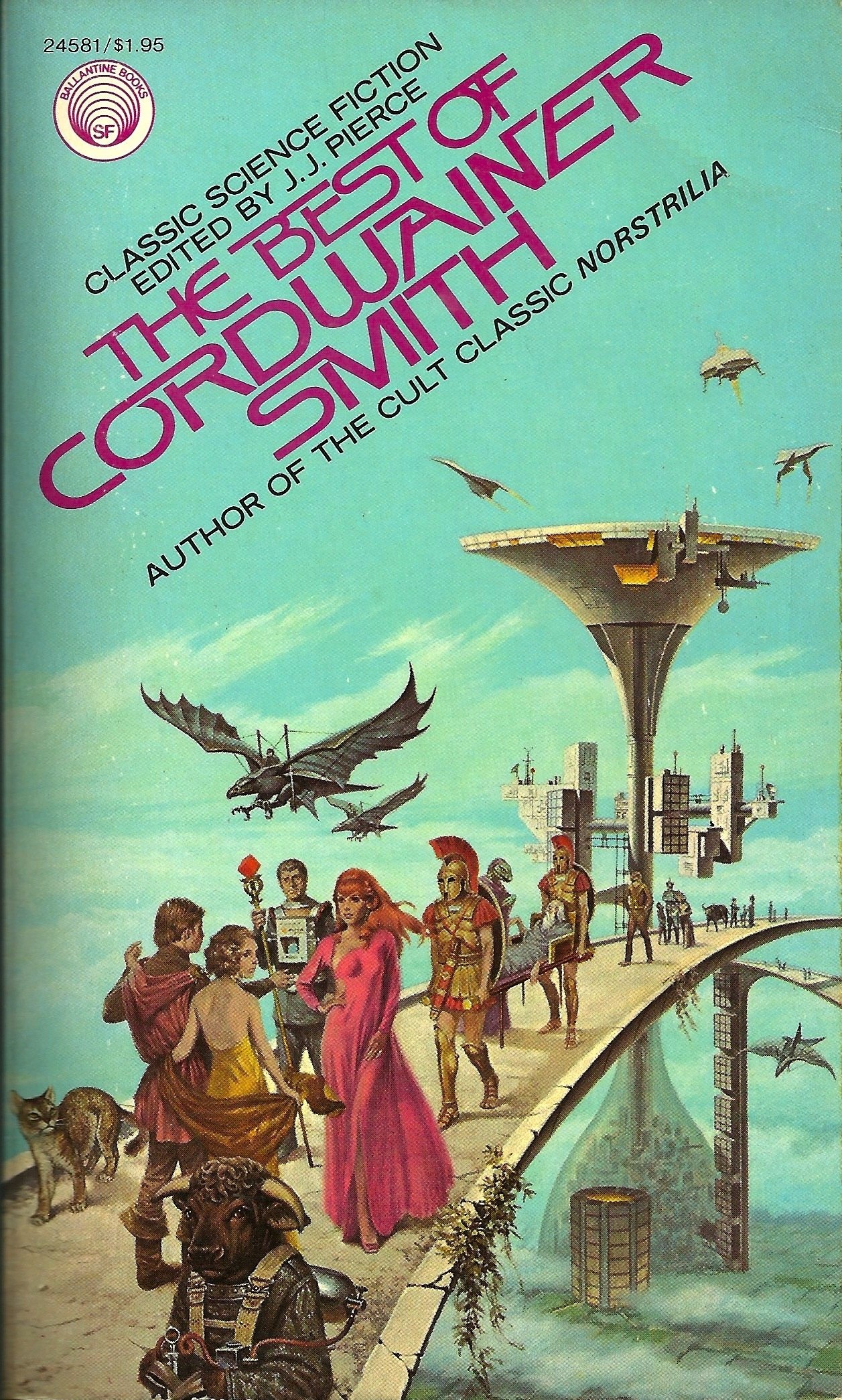
Amazing Stories October 1963-smallBack to Cele Goldsmith’s era at Amazing. This issue has a couple of middling stories by two of the strangest and most original of SF writers. The cover is by Lloyd Birmingham, illustrating Cordwainer Smith’s “Drunkboat.” Interiors are by Birmingham, George Schelling, and Frank R. Paul (who had just died). Indeed, Norman Lobsenz’ editorial opens by mentioning Paul’s death (Paul, of course, famously painted the cover for the very first issue of Amazing); and goes on somewhat randomly to mention a National Spelling Bee winner who credited reading SF for his vocabulary (though reading Amazing could hardly have helped his spelling, given the standard of proofreading displayed this issue!); and then mentions Groff Conklin’s latest anthology, Great Science Fiction About Doctors (which in fact made a point of including a number of stories BY doctors, though none by the Good Doctor*).

(*Of course, Isaac Asimov was not a medical doctor, though he was a professor at a medical school.)

“Or So You Say …,” the letter column, features letters by Kathryn Avila (complaining about the low quality of the July issue), Norman M. Davis (praising Robert Young’s “Redemption,” one of the stories Avila had complained about), and Paul Scaramazza, theorizing that the then low (he says) status of fantasy literature is the fault of readers without imagination.

In The Spectroscope, S. E. Cotts reviews a now quite obscure book, The Fools of Time, by William E. Barrett, and an anthology from Sam Moskowitz, The Coming of the Robots. (She [as I now assume Cotts was] didn’t like the first, did like the second.) Moskowitz himself contributes a Profile of Edmond Hamilton.

The stories are:

Novelets

“Drunkboat,” by Cordwainer Smith (11,200 words)
“The Prince of Liars,” by L. Taylor Hansen (17,300 words)

Read More Read More

Vintage Treasures: The Worlds of Jack Vance

Vintage Treasures: The Worlds of Jack Vance

The Worlds of Jack Vance-small The Worlds of Jack Vance-back-small

We live in an age where an astonishing amount of pulp science fiction and fantasy is readily available, both in print and digital formats. Want to read the complete stories of Leigh Brackett, or Fredric Brown, or Robert E. Howard, or Clark Ashton Smith, or Harold Lamb, or dozens of other fabulous pulp writers? For the first time in decades, they’re all available in handsome permanent editions and digital compilations. As well as inexpensive pulp reprints, if that’s your thing. And if you’re a serious collection who really wants the joy of tracking down each story in its original format… well, that’s easier than ever as well, thanks to online sites like eBay and Amazon.

So really, if you’re a fan of 20th Century SF and fantasy, you don’t have much to complain about. Unless, like me, you remember mass market collections and anthologies. Gone are the days when books like The Worlds of Jack Vance would line bookstore shelves, and that’s a shame.

The Words of Jack Vance is a delightful collection of some of the very best of Vance’s early fiction, including “The Moon Moth” (1961), one of his most brilliant stories, alongside three Magnus Ridolph tales, a novella in his Nopalgarth story cycle, and four other stories. It’s terrific introduction to one of the most gifted fantasists of the 20th Century. Sure, there are similar collections published today — the five volumes of The Early Jack Vance from Subterranean Press, for example. But they cost $45 each, which means not too many people (if any) will be buying them to try Vance for the first time. That Ace paperback? It’s $1.25.

Read More Read More

A Tale of Three Covers: Only the Dead Know Brooklyn

A Tale of Three Covers: Only the Dead Know Brooklyn

Only the Dead Know Brooklyn Chris Vola-small Only the Dead Know Brooklyn Thomas Boyle-small Only the Dead Know Brooklyn Thomas Wolfe-small

Chris Vola is the author of two previous novels, Monkeytown (2012) and the self-published E for Ether. His first mainstream release is the horror/thriller Only the Dead Know Brooklyn, published last month by Thomas Dunne Books.

If the title sounds familiar, perhaps it’s because you’re remembering the crime novel by Thomas Boyle (Cold Stove League, Post Mortem Effects) about the kidnapping of Whitman scholar Fletcher Carruthers III. It was published in hardcover by David R Godine in 1985, and reprinted in paperback by Penguin in 1986.

Or perhaps you’re thinking of the famous short story by Thomas Wolfe (which you can read here), about four guys on a subway platform in a heated discussion on how to get to Bensonhurst, narrated in a thick Brooklyn dialect. It was originally published in the June 15, 1935 New Yorker magazine, and collected in paperback by Signet in 1952 under the same title, with a spectacular cover by Ruth Nappi. To this day, readers are still debating what the story is about.

Whatever the case, you have to admit it’s a killer title, and I can’t blame Vola one bit for poaching it. Here’s the description of his novel.

Read More Read More

Smugglers, Alien Vampires, and Dark Dimensions: The Best of C. L. Moore

Smugglers, Alien Vampires, and Dark Dimensions: The Best of C. L. Moore

The Best of CL Moore-small The Best of CL Moore-back-small

The Best of C. L. Moore (1976) was the sixth installment in Del Rey’s Classic Science Fiction Series. After taking a break from the fifth installment to let J. J. Pierce edit, Lester Del Rey (1915–1993) returned to edit and give an introduction to this volume.

You may recall that Dean Ellis (1920–2009) did the cover art for the first four installments in the series with Darrell Sweet handling the fifth, though still in the style of Ellis. But the fabulous cover art of The Best of C. L. Moore was done by “The Brothers Hildebrandt” (twin brothers Greg [1939–] and Tim [1939–2006]) and represents something of a departure from the artistic precedence of Ellis and Sweet. It’s a portrait of the main character in Moore’s story, “No Woman Born.”

Catherine Lucille Moore (1911–1987) was one of the greatest science fiction and fantasy writers of the Twentieth Century. Writing under the name C. L. Moore, she was one of the first truly successful women writers in genre fiction, gracing the early pages of Weird Tales and Astounding Stories. She was also was famously married to another well-known sci-fi writer, Henry Kuttner (1915–1958), whom she collaborated with on many stories. However, all but two of the tales in The Best of C. L. Moore were written before her time with Kuttner. As with the previous books published while the featured author was still alive, Moore has a small afterword at the end.

Read More Read More

Half Past Human by T.J. Bass

Half Past Human by T.J. Bass

oie_1961050loaOe37g

‘Civilization is too high a price to pay for survival’

Moon from Half Past Human

I don’t know what made me buy Half Past Human (1971) by T.J. Bass fifteen years ago. It was one of those books I had always seen on the used book store shelves, but nothing about the cover (the basis on which I tended to buy unknown books back then) made me go “Gotta buy it.” Something on the back cover, though, must have caught my attention that day, because I plunked my money down on the counter of Red Bank, NJ’s (sadly, long gone) Book Pit. I started reading it on the ride home, and before I knew it I was a third of the way done. A week later I made a circuit of used book stores to get my hands on the sequel, The Godwhale (1974).

Initially published by Ballantine, Gollancz released the duology in 2014 as part of its Masterworks collection. If you’re a sci-fi reader of a certain age, or a student of the genre, you’ll recognize most of the books in the collection, definitely most of the authors. But with only two books published nearly fifty years ago, I wonder how many know Bass’s name today. Which is a shame.

The fear of overpopulation was immense in the late sixties. Paul Ehrlich’s 1968 The Population Bomb promised that if population growth was not brought under control, humanity faced oblivion. Regular famines, overcrowded cities, a polluted environment, and dwindling natural resources seemed to be our future. Science fiction was examining the problem with books like Harry Harrison’s Make Room! Make Room! (1966) (the basis for the Charlton Heston sci-fi noir Soylent Green) and John Brunner’s Stand On Zanzibar (1968). This fear set the stage for Bass’s vision of Earth crushed by the weight of three trillion people.

In this, the third millennium, Earth was avocado and peaceful. Avocado, because all land photosynthesized; and peaceful, because mankind was evolving into the four-toed Nebish — the complacent hive citizen.

Read More Read More

A Fairy Tale At The Heart Of The World: The Prince of Morning Bells by Nancy Kress

A Fairy Tale At The Heart Of The World: The Prince of Morning Bells by Nancy Kress

The Prince of Morning BellsContrary to conventional wisdom, sometimes a book’s cover gives matter enough for a fair judgment. The copy I read of Nancy Kress’ The Prince of Morning Bells is a 1981 first printing by Timescape; the book was reprinted in the year 2000 by Foxacre Press, and I learned from Black Gate supremo John O’Neill’s 2012 look at the title that a digital version came out in 2011. At any rate, the front cover of the Timescape edition promises: “In the magical tradition of The Last Unicorn, the tale of a restless young princess and her wondrous quest!” Parts of the blurb are only half-accurate, but the important part, the difficult-to-believe part, is quite correct. The Prince of Morning Bells is worth mentioning with The Last Unicorn, not just in terms of quality but in tone. It works with classic fantasy traditions, using a witty and often lightly-ironic style with a sprinkling of anachronism to tell a deep and profoundly moving tale. Kress has apparently noted the influence herself, though I don’t find the books excessively similar. Their bones are configured in different shapes. Distinctive, individual, The Prince of Morning Bells shows how a fantasy tale can transmute allegory into anti-allegory, telling a symbolic story that works as story while also working as symbol.

It is the story of Kirila, who begins as an eighteen-year-old princess discontented with what seems an increasingly unimportant life. She therefore decides to set out on a great Quest for the Heart of the World. She’s soon joined on her travels by a talking dog, Chessie, who claims to be a prince under a curse that can only be removed at the Heart of the World, which he tells her is to be found in the Tents of Omnium. Together they journey on, as Kirila encounters challenges and temptations; the story, which had opened on a comic note, gradually sounds bleaker tones and darker shades until, at the mid-point of the book, there is an unexpected structural turn. Kirila’s quest continues, but her resources and energy are taxed further than one might have imagined. The promised happy ending seems distant; and indeed the conclusion, although everything promised, is at the same time more equivocal than one might have imagined. Yet also satisfying, with real wisdom gained, Kirila thoroughly changed and developed, and a sense of both mystery and high majesty overriding all.

The book’s a fairy tale as much as fantasy, and if in the beginning it seems like a sending-up of fairy-tale cliches, it quickly grows more serious. As Kirila matures in the course of her adventures the quest gains in emotional intensity, giving the plot its centre without becoming episodic. Structurally, the book’s clever; although it divides into two halves, it’s so much of a piece it avoids a feeling of easy symmetry. Instead the midpoint does what a good midpoint’s supposed to, initiating the falling action in an unexpected way, leading through an increasing emotional intensity to an inevitable yet unpredictable conclusion. Kirila becomes an everywoman whose journey is a symbolic progress through life, yet if she begins as a generic spunky red-haired princess with a temper, she swiftly becomes an individual with distinctive gifts and flaws. While the quest defines the book, the shape of the quest follows the shape of her choices, prompted by who she is and what she wants. Fairy tale and characterisation combine.

Read More Read More

It’s Large: Ringworld by Larry Niven

It’s Large: Ringworld by Larry Niven

oie_1341223VTU50tGHBack in around 1980, when I read Larry Niven’s multi-award winning Ringworld (1970) for the first time, it totally blew my mind. I had never read anything that conveyed the feeling of BIGNESS so powerfully and so well. Rereading it yesterday, I was thrilled to discover it still does. It’s got its flaws, some pretty big ones in fact, but for much of its length it remains a terrific read. Despite having won numerous awards and a career that’s spanned over five decades, it remains the book he’s best known for.

Beginning with 1964’s “The Coldest Place,” Larry Niven began laying out the history of humanity’s expansion and exploits across a 30-light year bubble of of the Milky Way he dubbed Known Space. Over the next six years, he wrote about another twenty novels and stories that span from the late 21st century to the 32nd. Along the way he introduced some of the most iconic sci-fi aliens, including the cowardly Pierson’s Puppeteers and the ferocious Kzin (who now feature in their own unending series of shared-world anthologies).

Louis Wu is bored. Bored with an Earth where everywhere and everyone has blended into a bland homogeneity. In the past, he has taken what he calls “sabbaticals,” and gone on months-long solo deep space jaunts. The 1968 story, “There Is A Tide,” describes one of his voyages in great detail.

In 2850, while celebrating his 200th birthday, wandering the globe to avoid his own guests, stepping from one teleportation booth to another, Louis suddenly appears in an unexpected location with an even more unexpected host — a Pierson’s Puppeteer. Once, the three-legged, two-headed aliens maintained a vast commercial empire, trading in highly advanced technologies. Then, two hundred years ago, they pulled up stakes and left Known Space. Having learned the galactic core had exploded and the resultant wave front would reach Known Space in 20,000 years, they decided it was time to find safety. No human ever heard from them again or knew where they went.

Read More Read More