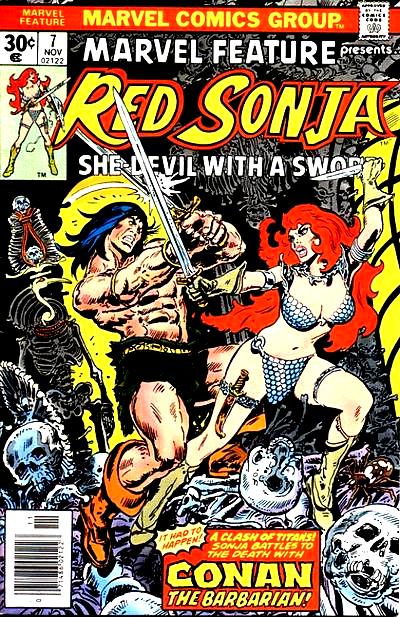
Red Sonja 4
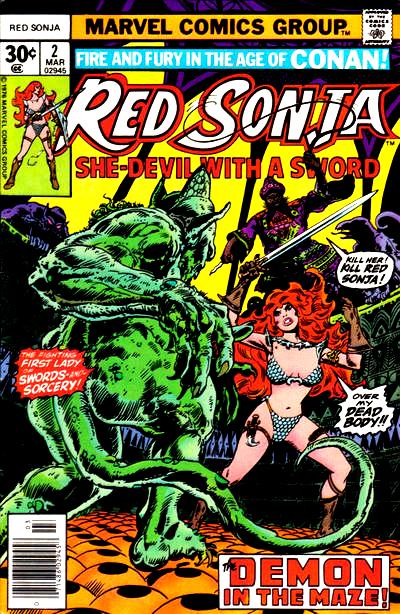
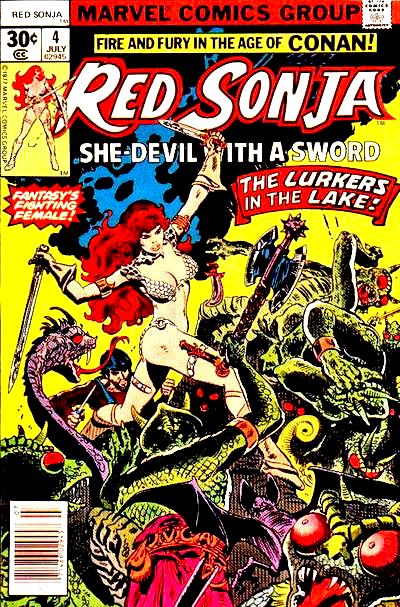 Last issue, Red Sonja competed in the Games of Gita, won, then killed the Queen of Athos. This issue, she’s still hanging around the city. Apparently, the queen wasn’t that popular. So her new friend, Mikal, is showing her the sights, which include a dark lake infested with shambling actors. “(T)hese strange beings, whose limbs are an eldritch mixture of beast and fowl and lowly reptile.” They slowly make their way to the aptly named “Theatre of Monsters.”
Walking into the Theatre, Sonja finds that the performances consist of monsters, who are clearly monsters wearing human masks, performing surreal renditions of standard plays. Of course, the actors behave with more dignity than the howling human audience around them. At one point, they invite Red Sonja to join their performance in exchange for a purse of gold.
Since Sonja is perpetually broke, she accepts the offer and takes the stage. But since it’s pretty much her fate to be perpetually broke, the offer of gold was a ruse and the monster performers try to kill her immediately. Several monster-corpses later, their leader is begging for mercy and offering to explain what just happened.
At this point, Mikal joins Sonja, having apparently been using the bathroom while she was fighting for her life on stage. The two of them are escorted to the lake, where the waters are parted Moses-style so that they can follow the monsters down to their underwater crystal city. There, she is told the story of how the monsters are descended from aliens whose ship crashed in the lake. After adopting water-breathing forms, they began to interbreed with various Earth animals (um, yuck) until the succeeding generations were the monsters that now occupy the city. Apparently, their leader was captured by the people of Athos and they are forced to perform as circus entertainers in order to ensure that he stays alive.
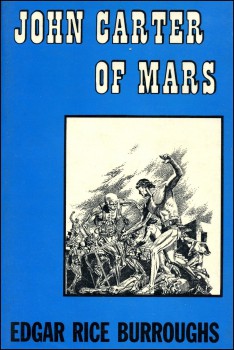 So it ends here, not with a climatic epic, but with a bit of house cleaning almost fifteen years after the author’s death. The final book in Edgar Rice Burroughs’s career-spanning Barsoom saga is a slender volume containing two unrelated novellas.
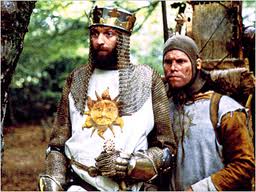 Just as an older generation recalls with perfect clarity where they were when they heard of Kennedy’s assassination, I know precisely where I first saw Monty Python and the Holy Grail (1975): perched on the floral-print sofa in my parent’s house, watching the film on a poor, weather-impacted PBS broadcast. I also remember falling right off that sub-par couch in paroxysms of laughter when the animator saved King Arthur’s band by conveniently suffering a heart attack.
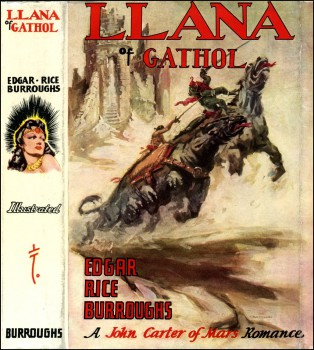 Back on Mars, and closing in on its finale, after my short sabbatical… What can I say? It seems Synthetic Men of Mars will suck out the desire to keep trudging forward from even the most dedicated ERB enthusiast.