Browsed by
Category: Books

Sherlock Holmes Tiptoes into the Public Domain
Sherlock Holmes Tiptoes into the Public Domain

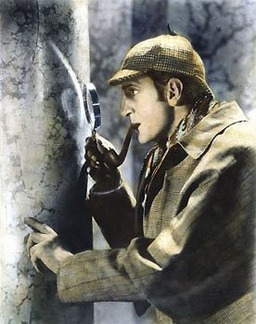
Sherlock Holmes dang itAn American judge has ruled that Sherlock Holmes is in the Public Domain.

Say what? If you’re like me, you’ve had some trouble wrapping your head around the fact that Arthur Conan Doyle’s famous detective wasn’t already in the public domain. His first appearance, in the short novel A Study in Scarlet, was in 1887, and he appeared in a total of four novels and 56 short stories between then and 1927. To my mind that’s the pre-pulp era, roughly contemporary with the Old Testament and the Dead Sea Scrolls.

Let’s review. If most of Robert E. Howard Conan tales, published between 1932 -1936, are in the public domain — and in fact, virtually all literary works published before January 1, 1923 are no longer covered by United States copyright law — what’s the deal with Sherlock Holmes?

Well. Near as I understand it, the Conan Doyle Estate bases their claim on the fact that the last Holmes story was published in 1927, and the characters of Sherlock Holmes, Dr. Watson, Irene Adler, etc. were not truly completed until then. The Estate has challenged any production that tried to make use of the characters — and indeed, popular TV series like the BBC’s Sherlock, and CBS’s Elementary, have paid a license.
…

Read More Read More

Rereading Orlando

Rereading Orlando

OrlandoFor some years now I’ve been wanting to reread Virginia Woolf’s Orlando. I first read the book about twenty years ago, and though I enjoyed it I came away confused. I felt as though on some level I really hadn’t understood the book. As though I hadn’t grasped how to read it. So, time having passed and me having (maybe) come to understand a bit more about books and reading, I sat down with Orlando again. And, as I’d hoped, I enjoyed it more thoroughly this time around, and felt as though I’d understood it a little better than I had. What surprised me was the reason for that understanding. I felt as though I’d worked out how to approach the book not because of any greater knowledge of modernism, or even because I’d read other books by Woolf, but because I now had a greater experience of early fantasy. More than I’d remembered or understood when I first read the book, Orlando is of a piece with the fantastic fiction of its time.
Orlando was first published in 1928. I have the impression that it’s read and spoken of primarily as an artifact of literary modernism, which is fair enough — Woolf was certainly one of the great modernists. But it’s worth remembering that Hope Mirrlees, who wrote the great fantasy Lud-in-the-Mist in 1926, was also a consciously modernist writer. And, to me, having read only To the Lighthouse and Mrs Dalloway among Woolf’s other work, the approach of Orlando is much more like something out of Lord Dunsany than it is similar to Woolf’s technique in those other novels. Orlando avoids inner monologue, presenting itself as written by an obtrusive biographer, playfully claiming to base its text on carefully-scrutinised sources, staying silent where these sources are silent; reading it I think of Joyce Carol Oates’ Gothic Quintet (which boasts an array of odd biographers, as well as at least one pivotal sex-change), but am also reminded of Dunsany’s mock-scripture of The Gods of Pegāna. I will even go so far as to say that in its playful fantasia on the theme of English history, Orlando distantly reminds me of G.K. Chesterton — a writer who Woolf would otherwise appear to be as unlike as it is possible to be.

…

Read More Read More

Fantasy Out Loud IV

Fantasy Out Loud IV

ReluctantBack in 2011, I penned the first in this occasional series with an attempt at rating and relating the fantasy titles I’ve read aloud to my boys, then aged seven and eleven. They’re now two years older and two years larger, if not wiser (though they are sometimes that as well).

Sadly, older child Corey no longer cottons to a bedtime story.

Evan, however, is not only game, he’s adamant that he receive his daily dose of out-loud fiction. The question as always is what to read? What’s appropriate? And what does “appropriate” even mean?

Right now, Evan’s big wish is to see Catching Fire in the theaters. He was too young for The Hunger Games, but he’s now read all the books (on his own, like most of his fourth grade classmates), and seems quite keen to revel in the filmic gore of Panem bloodletting. We’ll see.

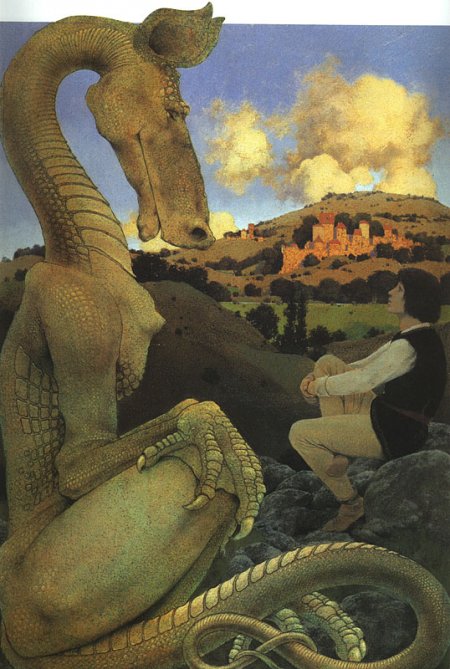
While that debate simmers, the fare of late has included L. Frank Baum’s The Magic Of Oz, Colin Meloy’s Wildwood, Mollie Hunter’s The Walking Stones, and Avi’s Crispin: The Cross Of Lead. Plus a short, Kenneth Grahame’s “The Reluctant Dragon.” Evan chose the Oz title, and I chose the other four.

…

Read More Read More

Lay Down Your Weary Year

Lay Down Your Weary Year

time-enough-at-last-350x263“It… is… later… than… you… think.” — Arch Oboler, Lights Out radio program

10…

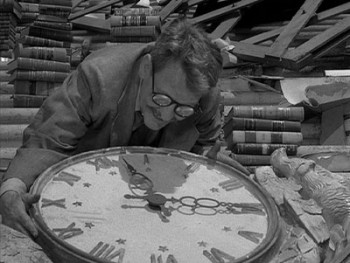
There’s that classic Twilight Zone episode about the bookwormish little gentleman who has a list long as his arm of books he’s always wanted to read, but who is constantly thwarted by the day-to-day demands of society and pressures of life. He happens to be down in the basement library stacks when a nuclear war breaks out. He emerges to find every other human being gone. After this revelation sinks in, he heads back to the library. Cut to hours or days later: he has amassed piles of books in the order he plans to — finally — read them all.

And then…the unexpected happens. The ol’ TZ twist. In this case, his glasses fall off, and he accidentally steps on them. In the closing shot, he stands there, blind as a bat without his reading glasses, with a look of utter despair on his face that dwarfs any emotions he may have felt on realizing that the rest of his fellow creatures were gone. With the books, even authors long dead were still with him. Now even they have been wrested away, leaving him truly alone.

Rod Serling provides his usual wry commentary in the coda of the closing narration, but everyone who’s seen that episode (“Time Enough at Last”, 1959, starring Burgess Meredith) remembers that final scene — within the context of the story’s simple little narrative, that pair of broken glasses is somehow, improbably, more devastating than the destruction of the human race.

…

Read More Read More

New Treasures: Night of Demons by Tony Richards

New Treasures: Night of Demons by Tony Richards

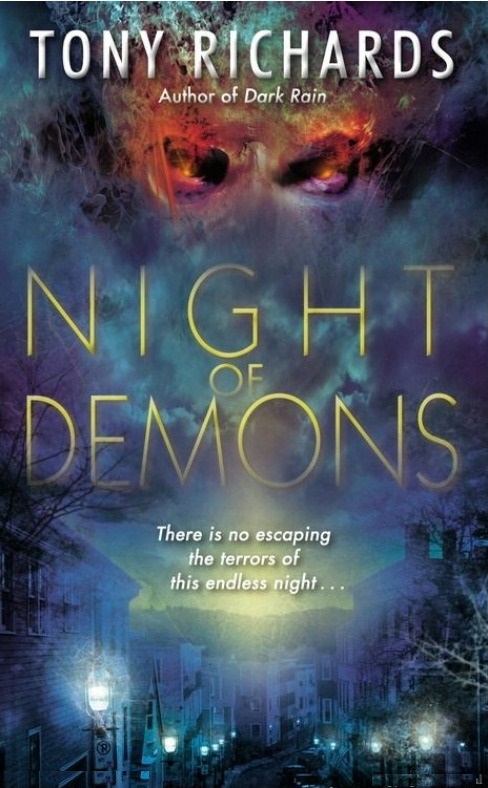
Night of Demons Tony Richards-smallI don’t tend to report much on horror in my New Treasures column. Not that I haven’t anything against horror, but I have enough trouble just keeping up with all the intriguing new fantasy crossing my desk.

But there’s a lot of interesting stuff going on in modern horror, and you deserve to know about it. So I try to sneak one in from time to time. Like Tony Richards’s intriguing Night of Demons, his latest novel set in a Massachusetts town that can’t be located on any map… and which people forget as soon as they leave.

Centuries ago, the Salem witches founded the village of Raine’s Landing, then cloaked it in magic to hide it from sight. Many of their descendants still practice the supernatural arts — and no one who lives here can ever leave. Now evil has breached its boundaries once again…

A serial killer with a corrupt and twisted soul, Cornelius Hanlon has freely entered Raine’s Landing, undeterred by the ancient magical safeguards. And when he chooses the town’s oldest adept as his first victim, the maniac inadvertently gains possession of a powerful “gift” more terrible than anything he could have sadistically dreamed.

Ex-town cop Ross Devries and his Harley-riding sometime-partner, Cassandra Mallory, have no supernatural abilities. But they are the last line of defense in this village of secrets and shadows — facing a psychopath who now wields the power to bend the living and the dead to his will.

Night of Demons is the sequel to Dark Rain, published in 2008. A third Raine’s Landing novel, Speak of the Devil, was just released this month. Richards is also the author of Our Lady of The Shadows (2011) and the collection Shadows And Other Tales (2010).

Night of Demons was published by Avon EOS in October, 2009. It is 390 pages, priced at $7.99 for both the print and digital editions. I bought my paperback on Amazon, on sale for just $3.20 — copies are still available at the discount price.

See all of our recent New Treasures articles here.

Lord Dunsany, Philip José Farmer, and Appendix N: Advanced Readings in D&D

Lord Dunsany, Philip José Farmer, and Appendix N: Advanced Readings in D&D

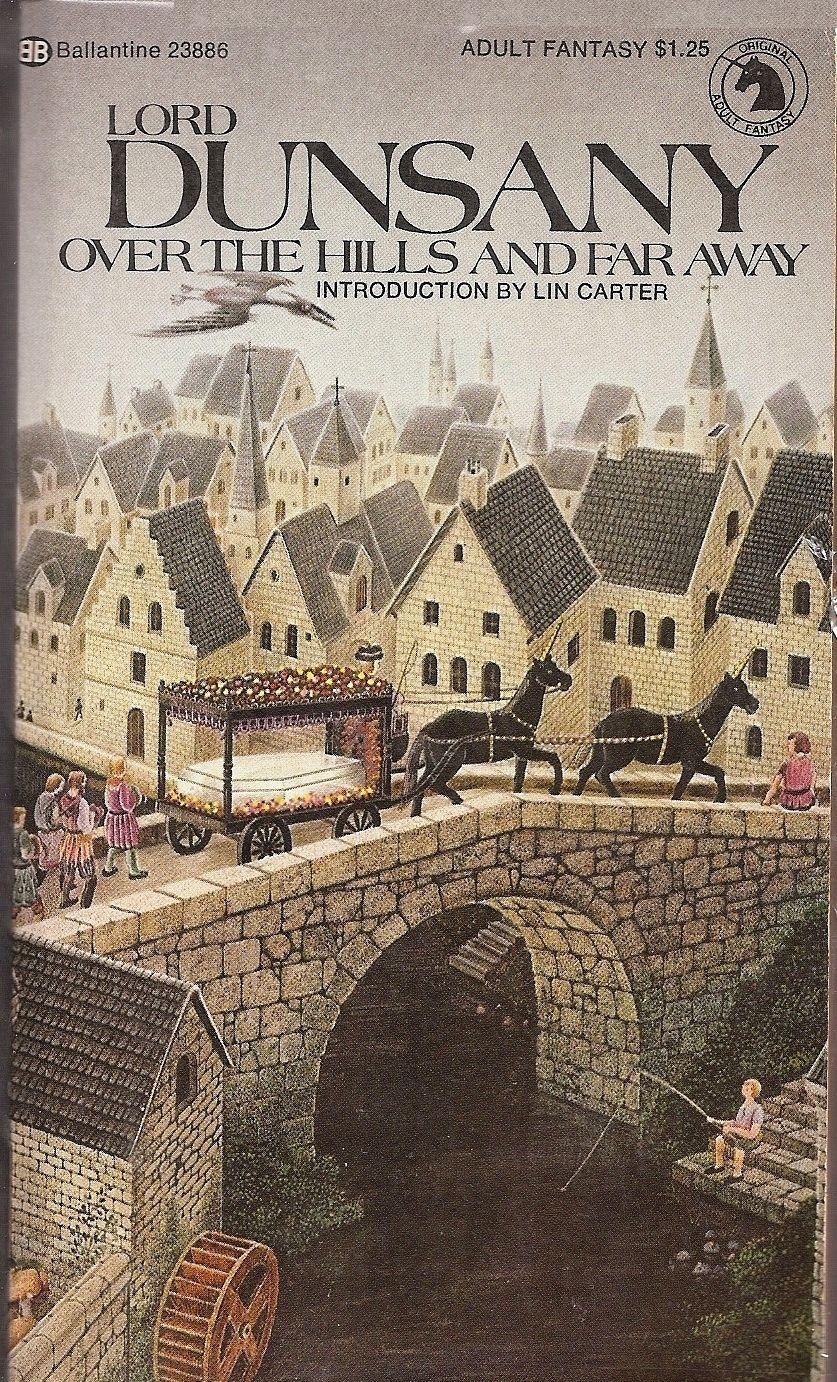
Over the Hills and Far Away-smallI’m still enjoying the Appendix N surveys by Tim Callahan and Mordicai Knode at Tor.com, as they read through every author Gary Gygax cited as an influence on Dungeons and Dragons, even though I’ve found lots to disagree with in their recent columns.

So I’m happy to continue with these re-caps here. Especially since I don’t have a lot emotionally invested in their next two subjects: Lord Dunsany and Philip José Farmer.

I have a lot of respect for Lord Dunsany, but that chiefly stems from the many fine writers who have cited him as an influence. I’ve read only a handful of his shorter works and, while I’ve enjoyed what I’ve read, he’s mostly an untapped natural resource for me.

It’s much the opposite with Philip José Farmer. I was a huge fan of his Riverworld books when I first read them decades ago. But they didn’t really hold up on re-reading 15 years later, for me.

So Farmer is a writer I largely lost interest in years ago, although I have to admit I haven’t really given fair attention to his many fantasy novels. I know his work is highly regarded, and in fact both Cynthia Ward and Christopher Paul Carey made excellent cases here for why I should pay a lot more attention to his Gods of Opar and Tales of the Wold Newton Universe series, for example.

So let’s say I have more of an open mind with both Lord Dunsany and Philip José Farmer, and I’m willing to be influenced.

With that out of the way, let’s see what Tim and Mordicai have to say.

…

Read More Read More

The Series Series: The Shadow’s Heir by K.J. Taylor

The Series Series: The Shadow’s Heir by K.J. Taylor

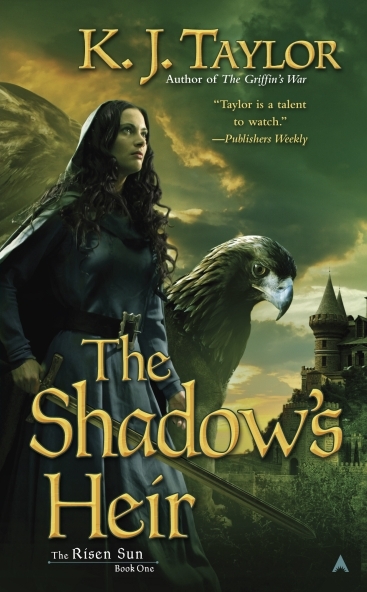
The Shadow's Heir-smallThis book is not the first volume in a new series, no matter what its cover says. It’s marketed as the first volume in a new trilogy, The Risen Sun, that happens to be in the same setting as The Fallen Moon, but with every page I read, I felt the lack of resonances that the author clearly intended and expected for readers who had already read her first three books.

The Shadow’s Heir was good enough that I may someday backtrack to Taylor’s debut, The Dark Griffin. Of course, since this is really the fourth volume in the series, it has enough spoilers about the first three volumes that I’ll need to wait years for my memory of this book to fade. The review quotes about those earlier volumes promise “twisty plots,” and they won’t be twisty for me until I forget nearly everything I just read.

If the book were bad, I’d just shrug and move on. As it is, I’m annoyed on the author’s behalf at the marketing folks at Ace. (This is, of course, an injudicious thing to admit, because I would give my eyeteeth to sell my trunk manuscript to Ace. Not that they’d want my eyeteeth. Imagine the slushpile horror story!) I would love to understand the marketing decision better, because it seems to me that telling people The Shadow’s Heir is a good entry point to Taylor’s fictional world might sell copies in the short run, but would surely turn readers off in the long run.

This book holds the payoff for several plotlines I could have been deeply invested in, had I read them from the beginning. Instead, I was keenly aware at every payoff point of how hollow the big scenes felt to me in comparison to structurally similar scenes in other series.

How on earth am I going to talk in any detail about the virtues and peculiarities of The Shadow’s Heir while avoiding spoilers about three previous volumes I haven’t read? Well, here goes.

…

Read More Read More

When One Window Closes . . .

When One Window Closes . . .

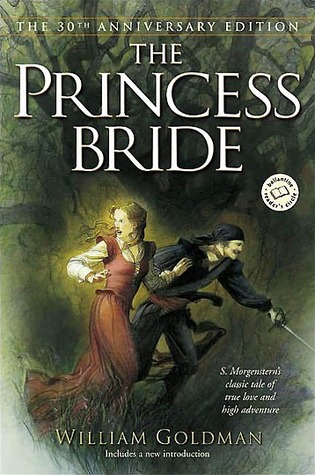
Princess BrideA friend of mine has stated – many times – that he won’t date anyone who doesn’t love The Princess Bride, or Rioja wine. It’s the former that’s important to me at the moment, even though I love a good Rioja myself. Actually, my friend thinks that Princess Bride is the best movie of all time, and I think he’s absolutely right. Except that he’s also absolutely wrong.

We’ve all had the experience of sharing some beloved book, or film, or piece of music with someone, and being disappointed by their tepid reaction. You know. They’re like, polite. What’s more, we’ve all disappointed others in the same way. Like it or not, when this occurs, we do feel differently about each other. And neither side is wrong, but neither side is right, either.

Welcome to my Window Theory of Emotional Response. Otherwise known as the Princess Bride Paradox, the Star Wars Syndrome, the Heinlein Hypothesis, or – dare I say it? – the Frodo Phenomenon. In a nutshell, here it is: for you to have a deep emotional response to something cultural, your exposure to it has to have come at the right time for you.

My theory builds from the phrase many of us have used in other contexts, “that window’s closed.” AKA “that ship has sailed.” Both phrases imply that there was a period of time when something was possible, that the window was “open,” and then, it wasn’t. The opportunity is lost. For a piece of culture to move you, to change the way you think about yourself and the world around you, you have to encounter it at precisely the right age, or the right level of emotional maturity or development or – call it what you will.

Or you haven’t, and that window’s closed for you.

…

Read More Read More

New Treasures: The Yard by Alex Grecian

New Treasures: The Yard by Alex Grecian

The Yard Alex Grecian-smallI’m always disciplined when I visit a bookstore. I go in, get what I came for, and leave. I look neither left nor right. Get in, get out, that’s my motto.

You’re right. I’m totally lying. I’m lucky if I even remember why I came to the bookstore by the time I get to the cash register. My arms are usually full, I have a dazed expression, and I’m no longer sure exactly where I am. Thank God the folks behind the counter recognize me by now. It saves a lot of time and embarrassment.

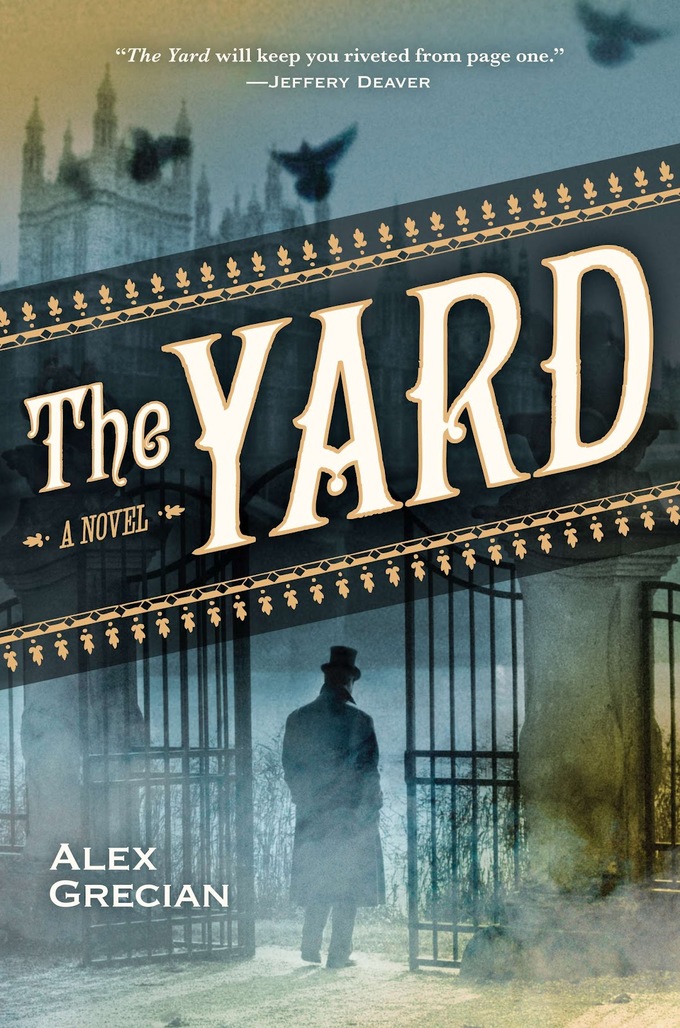
I usually stick to the SF and fantasy sections, but every once in a while something irresistible will cross my path. Something like The Yard, the start of a new gas-lamp mystery series by Alex Glexian, author of the popular Image comic Proof. A first glance The Yard doesn’t seem to include any of the gonzo steampunk action or bizarre characters of Proof — or indeed, anything overtly supernatural — but I find it very appealing nonetheless.

1889, London. Jack the Ripper’s reign of terror is finally over, but a new one is just beginning.

Victorian London — a violent cesspool of squalid depravity. Only twelve detectives — The Murder Squad — are expected to solve the thousands of crimes committed here each month. Formed after the Metropolitan Police’s spectacular failure in capturing Jack the Ripper, the Murder Squad suffers the brunt of public contempt. But no one can anticipate the brutal murder of one of their own…

A Scotland Yard Inspector has been found stuffed in a black steamer trunk at Euston Square Station, his eyes and mouth sewn shut. When Walter Day, the squad’s new hire, is assigned to the case, he finds a strange ally in Dr. Bernard Kingsley, the Yard’s first forensic pathologist. Their grim conclusion: this was not just a random, bizarre murder but in all probability, the first of twelve. Because the squad itself it being targeted and the devious killer shows no signs of stopping before completing his grim duty. But Inspector Day has one more surprise, something even more shocking than the crimes: the killer’s motive.

This is the author’s first novel. Grecian has already penned one sequel in what’s now being called the Scotland Yard’s Murder Squad series: The Black Country, released in hardcover in May of this year. The Yard was published in April 2013 by Berkley. It is 422 pages, priced at $16 in trade paperback and $9.99 for the digital edition.

“This Ghostly Little Book”

“This Ghostly Little Book”

A Christmas CarsolIt’s one of the most famous stories in the English-speaking world, and it is a fantasy. A Gothic fantasy of Christmas, and the meaning thereof: the story of the miser and the three spirits. It’s been retold any number of times, parodied, set in America, updated to the modern day, acted out with mice and ducks, with frogs and pigs. It’s easy to overlook how powerful the original work really is.

For myself, I cannot remember how old I was when I first encountered some version of A Christmas Carol. Very young, and possibly pre-literate. The story’s often presented, I think, as a children’s story; but as I read it now, it seems far from that. Indeed it seems like a story that can only be understood with age. When I was a child I didn’t believe in Scrooge’s conversion, and didn’t see how simply revisiting his past could start such a change in his personality. Now that I’ve lived long enough to have distant memories of my own, I understand it. And rereading the story now, I see that while it’s true Dickens was unashamed of being sentimental and broad, he was also in many ways very subtle in the way he described Scrooge. To me, now, Scrooge and the change in his character seem only one reflection of the book’s central theme and of its vision: a vision of the human soul, both alone and as part of society.

Charles Dickens wrote A Christmas Carol in 1843. He was thirty-one, and already famous. Made to work as a child in a blacking-warehouse while his father was imprisoned for debt, the adult Dickens had a fierce drive to succeed, and a horror of the developing industrial capitalism around him; he worked as a journalist and editor, then had a massive popular success with the serially-published The Pickwick Papers. Oliver Twist followed, then Nicholas Nickleby, The Old Curiosity Shop, Barnaby Rudge, and A Christmas Carol. On the one hand, that’s already an incredible body of work. On the other, Dickens was a very young man to so powerfully capture the elderly Scrooge. But capture Scrooge he did; if A Christmas Carol works — and given that it hasn’t been out of print in a hundred and seventy years, we can say it does — it’s because Dickens gets at something in memory, and in how people age.

…

Read More Read More