Browsed by
Category: Blog Entry

Lost Classics of Pulp: Guy Boothby’s Dr. Nikola and Pharos the Egyptian

Lost Classics of Pulp: Guy Boothby’s Dr. Nikola and Pharos the Egyptian

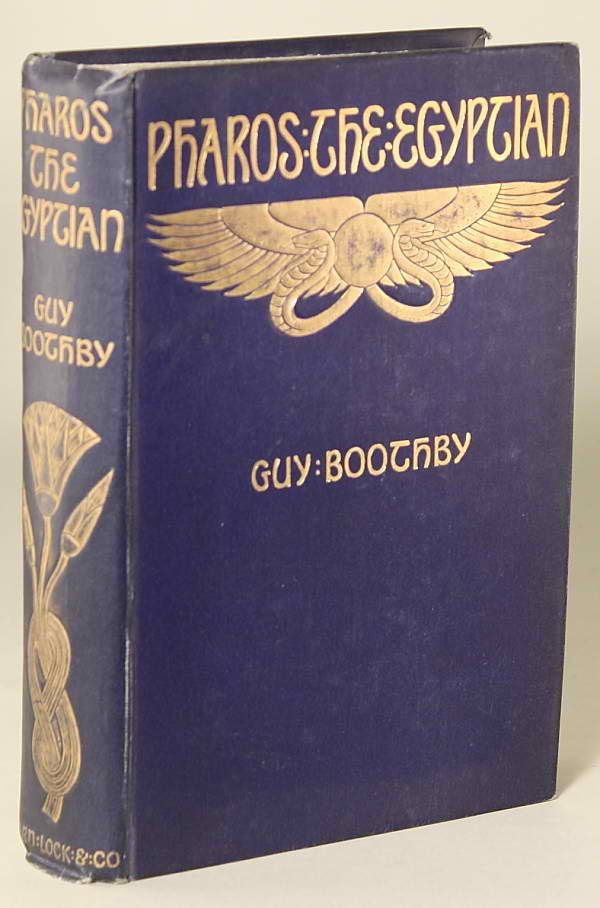
nikolapharos-book-first-editionOne doesn’t have to dig very far to discover my devotion to the works of Sax Rohmer. Peter Haining was, I believe, the first commentator to propose that Australian writer Guy Boothby’s works were a likely influence on Rohmer in the excellent survey, The Art of Mystery and Detective Stories. I first stumbled upon Boothby’s name and that of his most famous creation, Dr. Nikola courtesy of Larry Knapp’s brilliant Page of Fu Manchu website. Finally, it was a very informative piece written by that eminent Sherlockian, Charles Prepolec that convinced me I had to read the Nikola series for myself.

Five Nikola books were published between 1895 and 1901. The best editions available today are in the two-volume The Complete Dr. Nikola published by Leonaur Press. Dr. Nikola is a criminal mastermind with an occult twist. Think Conan Doyle’s Professor Moriarty (introduced only one year before Nikola) eerily anticipating Aleister Crowley and you have a pretty good idea of Boothby’s ambitions.

Like much fantastic fiction of the Victorian era, the books are more about how others fall into Nikola’s web than they are about the sinister doctor himself. This was the same approach taken by Bram Stoker with Dracula and Rohmer with his Fu Manchu series. The Nikola books are also globe-trotting adventures that move rapidly from Australia to Europe to Egypt to London to Africa to Tibet. The sense of mystery that pervades these exotic settings in those imperialist days of empire-building is part of the books’ nostalgic appeal today.

Read More Read More

Goth Chick News: Full Length Trailers for Shadows and Prometheus: It’s Getting Interesting…

Goth Chick News: Full Length Trailers for Shadows and Prometheus: It’s Getting Interesting…

image004This week saw all sorts of new goodies being released to moisten your pallet for what will surely be two of the upcoming summer movie season’s biggest box office draws.

Let’s start with Dark Shadows and my assertion that if Barnabas Collins were really in his grave somewhere, he’d probably be spinning like a rotisserie ham.

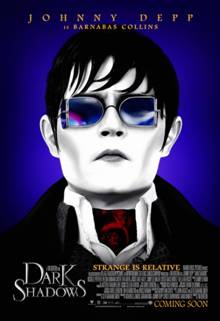
It’s because the original vampire Collins wasn’t particularly heartthrob material (and proper vampires really shouldn’t be) that I didn’t mind some of the initial low-quality stills that came from Tim Burton and Johnny Depp’s rewind of the 1960’s TV cult classic.

Depp had his hair plastered down and was sporting a seriously pasty complexion.

Okay, fair enough. I did fret ever so slightly about the borderline comical nature of his look but, well, that’s just Burton and Depp.

Then on March 16th we finally get the goods: a series of character portraits and a full length trailer of Dark Shadows to hold us over the 55 or so days until its release on May 11th.

Oh joy, oh rapture, oh…. seriously?

A comedy?

Read More Read More

INVADING FANTASY

INVADING FANTASY

CONQUER THIS

Lebor Gabála Érenn — it just rolls off the tongue, doesn’t it? Literally: “The Book of the Taking of Ireland” or, as it’s usually rendered in English: “The Book of Invasions”, or even, “The Book of Conquests”. It’s a medieval history in case you hadn’t guessed. A full and not very frank account of every event that ever happened on the island of my birth.

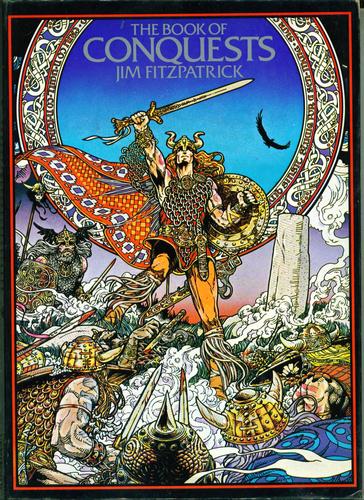
Jim Fitzpatrick did some amazing illustrations for his version of the story.

People love to visit Ireland, apparently, and it’s even more fun when you bring an army with you. They’ve all done it, every horde and its crazy gods: Patholonians, Fomorians, Nemedians, Belly Men, The People of the Goddess Danú (who later fled underground to become the Sidhe) and *finally* — drum roll — The Gaels.

I say “finally”, because that’s where The Book of Invasions ends, but just as WWI didn’t quite live up to “the War to end all wars”, and the unification of Germany failed utterly to “end history”… well, Ireland’s attraction for blood-thirsty tourists only got stronger after that.

Read More Read More

Art of the Genre: Art of the Iconic Female #1; Dejah Thoris

Art of the Genre: Art of the Iconic Female #1; Dejah Thoris

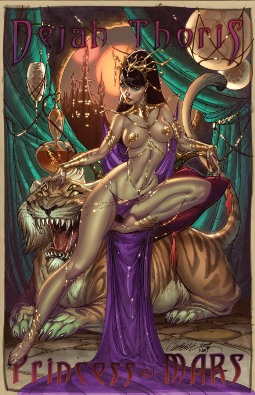
campell-255Yeah, so I saw John Carter, and like everyone else that I have heard saw it, I love the movie. In fact I was so taken by it that I decided I had to start a new thread in Art of the Genre, so appropriately the lovely and fierce Dejah Thoris will be the first icon in this series.

Now it’s both funny and sad to say this, but the marketing of the female lead in both science fiction and fantasy has been, and will ever be, the epitome of male chauvinistic. My wife loves nothing more than to rail against the infernal machine that is the business in which I’ve chosen to make my livelihood from [or lack thereof], but it’s hard to fight such a powerful Goliath.

So, I move through this art business as best I can, trying to navigate the turbulent waters between what is overtly offensive to women and acceptably sexy to all viewers. Since the business model, however, is geared toward young teenage boys, you can see how it’s difficult to try to sell anything other than sex.

Thus we find images of Dejah Thoris sprawling in half-naked glory all over the internet, and yet when I saw John Carter I could have stood up and cheered for Disney’s take on the showing of flesh in this particular film.

Dejah, as beautiful as she was, didn’t flaunt anything the men of the move didn’t as well, and I was twice as taken with that fact that although John Carter of course went barbarian bare-chested as any slave should, that red Martian warriors wore armor that fully exposed their midsections, no matter if they were male or female.

Read More Read More

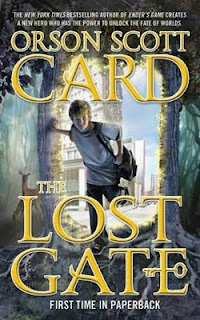
Orson Scott Card’s The Lost Gate

Orson Scott Card’s The Lost Gate

lostgateThe Lost Gate (Amazon, B&N)
Mither Mages Book 1
Orson Scott Card (Tor, $7.99, Jan. 2011)

Reviewed by Andrew Zimmerman Jones

As I mentioned in my recent review of the short story collection Keeper of Dreams, I’ve been a fan of Orson Scott Card since reading Ender’s Game and Speaker for the Dead as a teenager and have read most of his novels. In my experience, this is a very hit-and-miss proposition, especially when it comes to series.

The Lost Gate demonstrates some of the best and worst of Orson Scott Card’s writing at the same time, which makes me think that it’s a toss-up as to how the series as a whole will ultimately go. The setting and magical system – which Card’s been carrying around in his head since the late 70’s – contain a lot of potential, but the narrative seems to also go on pointlessly for many pages, getting bogged down in relative minutiae and plot threads which never go anywhere. Some of these might be setting the stage for future books, of course, but right now they just seemed out of place, distracting, and somewhat haphazard.

The story focuses on Danny North, a boy who has grown up among the remnants of ancient demigods, trapped on Earth centuries ago when the Norse god Loki destroyed all the gates linking this world to their home realm. While his various cousins have learned how to manipulate their basic magical energies, he has manifested no such talents … until he realizes that he has the rarest of gifts. He is a gate mage, possessing the ability to create portals from one location to another.

Unfortunately, after the devastation that Loki wrought, his family has vowed to destroy any gate mage that they find, including Danny. Forced to go on the run, Danny has to learn more about our modern world, his own powers, and how he wants to wield this power … in the service of himself or others.

Read More Read More

Lords of Waterdeep: D&D’s Newest Board Game Is a Hit

Lords of Waterdeep: D&D’s Newest Board Game Is a Hit

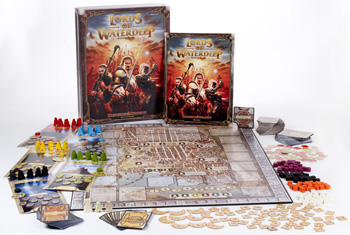
lordswaterdeepLords of Waterdeep (Amazon)
Wizards of the Coast ($49.99, March 2012)
2-5 players
Ages 12+
Approximate Play Time: 1 hour

Note: As I write this, Saturday March 17, there’s a 37% discount on the game’s pre-order over at Amazon.

Let’s get this out of the way: Of all of the fantasy board games I’ve ever forced my wife to play for review purposes (or any other purpose for that matter), this is by far her favorite. In her words, “I felt completely engaged throughout the whole game. Usually there’s some strategy here and there, but I had to plan out each and every move in this game.”

So, it’s a keeper!

With that spoiler out of the way, on to the review…

Read More Read More

When the Cover Blurb is the Kiss of Death

When the Cover Blurb is the Kiss of Death

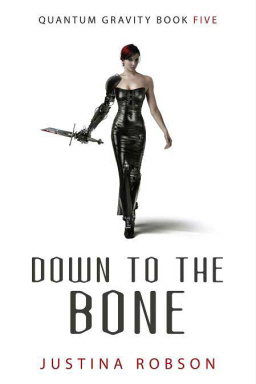
downtotheboneDown to the Bone by Justina Robson (Pyr, 2011) is book five of the Quantum Gravity series, so it must represent some sort of success. The first blurb on the back cover tells all, or maybe more than all:

“This isn’t SF for SF readers. This is SF for a generation raised on anime, manga, and MMORPGs.” — Ain’t It Cool News.

Presumably MMORPGs are some sort of role-playing game.

But seriously, have you ever seen a blurb which so explicitly told a large section of the potential buying public to go get stuffed? This (not to judge the actual book, which I have not read) is clearly marketed as post-literate SF for people who do not much read books.

I have never seen a blurb before which so firmly told me, “No, do not buy this one. You won’t like it.” Maybe I should appreciate the publisher’s honesty.

Is this suicide or a canny marketing strategy? Is the author cringing, or laughing all the way to the bank?

I don’t doubt that Justina Robson books sell admirably. There’s a kick-ass heroine with a pointy thing on the cover. It’s part of a generic series. Just what the market wants. It is very likely that the post-literate audience is in the majority now, and will rule mainstream publishing.

What I am remarking on is how explicitly the blurb tells me (and, I suspect, most long-term genre readers) to go away. Most blurb copy attempts to convince everyone that this is a great book they must have. This one comes right out and says that it is not SF for people who read SF or who are part of any literary culture.

Such breathtaking honesty.


Darrell Schweitzer’s last article for us was Selling SF & Fantasy: 1969 Was Another World.

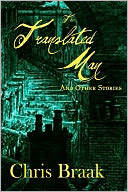
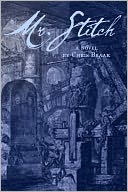
David Soyka Reviews The Translated Man and Other Stores and Mr. Stitch

David Soyka Reviews The Translated Man and Other Stores and Mr. Stitch


149279686

96893304

The Translated Man and Other Stories Threat Quality Press (224; 11.99 USD; softcover 2007)

Mr. Stitch Threat Quality Press (248; 11.99 USD; softcover 2010)

Chris Braak

Chris Braaks’s duology featuring Detective-Inpector Elijah Beckett demonstrates that you can tell a book by its cover.  These book jackets are dark, primitive and ugly; the novels are set in a steampunk Victorian metropolis called Trowth that is equally dark, primitive and ugly.

It was early morning and the strained watery light that flickered off the mountain of stormy architecture of Trowth did little to alleviate the cold, though it was actually one of the

warmest periods of the day — when warm air swept briefly in from the sea — and the late afternoon were the only times during Second Winter that pedestrians were common; a small, muted collection of passers-by and vendors had tentatively come out into the cold streets above St. Dunsany’s. The air was just barely

tolerable, and tasted faintly of salt and fish. Even the normally antisocial and solitary citizens of the city would take the time to wander about for a few hours, trying to catch a fleeting glimpse of the sun.

ps.52-53 (Mr. Stitch)

What we have here is a police procedural that mixes Sherlock Holmes and H.P. Lovecraft. I’m not much a fan of either (I know, how could I possibly be allowed on the BG staff, but mistakes happen). Nor do I much care for plotting littered with flaws in logic (a character can pick the lock of  a room to steal papers without ever thinking they  might be noticed missing, but apparently doesn’t think for a second to pick the lock of a suitcase she is forced to deliver to a train station to see if it contains anything potentially explosive, which, of course, it does) that hinges on fantastical mysteries with improbable coincidences (even if they take place in the context of an improbable reality) that seemingly have little point beyond giving the intrepid characters something to do so they can preserve civilization as they know it (though in this case, “civilization” is a questionable term).

That said, I thoroughly enjoyed this short series, mainly because of  the characters. Beckett is dedicated to his career as a Coroner, an elite force with a license to kill at will heretics and the consequences of their heretical metaphysical experiments.  He also suffers from the “fades,” a disease contracted by factory work as a child that results in deteriorating flesh (he wears a scarf to hide the missing half of his face) and drug addiction to control the pain.  Of course, every detective needs a fearless sidekick to fight the forces of evil.  Beckett has two.  Valentine Vie-Gorgon, an absent-minded aristocrat dabbling as a police functionary, and Elizabeth Skinner, a blind “knocker” aetherically equipped with telekinetic abilities that serve as a sort of radar to detect unchartered passageways and conspirators in hiding.

But the most interesting character of all is the city of Trowth, a mess of overbuilt, over thought architecture that results in dangerous labyrinths that connect ghettos of unusual creatures pressed into subservience to the human overlords.

It was almost evening when Beckett emerged from the depths of the Arcadium. The sky has turned from a dull, dark, sooty gray to a duller, darker sootier gray, redeemed only by the fact that looking at it no longer caused migraines. The perpetual cloud of thick, puissant smoke, spewed out by factories that burned phlogiston and flux and coal, hung low over the stony war of parapets, crenulations, buttresses, towers and arches that composed Trowth’s skyline.

p. 7 (The Translated Man)

Read More Read More

Art of the Genre: The Pillaging of Kickstarter?

Art of the Genre: The Pillaging of Kickstarter?

The Good of Kickstarter... The Order of the Stick

The pillaging of Kickstarter… Dramatic huh? Well, it might not exactly be the case, but I’ve seen a couple shocking trends happening out in the world of Kickstarter that disturbed me enough to talk about it here in my regular Kickstarter postings.

You see, Kickstarter at its very base level is about money, and that’s not a bad thing because it takes money to make cool things happen. Kickstarter, as a platform, helps thousands of independent minded artists, writers, musicians, inventors, and all other manner of creative people connect with fans to create projects that they love. How can that be wrong? Well, it’s not, but unfortunately corporations have now discovered the power of Kickstarter, and what was once a grass roots movement is quickly changing into a large scale money grab.

To illustrate this, I’m going to take you all through a couple of examples that I’ve seen in the past few months. First off I’m going to start with this little ‘Honest Man’s Kickstarter’ that introduced me to Kickstarters in the first place, the initial art recreation project by former TSR artist Jeff Dee. Dee, a forward thinking guy, was understandably put out that TSR threw away all his original art from his work on Dungeons & Dragons from 1979-1981. Who could blame him, right? So he goes to Kickstarter and asks folks to help him recreate those original pieces of art, as well as add some new ones if pledging was high enough. Jeff asked for $2,500 to do this and received funding to the tune of $5,750, which is a great thing to see for a guy who struggles with bills as much as anyone else in America today.

Read More Read More

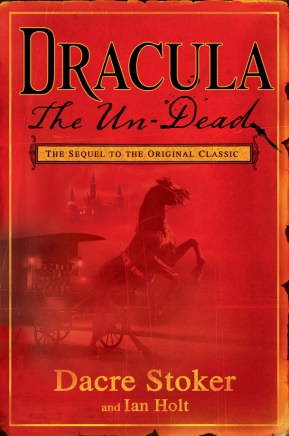
The Other Dracula the Undead

The Other Dracula the Undead

warrington-undeaddracula_the-un-dead1I belong firmly to the camp of Bram Stoker fan that approached Dacre Stoker and Ian Holt’s Dracula the Un-Dead with great anticipation and left disappointed. Well, actually appalled might be a more apt description of the reading experience. Had I not had my jaws wired shut at the time I read the book, I would have described myself as speechless. Severn House, a small press that has been kicking around for at least forty years when they took over Tom Stacey’s imprint, decided to capitalize on the attendant hoopla of a Stoker descendant co-writing a sequel to reprint an earlier literary sequel with very nearly the same title.

Freda Warrington’s Dracula the Undead was originally published to mark the centennial of Stoker’s classic original in 1997. I was aware of the book prior to its reprinting, but avoided it like the plague at the time believing incorrectly it was comparable to Elaine Bergstrom (aka Marie Kiraly)’s romanticized and anemic sequels, Mina and Blood to Blood. There is an element of romance found in Ms. Warrington’s book that does not ring true for the Stoker purist, but Warrington is a gifted British fantasy and horror author who accomplished something few writers can claim – she authored a sequel to a literary classic that doesn’t pale in comparison.

Read More Read More