Browsed by
Category: Blog Entry

What Do I Know?(1)

What Do I Know?(1)

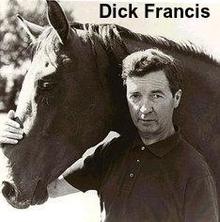
Dick_FrancisMost of us have, at one time or another, been given the advice “write what you know.” Even people who don’t write themselves have heard it. Sometimes this advice gets people writing furiously away – and sometimes it leaves them scratching their heads, saying “But, um, I don’t know anything.”

I think it was Lawrence Block who pointed out that we all know something. We know what loss, grief, sorrow, joy and frustration feel like. We know what it’s like to be human, to be a sibling, a parent, a child, a lover, a person who’s been hired, or fired, and a person who didn’t vote for that guy. It’s when dealing with this kind of knowledge that we become most aware that story is king. Without a story to give this knowledge context, you got nothing.

People do mine their own professions for story and character backgrounds. Dick Francis was a jockey and a pilot. Dashiell Hammett was a Pinkerton detective. Patricia D. Cornwall was a medical examiner. Kathy Reichs a forensic anthropologist – and the list goes on.

Read More Read More

Patrick Swenson on Talebones, Fairwoods Press, and the Bad Old Days of Print on Demand

Patrick Swenson on Talebones, Fairwoods Press, and the Bad Old Days of Print on Demand

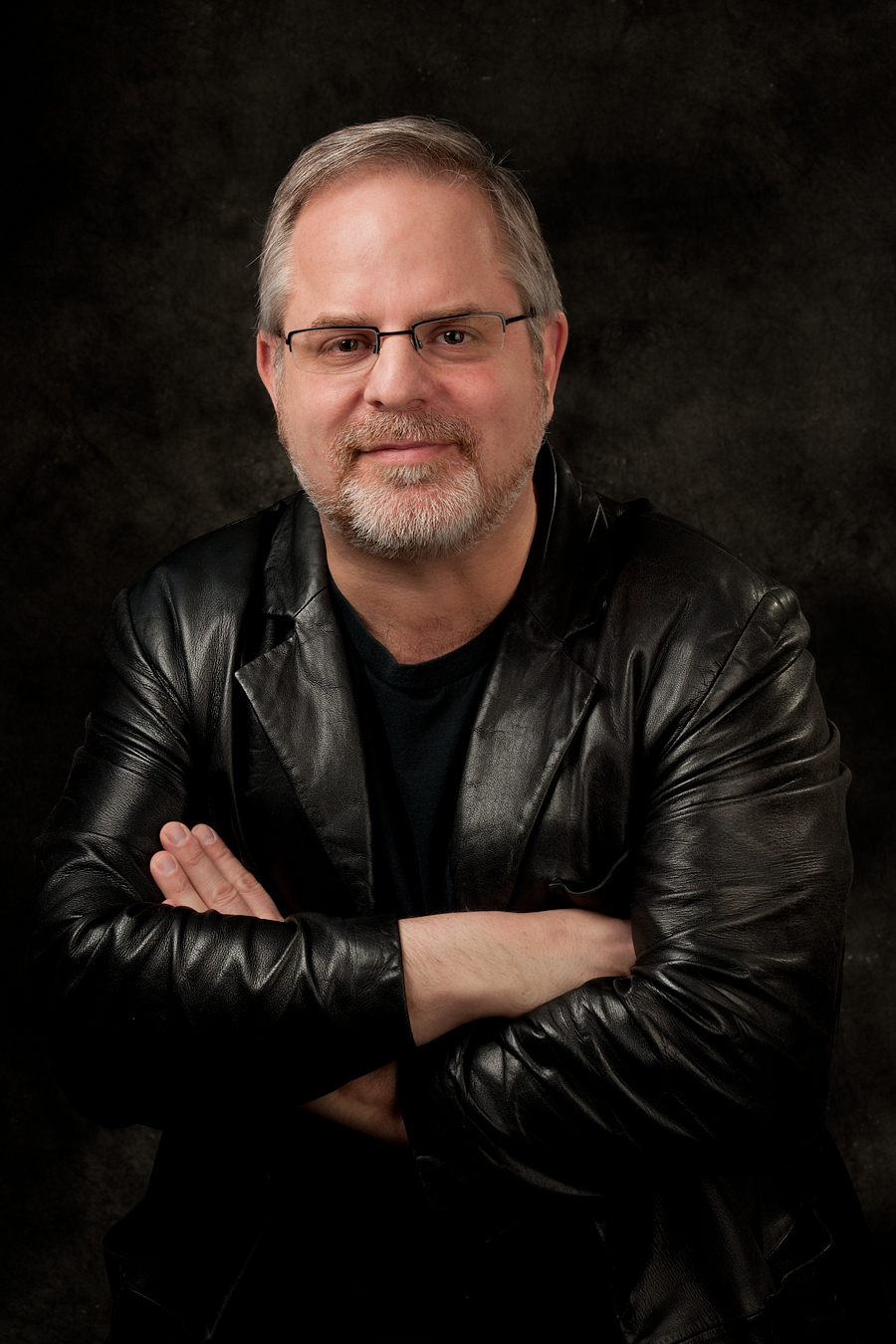
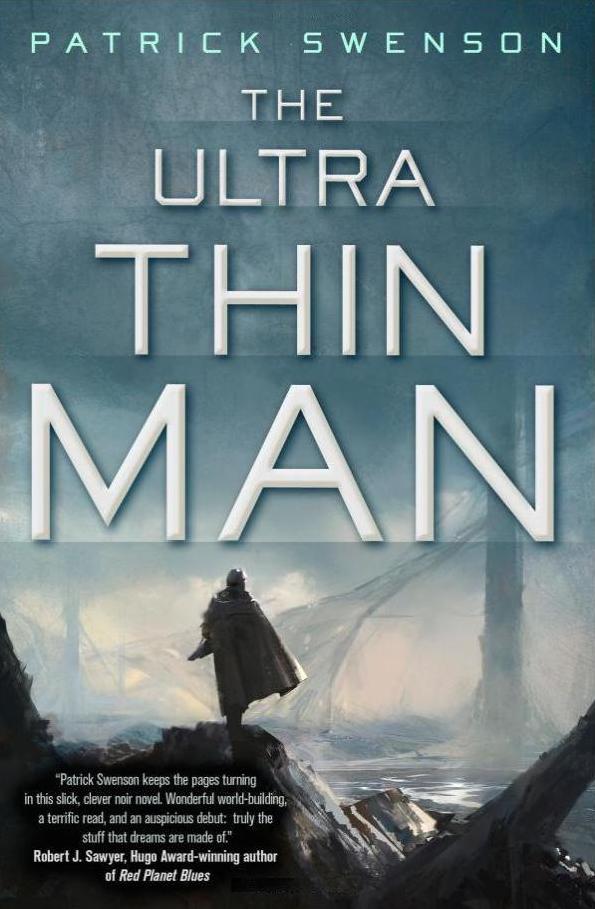
Patrick Swenson-smallThe Ultra Thin Man-smallPatrick Swenson has been a major figure in speculative fiction for decades, first as the editor of Talebones, and now as the editor in chief of Fairwood Press. Many still remember his semi-pro magazine as the market to send to if you had a story that fit nowhere, but was nevertheless amazing. He has an eye for such things.

Nowadays, getting published by Fairwoods requires more than a good agent or query letter. It is by invitation only, and to be invited, one has to be on Patrick’s radar, and to be on Patrick’s radar, one has to be excellent.

He isn’t just an editor and publisher, though. He’s a writer as well, and his career is both exciting to watch, and an excellent snapshot of modern day publishing. His first book, The Ultra-Thin Man, was published by Tor, but when they passed on the second book, The Ultra Big Sleep, he elected to publish it himself.

Patrick explained this to me while I was standing at his table during the mass signing at Mile-Hi Con. There on the table were both books, and no one who saw them would have been able to say which was self published and which was published by Tor. The quality of their covers and bindings were identical.

On top of all this, Patrick also runs the Rainforest Writer’s Retreat twice a year. This retreat is where:

Writers gather at a location of minimized outside interference or influence, ready to spend an intensive four or five days on their own work, with others involved in the same who were present for support and interactive development of written creative work as art, craft, and science. Balanced against this is a schedule of events aimed at supporting this process, with the number of retreat guests and attendees kept to a limit.

Held in a resort village on the Olympia Penninsula, it’s an opportunity unlike any other to give an added boost to one’s writing career.

Read More Read More

When Fantasy and Theology Collide: Some Thoughts on Satan

When Fantasy and Theology Collide: Some Thoughts on Satan

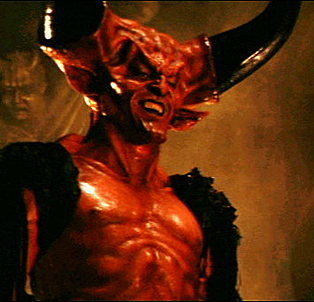
Lord_of_DarknessI recently met a woman whose father-in-law had been a federal prison guard at a medical prison that held the “Blind Sheikh” back around the time of the 9/11 terrorist attack. The Blind Sheikh (Omar Abdel-Rahman) was an associate of Osama bin Laden and the planner behind the 1993 World Trade Center bombing — one of the early “masterminds” of Al Qaeda. In other words, a real life counterpart to the nastiest, most nefarious villains in our fictional thriller novels and cinema fare.

She told me that her dad-in-law spoke to the Sheikh a couple times, as could be expected: casual banter will occasionally happen between guards and the imprisoned criminals they are guarding. She said the Sheikh seemed friendly enough to her father-in-law, but she added, “The Sheikh told him that we worship three gods. That was a big issue he had with us, that we worship three gods. So much of it was cultural misunderstanding.”

Read More Read More

Things Your Writing Teacher Never Told You: The Many Faces of Bob Weinberg

Things Your Writing Teacher Never Told You: The Many Faces of Bob Weinberg

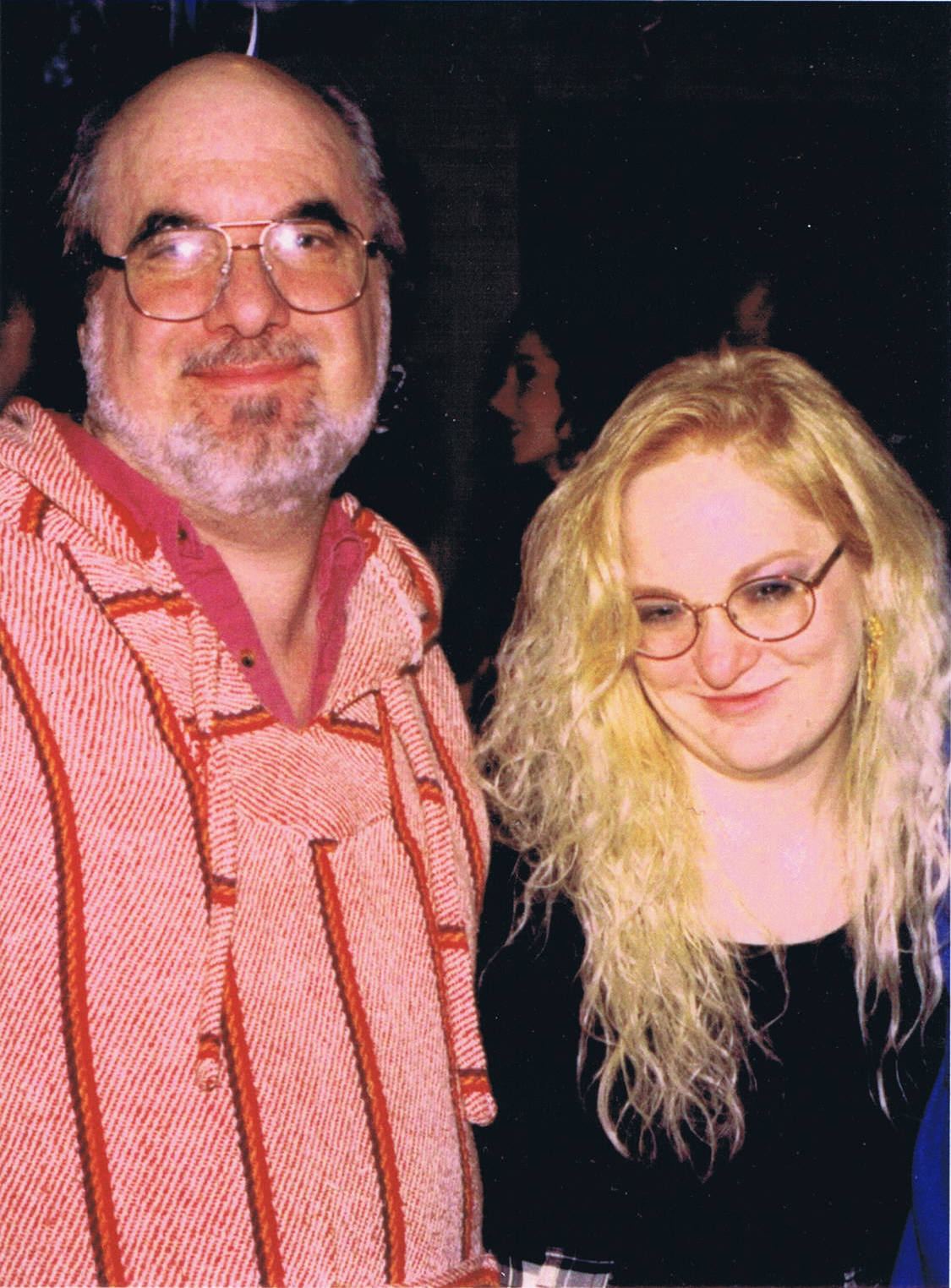
Bob Weinberg and Tina Jens-small

Robert Weinberg and Tina Jens

In many ways, Bob was like the Tony Randall character in the movie 7 Faces of Dr. Lao. In the movie, Tony Randall is the “owner“ of a mysterious circus that visits a western town. He appears in different guises to teach the townspeople what they each need to know to become better people. Based on a novel by fantasy writer Charles G. Finney, the screenplay was written by one of Bob’s favorite authors, Charles Beaumont. To one townsperson, Dr. Lao is the oracle Apollonius; to another, the music-loving, goat-god Pan; to yet another, Merlin the magician and wizard.

Read More Read More

Modular: Adventuring in Dangerous Terrain – Frog God Games’ Perilous Vistas

Modular: Adventuring in Dangerous Terrain – Frog God Games’ Perilous Vistas

Fields_CoverBack in 3rd Edition D&D, there were five supplements that fell under the ‘Environmental Series’ category (I’d argue it should only be the first three, but I don’t make that decision):

  1. Sandstorm: Mastering the Perils of Fire & Sand (Bruce R. Cordell)
  2. Frostburn: Mastering the Perils of Ice & Snow (Wolfgang Baur)
  3. Stormwrack: Mastering the Perils of Wind and Wave (Richard Baker)
  4. Dungeonscape: An Essential Guide to Dungeon Adventuring (Jason Buhlman)
  5. Cityscape: A Guidebook to Urban Planning (Ari Marmell & C.A. Suleiman)

It’s not uncommon to hear one of those books cited as a favorite by players from that era. They gave Dungeon Masters lots of material to incorporate into their adventures. Necromancer Games (who you read about here, right?) added to the concept with Glades of Death (a wilderness book) and Dead Man’s Chest (sea adventuring).

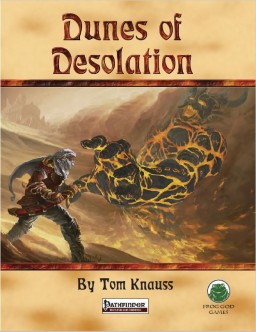
The concept has been continued by Frog God Games (surely you read this post about them!) for Pathfinder, Swords & Wizardry and 5th Edition D&D under the moniker, Perilous Vistas. Along with an updated Dead Man’s Chest, there have been four releases so far, all written by Tom Knauss:

Dunes of Desolation (Deserts)
Fields of Blood (Plains)
Marshes of Malice (Wetlands)
Mountains of Madness (Mountains)

The fifth installment, Icebound (Frozen Wastes), is in the works!

The general idea is that if the Dungeon Master wants to infuse some atmosphere and environment into the adventure, these supplements provide a myriad of options. Sure, they can just have the party get to the abandoned fort in the desert, or have them uneventfully move through the mountains to the deserted abbey or the monster-infested dwarven hall. Some folks like to just get to the dungeon crawl and start hacking away. That’s fine.

Read More Read More

The Poison Apple: Shared Worlds All Over the World – A Q & A with the Dynamic Duo, Ellen Kushner and Delia Sherman

The Poison Apple: Shared Worlds All Over the World – A Q & A with the Dynamic Duo, Ellen Kushner and Delia Sherman

Ellen Kushner and Delia Sherman - Black Gate interview

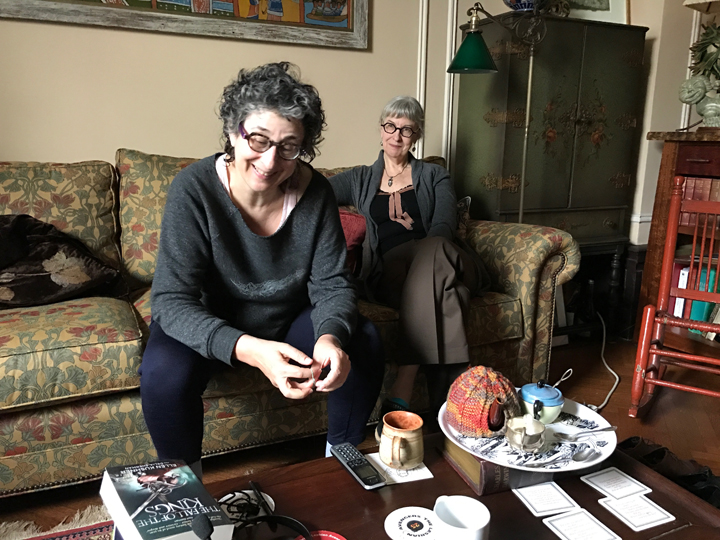
Authors Ellen Kusher (left), Delia Sherman (right), 2017. Photo by Elizabeth Crowens

Ellen Kushner is a former editor at Ace Books and Pocket Books, hosted the national public radio series Sound & Spirit via WGBH in Boston and was the winner of the 1991 World Fantasy Award, 1991 Mythopoeic Award and 2007 Locus Award for Best Fantasy Novel, has won Audie Awards, etc.

Delia Sherman is a former consulting editor from Tor Books. Her novel The Freedom Maze won the Andre Norton Award for Young Adult Science Fiction & Fantasy, a Prometheus Award, was a SWFWA winner, and made the Tiptree Honor List. She won the Mythopoeic Award for The Porcelain Dove, etc.

You were married in 1996 and are one of the long-time couples of speculative fiction. How did the two of you meet?

Ellen: Actually, we were married many times — illegally in 1996 and legally in the State of Massachusetts in our backyard there in 2004. Jane Yolen introduced us at Boskone — not for any romantic reasons, but because Delia had taken a course in writing fantasy at the U. Mass, Amherst.

Read More Read More

Don’t Mess With the Amazons: The Wonder Woman Movie

Don’t Mess With the Amazons: The Wonder Woman Movie

Gal Gadot as Wonder Woman

Gal Gadot as Wonder Woman

A lot has been said about Patty Jenkins’ movie Wonder Woman, pretty much all of it by people smarter and more qualified than I.

But given that I do a lot of comic books musing for Black Gate, and that I also reviewed Rogue One and Dr. Strange, I wanted to give Wonder Woman the attention it deserves.

Superhero movies are what they are.

Read More Read More

The 33% Mark: When it’s OK to Stop Drafting Go Back and Edit

The 33% Mark: When it’s OK to Stop Drafting Go Back and Edit

"Ticket to the last station!"
“Ticket to the last station!”

When you’re writing that first draft, standard advice is: Don’t go back to edit!

Make like Omar Khayyám:

The Moving Finger writes; and, having writ,
Moves on: nor all thy Piety nor Wit
Shall lure it back to cancel half a Line,
Nor all thy Tears wash out a Word of it.

Or if you prefer, Guderian:

Ticket to the last station.

Yes, the ideal first draft is a blitzkrieg: rampage onward with the story, ignore pockets of resistance, you can catch them on the second draft.

However, you are neither a medieval Persian ruminating on life, nor a Panzer general.  For all we like to skin it with the aesthetic or the macho, writing is its own activity. The truth, so I’ve learned, is more complex.

Read More Read More

The Play’s The Thing

The Play’s The Thing

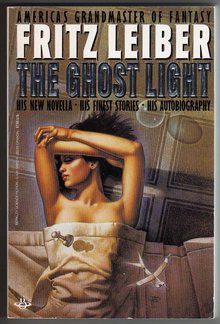
Leiber Ghost LightHere at Black Gate we often have posts on films and TV shows as they connect with or pertain to our favorite genre(s). If we don’t talk as much (or at all) about live drama, it’s probably because there’s not as much SF or Fantasy happening on the stage as there is on the screen. I’d think we’d all agree that with a very few exceptions stage effects are simply not equal to the kind of special effects SF and Fantasy often need.

But if we don’t see our favourite novels and stories on the stage, we certainly do see the opposite: we see the stage in our novels and stories.

We’re all familiar with the “play within a play” concept since we had to read Hamlet in high school. After all, practically every Fred Astaire movie musical is about a musical production, and there can’t be anyone alive who doesn’t know that Singing in the Rain is about making a movie musical. But again, what I’m looking at here is play-within-the-story. We should note that if we follow in Shakespeare’s footsteps, the device has to have purpose. In Hamlet, the play was “the thing to catch the conscience of the king,” that is, it played an integral part of the plot. The same should be true if we see the device in a short story or novel.

Read More Read More

“A World Gone to the Dogs”: City by Clifford D. Simak

“A World Gone to the Dogs”: City by Clifford D. Simak

These are the stories that the Dogs tell when the fires burn high and the wind is from the north. Then each family circle gathers at the hearthstone and the pups sit silently and listen and when the story’s done they ask many questions:

“What is Man?” they’ll ask.

Or perhaps: “What is a city?”

Or: “What is a war?”

from the Editor’s Preface to City
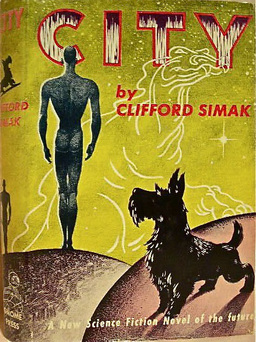
oie_671529XHRO0a33City (1952), by Clifford D. Simak, unfolds over thousands of years, telling of the end of humanity, the rise of dogs and robots to terrestrial preeminence, and finally, the near abandonment of Earth. It’s a fix-up of nine stories, eight written between 1944 and 1951, and one more, added to later editions, in 1973. It is a book conceived of in anger and despair, yet one that strives to posit a better, more humane world — even if it’s one devoid of humans.

Perhaps because we, by which I mean the post-WW II generations, have grown up aware of the deepest, most evil tendencies of humanity, it’s difficult to appreciate completely the anger and despair over what happened during the 1930s and 40s. Years after its publication, Simak said:

“The series was written in a revulsion against mass killing and as a protest against war.”

That revulsion was so intense that Simak contemplated the extinction of his own species and its replacement by a better one.

I suppose following the First World War, there was some hope that humanity would avoid that sort of mass slaughter again. Instead, it only increased by many magnitudes. In an essay on City, Robert Silverberg wrote that the story “Desertion” was written in 1943 in direct response to reports from Europe about the Holocaust. Simak was a gentle writer, so there is little anger or bitterness in the novel, but he wasn’t prone to sentimentality either. His depiction of humanity’s downfall and supplantation is remorseless.

When Simak collected the stories, he presented them as a tales told by dogs to each other as perhaps no more than legends. For each story, Simak wrote an interstitial explaining what different dog philosophers thought about the veracity of each story, as well as any meaning it might hold for their society.

Read More Read More