Browsed by
Category: Blog Entry

The Past Remembered

The Past Remembered

oie_945629XusRtgBBLast week I attended the funeral for my friend Densel’s wife, Sheryl. As these things tend to, it spawned a reunion of friends who don’t see each other anymore. Densel was a major hub of roleplaying on Staten Island, and our love for our friend, and each other, grew from our meeting together to play Dungeons and Dragons. Only in recent years have I learned that while he was gaming with me and my group, he was moonlighting with other groups all across the Island. He is single-handedly responsible for more people playing D&D on Staten Island than any other person I know.

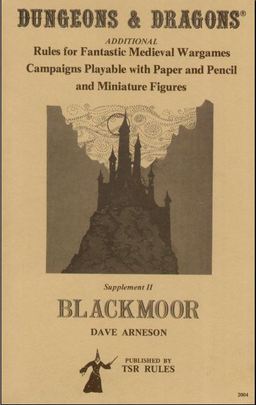
The first time I met Densel was when his friend, Desmond, brought him to Boy Scouts to play violin for us and join our troop. He was a six-foot-four, sixteen-year-old black kid and I was a five-foot-four, eleven-year-old white kid. Though five years older than I, we hit it off. What really connected us were the three wildly illustrated pamphlets he brought on a camping trip: Dungeons & Dragons, Greyhawk, and Blackmoor. One of his older brothers had gone to school in Wisconsin and brought the game back to Staten Island with him. When we saw Densel reading them, a couple of us younger guys asked him what they were. When he asked if we had read Moorcock or Tolkien and we said yes, he then asked if we would like to play a game where we could be knights and rangers. Without hesitation, we said yes.

We didn’t play the game properly. Mostly, it was just us talking about the characters we wanted to play and then Densel talking us through adventures. It didn’t matter that I wasn’t really learning the game; I was hooked by the idea of roleplaying. The illustrations from those original books are a major part of what I believe fantasy should look like. The thought of getting caught up in playing someone like Elric or Aragorn blew my eleven-year-old mind.

Densel aged out of scouts and I didn’t see him again for a couple of years. I was still finishing grade school and he was getting ready to enter college. It was then that I started playing D&D for real with my immediate circle of friends. Both my neighbor and I got the boxed Basic Set for Christmas. For two years we played relentlessly; and I mean relentlessly. For anyone who played the game in that first flush of its popularity in the late 1970s, you know what I mean. Every free weekend was spent playing, and the days between designing dungeons and drawing maps. Soon I was building up a shelf of hardcover Advanced D&D manuals. Almost any money I earned or got as a gift was plowed into the game.

Read More Read More

September/October Analog Now on Sale

September/October Analog Now on Sale

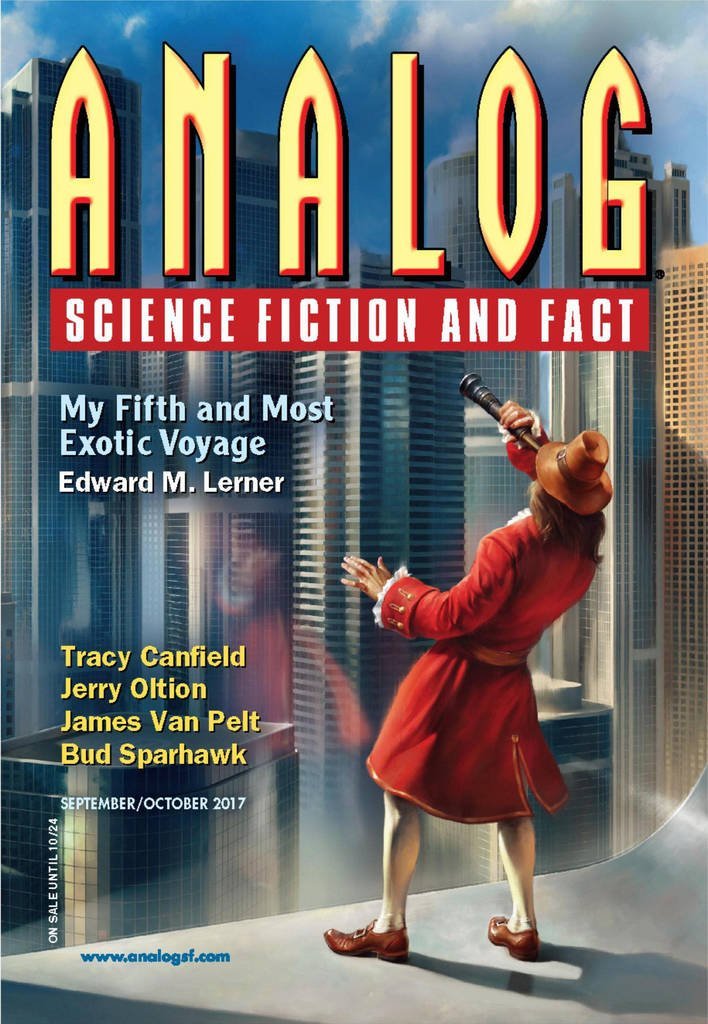
Analog Science Fiction September October 2017-smallThe September/October Analog has a diverse mix of tales, of time travel, uplifted animals, ghostmail, siege engines on Mars, cryo-prisons, space elevators, crash landings on hostile worlds, mysterious alien invaders, and Norman Spinrad’s tale of the Order of the Galactic Eye. Here’s Nicky Magas at Tangent Online to give us the highlights.

An exciting new world that is hostile to technology awaits Mbasi in “Orphans” by Craig DeLancey. No probes sent to the planet teeming with vegetation have survived through to their full life expectancy. It’s up to Mbasi and the rest of the research crew to figure out why. But when an unexplainable accident forces them into an emergency crash landing from their planned orbit, Mbasi finds herself a little closer to the conundrum than she first anticipated. To make matters worse, whatever has been destroying their probes is making short work of their ship as well.

The mystery in “Orphans” is what truly makes this story shine. The sense of urgency DeLancey puts into every word is palpable to the reader, making every decision seem like life or death. DeLancey cultivates a deep curiosity in readers, and though he peppers the narrative with speculation between his characters, the open ended nature of the conclusion leaves readers on the edge of the cliff of what is knowable, both satisfied and deeply wanting more.

In “The Old Man” by Rich Larsen, Ezekiel wants nothing more than to kill his father and have him know who did it. Lucky for him the Old Man escaped his cryo-prison. Luckier still, the government thawed Zeke for the task of taking him out. The Old Man has much to atone for and Zeke means to see the debt settled down to the last drop of blood.

Larson tells a fascinating story of revenge and humanity in “The Old Man.” As the narrative unravels itself in a non-linear way set to the backdrop of the swampy bayou, readers find their sympathies torn between politics, family, and human rights in a technologically advanced future. There are layers to this story that make it exquisitely complex and an ethically thoughtful read. Readers expecting a story whirling with technology might be surprised by how intricately and tragically organic it is, however this does not detract from the brilliant piece of futuristic science fiction that it is.

Read Nicky’s complete review here.

The September/October issue contains fiction by Edward M. Lerner, Lettie Prell, Jerry Oltion, Rich Larsen, Michael F. Flynn, James Van Pelt, Stanley Schmidt, Norman Spinrad, Bud Sparhawk, and many others. The cover is by Eldar Zakirov, for “My Fifth and Most Exotic Voyage,” by Edward M. Lerner.

Read More Read More

In 500 Words or Less … Utter Fabrications: Historical Accounts Of Unusual Buildings And Structures, ed. by Dawn Vogel and Jeremy Zimmerman

In 500 Words or Less … Utter Fabrications: Historical Accounts Of Unusual Buildings And Structures, ed. by Dawn Vogel and Jeremy Zimmerman

Utter Fabrication-smallUtter Fabrications: Historical Accounts of Unusual Buildings and Structures
Edited by Dawn Vogel and Jeremy Zimmerman
Mad Scientist Journal Presents, DefCon One Publishing (354 pages, $14.99 paperback, $4.99 eBook, Sept 2017)

“No one understands strange places like the people who have been there,” opens the description for Utter Fabrications: Historical Accounts of Unusual Buildings and Structures, calling out the fact that everyone knows a place that gives them a funny feeling. For me, it was a stretch of residential street partway between the grocery store where I worked as a teenager and the home where my mom and stepdad lived. Walking that way wouldn’t always make my skin crawl… but enough that I started to avoid it.

The idea behind this anthology, I think, is to evoke that familiar feeling of the uncanny. And some of the stories in Utter Fabrications manage to do that. “Every House, A Home” by Evan Dicken focuses on a freelancer who tries to suss out the negative energy around buildings – not because of bad feng shui or poltergeists, but because the building is actually unhappy. In “Kingsport Asylum” by Diana Hauer, a woman returns to the asylum where she spent her youth and faces the very tangible memories of the crimes committed there.

Each story takes the idea of a place being inhabited by energies beyond our understanding and plays with it, and one of the strengths of this anthology is the different ways this idea is shaped, whether it’s through a roving bike rack, a house that dreams of exotic locales or a city district that sometimes takes people but also sometimes protects them. There are also a number of diverse characters on display; my favorite was the non-binary groundskeeper in “Asylum,” with a close second being Nat in “Every House,” who struggles with reading human emotions but can become totally in tune with a building.

If I’m being entirely honest, though, none of the stories really drew me in or gave me that “aha” moment I look for in short fiction. In some cases the stories are predictable, and in many cases things work out well in almost prosaic or Lifetime movie sort of way, which has never been my cup of tea. The roving bike rack that becomes attached to Alanna McFall’s protagonist in “Can’t Be Locked Down” is the one story that struck me with its quirky originality, but none of the others really did the same.

Read More Read More

Modular: Starfinder Alien Archive — Clark Ashton Smith meets Douglas Adams (with visuals by Ray Harryhausen)

Modular: Starfinder Alien Archive — Clark Ashton Smith meets Douglas Adams (with visuals by Ray Harryhausen)

256 Starfinder Alien Archive
Starfinder Alien Archive — due  October 18th
256 Kurtzhau the GM
“Kurtzhau,” 13, our local Starfinder GM

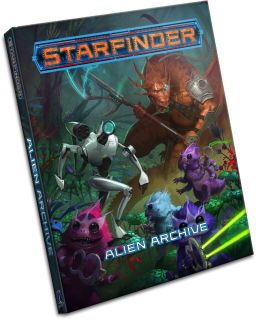
Though writers are notoriously not always the best parents, I’m a Good Dad right now. I got us a preview copy of the forthcoming Starfinder Alien Archiveit’s due out October 18th.

Kurtzhau, my 13 year old son who’s currently GMing the game for his mates, rates it as “Awesome.”

I concur.

80+ new aliens (depends on how you count), 20 playable races (some delightfully nuts ), lots of alien tech, each entry a rich adventure seed in its own right and rules for building your own NPC aliens.

Lovely illustrations. Good writing. And it’s got a sort of creative gravitas. Nothing here is throwaway.

Take the Void Hag.

Read More Read More

Another View: The Difficult Experiment of Scott Oden’s A Gathering of Ravens

Another View: The Difficult Experiment of Scott Oden’s A Gathering of Ravens

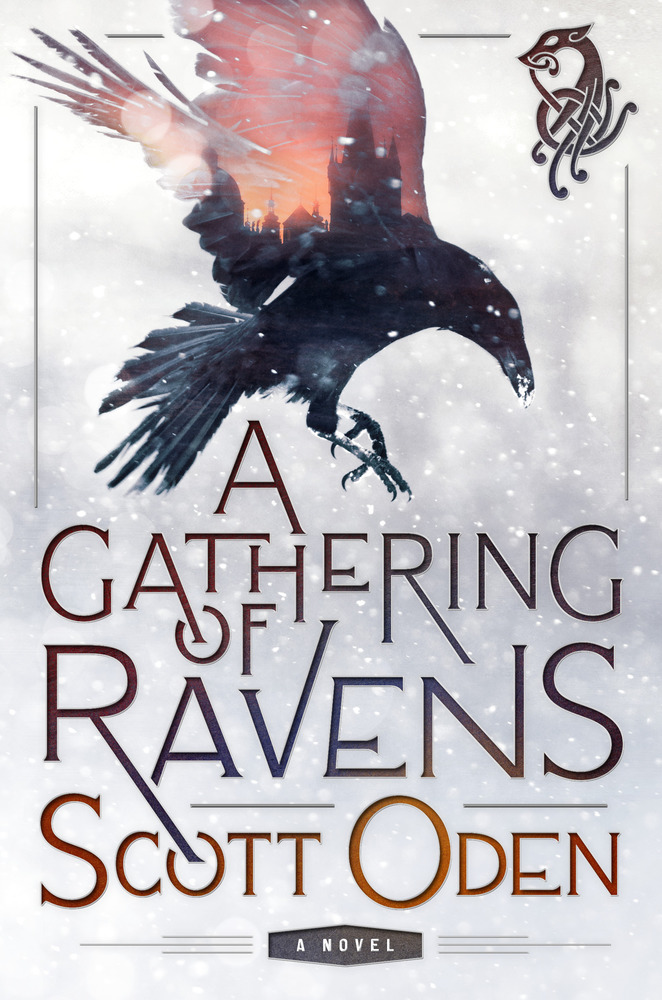
A-Gathering-of-Ravens-smallerI really wanted to like this book. With pleasure I listened to Oden speak on The Literary Wonder and Adventure Show. He talked at length about Tolkien (my own spiritual and literary master), and it seemed that Oden’s and my dials were approximately set. Oden’s book, like Tolkien’s most popular works, deals with “that northern thing” (though I just today learned that Tolkien objected, in part, to this characterization from W.H. Auden).

But Oden’s book is so grimdark that, while reading, I couldn’t find my feet. The work ostensibly is about an orc Hel-bent on revenge — and here is my first objection: the attitudes and actions of this orc, our “protagonist,” are indistinguishable from those of the larger majority of characters in the book. Grimnir, our orc, seems capable only of speaking and thinking in profanities. He murders even when there absolutely is no reason to. The only thing (in this book) we can’t accuse Grimnir of is the sin of rape. That assault remains to be committed by many of the other “human” characters you will find therein: your average male, in this portrayal, seems hardwired to enter rape mode the moment he lays eyes upon any “unprotected” female. Now, remember, Grimnir is supposed to be the “orc,” yet he doesn’t behave much differently from the novel’s many other human characters. Moreover, even when it doesn’t cost a character anything necessarily, few characters are liable to show any shred of kindness for one another. Oden’s narrator summarizes this world’s milieu thusly: “She [the character Etain] knew the score … and she knew sooner or later there would be a reckoning. Men did nothing — undertook no good deed, performed no kindness — without first attaching a price to it.” Oden’s characters, I suppose, are consummate Dark Age businesspersons.

“But that’s the Way It Was,” a number on Goodreads might say, defending Oden’s work from the very few negative reviews I can find there (here and here are two well-said assessments). What these apologists are claiming is that the worldview of the so-called Dark Ages is exactly this: murder whenever you can get away with it, rape whenever you like (for those who like it, I guess, who are all young pre-modern men). I don’t entirely agree with this representation. In the worst possible reading, this might represent the author’s views of the natural state of humankind freed from the fetters or checks thankfully supplied by modernity. In the best possible reading, this representation assumes that, at least in the area of moral development, humans who happened to live a mere millennia ago might be considered pre-human in these respects. Granted, the spread of more nation-building and socializing beliefs and philosophies such as Christianity might have a civilizing influence on a pre-modern worldview, might even be of some aid in the sense of an evolving moral consciousness. But this book barely acknowledges even this. It ostensibly presents two competing worldviews, that of northern paganism and that of Christianity, but, in this book, in practice adherents to either faith might as well be indistinguishable. They merely serve one team in a two-sided competition that is drawn as equal in every respect. Again, apologists should be quick to point to aspects of history that reveal a number of Christians as hypocritical and intolerant throughout their persecutions. Granted, but are you going to deny that there remain some fundamental differences and worldviews between the two perspectives, and therefore requisite actions and behaviors on behalf of the religion’s adherents? To this point Oden seems to relent, to some measure, in the second and much-preferred half of the book, in the figures of King Brian and his freed thrall Ragnar. But we’ll get to that in a moment.

Read More Read More

Star Trek: Discovery and Star Trek: Desperate Hours – A One-Two Combo

Star Trek: Discovery and Star Trek: Desperate Hours – A One-Two Combo

saru-star-trek-discovery-small

This week saw the first new Star Trek TV show debut in a long time. If you missed it, or because subscribing to CBS All-Access for a single show irks you, it was more than pretty good. In fact, I downright enjoyed myself in a way I haven’t since the Star Trek: Enterprise debuted in 2001. And it was my 12-year old son’s first real experience of Star Trek.

Read More Read More

Readings Right, and Readings Wrong

Readings Right, and Readings Wrong

chizineLike most other writers, I’ve given all kinds of readings, from story books to pre-schoolers (supporting early literacy) to academic papers on 18th-century pastoral poetry (supporting my academic career). I’ve had everything from great experiences (the kids really liked the animal noises) to eye-rolling ones (someone should have told the hotel hosting the NEASECS Conference that we would need lecterns) to amazing ones (people turned out at 8:30 on a Saturday morning to hear about the georgic).
I’ve had a room full of people show up, and I’ve had no one show up at all. I’ve arrived at places that invited me, only to find no one there who knew I was expected, and, I’ve been taken out for dinner first. I’ve read the same piece to both thunderous applause, and polite smiles. Altogether, a pretty mixed bag, and I don’t think there’s a single writer out there who can’t match me, story for story. So why am I taking you on this trip down readings-I-have-done lane? Because, while there’s not much you can do about the audience, there are organizers out there who get everything else right.

Read More Read More

The Evolution of Process — A Writerly Tale

The Evolution of Process — A Writerly Tale

A Julie as Young Writer-small

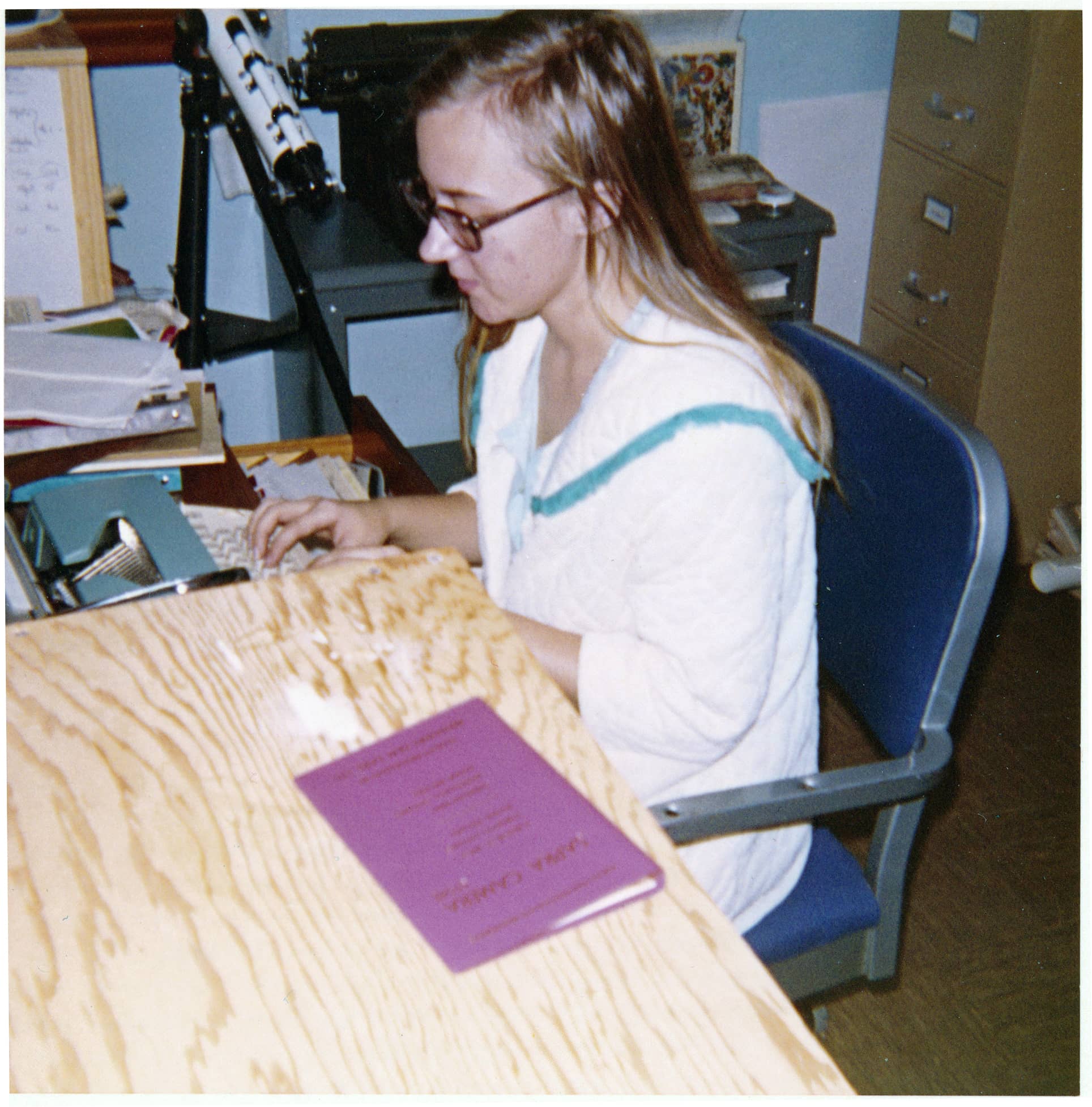
The young author with her first electric typewriter!

This guest post by Julie Czerneda is part of the #againstthedark blog tour. Enter a comment below to be entered to win her latest book in hardcover, To Guard Against the Dark, plus a mass market of The Gulf of Time and Stars (US and Canada entries only, please). To enter the tour-wide giveaway of the entire nine-book series, click here before October 16th at 5pm EST.

Once upon a time, there was an unpublished, (and never-thinking-to-be-published) writer named Julie, who would scribble her stories on paper (which she scrunched up to make taller stacks that whispered and rustled in a lovely, ever-so-literary way), when not typing with two fingers on the ancient and indestructible Underwood typewriter her mother gave her. (Then, yes, would scrunch up the paper to make taller stacks.) Eventually, Julie’s stacks burst from her desk drawer. Her mother found her a used portable electric typewriter and filing cabinet, suggesting she stop scrunching and write.

Read More Read More

September Short Story Roundup

September Short Story Roundup

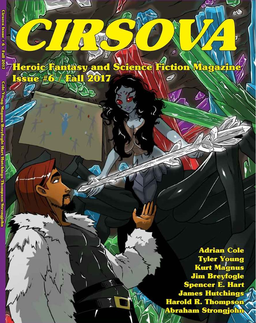
oie_265816EcRH9xZLAnother month, another roundup. While I’m still dubious of any sort of serious swords & sorcery revival, there is most definitely a renewed interest in the older roots of fantasy and science fiction going on. Howard Andrew Jones is editing a new magazine, Tales from the Magician’s Skull, that is inspired by Gary Gygax’s fabled Appendix N. The folks at Castalia House have built up a serious following based on their love of pulp and Appendix N. One of the most serious proponents of some sort of pulp restoration is P. Alexander, editor of Cirsova magazine.

The latest issue of Cirsova, #6, is 126 pages long and contains seven stories and an installment in an ongoing epic poem about John Carter of Mars. There’s more of a science fiction emphasis in this issue than suits my tastes at present, but that doesn’t detract from its general high quality.

The magazine kicks off with “The Last Job on Harz,” by Tyler Young. When a party of miners is wiped out in horrible fashion on the planet Harz, two government agents are sent out from Earth to investigate and protect the interests of the Company. The Company, properly known as Universal Resources, is one of those monolithic businesses found across science fiction. The agents quickly discover that some heretofore unknown entity, in fact a whole herd of entities, is at large on Harz.

Aside from the overly familiar basic plot of the story and its too-obvious conclusion, “The Last Job on Harz” skips out on most of the action. Maybe it’s just me, but in a story featuring creatures described as a cross between a praying mantis and a kangaroo and with “an armored, segmented body, long arms ending in curved claws, and a narrow insect-like head,” I want more of them. Too much of the tale is given over to not very exciting detective work, and the most interesting of that takes place off camera.

“Death on the Moon” by Spencer H. Hart, flips the setup of the previous tale. Bert Henderson is an agent from one of those sci-fi monopolies, in this case, Phillips Atomics. He’s sent to the Moon to investigate a murder and soon finds himself swept up in a plot involving gangsters, a scientist, and his (of course) lovely daughter. Set in a mythical post-WWII world where space travel and lunar colonies came to pass, it has a good hardboiled atmosphere, and plenty of whiz-bang chrome-plated-rocketship details.

Read More Read More

Modular: Starfinder Under the Hood – Character Creation

Modular: Starfinder Under the Hood – Character Creation

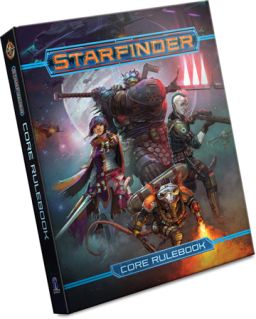
256 Starfinder CoreWhen playing Dungeons & Dragons or other fantasy RPGs, have you ever wanted to play a space wizard? A gnome with a jet pack? Or a fighter with a flaming laser sword and a force field?

These options are all available to you in the new Starfinder RPG (Paizo, Amazon). Paizo has built the new science fantasy game to explore the distant future of their Pathfinder universe. Though I’ve been excited about it for over a year, since it was first announced, I’ve only just gotten the opportunity to play a full game of it.

So now that the game is more than an abstraction … now that I’ve actually rolled the dice and taken some damage … does it still hold up like I was hoping? Honestly: Even better.

But rather than just singing the praises of the game (which I’ve and others have already done here and here and elsewhere), I’m going to dive a bit deeper into how the game is similar – and different – from the Pathfinder game that we know and love.

Read More Read More