Browsed by
Category: BG Staff

Leigh Brackett: American Writer

Leigh Brackett: American Writer

shannach
The 4th and final Leigh Brackett hardback from Haffner Press, a set collecting all her short fiction.

This 4th of July I thought I’d take a look at one of my very favorite writers, the late, great Leigh Brackett, queen of planetary adventure.

Only a few generations ago planetary adventure fiction had a few givens. First, it usually took place in our own solar system.  Second, our own solar system was stuffed with inhabitable planets. Everyone knew that Mercury baked on one side and froze on the other, but a narrow twilight band existed between the two extremes where life might thrive. Venus was hot and swampy, like prehistoric Earth had been, and Mars was a faded and dying world kept alive by the extensive canals that brought water down from the ice caps.

To enjoy Brackett, you have to get over the fact that none of this is real — which really shouldn’t be hard if you enjoy reading about vampires, telepaths, and dragons, but hey, there you go. Yeah, Mars doesn’t have a breathable atmosphere, or canals, or ancient races. If you don’t read her because you can’t get past that, you’re a fuddy duddy and probably don’t like ice cream.

A few of Brackett’s finest stories were set on Venus, but it was Mars that she made her own, with vivid, crackling prose.

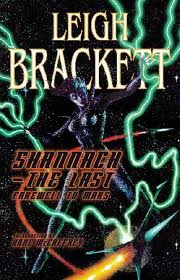
Here. Try this, the opening of one of her best, “The Last Days of Shandakor.” You can find it in two of the three books featured as illustrations in this article, Shannach — the Last: Farwell to Mars, and Sea-Kings of Mars and Otherworldly Stories.

Anyway. On to Brackett.

He came alone into the wineshop, wrapped in a dark red cloak, with the cowl drawn over his head. He stood for a moment by the doorway and one of the slim dark predatory women who live in those places went to him, with a silvery chiming from the little bells that were almost all she wore.

Read More Read More

Confessions of a Guilty Reviewer

Confessions of a Guilty Reviewer

Howard Andrew Jones with his Review Rooster.

I used to write occasional reviews for Tangent Online, and once I wrote one that I still regret. I’ve rarely found a slice-of-life story or flash fiction that I enjoyed, so I probably had no business evaluating a piece of short fiction that was both. Yet I read it, and I slammed it. Not because it was bad flash fiction, or because it was a bad slice-of-life story (I had no kind of qualifications for adequately judging either) but because I didn’t like flash fiction or slice-of-life stories. It was the epitome of ill-informed reviewing, where the writer is arrogant enough to know better than fans of an entire genre. Or two.

I didn’t understand my mistake for a while, and when I met the author of the story at a convention years later he was kind enough not to mention my idiocy, or, more likely, hadn’t remembered the name of the idiot who’d written the review.

You’d think that my epiphany about having written such a bad review would have arrived when I started to get my own fiction published more regularly, but it actually hit me faster, probably because it took a loooong time for my fiction to get published regularly.

I began to evaluate game products for Black Gate and it finally dawned on me that I had to consider both a work’s intended function and its intended audience. For instance, if I was looking at a role-playing product, I couldn’t evaluate a retro dungeon crawl by the same standards I looked at a modern story-based adventure with plot arcs.

Read More Read More

New Treasures: Patrice Sarath’s The Crow God’s Girl

New Treasures: Patrice Sarath’s The Crow God’s Girl

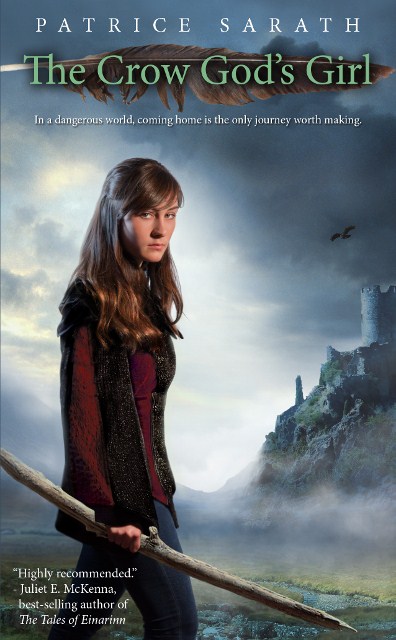
the-crow-gods-girl-patrice-sarathPatrice Sarath has had an enviable career. Her contribution in Black Gate 4, “A Prayer for Captain LaHire,” the tale of three knights and followers of Joan of Arc who discover the horror a fourth disciple has unleashed, was one of the most acclaimed stories from our early years and was reprinted in Year’s Best Fantasy 3 (2003). She edited the anthology Tales From The Secret City in 2007.

She turned to novels in 2008 with Gordath Wood, a book she describes as “hard to categorize:”

It’s fantasy but with only a touch of magic to it. It has romance, but is not a romance (a very different beast). It has a murder-kidnap mystery in it. Basically it has all of the elements of books I like to read. And although everybody has different tastes, I am betting that more than a few of you also like your books the same way I do — shaken and stirred. So if you like fantasy-mystery-romance novels, this one’s for you.

Gordath Wood was well reviewed and spawned a sequel, Red Gold Bridge, in 2009. In 2011 she published The Unexpected Miss Bennet, a Pride & Prejudice sequel which follows middle sister Mary Bennet, the most misunderstood of the Bennet sisters.

Now she’s turned to digital books with a second sequel to Gordath WoodThe Crow God’s Girl. When Lord Terrick’s youngest son is kidnapped, teenage Kate Mosland teams with a mysterious young girl named Ossen to execute a daring rescue… an action with unexpected consequences. As the kingdom stands on the brink of war and Terrick demands Kate submit to a new role, Kate finds that another daring and unexpected action may be the only way to find her true home.

The Crow God’s Girl is 326 pages and was published June 6, 2012. It is available via Amazon Kindle for $3.99.

Chicks Kick Butt

Chicks Kick Butt

ckI recently reviewed Chicks Kick Butt over at The SF Site. My reaction was a little less than enthusiastic, certainly less so than fellow Black Gater Alana Joli Abbott’s review.  Here’s probably why:

…an anthology called Chicks Kick Butt sounded like something that would appeal to me, even if I’d never read anything by the female authors collected here, nor the editors. But, half the fun of picking up a story collection is discovering the work of people you’ve never heard of, or have heard of but never read.

In this case, however, that’s part of the problem. Some of these stories will no doubt resonate with their fan base. Not being part of them, I’m left to wonder what the fascination is. In part, that’s because I don’t get the whole vampire deal. Though I understand the charismatic kink of the guy (or girl) who drinks your blood and consumes your soul, maybe the first time someone thought of putting a cell phone in the hands of the attractive undead to use their curse for good instead of evil, or at least have highly charged sex, but still have problems just like the rest of us whose throats are unblemished, it was kind of fun. But an entire genre with multiple sub-genres of this stuff, really?

New Treasures: The Fantasy Fan

New Treasures: The Fantasy Fan

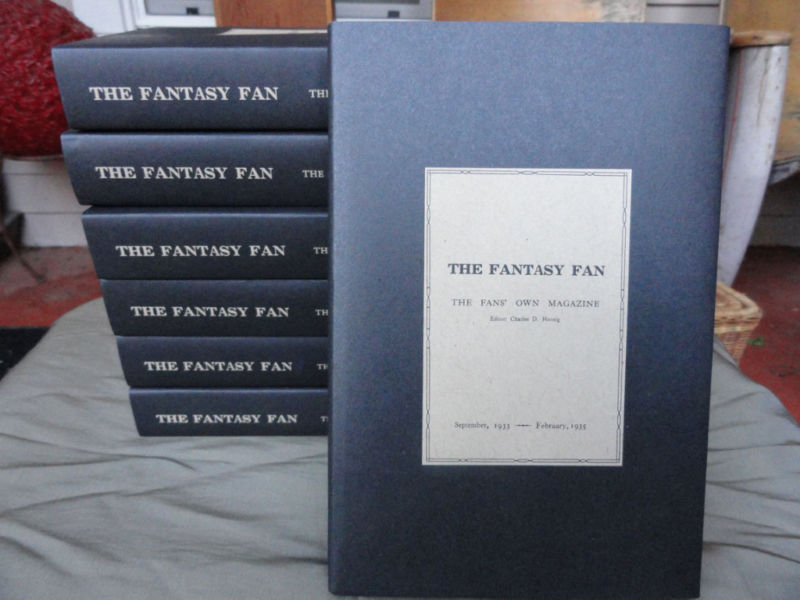
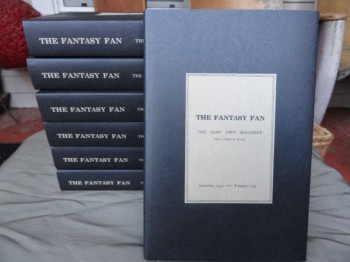
the-fantasy-fanLast month, I got a great e-mail from Black Gate blogger Barbara Barrett. In between her entertaining comments on The Avengers, Arthur Machen, and re-discovering comic books, was this fascinating tidbit:

I’ve started reading The Fantasy Fan — a fan’s tribute to Hornig.  It’s a book containing a compilation of all the Fantasy Fan magazines… I’m only on the first zine but I’m amazed how closely the format matches that of Black Gate. Is this a *coincidence*? The first zine was published in September 1933 and it’s chilling because I keep in mind Robert E.Howard was still alive at that point… the breadth and depth of authors, articles and stories are wonderful. It’s definitely a page out of Living History.

Among fantasy collectors The Fantasy Fan is legendary. The world’s first fanzine dedicated to weird fiction, it lasted for 18 issues, from September 1933 to February 1935. Its contributors included some of the most famous names in the genre — H.P Lovecraft, Clark Ashton Smith, Robert E. Howard, Bob Tucker, Julius Schwartz, Forry Ackerman, Robert Bloch, August Derleth, Eando Binder, and many others — and its young editor Charles Horning so impressed Hugo Gernsback that he hired him to edit Wonder Stories in 1933, at the age of 17. While at Wonder Stories he published Stanley G. Weinbaum’s “A Martian Odyssey” and many other famous pulp stories.

Barbara’s reference to a compilation of The Fantasy Fan was so intriguing I had to track down a copy for myself, and it finally arrived last week. Copies of the original fanzine are so rare that I’ve never even seen one, so to hold a facsimile reprint of all 18 issues in my hands was rather breathtaking. The man behind the book is Lance Thingmaker, and here’s what he says in his introduction:

These fragile gems were so unique. They were simple little fanzines, but were filled with stories, articles and comments by history’s most important weird fiction writers and fans. I felt like I was looking back in time… Since they are extremely hard to find, it seemed many others probably never had the chance to check out the world’s first weird fiction zine. I wanted to make it happen.

The end product is a top-notch piece of work. The magazines are presented in facsimile format, with painstaking restoration of the original barely legible pages, hand printed and hand-bound in hardcover by Thingmaker. The book is over 300 pages, including the complete text of H.P. Lovecraft’s famous essay “Supernatural Horror in Literature,” which was being serialized when the magazine folded. It is limited to 100 copies and sold for $50. Thingmaker’s next project, due to ship later this month, is a facsimile reprint of all four issues of the ultra-rare pulp Marvel Tales.

You can find a detailed breakdown of the contents of The Fantasy Fan here. My thanks again to Barbara for alerting me to this before it sold out!
Apex #37 and Interzone #240

Apex #37 and Interzone #240

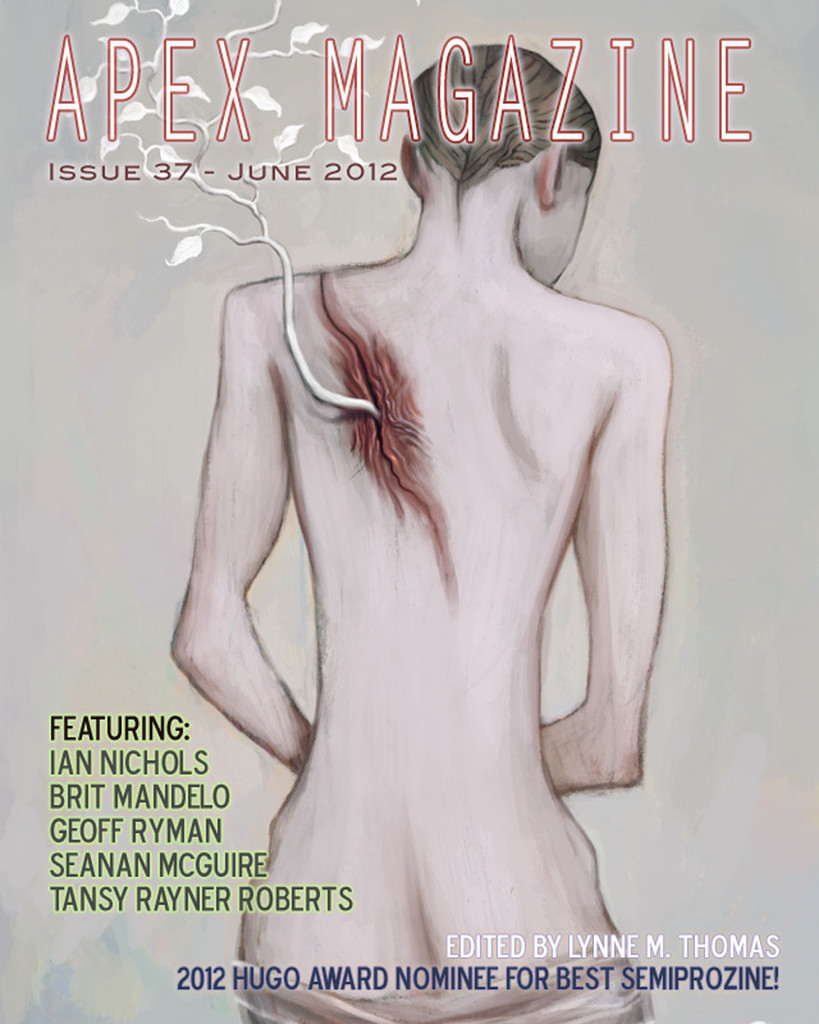
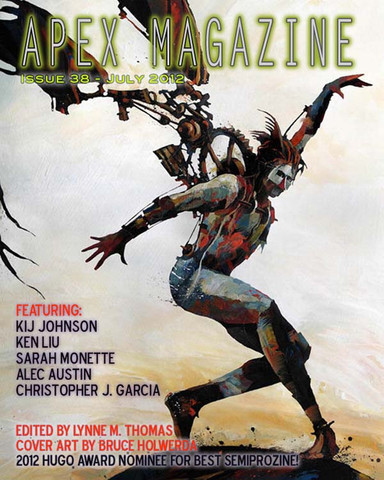
apexmag0612June’s Apex Magazine features  ”Winter Scheming” by Brit Mandelo, “In the Dark” by Ian Nichols and “Blocked by Geoff Ryman  (who is interviewed by Maggie Slater), as well as Seanan McGuire’s poem, “Wounds.” Ken Wong provides the cover art. Nonfiction by Tansy Rayner Roberts and editor Lynne M. Thomas round out the issue.
Apex is published on the first Tuesday of every month.  While each issue is available free on-line from the magazine’s website, it can also be downloaded to your e-reader from there for $2.99.  Individual issues are also available at  Amazon and Weightless.

467_large2A version for the Nook will also be available in the near future.  Twelve issue (one year) subscription can be ordered at Apex and Weightless for $19.95Kindle subscriptions are available for $1.99 a month.

The May–June issue of Interzone has stories by Vylar Kaftan, Ray Cluley, Lavie Tidhar, Elizabeth Bourne and Tracie Welser. Cover art is ‘The Hanged Man’ by Ben Baldwin, the third of his covers commissioned for 2012.

The issue also includes all the usual suspects: “Ansible Link” by David Langford (news and obits); “Mutant Popcorn” by Nick Lowe (film reviews); “Laser Fodder” by Tony Lee (DVD/Blu-ray reviews); along with book reviews by Jim Steel and others, and an interview with Nancy Kress.

Interzone alternates monthly publication with sister dark horror focused Black Static, published by the fine folks at TTA Press.

Yes, The New Yorker

Yes, The New Yorker

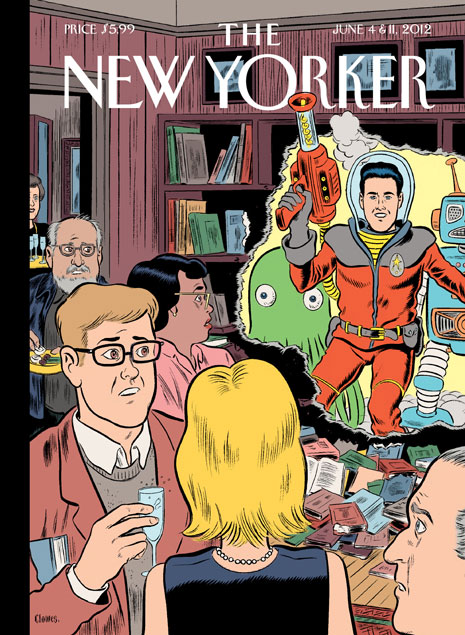
the-new-yorker-science-fiction-issue2This week’s issue of The New Yorker (yes, The New Yorker!) is a science fiction issue, featuring fiction by Jonathan Lethem, Jennifer Egan, and Junot Diaz, among others.

Here’s the complete table of contents.  Now you can have your science fiction fix and feel literary about it at the same time.

A Wiscon Reading Report: The Best in Upcoming Fantasy

A Wiscon Reading Report: The Best in Upcoming Fantasy

the-unnaturalists-2Last weekend I drove to Madison, Wisconsin, for Wiscon, one of the best SF conventions in the Midwest. My travel companions were four young women, and the two-hour drive from Chicago was filled with enthusiastic discussions of My Little Pony, how to cook kale, the most satisfactory sexual positions, and who that hot-looking agent was. When I wasn’t driving I sat in the back and kept my mouth shut.

You can learn a lot about life by keeping your mouth shut. For example, I learned I definitely need to check out My Little Pony.

I learned some important stuff at Wiscon, too. Wiscon has some pretty heavy panels, with titles like Intersectionality and Feminist Community, Dogmatic Rationalism, and Performing Katniss in Print and On Screen: Gender Performativity and Deconstructing Reality TV in The Hunger Games.

No, I didn’t learn what any of those things meant. The first thing I learned at Wiscon was: Don’t volunteer to be on panels. It’s like picking my teeth with a golf club — it’s painful, and it makes me look stupid.

But the second thing I learned was: Wiscon has the best reading program on the continent. And if you’re not listening to talented authors reading their work, you’re wasting your precious hours here on Planet Earth.

So I packed my hours with as many readings as I could. At the last two Wiscons I simply followed the brilliant C.S.E. Cooney — the Queen of Wiscon, and her most gifted reader-poet — as readings seemed to spontaneously spring  forth wherever she wandered. But this year she was in Ottawa giving a command performance at the most prestigious venue in the country, Canada’s National Art Centre, so we were forced to rely on our own devices. When there weren’t any readings, my driving companions and I simply created our own. In the process we were introduced to some of the hottest new writers on the fantasy scene, and several really terrific new, upcoming, or wholly undiscovered SF and fantasy novels.

Below is a list of the best of the best.

Read More Read More

Charlene Brusso Reviews The Cloud Roads

Charlene Brusso Reviews The Cloud Roads

the-cloud-roadsThe Cloud Roads
Martha Wells
Night Shade Books (300 pp, $14.99, February 2011)
Reviewed by Charlene Brusso

I always look forward to reading anything by Martha Wells, because she always gives me something marvelous and new–and The Cloud Roads doesn’t disappoint.

Moon is an outsider. He’s drifted all over, living with one tribe or clan or family after another, and never met another soul like himself. Because Moon has a secret: he’s a shapeshifter. With a little concentration he can alter his body from something that appears human and “normal” to a scaly humanoid with big dragon-like wings and sharp, retractable claws. Orphaned as a child, he’s been on his own ever since, never quite fitting in, and never staying long. It’s not safe to stay, because if anyone found out what he was, what he could become, they’d be certain to think he was one of the vile, noisome Fell, creatures from nightmares who live to hunt and consume humankind.

Moon isn’t Fell. Hes’ not sure what he is. And Moon doesn’t want to be alone. That’s just how things are.

Then he meets another shapeshifter: Stone, someone like himself. From Stone, Moon learns about the Raksura, who shift between groundling and dragonish shapes and live in courts run by Queens. There’s a long list of hierarchical rules to learn, but Moon is welcome to come back with Stone to Indigo Cloud Court and become one of its warriors. More than welcome, in fact.

Read More Read More

Clarkesworld #68 plus PKD and Gnosticism

Clarkesworld #68 plus PKD and Gnosticism

cw_68_300The May  issue of Clarkesworld is currently online. Featured fiction: “Prayer” by Robert Reed, “Synch Me, Kiss Me, Drop” by Suzanne Church and “All the Things the Moon is Not” by Alexander Lumans.  There are also audio versions of all three stories, read by Kate Baker. Non fiction by Aletha Kontis, Jeremy L.C. Jones and Elizabeth Bear.  The cover art is by Jessada Suthi.

All of this is available online for free. However, nothing is really free. The magazine is supported by “Clarkesworld Citizens” who donate $10 or more. There’s also a Kindle edition.

One personal reaction to Bear’s very funny essay, “Another Word: Dear Speculative Fiction, I’m Glad We Had This Talk”: I agree that Lenny Bruce didn’t get funnier when he got angrier (his drug problems certainly didn’t help), but I found George Carlin to be more interesting the angrier he got. Maybe he wasn’t quite as funny, but his anger certainly resonated with me.  Sometimes having your “face pressed down into a trough of human misery until the bubbles stop” is necessary to remind people that life is not a television sitcom. At least the ones who haven’t already drowned.

Someone else who got less interesting when he started taking himself too seriously (and, once again, the drugs didn’t help) was Philip K. Dick. Simon Critchley examines Dick’s metaphysical worldview as expressed in Exegeiss, a posthumously published series of philosophical 133948681ramblings. While I tend to think all this stuff really is the result of a bad acid trip, Critchley as a professor of philosophy for the most part keeps a straight face. Some of you may laugh out loud not only at the source material, but the attempt at exegesis.

We last covered Clarkesworld with issue #67.