Browsed by
Author: John ONeill

The Wise Man’s Fear by Patrick Rothfuss wins the David Gemmell Legend Award

The Wise Man’s Fear by Patrick Rothfuss wins the David Gemmell Legend Award

the-wise-mans-fear1Patrick Rothfuss’s The Wise Man’s Fear, the second volume of The Kingkiller Chronicles, has won the David Gemmell Legend Award for Best Fantasy Novel of 2011.

The David Gemmell Legend Award is a fan-voted award administered by the DGLA. The Legend Award for Best Fantasy Novel was first granted in 2009, to Andrzej Sapkowski’s Blood of Elves; in 2010 the winner was Graham McNeill’s Empire: The Legend of Sigmar, and last year’s was Brandon Sanderson’s The Way of Kings.

The nominees for the 2012 award also included The Heroes by Joe Abercrombie, Blackveil by Kristen Britain, Warhammer: Blood of Aenarion by William King, and The Alloy of Law by Brandon Sanderson.

The Morningstar Award for Best Fantasy Debut was awarded to The Heir of Night by Helen Lowe.

The Ravensheart Award for best Fantasy Book Jacket/artist went to the cover for Warhammer: Blood of Aenarion, done by Raymond Swanland.

Complete details are available at the DGLA website.

Congratulations to all the winners!

New Treasures: Phil & Kaja Foglio’s Girl Genius Omnibus Volume One

New Treasures: Phil & Kaja Foglio’s Girl Genius Omnibus Volume One

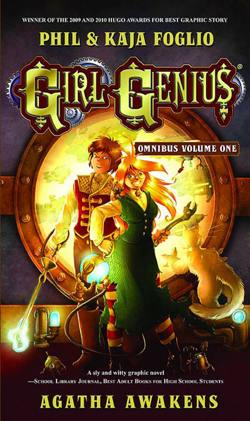
girl-genius-omnibus-volume-oneGirl Genius is one of my favorite comics. Or at least it would be, if my dang kids didn’t stop stealing the issues and I could read them.

Now Tor has solved that problem nicely, with the publication of Girl Genius Omnibus Volume One: Agatha Awakens, a handsome 320-page full-color compilation of issues 1-10.

Which my kids immediately stole.

Until I find it again, I have to talk about it in the abstract. Like this: Girl Genius rocks. It’s a “Gaslamp Fantasy” (don’t call it steampunk) which follows the adventures of Agatha Heterodyne, a struggling student at Transylvania Polygnostic University who ends up on the run from the sinister Baron Klaus Wulfenbach. As she makes her way across the wasteland of a devastated Europe, she learns she comes from a family of Sparks — mad scientists with superhuman scientific gifts, and that her own gifts are just beginning to blossom.

I’m making liberal use of Wikipedia to fill in gaps here, owning to the missing issues stashed somewhere under my children’s beds upstairs.

Suffice it to say that Girl Genius is a terrific all-ages comic (one hopes, anyway). It’s fun, fast paced, and filled with lots of laugh-out-loud moments. Phil & Kaja Foglio make especially innovative use of color — the opening pages are black and white, and when color slowly seeps into the pages the effect is quite dramatic. Girl Genius began life in 2001 as a print comic, but became a full-fledged webcomic on April 18, 2005. In 2008 Phil Foglio was nominated for a Hugo award for Best Professional Artist for his work on Girl Genius, and in 2011 the strip won the Hugo Award for Best Graphic Story.

Girl Genius Omnibus Volume One: Agatha Awakens was published in hardcover by Tor Books on February 28, 2012. The cover price is $34.99 for 320 pages in full color.

New Treasures: The Fantasy Fan

New Treasures: The Fantasy Fan

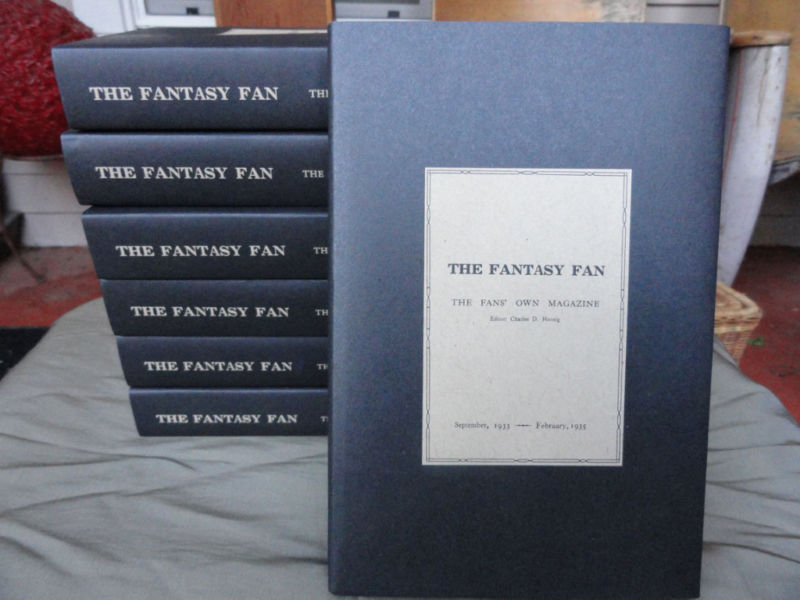
the-fantasy-fanLast month, I got a great e-mail from Black Gate blogger Barbara Barrett. In between her entertaining comments on The Avengers, Arthur Machen, and re-discovering comic books, was this fascinating tidbit:

I’ve started reading The Fantasy Fan — a fan’s tribute to Hornig.  It’s a book containing a compilation of all the Fantasy Fan magazines… I’m only on the first zine but I’m amazed how closely the format matches that of Black Gate. Is this a *coincidence*? The first zine was published in September 1933 and it’s chilling because I keep in mind Robert E.Howard was still alive at that point… the breadth and depth of authors, articles and stories are wonderful. It’s definitely a page out of Living History.

Among fantasy collectors The Fantasy Fan is legendary. The world’s first fanzine dedicated to weird fiction, it lasted for 18 issues, from September 1933 to February 1935. Its contributors included some of the most famous names in the genre — H.P Lovecraft, Clark Ashton Smith, Robert E. Howard, Bob Tucker, Julius Schwartz, Forry Ackerman, Robert Bloch, August Derleth, Eando Binder, and many others — and its young editor Charles Horning so impressed Hugo Gernsback that he hired him to edit Wonder Stories in 1933, at the age of 17. While at Wonder Stories he published Stanley G. Weinbaum’s “A Martian Odyssey” and many other famous pulp stories.

Barbara’s reference to a compilation of The Fantasy Fan was so intriguing I had to track down a copy for myself, and it finally arrived last week. Copies of the original fanzine are so rare that I’ve never even seen one, so to hold a facsimile reprint of all 18 issues in my hands was rather breathtaking. The man behind the book is Lance Thingmaker, and here’s what he says in his introduction:

These fragile gems were so unique. They were simple little fanzines, but were filled with stories, articles and comments by history’s most important weird fiction writers and fans. I felt like I was looking back in time… Since they are extremely hard to find, it seemed many others probably never had the chance to check out the world’s first weird fiction zine. I wanted to make it happen.

The end product is a top-notch piece of work. The magazines are presented in facsimile format, with painstaking restoration of the original barely legible pages, hand printed and hand-bound in hardcover by Thingmaker. The book is over 300 pages, including the complete text of H.P. Lovecraft’s famous essay “Supernatural Horror in Literature,” which was being serialized when the magazine folded. It is limited to 100 copies and sold for $50. Thingmaker’s next project, due to ship later this month, is a facsimile reprint of all four issues of the ultra-rare pulp Marvel Tales.

You can find a detailed breakdown of the contents of The Fantasy Fan here. My thanks again to Barbara for alerting me to this before it sold out!

Vintage Treasures: Poul Anderson’s After Doomsday

Vintage Treasures: Poul Anderson’s After Doomsday

after-doomsdayI’m putting away all the paperbacks that arrived with my two Philip K. Dick lots, and I stumbled across the fabulous artifact at right.

After Doomsday was published by Ballantine Books in 1962, two years before I was born. It was originally serialized in Galaxy magazine (as The Day after Doomsday) between December 1961 and February 1962.

What truly makes it fabulous isn’t just the great cover art by Ralph Brillhart, with a bug-eyed alien stumbling on some guy surveying a road during his evening constitutional. No no no. It’s this wonderful description on the back cover:

CARL DONNAN was a space engineer — a man of action who did his job well and didn’t think much beyond that — but now his home planet was destroyed and he found himself with two burning ambitions:

– FIND the beings who blew up the Earth.

– SEARCH the galaxies until they located another Starship with female humans aboard.

BOTH PROJECTS were vital to the survival of the human race — and both were monumental tasks.

THIS was the time when the galaxies discovered how grim and purposeful a handful of homo sapiens could be.

A starship with “female humans” aboard. I think the first task for this guy Carl should be to look up “female humans,” find out they’re called “women,” and then put an ad on Craig’s List. The survival of the species is on your shoulders, dude. Time to put down that survey equipment and pick up a clean shirt. And maybe some mouthwash.

There’s a lengthy plot synopsis of After Doomsday here. Don’t expect it to be as entertaining as that back cover copy, though.

Selling Philip K. Dick

Selling Philip K. Dick

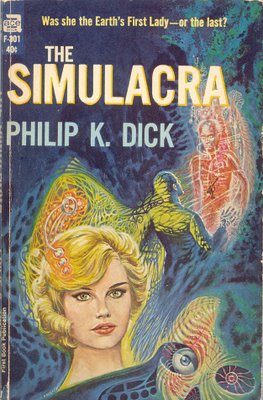
the-simulacra-philip-k-dickAlmost exactly a year ago this weekend I was in downtown Chicago, selling books and Black Gate magazines at the Printer’s Row book fair. It was hot and I got sunstroke, and I had to cancel dinner plans with the charming and beautiful Patty Templeton. Stupid, stupid sunstroke.

But I learned something fascinating. Well, two fascinating things. The second was that no one wants print fiction magazines anymore. I can’t tell you how many people picked up copies of Black Gate 15, dazzled by the look and heft of the thing, asking “What is this?” The moment they learned it was a magazine, they put it down and wandered over to the booth selling travel books.

But the first fascinating thing I learned is that vintage Philip K. Dick paperbacks sell at almost any price.

I learned this mostly by accident. I had a few hundred recently-acquired vintage paperbacks bagged up, but didn’t have time to price them. The night before the show they were spread out in stacks on our bed, all with cheerful blank price stickers, and Alice was threatening to sleep on the couch.

So I just priced them at random. Most I listed at 2 – 3 bucks, occasionally as high as 10. When I got to the more valuable stuff, like the Philip K. Dick , I wrote “$35” on most of ’em, even the stuff I’d only paid a buck or two for. I figured I’d do my homework and re-price everything that didn’t sell later.

Instead, I sold all the Philip K. Dick in less than two days.

Obviously, this was an unusual test case. For one thing, this wasn’t an SF convention and my buyers generally weren’t science fiction readers. They were book collectors who knew just enough about Philip K. Dick to know he’s in demand. There was a lot of impulse buying, and hardened rare book collectors are maybe less reluctant to fork over $30 – $40 on impulse than a typical SF reader.

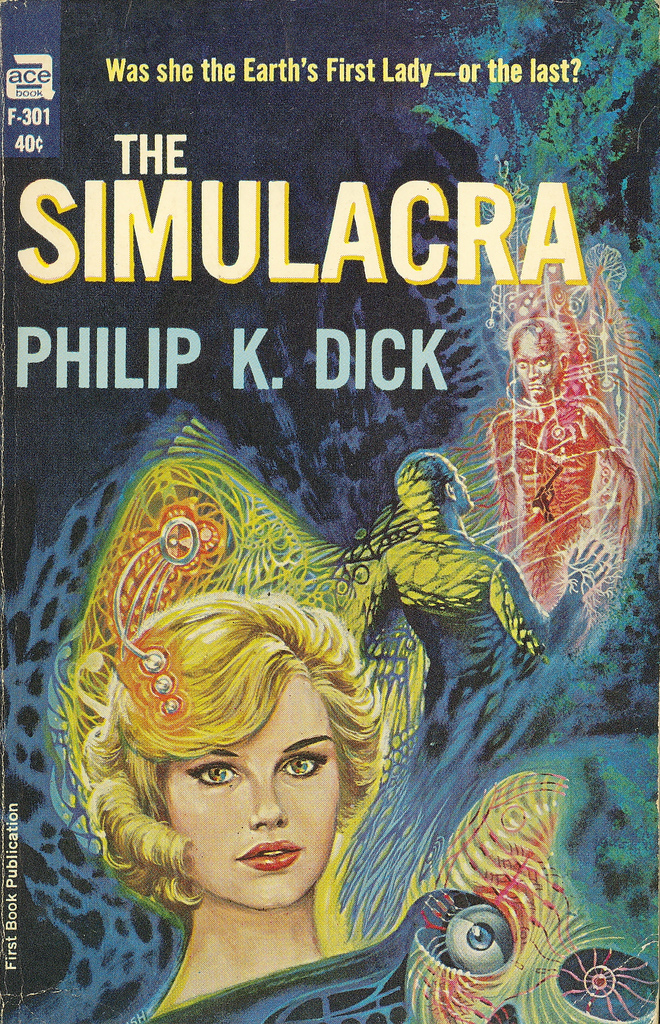
Still, it was very educational. Dick was one of the only authors browsing customers frequently asked about (the others were Samuel R. Delaney and Ursula K. LeGuin), and if I could put a book in their hands, it was a short step to a sale. It didn’t hurt that many of his paperbacks look terrific, like the Emsh cover on the 1964 Ace edition of The Simulacra, above.

I don’t sell much anymore, but I do have two tables reserved for Chicon 7, the World Science Fiction convention coming up this Labor Day here in Chicago. In preparation, I’ve been accumulating as many Philip K. Dick titles — and other vintage SF paperbacks — as I can find. eBay is one fertile hunting ground, especially if you’re willing to buy larger lots. Last week I purchased lots containing The Simulacra and Dr. Bloodmoney (plus 10 other mixed SF paperbacks) for $6.05 each. I’m pretty sure I can re-sell the Dick titles alone for a lot more than that.

Just how much more remains to be seen. I’ll let you know after Chicon.
Octavia E. Butler’s “Bloodchild”

Octavia E. Butler’s “Bloodchild”

isaac-asimovs-science-fiction-magazine-june-1984I’m still putting away boxes of stuff that’s piled up in my library. Today it’s a collection of science fiction magazines I purchased from Craig Sandford, a guy I met on eBay, a few months ago. Craig kept his magazines in great condition. I had most of them already (don’t tell Alice), but Craig offered me a sweet deal. And realistically, I won’t be content until my basement is so stuffed with games and magazines it’s impossible to move. So this is progress.

As I slid each magazine into a protective plastic bag, daydreaming of the future age when SF digests from the 1980s are near-priceless cultural artifacts (not far off now), I came across the June 1984 issue of Isaac Asimov’s Science Fiction Magazine, with Wayne Barlowe’s brilliant and chilling cover for Octavia E. Butler’s story “Bloodchild.”

“Bloodchild” is a stunning work of short fiction. It won both the Hugo and Nebula awards for best novelette, and was the title story of her slim 1995 collection, Bloodchild and Other Stories. Although I had magazines and boxes scattered all over the floor, I curled up in my big green chair to re-read it.

Butler has described “Bloodchild” as a tale of male pregnancy, which is apt even if it isn’t very descriptive. The young Gan lives with his family on a Preserve on an alien world, where humans are protected from the dominant species — the huge, powerful and intelligent insect-like Tlic, who lay their eggs in humans and nearly wiped them out when the first human settlers arrived. Gan’s father gave birth to three alien broods before he died, including the noble T’Gatoi, a female Tlic who’s become one of humanity’s strongest protectors. But now it’s time for T’Gatoi to lay her own eggs, and she has chosen Gan as her mate. When Gan witnesses the violent and bloody birth of a clutch of grubs, he realizes for the first time exactly what he’s being groomed for. He’s unsure he can go through with it, but to refuse now will have dangerous ramifications for his family. “I knew birth was bloody and painful, no matter what,” he reasons. And how does T’Gatoi see her mate? Is he just a pet? Or is it possible she feels… something like love?

Barlowe captures the innocence and horror of “Bloochild” perfectly in his cover, which depicts a new-born alien grub leaving a trail of blood as it emerges from the adolescent boy Gan, who watches with a calculating look. Click on the image above for a bigger version.

This is why I love science fiction and fantasy magazines. They’re not just slender collections of stories. They are a refined meeting of fact, art, and fiction, and when that meeting turns into a wild night of necking in the back seat, as it does here, it’s worth telling your friends about. You’re my friends, so I’m telling you. (And as we’ve discussed, kindly don’t mention this to Alice).

I don’t know any place where you can read “Bloodchild” online, but you can get a copy of the June 84 issue of Asimov’s online for only a couple of bucks. Just buy it soon, before the inevitable day 80s SF magazines become priceless. Why not hoard them in your basement, like me? You’ll thank me later.

Vintage Treasures: TSR’s Amazing Science Fiction Anthologies

Vintage Treasures: TSR’s Amazing Science Fiction Anthologies

amazing-the-wonder-yearsD&D publisher TSR generally gets a bad rap for their brief venture into science fiction in the 1980s. Much of their D&D related fiction — especially the Weis and Hickman DragonLance novels, which launched their entire publishing line — is still remembered fondly today. But does anybody remember Martin Caidin’s Buck Rogers novel, or Martin H. Greenberg’s Starfall anthology?

Nope.

Which is a shame. At one point — riding high on the success of the DragonLance books — TSR claimed it was the largest publisher of SF and fantasy titles in the nation, and it sure looked that way whenever I walked into a bookstore. There were literally racks of the stuff: DragonLance books, Forgotten Realms books, Dark Sun novels, Birthright novels, SpellJammer novels, Greyhawk books, Ravenloft novels, Planescape novels… and on and on and on.

If you were a serious genre reader in the late 80s, you gradually trained your eyes to ignore it all as you scanned the shelves for anything new and original.

What many of us never knew — because they were hidden alongside all their gaming fiction — was that TSR published dozens of new and original SF and fantasy novels, unconnected to any of their gaming fiction, including bestselling author Sharyn McCrumb’s famous science fiction pastiche Bimbos of the Death Sun (1987), Paul B. Thompson and Tonya C. Cook’s Red Sands (1988), Ardath Mayhar and Ron Fortier’s Monkey Station (1989), Robin Wayne Bailey’s Nightwatch (1990), and many others.

They also discovered several major authors, publishing Nancy Varian Berberick’s first novel The Jewels of Elvish (1989), Nick Pollotta’s first novel Illegal Aliens (written with Phil Foglio, 1989), and first novels from L. Dean James, Chrys Cymri, K.B. Bogen, and others.

But my favorite books published by TSR during this period weren’t novels at all. They were five anthologies collecting stories from the pulp days of Amazing Stories, edited by Martin H. Greenberg.

Read More Read More

New Treasures: Zombiegeddon

New Treasures: Zombiegeddon

zombiegeddon2I’m still unpacking from the horrible bout of auction fever I suffered back in March. I uncovered a box of games buried by loot from the April Windy City Pulp and Paper Show in my library on Friday … man, I go to too many auctions.

It’s fun to dig through unexpected boxes of games, though. It’s sort of like archaeology, especially since each item still has the auction tag and price on it. Man, what kind of primitive barbarian would pay 28 bucks for a copy of StarSoldier?? Since it’s in the box … me, apparently.

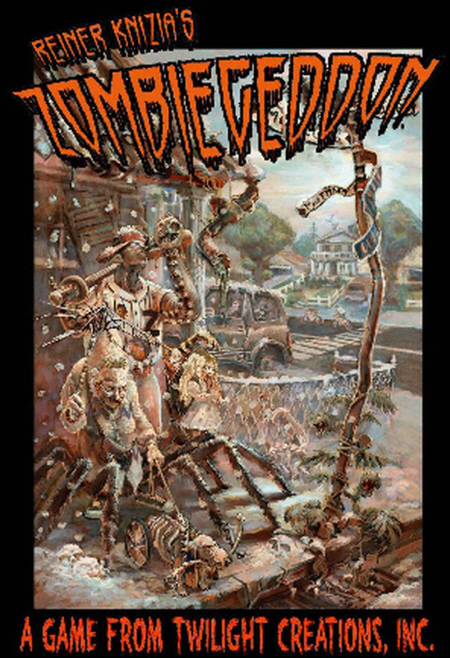
Still, there’s some intriguing surprises. Like this copy of Reiner Knizia’s Zombiegeddon I found. [Click on the image at right to embiggen.]

I don’t remember buying this game. In truth, twenty minutes ago, I didn’t even know it existed.

But I can imagine what happened. They rattle through items pretty fast at the Games Plus Spring Auction. The auctioneer held it up, I got a quick glimpse of a rare and mysterious gaming artifact with an old lady with spider legs and an undead dog on the cover, I heard the words “mumble mumble ZOMBIE mumble,” and everything went black.  Three months later, I’m holding a copy of Zombiegeddon and someone has fifteen bucks of my money.

Zombiegeddon looks pretty neat, though.  I mean, how could it not? Here’s the text on the back:

Well, it was nice while it lasted! You have gotten word that the end is near, and Armageddon is right around the corner. (Actually, it begins tonight!) Since it may be a while before you can get to the store, today would be a good time to gather as many supplies as possible. After all, tomorrow might be the beginning of a long, cold, (nuclear) winter!

Reiner Knizia’s Zombiegeddon is a fast-paced, perfect-information, strategy game. Each player spends the first half of the game rushing around the board collecting supplies and trying to stop your pesky neighbors from taking stuff that is rightfully yours … The second half of the game is spent trying to survive. Sure their is some good stuff around, but it certainly isn’t plentiful and let’s face it, everyone is still trying to take it before you do! (Whoever has the most stuff at the end of the game wins!)

The board looks pretty pedestrian — essentially just a blank grid — but the components are sturdy, and the rule book is only two pages. Maybe Drew will play this with me, once we finally find that frickin’ holy grail.

Reiner Knizia’s Zombiegeddon is available from Twilight Creations. It was published in March 2009, and retails for $24.99. The complete rulebook in PDF is here.

June Page XX Available — get the latest Pelgrane Press News

June Page XX Available — get the latest Pelgrane Press News

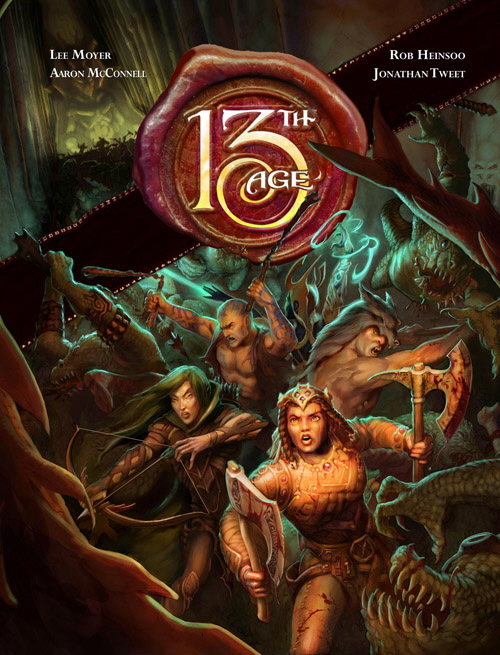
the-13th-ageSimon Rogers, publisher of Pelgrane Press, tells us a bumper-sized issue of their newsletter Page XX is now available.

I’ve been a huge fan of Pelgrane Press since they published the superb The Dying Earth role playing game nearly a decade ago, and began supporting it with one of the best small press gaming magazines ever published, The Excellent Prismatic Spray, which included articles by Gary Gygax, Robin D. Laws, Phil Masters, Steven Long, and many others.

More recently Pelgrane Press has produced Trail of Cthulhu, Mutant City Blues, Night’s Black Agents, and the highly acclaimed science fiction RPG Ashen Stars.

This latest issue of Page XX is packed with updates on three major new releases and lots of news, including the latest on their new fantasy RPG 13th Age by D&D designers Jonathan Tweet and Rob Heinsoo:

And lots more! Check out the latest issue of Page XX here.

This Week’s Bargain SF & Fantasy Books at Amazon.com

This Week’s Bargain SF & Fantasy Books at Amazon.com

nights-of-villjamurFour packages from Amazon.com piled up on my doorstep today, which reminds me it’s time to do another bargain book round-up. Ah, I love bargain books.

Here’s the latest remaindered SF & fantasy titles I’ve found on Amazon, including two new titles by Cory Doctorow; Fergus and the Night-Demon, a great-looking illustrated fantasy from Jim Murphy & John Manders; the recently-reviewed Black Blade Blues by J. A. Pitts; plus books by Kage Baker, Kat Richardson, Fiona McIntosh, Gordon Dahlquist, Michael Marshall Smith, Christina Meldrum, Galen Beckett, and the debut of a promising new fantasy series from Mark Charan Newton, Nights of Villjamur:

Nights of Villjamur, Mark Charan Newton [$10.38, was $26]
Makers, Cory Doctorow [$10, was $24.99]
For the Win, Cory Doctorow [$7.20, was $17.99]
The Dark Volume, Gordon Dahlquist [$10.40, was $26]
Myrren’s Gift: The Quickening Book One, Fiona McIntosh [$5.98, was $14.95]
Downpour (Greywalker, Book 6), Kat Richardson [$9.98, was $24.95]
The Magicians and Mrs. Quent, Galen Beckett [$9.20, was $23]
The Servants, Michael Marshall Smith [$5.98, was $14.95]
Madapple, Christina Meldrum [$6.80, was $16.99]
The Empress of Mars, Kage Baker [$10.38, was $25.95]
Fergus and the Night-Demon, Jim Murphy & John Manders [$6.40, was $16]
Black Blade Blues, J. A. Pitts [$6.40, was $15.99]

Most books are discounted from 60% to 80%. As always, quantities on these bargain books are very limited. All are eligible for free domestic shipping on orders over $25. Most of last week’s discount titles are still available; you can see them here.