Vintage Treasures: Runyon First and Last by Damon Runyon
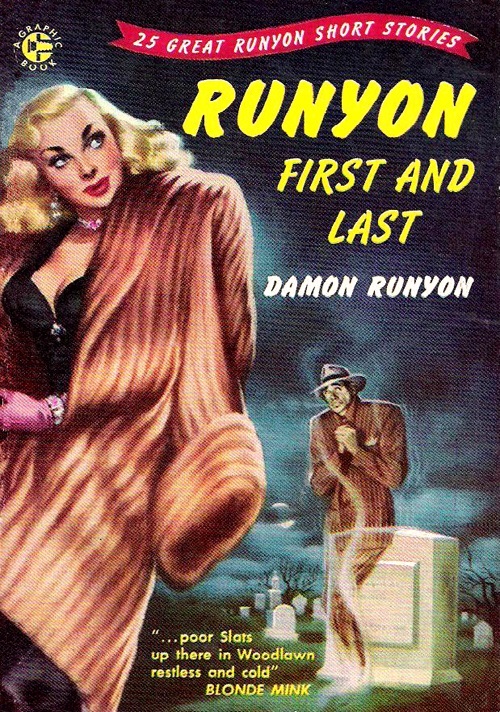 It was Chicago writer Steven Silver who introduced me to Damon Runyon, with his hilarious Cthulhu-Runyon mash-up “In the Shadows of Broadway,” published as a podcast in StarShipSofa #236 in May, 2012. Since then, I’ve been acquainting myself with Runyon’s comedic short stories, several of which were the basis for the famous Broadway musical Guys and Dolls.
Runyon First and Last is a fine sampling of his earliest and later stories, including his last, “Blonde Mink,” published in Collier’s Magazine in August, 1945, the tale of a ghost who cannot rest until his fiancé buys the headstone she promised with the $23,000 he left her… and the strange fate of the blonde mink coat she bought with the money instead. Hilarious and sad, it’s unlike any other fantasy you’ve ever read.
Here’s the blurb from the back of the book.
This is a collection of 25 short stories by one of the truly great writers of American fiction. Six of the stories presented here were written during Runyon’s earliest phase. They are technically expert and have a non-Broadway background.
Among his later stories, his last, titled “Blonde Mink,” sets a new high in the art of short story writing. It displays the full flower of that Runyonese which perfectly conveys the flavor of Manhattan’s high-flying guys and dolls.
“The Informal Execution of Soupbone Pew” is the story of the revenge wreaked upon a vile vicious character who killed a kid who had been popular with a gang of tramps and hobos.
The kind of writing included in this collection clearly shows the reasons for Damon Runyon’s world-wide reputation.
Runyon First and Last was published in paperback by Graphic Publications in 1951. It contains 27 stories of the 39 stories included in the 1949 hardcover edition. It is 189 pages; there is no cover price. The cover is uncredited. I bought my copy on eBay last month as part of a collection for just under one dollar.
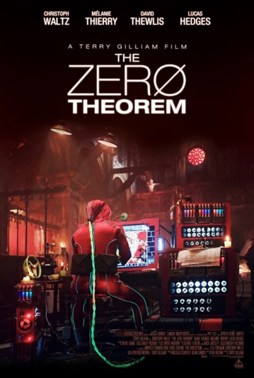 Before continuing my Fantasia diary with a look at the movies I saw last Sunday, I want to focus in on one specific film that struck me as an utterly brilliant piece of science-fiction satire. I think it divided the audience; I’ve heard and seen reactions from people who were left cold by it as well as from people who loved it as much as I did. Perhaps that’s not surprising. The movie is The Zero Theorem, directed by Terry Gilliam from a script by Pat Rushin, and it is as idiosyncratic and persistently individual as you’d expect from Gilliam.
 To my mind, if you’re a critic of any integrity, sooner or later the criticism you write will lead you to challenge your views of yourself as well as your views of the art you experience. That’s the nature of much truly effective art: it makes you look at yourself and think about yourself in new ways. If you’re trying to articulate your reaction and assessment of such a work, honesty will compel some self-examination as well. Powerful art requires an acknowledgement of one’s subjective response.