Browsed by
Category: Reviews

Internal, External Conflict Ignite Cornwell’s The Burning Land

Internal, External Conflict Ignite Cornwell’s The Burning Land

“Our gods prefer feasting. They live, Uhtred. They live and laugh and enjoy, and what does their god do? He broods, he’s vengeful, he scowls, he plots. He’s a dark and lonely god, Uhtred, and our gods ignore him. They’re wrong.”

–Bernard Cornwell, The Burning Land

burning-land-us-cover2Conflict — internal to fictional protagonist Uhtred of Bebbanburg, and external to blood-soaked, fire-ravaged Britain — burns brightly in The Burning Land, the fifth and latest entry in Bernard Cornwell’s Saxon Stories, a partially fictionalized chronicle of the real-life Viking invasions that swept Dark Ages Britain.

A Saxon-raised-Dane, Uhtred is a microcosm of the rough mixing of Christianity and pagan culture that occurred in war-torn ninth century Britain. Uhtred is a Saxon whose father was killed in a Danish raid. Taken prisoner as a thrall to the Dane Earl Ragnar and raised hard, he nevertheless grows to love the Danes. Although they’re ferocious raiders, the Danes drink deep of life, scorn Christian virtues of humility and pity, and worship the pagan gods of Thor and Odin (they expect less of their followers than the one God, and leave more leeway for fun).

But Uhtred’s loyalties are torn. His hereditary home is the Northern kingdom of Bebbanburg and his peoples are Saxon. Over the course of the series he comes to respect the coldly pious and serious, but brilliant and fair King Alfred of Wessex (Alfred the Great) and at times reject the occasionally murderous habits of the Danish warlords.

Read More Read More

Howard Andrew Jones Reviews Level UP Issue 1

Howard Andrew Jones Reviews Level UP Issue 1

gmg9101coverlargeGaming magazines can be a great asset to planning a roleplaying game, but I’ve often considered them to not be worth the cost. This one, reviewed by our very own Howard Andrew Jones, looks like it gives quite a bit of bang for the buck (or, in this case, 2 bucks). The publisher, Goodman Games, has a solid track record for producing quality game supplements.

Level UP Issue 1

Goodman Games (55 pp, $1.99 magazine, April 2009)
Review by Howard Andrew Jones

I like this magazine. Issue 1 comes in at 55 pages, the first offering of a new quarterly publication from Goodman Games devoted to Dungeons and Dragons. It means to fill some pretty big missing boots – you probably know the ones I mean if you’re an old fan of the game – and I think it’s off to a good start.

Read More Read More

Back to the Ninth Legion . . . Yep, Still Lost: The Eagle

Back to the Ninth Legion . . . Yep, Still Lost: The Eagle

the_eagle_posterThe Eagle (2011)
Directed by Kevin Macdonald. Starring Channing Tatum, Jamie Bell, Donald Sutherland, Mark Strong, Tahar Rahim.

Less than a year after Centurion was released theatrically on a small number screens, along comes another historical adventure film telling the tale of the vanished Ninth Legion. Except The Eagle got released on many screens. In a just and fair movie world, the situation would be the opposite. But anybody who has every griped about the Academy Awards knows that we live in no such world. (And by the way . . . no Best Score nomination for Daft Punk’s work on TRON Legacy?)

The Eagle is the opposite of Neil Marshall’s incredibly energetic, almost gonzo Centurion. Marshall’s film uses a great cast to flesh out its characters and themes of survival and duty while keeping an insane and glorious momentum. At every turn, Centurion does its damndest to keep audience’s adrenaline high. The Eagle, given greater dramatic space for characters between battle scenes, sketches out complete blanks for protagonists, contains no sense of the Roman frontier, and features poorly shot and edited battle scenes that emit out not single nanowatt of excitement. (Oh, I’ll be generous. Not a single microwatt of excitement.) No wonder Focus Features unceremoniously dumped this film out in early February, during Valentine’s Day weekend, up against a kid’s CGI animated movie and romantic comedy starring Adam Sandler. The Eagle is totally disposable.

And given the subject matter, it’s a shame. I hate to see any movie mess up the wonders that the Roman Empire can deliver in terms of action and spectacle. It takes a tremendous amount of work to make me dislike a film about the empire, but dammit if director Kevin Macdonald (The Last King of Scotland, State of Play) and his cast and crew put in overtime to produce a boring film.

Read More Read More

Supernatural Spotlight – Episode 6.13 “Unforgiven”

Supernatural Spotlight – Episode 6.13 “Unforgiven”


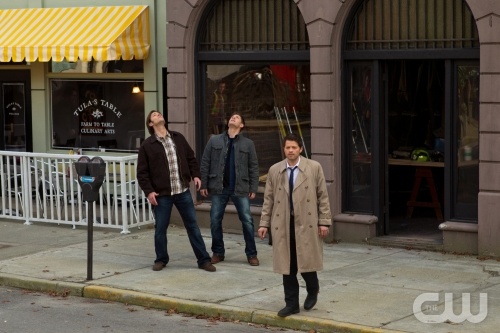
Dean (left) and Sam (right) Winchester
Dean (left) and Sam (right) Winchester (from a previous episode)

Every episode starts off with a monster attack … but this week, the monster is Sam! A year earlier, in Bristol, Rhode Island, Sam worked a case with his grandfather Samuel. He shot someone or something, which made Samuel look a bit uncomfortable.

As they were leaving town, though, they got pulled over by a deputy … who soulless-Sam beat senseless when he tried to arrest them, because Sam was suspiciously covered in blood.

“You think there may be calmer ways we could have done all of that?” Samuel asked.

“Do we care?” Sam replied, reminding us all why soulless-Sam was not a fun guy to hang out with.

Read More Read More

BookPage Reviews The Desert of Souls

BookPage Reviews The Desert of Souls

desert-of-souls2Howard Andrew Jones’ novel The Desert of Souls will be released Tuesday, Feb 15.

But the early reviews have begun to appear, and it’s obvious the excitement surrounding the book is already starting to build.  Here’s an excerpt from the review at BookPage:

In the space of the first two sentences… Howard Andrew Jones has captured the reader. By the end of the first page — and in my case, the first paragraph — the crisp, evocative imagery has gripped one’s attention… that grip only tightens in the pages that follow.

The Desert of Souls has been described as Sherlock Holmes meets the Arabian Nights meets Robert E. Howard. The comparisons are apt, and in the case of Arthur Conan Doyle’s famous duo, overt. The martially adept Captain Asim partners with the erudite Dabir, a scholar whose principle weapons are his piercing intelligence and keen observations… Fantastic adventure ensues. Though this is only the first book, the tandem of Asim and Dabir shows great promise to be worthy of the “great fictional duos” mantle worn by the likes of Lieber’s Fafhrd and the Gray Mouser, Bilbo and Gandalf, and even Kirk and Spock.

The rich tapestry of 8th-century Baghdad recalls some of Scheherazade’s most engaging tales, and the supernatural horrors faced by Asim and Dabir during the course of their adventures could just as easily have menaced the likes of Conan, Solomon Kane or Bran Mak Morn…. At its heart, Jones’ work is a great read — a page-turner in its purest form. As such, The Desert of Souls is a powerful place — it can wreck sleeping schedules, cause chores to be neglected and, best of all, make one yearn for the next installment.

The complete review by Michael Burgin is available here. You can pre-order The Desert of Souls at Amazon.com and other fine bookshops.

Rich Horton Reviews The Bell at Sealey Head

Rich Horton Reviews The Bell at Sealey Head

bell-at-sealey-headThe Bell at Sealey Head
Patricia A. McKillip
Ace (288 pp, $14.00, September 2009)
Reviewed by Rich Horton

I think of Patricia McKillip a little like I think of Van Morrison. Which is really not a terribly useful comparison, because I don’t mean it to apply to their respective styles… rather, I mean to say that McKillip is one of those writers who reliably issues a novel every year or two, always enjoyable work. In the same way I look for a new Van Morrison album every year or two, and they are always satisfying.

Now it can also be said the McKillip’s novels, as with Morrison’s latter period works, are fairly small scale affairs, and while they show a certain range and a willingness to try different things, they aren’t groundbreaking masterpieces, either. (But as McKillip had the Riddle Master books early in her career, and the utterly gorgeous Winter Rose somewhat later, so Morrison has Astral Weeks and Veedon Fleece. Though here the comparison rather breaks down, because fine as The Riddle Master of Hed is, it’s no Astral Weeks. Which is hardly an insult – Astral Weeks being arguably the greatest album ever to come out of the pop/rock idiom.)

Read More Read More

Short Fiction Review #34a: Noam Chomsky and the Timebox

Short Fiction Review #34a: Noam Chomsky and the Timebox

287“Noam Chomsky and the Time Box,” Douglas Lain’s lead story in the January-February Interzone, is a time travel yarn that  re-visits the time-honored trope of is it possible to change the past and, in attempting to do so,  how do you avoid inadvertently screwing it up worse than it already is (see Ray Bradbury’s “A Sound of Thunder” for the classic take on this “butterfly effect”)?  Or, is it the case that time is an immutable continuum in which the very fact that you’ve traveled back in time (and thus has already happened in the past relative to your present timeline) something that has already occurred in determining the “future”?  Another way of putting this is, if you were given the chance to go back in time to kill Hitler, could you?  And, if you could, as bad as evil as Hitler was, might it cause something even worse?

These days, with physicists with straight faces contemplating notions of a multiverse, there’s speculation that rather than a linear topology, any particular point in time is a potential branch portal to potentially infinite outcomes in co-existing alternative universes.

Lain puts a nice spin on this, with a narrator who is a geeky tech reviewer blogging about his experiences with the “Time Box 3.0” personal time travel machine that warns “plainly and in 36 point Helvetica: TIME BOX IS PARADOX FREE. DO NOT ALTER FACTORY SETTINGS.”   Needless to say, that’s the same as an open invitation to any hacker to do exactly that.

The story, however, is less concerned with the philosophical and moral conundrums of  time travel and attempts to change the future (i.e., the present we live in) than it is a satire of both the 1970s (“…I could hear Carole King’s every breath as she crooned about how it was too late and how we should just stop trying. Listening to music from the 1970s was probably a mistake.”) and the second decade of the 21st century (“I’m nearly forty and yet I was dressed like a teenager from 2012. I was wearing loose blue jeans that hung down below my wast exposing tartan boxer shorts…[eyeglasses] made of transparent plastic, and filled with red ink. Cool, not?”).  Our hero acknowledges as axiomatic that  “you can’t kill Hitler,” but thinks perhaps very small alterations at the “seams of time” (i.e., where dimensions of multiple branching possibilities might meet) could avoid an ecological catastrophe in 2012. Consequently, he decides to try to connect the paths of Noam Chomsky, the linguist who conceived the notion of a “universal grammar” inherent in human consciousness and radical left wing philosopher (who, by  the way, also makes a fictional appearance in Lydia Millet’s “Chomsky, Rodents”) and psychedelic mystic Terrence McKenna back in 1971 when both are taking the same flight from Chicago O’Hare Airport as a means to enlist this unlikely pair towards subtly reshaping the future.  Speaking to McKenna and his girlfriend while they are smoking hash in the airport parking lot, the narrator relates:

I said that I’d come back to save the world…I wanted them to see how far away they were from the root of their problems.  They could trip out as much as they wanted, but the multicolored chaos they brought back would either be bleached out with Clorox or slapped on the Clorox bottle as part of a rebranding campaign.

p. 9

Read More Read More

A Review of Warbreaker

A Review of Warbreaker

warbreakerWarbreaker
Brandon Sanderson
Tor (688 pp, $7.99, June 2009 – March 2010 mass market edition)
Reviewed by Bill Ward

In the stand-alone fantasy novel, Warbreaker, Brandon Sanderson, best known for his Mistborn trilogy, gives us a story in which the goal is not to fight and win a war, but to prevent one from occurring. The rival kingdoms of Idris and Hallandren are on the brink of war based on a centuries-old dispute, and at the novel’s start it seems the only way for Idris to prolong the uneasy peace between the two realms is to fulfill the letter of a treaty signed at the close of the last war. The treaty stipulates that when the Idrian King’s oldest daughter reaches her majority, the King will provide a daughter in marriage to the ruler of the Hallandren – a fantastically powerful immortal monarch known as the God-King.

The catch is, the treaty doesn’t specify exactly which daughter the Idrian king had to provide in marriage.

Vivenna, the King’s eldest and most-favored daughter, had been trained from birth to be a wife to the God-King. But the Idrian King cannot bear to part with her, and sends instead his youngest daughter Siri, a girl as free-spirited and undisciplined as her older sister is serious and sober-minded. Thus the events of Warbreaker are set in motion as the ‘wrong’ daughter is sent from her mountain home to the fabulous Hallandren capital of T’Telir, with her older sister – shocked by her father’s actions and concerned for both Siri and the fate of their two kingdoms – running away to follow close on her sister’s heels. Once in T’Telir, both sisters get embroiled in plots and counter-plots that may mean a disastrous war for their homeland.

Read More Read More

Like a Bridge Over (Sharon Shinn’s) Troubled Waters: A Review

Like a Bridge Over (Sharon Shinn’s) Troubled Waters: A Review

The Thirteenth House (art by Donato Giancola)

Troubled Waters
By Sharon Shinn
Ace Hardcover [400 pages, October 5th, 2010, $24.95]

I periodically go through Sharon Shinn phases. The word “thrall” comes to mind.

These fiction-consuming frenzies may last several weeks. When they end, I usually shake my fists at the sky and vow never to do it again. Ever. No more staying up every night for days on end rereading the Twelve Houses books and the Samaria series and that Jane Eyre retelling, Jenna Starborn, or Summers at Castle Auburn, or The Shapechanger’s Wife, or, or…

It’s exhausting, I tell you! The woman renders “prolific” a gross understatement.

And then I was offered up Troubled Waters to review for Black Gate. I’m not saying I snatched it out of John O’Neill’s hands as from the maw of many-tentacled Cthulhu. Or glared at him when he tried to take it back. I merely assured him, very calmly, that, Yes, I would like to review it, and oh does that mean I get to keep this copy, really, how nice, and no, that is not slobber on my chin.

Read More Read More

Supernatural Returns – Episode 6.12 “Like a Virgin”

Supernatural Returns – Episode 6.12 “Like a Virgin”

SUPERNATURALWhen we left Supernatural for its winter hiatus, Death had rescued Sam’s soul from where it was trapped with Lucifer and the Archangel Michael and placed it back into Sam’s body. (And I’d made several predictions about where the plot would go.)

We return to the series with the requisite opening monster attack … but let’s get to the important part: Sam’s got his soul back.

He’s unconscious, though, and Castiel can’t tell if he’ll ever wake up. He does, however, and doesn’t seem to remember anything that’s happened after he jumped into the pit with Lucifer & Mikey. (This is to be expected, because Death could only bring him back intact by “walling off” the part of his soul that remembered the torments inflicted upon him.)

Dean decides that Sam doesn’t need to know what’s happened, so tells him that he’s been in the hellish prison for a year and a half. He explains that Death brought Sam back, but doesn’t give further details. Bobby’s reluctant but does go along with the deception, although he makes it clear that Sam will figure it out eventually. (Turns out that eventually isn’t what it used to be.)

Read More Read More