Clash of the Titans: The Alan Dean Foster Novelization
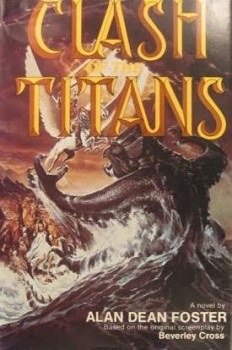 Update: Alan Dean Foster has generously provided some comments of his own about the novelization. Please see the comments section.
2010: The Year We Remake Clash of the Titans.
I have never thought that re-making Ray Harryhausen’s final movie, the 1981 telling of the Myth of Perseus and Medusa, was a smart idea. I don’t, in principle, oppose re-makes (what good would that stance do in these strange times anyway?), but the original Clash of the Titans is a 100% auteur film, a movie that exists because Ray Harryhausen did the stop-motion effects. Harryhausen defines the movie. Any re-make would simply tackle an old myth with new—and not necessarily more interesting—effects to cash-in on Generation X name recognition. And then when I actually read the plot description of the 2010 Clash, I shook my head in mystification . . . this Hades vs. The Other Gods concept is antithetical to Greek Mythology. The original Clash alters many elements of Perseus’s story, but it still feels similar to how the Archaic and Classical Greeks must have imagined their Heroic Age.
A deeper reason that I’m doubtful of the re-tooled Clash of the Titans is the enormous personal investment I have in the original film. No other movie from my childhood has had such a direct effect on my later interests as an adult. Unlike many childhood loves, Clash of the Titans holds up perfectly today; the magic remains, and many scenes still give me shivers. Nostalgia alone does not carry the film; it can carry itself quite proudly.
But . . . I’m not here today to review the original Clash of the Titans. I’m planning to do an extensive analysis of it later this month, but for the first post of 2010 I’ve decided to take a different tactic as a warm-up and approach Clash of the Titans from a side road; a road rarely taken in film or book critiques: the movie novelization.
 Well, entering the year (both in terms of typing the title and having lived to see
 it) was a little weird to write. The first chapter of The Martian Chronicles is January 1999, which from the vantage point of the middle of the 20th century, when the German V-rockets had landed not on another planet, but London, that seemed about right for when humanity might be “reaching for the stars” as it was called. The book ends in April 2026 which, with luck, proper diet and exercise, and health care reform I might actually still be alive to see. And which more than likely humankind, assuming it hasn’t blown itself up, will remain earthbound.
 As some of you may know, I’ve been talking and thinking and blogging (not necessarily in that order) about reading more, and reading better over the course of the last year. Today being New Year’s Day, the day of resolutions and goal-setting, I thought I’d link to some of the posts I’ve written on the subject for those interested in focusing on ratcheting up their reading in the coming year.
 As 2009 comes to an end I find the events of the last twelve months firing past my sub-conscious like the recap sequence before one of those lame “it was all a dream” mini-series endings.
 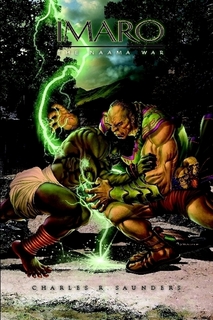 Back when Black Gate‘s editor John O’Neill lived in Ottawa in the early 80s, he was a member of a small SF fan club. His first meeting featured a reading from the editor of an excellent local fanzine, Stardock, who had just completed his first novel. The author was Charles Saunders, the novel was Imaro, and the reading he never forgot.
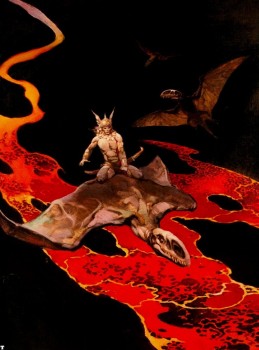 Cameron’s inspirations for AVATAR span the gamut of everything from Edgar Rice Burroughs’ BARSOOM (John Carter of Mars) stories to Lucas’ STAR WARS (which were inspired by FLASH GORDON comic strips, among others), to the deep myths of the Old West, stone-age adventures, Jungle Tales comics, American Indian mythology, and wraps it all in a lush visual style worthy of the master Frank Frazetta himself.
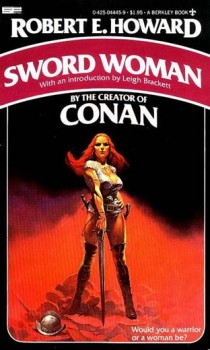 It’s strange that Robert E. Howard’s most famous female character is one he didn’t actually create: Red Sonja, the work of comic book writer Roy Thomas and artist Barry Windsor-Smith, based on the historic adventuress Red Sonya from the story “The Shadow of the Vulture.” Red Sonja has been erroneously credited to Howard for years; even the movie Red Sonja lists him as the creator on the main credits.
 Luke Forney