R&D to SF: Thanks for ruining it for the rest of us!

Although it first filed paperwork in mid April of this year, the news that Samsung was suing Apple (the iPhone guys, not the Beatles label) was rendered strange by one of their arguments. It seems that Samsung was contesting the viability of Apple’s patents for the iPhone and iPad, because a nearly identical device had been seen used on the U.S. space mission Discovery One, way back in 1968.
Yes, that Discovery One. You know, the mission to Jupiter where the HAL-9000 AI had a series of unforeseen technical difficulties and eliminated the human crew, thus putting the U.S. space program on hold until mid 1969, when America renounced its Jovian ambitions and settled for landing on the moon.
Samsung used, in its initial defense of the argument, this clip from a documentary on Discovery One, clearly showing members of the ill-fated crew using an iPad-a-like to stream video feeds while somewhere past Mars orbit. This, Samsung assured the press and the courts, is clear evidence that Apple didn’t invent anything, and that the idea –the actual execution, even– of the iPad had been around long before Apple even existed. So, all of Apple’s patents had to be seen for the shams that they were. Steve Jobs was, in effect, cribbing ideas from doomed U.S. space missions, and profiting from the misfortunes of historical figures.
 “There was a man, Magnus’s son,
 William Hope Hodgson’s Carnacki outlived his creator with a tenacity that Hodgson, a bantam rooster of a man, would have appreciated. Thomas Carnacki, resident of 472 Cheyne Walk, London, first appeared in a series of five stories (“Gateway of the Monster”, “The House Among the Laurels”, “The Whistling Room”, “The Horse of the Invisible”, and “The Searcher of the End House”) in The Idler Magazine in the January through April, as well as June, issues of 1910. But despite Hodgson’s death in World War I, Carnacki carried on in a further four stories (“The Thing Invisible”, “The Hog”, “The Haunted Jarvee” and “The Find”) retrieved from Hodgson’s papers by his wife.

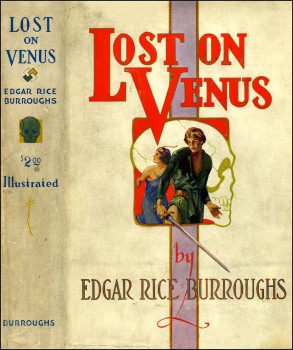 The parade on the second planet continues in Lost on Venus. This is one of the most controversial works that Edgar Rice Burroughs ever published, although it surprises me that enough readers managed to get through the lackluster first book, Pirates of Venus, to want to pick up the sequel and be able to argue about it. But here it is, so get out your anti-tharban gear and be ready to test your genetic purity!