End of Summer Remembrance: The Rocketeer
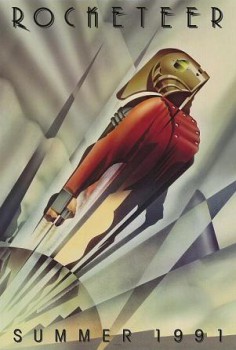 Update: Right as I was posting this review, I received the official news that Disney is releasing a 20th Anniversary Blu-ray of The Rocketeer. It will come out on December 13. No other technical information or details on extras are yet available. Disney should have planned this earlier, but the obvious reason they did it … Captain America. And my telepathic waves sent from writing this review.
The summer is over, and it was a good one at the movies. It was certainly better than 2010, known as the year that Inception made everyone else look like idiots. This year the movies gave us more variety, more base hits, and a few home runs. Unfortunately, it also gave us the tremendous flop of Conan the Barbarian, but in a summer that took one of my beloved characters and put him in a great movie (Captain America: The First Avenger) and also refreshed one of my favorite film series with a stunning new kick-off (Rise of the Planet of the Apes), I have plenty to feel thankful for. Other films I enjoyed: X-Men: First Class, Hobo with a Shotgun, Harry Potter and the Deathly Hallows, Part 2 (and I’m not even much of a Potter fan), Attack the Block, Midnight in Paris, and Thor. I didn’t hate Green Lantern either!
But Captain America is the reason this post exists, because it got me thinking about 1991’s summer surprise and fan-favorite flick, The Rocketeer. The films share the same director, Joe Johnston, who is a natural with this sort of big-hearted, nostalgia-filled, period superhero film.
There is an unfortunate difference between the films, however. Captain America was a hit. The Rocketeer was considered a disappointment in 1991, and Disney ditched plans for a sequel. However, you would never know that the film was a box-office failure based on talking about it with people today. The Rocketeer has enormous fan-love.
 Before continuing the series of posts on Romanticism that I talked about last week, I’d like to write about a couple of subjects I’ve had on my mind for a while. First up is Q.D. Leavis, and her book Fiction and the Reading Public.
 I’m planning a more lengthy post on the role of religion and spirituality in fantasy (expanding on some things I hinted at in my last post, which involved orc samurai), but the last couple weeks have been so crammed with lounging on beaches, jujitsu, and job hunting that I haven’t had the opportunity to give it the work it deserves. So, instead, I present:
 The new

 “There was a man, Magnus’s son,