Back on Solid Ground

Back on Solid Ground

Our beloved founder John O'Neill, just before losing all his money at the shipboard casino.

On Sunday February 5th, I returned to Chicago from a cruise with my family, my first vacation on a cruise liner and my first trip to the Caribbean.

It’s good to be home. The cruise was amazing, but poor weather and rough seas (several days of cruising through 6′ to 9′ ocean swells) eventually took their toll. Surprisingly, I never got seasick, but I did have to abandon a delicious-looking slice of tiramisu when my son abruptly turned green across the dinner table, and rush him back to our cabin. My daughter followed minutes later, looking none too healthy herself.

It wasn’t all bad weather and disappointment. The highlights were the excursions, including a sandbar 15 miles offshore of Grand Cayman where a colony of sting rays — trained by generations of fishermen who’d clean their catch in the quiet waters of the sandbar, and toss tasty fish intestines overboard — races towards any boat that approaches and cuts engines. In waist-deep water my three kids and I were mobbed by dozens of the creatures, which our guide characterized as “just like puppies.” It was an apt description. Want to know just how diverse life is on this planet? Gaze into the alien eyes of a four-foot sting ray resting in your arms before it darts off. Amazing.

My children won’t soon forget our dolphin encounter in the Honduras, either. We played with my new best friend, a 450-pound dolphin named Mauri, in the shallow waters of Anthony’s Key resort on the island of Roatan, and swam with her pod for nearly an hour. Magical. I was also taken with the Mayan ruins of Coba on the Yucatan peninsula in Mexico, although it was a considerable hike into the jungle to reach them. Well worth the trip.

Most of the time I spent reading, however (and checking on my queasy patients, tucked into their bunks). I didn’t finish half of the books I brought, but I was delighted to finally read The Dragon Masters by Jack Vance, and No Truce With Kings by Poul Anderson.  I was also captivated by Harry Connolly’s first novel, Child of Fire, which I read on my Kindle. If I have time, I’ll discuss more of my fiction discoveries here. But first, I have about 350 unanswered e-mail to dig through.
I’ll Look Down and Whisper “No”: “Before Watchmen”

I’ll Look Down and Whisper “No”: “Before Watchmen”

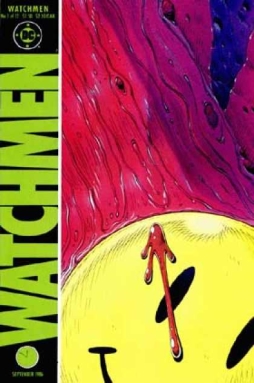
Watchmen 1Last Wednesday, DC Comics announced a new publishing venture: “Before Watchmen,” a set of related miniseries that would act as a prologue to the best-selling and critically acclaimed Watchmen graphic novel. The news was met with a considerably mixed reaction. Alan Moore, writer and primary creator of Watchmen, has spoken out against the project. Personally, I’m not going to buy any of DC’s new series, and I want to explain why.
First, some more details. From The Beat website, a list of titles and creators:

Rorschach (4 issues) – Writer: Brian Azzarello. Artist: Lee Bermejo
Minutemen (6 issues) – Writer/Artist: Darwyn Cooke
Comedian (6 issues) – Writer: Brian Azzarello. Artist: J.G. Jones
Dr. Manhattan (4 issues) – Writer: J. Michael Straczynski. Artist: Adam Hughes
Nite Owl (4 issues) – Writer: J. Michael Straczynski. Artists: Andy and Joe Kubert
Ozymandias (6 issues) – Writer: Len Wein. Artist: Jae Lee
Silk Spectre (4 issues) – Writer: Darwyn Cooke. Artist: Amanda Conner

“Before Watchmen” starts sometime this summer, with one comic to be released per week. Each book will have a two-page back-up feature, “The Curse of the Crimson Corsair,” written by Wein, who edited the original Watchmen, with art by John Higgins, who coloured the series. An epilogue featuring a number of writers and artists will wrap up the event.

Read More Read More

Steampunk Spotlight: Cherie Priest’s Dreadnought

Steampunk Spotlight: Cherie Priest’s Dreadnought

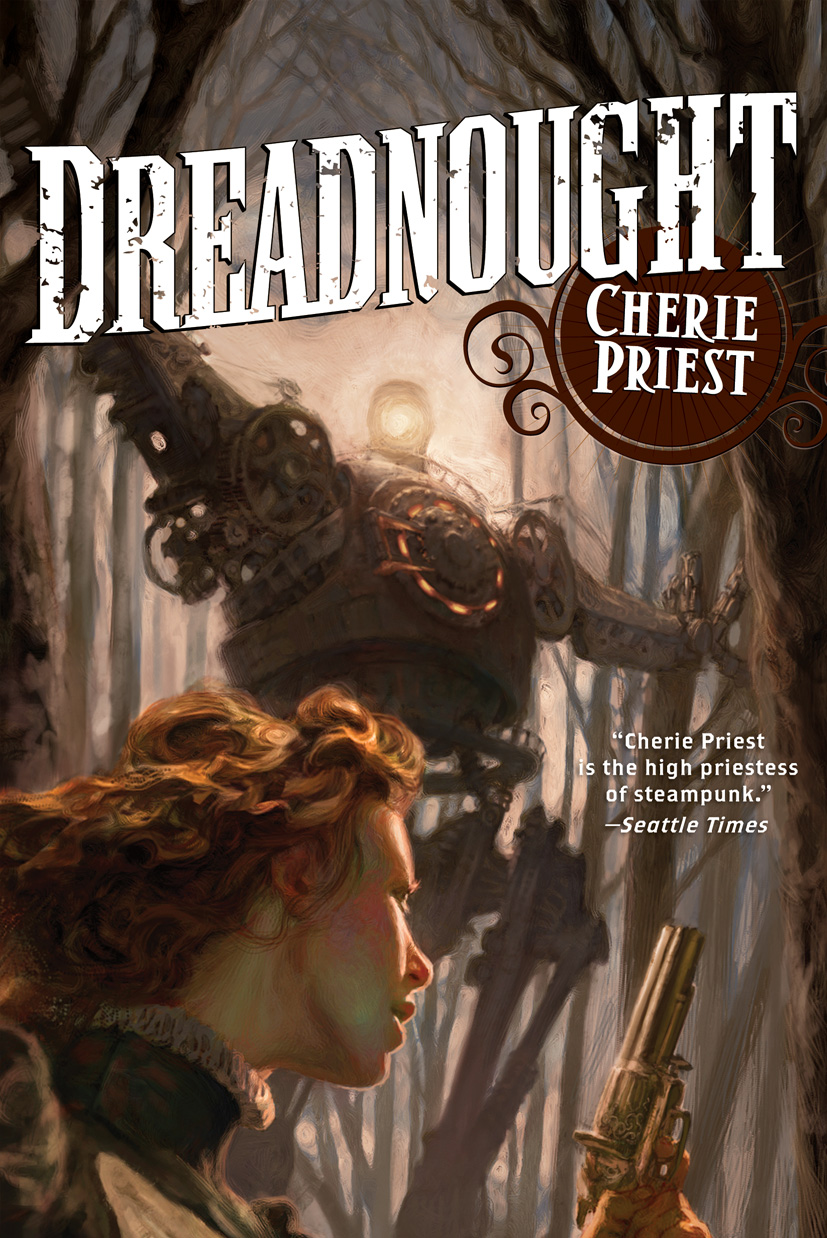
dreadnoughtDreadnought (Amazon, B&N)
Cherie Priest
Tor (400 pp., $14.99, 2010)

Reviewed by Andrew Zimmerman Jones

Cherie Priest returns to her “Clockwork Century” in full force in this third novel. In some ways, I would recommend that readers begin with Dreadought, even though it’s the third book in the series. Basically, the plot twist at the end of Dreadnought is the entire premise of Boneshaker, as I’ll explain later in the review. (Spoiler-ish alert!)

The book focuses on Mercy Lynch, a Confederate nurse whose husband has just died fighting for the Union. (Gotta love those border state romances!) She receives word from her father – who left her as a child – that he is dying, and he would like her to visit him in the Washington territory. That father is Jeremiah Swankhammer, who readers of Boneshaker will recognize as one of the key characters in that story.

With nothing really to keep her in Virginia, she sets off on a cross-country journey by airship and train to reach Tacoma and, ultimately, Seattle.  Unfortunately, the only train that can get her from St. Louis to Tacoma is the Union steam engine Dreadnought, and the train is carrying some bizarre cargo … cargo which makes the train trip into a harrowing ride that brings Mercy and the other passengers into conflict with bushwackers, a mad scientist, and even zombies!

Read More Read More

Mark Rigney Reviews The Holler

Mark Rigney Reviews The Holler

the-hollerThe Holler
Marge Fulton
BlackWyrm Press (87pp, $11.95, 2010; kindle edition $2.99)
Reviewed by Mark Rigney

Brevity, observed Shakespeare in the ghost story known as Hamlet, is the soul of wit. Does it follow that it is also the soul of horror fiction? Writers as diverse as Shirley Jackson (“The Lottery”) and Jeffrey Ford (“The Night Whiskey”) rise at once to make the case for the sharp, jabbing effects of short-form terrors. Now enter Marge Fulton with The Holler: Tales of horror from Appalachia. Fulton’s arsenal starts with brevity in the extreme. The book’s eighty-seven pages pack twenty-four separate stories.

“Black Santa” opens the set with a deaf dreamer trying to regain the toy she lost as a child, getting it, and discovering that once you have Santa for a toy, the gifts just keep on giving. Hardly a horrific opener, except for the tawdry semi-Southern Gothic feel, and the next in line, “Preying Hands,” turns out to be science fiction (of the murderous fat camp variety). A haywire ATM spurts blood in “Blood Bank,” for reasons as yet undivulged, but we know this is Appalachia because leading lady Bree frequents the Boone Ridge Mini-Mart and the Nearly New Shop while, in another tale, a character slurps Mountain Dew.

Read More Read More

The Future of Bookstores Latest Update

The Future of Bookstores Latest Update

29-barnes-jp4-articleinlineSo it now it seems publishers are counting on Barnes and Noble to help them stay in business.  Which is funny because it wasn’t that long ago when Barnes and Noble was a slayer of independent bookstores and an enemy of the books business; now it’s considered the only thing that stands in the way of total world domination by Amazon.

Interesting that the notion of a bookstore is beginning to look more and more like an Apple store. Which is not necessarily a bad thing. My kid just got a Nook and she goes to our local Barnes and Noble because she can read certain e-books online for free there. Meanwhile she can consume some mocha lattes and maybe even take home a real book. Like everyone else I shop on-line, but the atmosphere of a bookstore leads to impulse buys that isn’t the same as scanning some algorithm’s suggested reads.

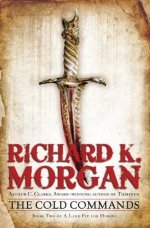
Speaking of physical books, I just finished Richard Morgan’s The Cold Commands, Book Two of presumably a trilogy ironically titled A Landcc Fit for Heroes (in which the land is neither fit for heroes nor populated with behavior typically classified heroic) by Richard K. (whose middle initial is used on book jackets only on the American side of the pond for some reason) Morgan describe it as “genre busting.” That’s not just some publicist’s hyperbole.  You can read the complete review over here at the SF Site.
Blogging Alex Raymond’s Flash Gordon, Part Nineteen – “Fiery Desert of Mongo”

Blogging Alex Raymond’s Flash Gordon, Part Nineteen – “Fiery Desert of Mongo”

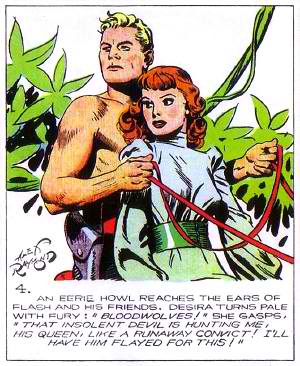
fiery-desertqueendesira2“Fiery Desert of Mongo” was the nineteenth installment of Alex Raymond’s Flash Gordon Sunday comic strip serial for King Features Syndicate. Originally published between November 8, 1942 and July 11, 1943, “Fiery Desert of Mongo” picks up where the preceding installment, “Jungles of Mongo” left off with Prince Brazor trailing Queen Desira to the border of Tropica’s Flaming Desert.

Flash causes an avalanche to delay Brazor’s men. The river of lava and the fire dragon that lurks within menace the fugitives as they proceed into the increasingly unbearable heat of the Flaming Desert. A volcanic eruption nearly finishes them off. Flash escapes to safety by managing a broad jump of over thirty feet. Alex Raymond and script writer Don Moore make the escape from the volcanic eruption a tension-filled drama that makes one forgive the implausibility of Flash’s near-superhuman feat.

As they near the edge of the Flaming Desert, the fugitives run out of water. A delirious Flash sees pixies emerge from a volcano and float through the air and set upon him, beating him senseless. On the verge of collapse, they are rescued by desert raiders.

Read More Read More

Transcendent Fantasy, or Politics as Usual?

Transcendent Fantasy, or Politics as Usual?

My Black Gate post this week is not a review, nor an essay proper, but a question: Is it possible for fantasy to move beyond the political? Or because it is written by authors of a particular time and place, must fantasy—however fantastic its subject matter—forever remain trapped within the circles of our own world?

China Mieville
China Mieville

China Mieville and others say that no, you cannot read fantasy except through the lens of politics, and that there is no escape. In this interview from 2000, Mieville says:

The problem with escapism is that when you read or write a book society is in the chair with you. You can’t escape your history or your culture. So the idea that because fantasy books aren’t about the real world they therefore ‘escape’ is ridiculous. Fantasy is still written and read through the filters of social reality. That’s why some fantasies (like Swift’s Gulliver’s Travels) are so directly allegorical–but even the most surreal and bizarre fantasy can’t help but reverberate around the reader’s awareness of their own reality, even if in a confusing and unclear way.

I think that as we’ve grown more secular and rational fantasy is following suit. Led by writers like George R.R. Martin and Joe Abercrombie, fantasy has become less whimsical and more historical, less hopeful and more gritty and pessimistic. Many “fantasies” now actively grapple with issues like racism and misogyny, or conservatism vs. liberalism, which lurk beneath the veneer of strange secondary worlds that in other fundamental ways closely resemble our own.

Read More Read More

Matthew David Surridge Reviews The Last Page

Matthew David Surridge Reviews The Last Page

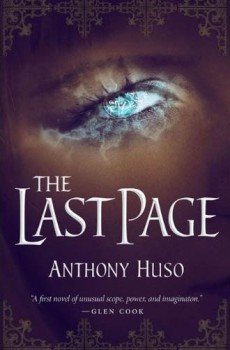
the-last-page-husoThe Last Page
Anthony Huso
Tor (431 pp, $25.99, 2010)
Reviewed by Matthew David Surridge

Anthony Huso’s debut novel The Last Page is something of a problem. It’s not that it is a bad book; in many ways, it is quite a good one. In fact, it is good enough, creative enough, smart enough, that it raises expectations. You want it to be great. And that is the problem, because I don’t think it is.

The Last Page is a high-fantasy steampunk novel, and a love story. We follow the sexually charged relationship between the improbably named Caliph Howl, heir to the throne of the northern country of Stonehold, and a witch named Sena. The two of them meet at university, go their own ways, and then come together again after Caliph has become king and Sena has acquired a vastly powerful magical tome. Unfortunately, Caliph is facing a civil war against a national hero, and Sena’s book has a lock which can only be opened at a fearsome emotional cost.

Read More Read More

Goth Chick News: Taking the Week Off

Goth Chick News: Taking the Week Off

image0023The interns are between semesters, the temperatures in Chicago are sub-zero and most important, the Boss is in Belize.

Belize…?  What’s in Belize?  Anybody?

Well, no matter.  What we have here is the perfect storm of opportunity to take the week off and get ready for Goth Chick News’ second busiest season besides Halloween.

Convention season.

In the coming weeks I’ll be road-tripping to St. Louis to cover the 2012 Halloween Costume and Party Show, chatting up the disturbing participants of C2E2 and joining my fellow Black Gate staffers at something called Capri-con (where I’ll appear incognito to see what all you Sci-Fi-er’s get up to when you get together).

Until then, it’s frozen blender drinks and days nights on the sand.

See you next week.

Are you hitting up any conventions this year?  If so, which ones?  Post a comment or drop a line to sue@blackgate.com.

Fantasy Out Loud – Part II

Fantasy Out Loud – Part II

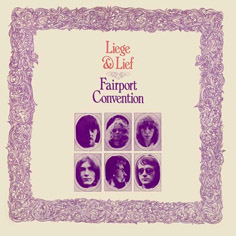
bgfairport-liege-liefYes, Black Gate’s focus is on the literature of the fantastic. But sometimes, fantasy needs a soundtrack.

In my first installment of “Fantasy Out Loud,” I focused on the act of reading adventure fantasy aloud. To children, by and large. But what happens once the darling tots are tucked into bed, with visions of sugarplums (or online MMO’s) dancing in their heads?

I’ll tell you what happens. I go downstairs and crank up the music. And what makes it onto the stereo more often than not? The music of the fantastic.

I’m not referring to film soundtracks, no, nor Wagnerian opera, though both surely count as fantastical (and I hope to treat both in future editions of “Fantasy Out Loud”). No, I’m talking here about rock music and its venerable forbear, folk. Folk music, with special attention here to the tradition of the British Isles, is positively rife with fantasy settings and tropes: swordplay (of both kinds), fairy abductions, marauding giants, the works.

Read More Read More