Jinnrise and the Game of Life

Jinnrise and the Game of Life

Jinnrise #1-small“The game of life’s about us all…wherever we are or wherever we’re from.” Jinnrise, my comic book series published by IDW Publishing, was inspired by this mantra and line from issue #1. The best of stories, those that resonate throughout the ages, start with the seeds of a theme.

Informed by the writer’s passions and experiences, the essence of the story springs forth. Such was the case for me.

Growing up in a mixed heritage household, I found myself drawn to novels, comics, and films that celebrated our common humanity. Fears, hopes, nightmares, and dreams: the ties that bind were what fascinated me the most. The outer trappings and vehicles of storytelling? In the short term, they didn’t really matter.

As I became a more discerning fan of genre entertainment, I grew less and less excited about the tentpole projects being announced year after year. Conventions like San Diego Comic-Com were no longer celebrations, but yearly commentaries on the growing stagnancy in science fiction and fantasy.

How many stories with zombies, vampires, robots, and wizards could one enjoy without being overwhelmed by déjà vu?

Read More Read More

Some Mysteries You Don’t Want to Solve: Exploring Dead Rock Seven

Some Mysteries You Don’t Want to Solve: Exploring Dead Rock Seven

dead-rock-sevenOne of the most popular gaming articles I’ve written in the last year was my review of Robin D. Laws’s Ashen Stars, the new science fiction RPG from Pelgrane Press. Month after month, that review has been creeping up the traffic charts.

It’s not hard to see why. Ashen Stars is one of the best new SF games on the market — and one of the best new RPGs in any category. It was a winner in the “Best Setting” category in the 2012 ENnie Awards and Pelgrane Press has continued to support it with top-notch adventures and other supplements. It’s taken a while to catch on, but the industry is starting to notice.

Here’s what I said, in part, in my October review:

Robin D. Laws has created an extremely appealing game of space opera procedural mysteries. In the tradition of the best hard boiled detective fiction, players are constantly scrambling for money, equipment, and respect… all of which they’ll need to succeed in a war-ravaged perimeter where trust is a precious commodity, and very little is truly what it seems.

The players in Ashen Stars are private eyes — excuse me, licensed mercenaries — acting as freelance law enforcement on a rough-and-tumble frontier called “the Bleed,” where humans and half a dozen alien races mingle, compete, and trade. The Mohilar War that devastated the once powerful governing Combine ended seven years ago, and no one is sure exactly how. The Combine is in no shape to govern the Bleed, and rely on loosely-chartered bands like the players to maintain peace in the sector, keep a lid on crime, and investigate odd distress signals from strange corners of space…

The writing and color art are impressive throughout, and the book is filled with fascinating tidbits that will make you anxious to play, and re-introduce you to the essential joy of role playing.

Given a game with that much promise, I was anxious to see what kinds of adventures would arrive to really flesh it out. Now I finally have my hands on the first major campaign for the setting, Dead Rock Seven, a set of four scenarios by Gareth Hanrahan, and I’m pleased to report that I’m not disappointed.

Read More Read More

‘Masterfully Told’: Tangent Online on “The Keystone”

‘Masterfully Told’: Tangent Online on “The Keystone”

AppleMarkLouis West at Tangent Online reports on the final chapter in Mark Rigney’s The Tales of Gemen saga, published here on August 4th:

The quirky yet relentless Gemen finally completes his life-long mission to rebuild the portal through which his sister had disappeared so long ago. Except, once the portal is reconstructed, nothing goes as Gemen had planned. This masterfully told story closes out this trilogy yet opens possibilities for continued Gemen adventures since, as Gemen himself concludes, “the world is once more in play.”

The tension never stops, starting with nightmares, followed by chases across half the world, as two forces pursue Gemen and his party. The Corvaen seek justice for wrongs Gemen has visited upon them, and the Thornland Raiders, merciless reavers from a long-abandoned land, are zealously bent on destroying Gemen…

Once I started reading, I couldn’t stop. I highly recommend the complete trilogy.

“The Keystone” is the third and final installment of The Tales of Gemen, which opened with “The Trade,” which Tangent Online called a “Marvelous tale. Can’t wait for the next part” — and “The Find,” which Tangent called “Reminiscent of the old sword & sorcery classics. I can’t wait to see what fate awaits Gemen. A must read.”

The complete catalog of Black Gate Online Fiction, including stories by Vaughn Heppner, Mark Rigney, Aaron Bradford Starr, Jamie McEwan, Martha Wells, Mary Catelli, Nina Kiriki Hoffman, E.E. Knight, C.S.E. Cooney, Howard Andrew Jones, Harry Connolly, and many others, is here.

“The Keystone” is a complete 15,000-word tale of weird fantasy. It is offered at no cost. Read the complete story here.

New Treasures: Pile of Bones by Bailey Cunningham

New Treasures: Pile of Bones by Bailey Cunningham

Pile of Bones Bailey Cunningham-smallUsually when I’m looking for new reading material, I turn to one of my old favorites. Or I’ll try the latest novel by a BG contributor, or by an author I’ve met recently at a convention. It’s a rare thing these days when I crack open a book by someone I know absolutely nothing about. But sometimes I miss those days when the whole field was new and I approached every book with no expectations — nothing but a willingness to be entertained and transported. In those days, I was constantly delighted, surprised by almost every book I read.

And you know what? I think the two are connected.

Once upon a time, every author I tried was new and all I knew was wonder and magic. Now I read exclusively the same small circle of authors and very little surprises me anymore. So to recapture that wonder again, I try the simplest thing: I read new authors. Writers like Bailey Cunningham, whose first novel, Pile of Bones, first in the Parallel Parks series, was just released by Ace Books.

In one world, they’re ordinary university students. In another world, they are a company of heroes in a place of magic and myth called Anfractus…

The Cree called the area Oscana, “pile of bones,” a fertile hunting ground where game abounded. The white settlers changed that to Wascana. And centuries later, it became Wascana Park, a wooded retreat in the midst of the urban sprawl of Regina.

For a select few, who stay in the park until midnight, the land reverts into a magical kingdom, populated by heroes and monsters. They become warriors, bards, archers, gladiators. In the city called Anfractus, they live out a real-life role playing game.

All harmless fun — until they find themselves in the middle of an assassination plot which threatens to upset the balance of everything. Politics are changing, and old borders are about to disappear. The magic of Anfractus is bleeding into the real world — an incursion far more dangerous than the students suspect. Only they know what is happening — and only they can stop it…

Pile of Bones was published July 30th by Ace Books. It is 321 pages, priced at $7.99 for both the paperback and the digital version. The sequel is Path of Smoke.

Deepest, Darkest Eden: Return to Hyperborea

Deepest, Darkest Eden: Return to Hyperborea

HyperboreaCoverDEEPEST, DARKEST EDEN: New Tales of Hyperborea is a new fantasy anthology from Miskatonic River Press. Editor Cody Goodfellow has assembled 17 stories (and two poems) set in the primordial world of Clark Ashton Smith‘s Hyperborea.

Although it officially launches this month at the Rhode Island NecronomiCon, the book is available right now through Amazon. Here is the Table of Contents:

Nick Mamatas – “Hostage”
Joe Pulver – “To Walk Night…Alone”
Darrell Schweitzer – “In Old Commoriom”
Ann K. Schwader – “Yhoundeh Fades” (poem)
Cody Goodfellow – “Coil Of The Ouroboros”
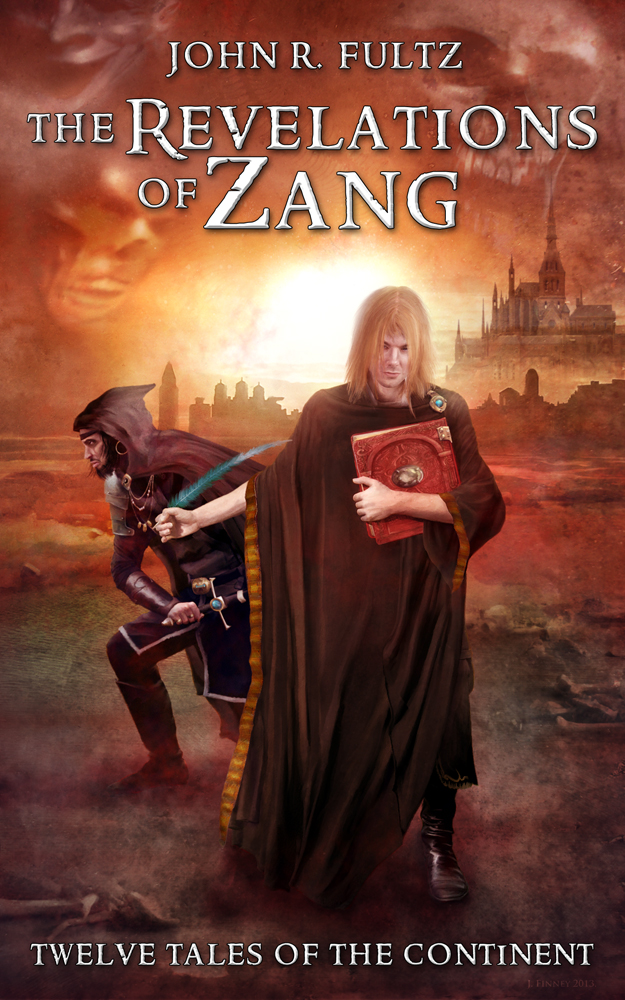
John R. Fultz – “Daughter Of The Elk Goddess”
Brian R. Sammons – “The Darkness Below”
Dieter Meier – “The Conquest Of Rhizopium”
Lisa Morton – “Zolamin And The Mad God”
Brian Stableford – “The Lost Archetype”
Ran Cartwright – “One Last Task For Athammaus”
Don Webb – “The Beauties Of Polarion”
Robert M. Price – “The Debt Owed Abhoth”
Marc Laidlaw – “The Frigid Ilk Of Sarn Kathool”
Charles Schneider – “The Return Of The Crystal”
John Shirley – “Rodney LaSalle Has A Job Waiting in Commoriom”
Zak Jarvis – “The Winter Of Atiradarinsept ”
Jesse Bullington – “The Door From Earth”
Ann K. Schwader – “Weird Of The White Sybil” (poem)

Most of Smith’s original Hyperborean tales ran in WEIRD TALES in the 1930s. They featured lost cities, haunted jungles, strange sorcery, and terrible demon-gods such as Tsathoggua and Abhoth. His entire cycle of these tales was gathered into a single volume first in 1971’s HYPERBOREA from Ballantine Books, then again in 1996 for THE BOOK OF HYPERBOREA from Necronomicon Press.

(See the entire wrap-around cover after the jump…)

Read More Read More

ARAK Issue # 6: “The Stalkers of the Snows”

ARAK Issue # 6: “The Stalkers of the Snows”

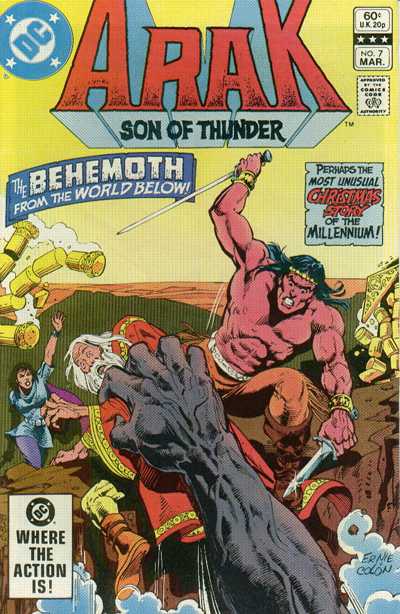
ARAK6CRight off the bat (no pun intended), the cover tips us off that this issue will feature the blood-sucking undead!

In the eerie blue glow of the full moon, a vampire swoops down on sword-drawn Arak like a bomber lugging twin torpedoes. And, oh dear, those sharp fangs aren’t the only pair of pointy objects poised to pierce Arak or poke his eyes out. (Yeah, they’re hard to miss, framed as they are by the yellow moon.)

[Okay, the adolescent male has been sent back to his room in my psyche; now let’s summarize this issue with less juvenile eyes, shall we?]

We don’t get to any vampires until 19 pages in; this issue fits a recurring pattern of narrative structure that reserves the monster-of-the-month for the last five pages or so, while the first four-fifths of the issue covers court intrigue and character development that furthers the overarching plot.

Arak returns from being demon-flung out of the sorceress Angelica’s tent the night before, arriving at Carolus Magnus’s jousting tournament just in time to reveal to the Twelve Peers that Angelica’s brother Argalia cheated by using sorcery when he defeated the champion Rinaldo last ish. Also, by the way, her demons have carted off one of the Twelve, the court magician Malagigi, to White Cathay.

Most of the Twelve (well, they’re down to ten now, since one seat has been mysteriously empty and, of course, poor old Malagigi is a hostage to goat-footed devils) dismiss the charges of the “savage heathen,” since it is his word against Angelica and Argalia, who are both nobility and allegedly Christian.

The ensuing exchange rather amusingly ticks off Arak, who lays out a good case of circumstantial evidence and shows himself to be smarter than just about all the rest of them combined. Even Valda, usually stoically silent, intervenes, telling the rest of her Peers that they should heed the words of Arak.

All this gets her is a snickering remark from the Bishop: “Well, now! It seems rave Valda is smitten with the young savage!” Another one chimes in, “Perhaps we should call her the ‘Iron Maiden’ no more, eh?” Nudge nudge wink wink. Man, and you thought I was juvenile! These guys need a serious come-uppance.

Read More Read More

Vintage Treasures: The Best of Edmond Hamilton

Vintage Treasures: The Best of Edmond Hamilton

The Best Of Edmond Hamilton-smallEdmond Hamilton is my favorite pulp writer and he has been since I read the chilling short story “The Man Who Evolved” in Before the Golden Age. (Read the complete story online at The Nostalgia League.)

That’s a long time, especially considering how many pulp tales I’ve read in the intervening years. But Hamilton had a lengthy and productive career — he was one of the few writers to survive both the coming of Campbell, who ushered in the Golden Age of Science Fiction, and the death of pulps more than a decade later.

Hamilton’s first published story, “The Monster-God of Mamurth,” appeared in the August 1926 issue of Weird Tales. It was a fully realized tale of eldritch horror, following the exploits of a group of explorers who discover a legendary lost city in the desert and the sinister spider-things who inhabit it still.

When we began including reprints in the print version of Black Gate, “The Monster-God of Mamurth” was the second one we chose, and it appeared in BG 2, with all-original art by Allen Koszowski (see one of the magnificently creepy illos he did for us here).

Hamilton quickly became one of Weird Tales‘ most popular and prolific writers, appearing alongside H. P. Lovecraft and Robert E. Howard. All told he sold 79 stories to Farnsworth Wright and the magazine’s later editors between 1926 and 1948; only Seabury Quinn and August Derleth appeared more often in the magazine’s pages.

According to his ISFDB page, Hamilton wrote exactly 200 short stories for the magazines between 1926 and his death in 1977. He appeared in virtually all the science fiction and fantasy pulps, including Air Wonder Stories, Wonder Stories, Thrilling WonderSuper Science Stories, Amazing Stories, Fantastic Science Fiction, and many others.

Read More Read More

Black Gate Online Fiction: “The Serpent of Thep” by Vaughn Heppner

Black Gate Online Fiction: “The Serpent of Thep” by Vaughn Heppner

oracle of gogThe young warrior Lod, last seen here in “The Oracle of Gog” (Black Gate 15) and “The Pit Slave,” returns in a fast paced tale of sword & sorcery on the high seas.

Eglon paced the stern deck. Subdued archers and soldiers sat in clumps about the galley, whispering and casting fearful glances at the captain’s cabin. They were alone in the vast sea, a small island of rotten, creaking wood.

Then an eerie moan emanated from the captain’s cabin. Wood rattled and a harsh red light poured through the chinks between the boards. The hellish glare startled the soldiery, many crying out and pointing. The moan became a high-pitched scream. The shadows nearest the cabin flickered as if with infernal life. The scream lasted too long. It stretched impossibly, and then the wicked light snapped off and the scream died.

“Necromancy,” whispered Eglon.

SF Site called Lod “a cross between Conan and Elric of Melniboné,” and Louis West at Tangent Online called “The Pit Slave” “classic sword & fantasy.”

Vaughn Heppner has written Amazon best sellers such as Star Soldier, Invasion: Alaska and People of the Ark. His new SF novel, Assault Troopers, is hitting the top of some Amazon SF categories and Alien Honor, the latest in his Doom Star universe, will be released on November 26.

The complete catalog of Black Gate Online Fiction, including stories by Mark Rigney, Aaron Bradford Starr, Jamie McEwan, Martha Wells, Mary Catelli, Michael Penkas, Nina Kiriki Hoffman, E.E. Knight, C.S.E. Cooney, Howard Andrew Jones, Harry Connolly, and many others, is here.

“The Serpent of Thep” is a complete 11,000-word novelette of sword & sorcery offered at no cost.

Read the complete story here.

Animal Stories: Johanna Sinisalo’s Troll: A Love Story

Animal Stories: Johanna Sinisalo’s Troll: A Love Story

Ennen päivänlaskua ei voiA few years ago, a cat came to live with me under unexpected circumstances. (This is getting around to a look at a fantasy novel, and no the novel has nothing to do with cats as such, and yes I have a point.) I’d never had a pet when I was young, so I suddenly found myself dealing with a new range of experiences and emotions; and found also that the depictions in most media of relationships between pets and their humans were notably lacking. There’s a complexity of living with, and to an extent being responsible for, a non-human animal. You have to learn about (and sometimes worry about) diet and medical needs and what certain behaviour patterns mean. You have to learn how to communicate with a creature that does not use words — but which may be surprisingly good at understanding emotions in a voice. These sort of things are rarely shown in most stories about humans and animals, but they’re a crucial part of the experience of dealing with a pet.

Which brings me around to Johanna Sinisalo’s book Ennen päivänlaskua ei voi, a Finnish book translated into English in 2003 by Peter Owen as Not Before Sundown and then again the same year by Herbert Lomas as Troll: A Love Story. The book won the 2000 Finlandia Prize for best novel written by a Finnish citizen and was one of the winners of the 2004 Tiptree Award, apparently in the Owen translation. I read the Lomas version, and was impressed by the prose and structure, by the book’s conceptual flexibility and symbolic heft, and by Sinisalo’s depiction of a man coming to learn to live with an inhuman creature — specifically, a troll. It’s not quite a ‘pet’ in the sense of a domesticated animal, and the relationship between man and troll is certainly different than that of the usual human and pet. But some of what the main human character feels and does is recognisable to me as somebody who lives with a cat.

And I think that kind of relationship informs the basic theme of the book: otherness and the things one person projects on another. Sinisalo’s book acknowledges that the most profoundly ‘other’ creatures around us are the animals we call ‘pets.’ They are adopted members of our families; but do not share the biology that makes us what we are, and that shapes how a human thinks. Their thought processes are alien to us. We try to understand them, we think we come to know them, but for all our good intentions probably still can’t help but project ourselves onto them. That tendency to project fears, hopes, and narratives onto others is I think what drives Sinisalo’s book.

Read More Read More

Revisit Pavis: Gateway to Adventure

Revisit Pavis: Gateway to Adventure

Pavis Gateway to Adventure-smallLast April, Sarah Newton wrote a marvelous two-part review of Moon Design’s Pavis: Gateway to Adventure, the third (and easily the most massive) edition of a fantasy setting I first enjoyed 30 years ago.

Getting my hands on one proved to be more challenging than I expected, however. Apparently, the first printing sold out quickly and I had to wait until it was reprinted. Finally, more than a year after Sarah’s enticing review appeared here at Black Gate, I was able to sit down with my own copy.

Why was I so intrigued? Partly it was memories of that marvelous first edition, a gorgeous boxed set from Chaosium. Pavis was one of the most ambitious RPG adventure supplements ever made when it appeared in 1983: a completely realized bronze age city, packed with historical detail, strange cultures and cults, maps, thieves, profiteers, and adventurers.

Most important of all, however, Pavis was a launching point for adventure in Big Rubble, its sister publication, a ruined city overrun by trolls, snakes — and much worse things. The subtitle of the new edition is “Gateway to Adventure,” and that’s a wholly accurate description.

The new edition combines both Pavis and Big Rubble under a single cover, adding a host of new material on top of an already well-realized setting.

The result is a terrific product, with more tightly-woven encounters and plot threads and everything you need to kick off a grand adventure.

Read More Read More