Daughter of the Bright Moon by Lynn Abbey
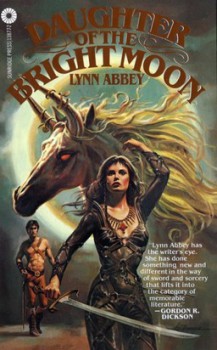 Daughter of the Bright Moon (1979) by Lynn Abbey has been sitting on my swords & sorcery to-be-read pile for a long time. One of the main goals I set for myself when I started blogging was to read all the classic era S&S I could. Not only does DotBM date from S&S’s golden age in the 1970s, its hero, Rifkind, is one of the earlier sword-swinging women. This was a book that demanded a look.
Even with all that going for it, I didn’t get to it until last week. Every now and then, I felt like it was staring at me, admonishing me for not having read it already. I mean, I’ve known about it since I read a fun write-up on Rifkind in the Giants in the Earth column in Dragon Magazine #57 and my dad actually had a copy in the attic.
I even started it last year, but stopped after a chapter or two. I don’t know why… I liked it, but maybe something shiny caught my eye.
Warrior women characters have been around forever. There are the myths of the Amazons and the valkyrie. In real life, of course, there was Joan of Arc.
Jirel of Joiry was the first swordswoman to star in her own stories. C. L. Moore created her kick-ass French noblewoman in 1934, but for decades after that you really had to dig to find fighting women as the lead protagonists.
 As Stephen King once observed, horror has a short shelf life. What scares us today will lose its impact tomorrow. The shock of the new will wear off, the fear of the unknown dispelled by our having come to know it.
 Of the many useful terms suggested by John Clute in The Encyclopedia of Fantasy, perhaps the most useful is the idea of ‘thinning.’ Clute sees certain archetypal patterns frequently recurring in fantastic fiction and thinning’s a part of that. It is the lessening that afflicts threatened fantasylands, a type of diminishment. It’s the fading of magic, the passing of the great old order. Sometimes, eventually, the greatness of the past is restored, though perhaps in a different form.