Eccentric in Retrospect: Helen Simpson’s The Woman on the Beast
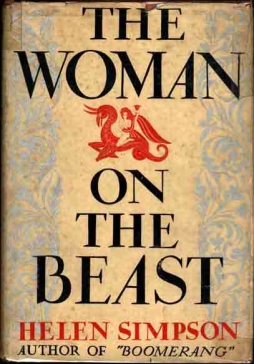 One of the distinct pleasures of used-book sales is finding an old book about which you know nothing, and making a cheap gamble: a literary bet that the story will prove worth the coin. You hope it pays off with unsuspected greatness, but for me as a reader the bet’s covered if I find something memorably strange. Not necessarily greatly strange, but eccentric, interesting, and outside the received narratives of literary histories (and genre histories past). Which brings me to Helen Simpson’s 1933 novel The Woman on the Beast: Seen From Three Angles.
According to the online Australian Dictionary of Biography, Simpson was born in Australia in 1897, went to England in 1914 to study, published some short plays, and returned to Australia in 1921, where she began publishing poetry, plays, and novels. She divided her life between Australia and England, and in 1939 was selected to be the Liberal candidate for Parliament for the Isle of Wight. Unfortunately she soon fell ill, and ultimately died of cancer in 1940. Among her prolific output were 1932’s Boomerang, which won the James Tait Black Memorial Prize for Fiction, and two books filmed by Alfred Hitchock: 1937’s Under Capricorn, and 1929’s Enter Sir John (written with Clemence Dane), which reached screens under the title Murder! (Her 1935 novel Saraband For Dead Lovers was also made into a movie, Saraband, in 1948.)
And then there’s The Woman on the Beast, which is strangeness of a different order: science fiction mixed with Christian fantasy. A preface lays out the theme — “that the most hateful actions are, as often as not, performed for the best of reasons” — and states that the book’s three stories have only that idea in common. After a prologue set in the dark ages, the three stories in question follow, set in India in the sixteenth century, in France during the Revolution, and in Australia in 1999. Then there’s a brief epilogue, depicting, as you might expect from the title, the Apocalypse. But which also makes clear that the three stories have more than theme in common.