Browsed by
Category: Vintage Treasures

The Mind and Soul of an Honest Creator: Paul Di Filippo on Robert Moore Williams

The Mind and Soul of an Honest Creator: Paul Di Filippo on Robert Moore Williams

Time Tolls for Toro-smallOver at Locus Online, author Paul Di Filippo reviews the latest in the Masters of Science Fiction line from Armchair Fiction, Time Tolls For Toro and Other Stories by Robert Moore Williams, which collects a nice assortment of pulp fiction from Super Science Stories, Amazing Stories, Fantastic Universe, Planet Stories, and Imaginative Tales from 1950 – 1959.

Like a combination of Asimov’s robot stories and Simak’s robot stories, “The Soul Makers” (Super Science Stories, 1950) takes us to the far-off year of 1987, in the middle of an atomic war. Humanity’s sentient robots are going AWOL, and the two men sent to discover the reason uncover more than they anticipated. Williams extracts a fair measure of pathos from the noble actions of the robots, and the inevitable doom and rebirth of humanity… “The Diamond Images” (Fantastic Universe, 1959) is one of those “Old Venus” tales so common in the consensus future history of this era. A butterfly collector named Wolder has made friends with the seemingly unsophisticated Venusians after eight years among them. But then his son arrives, unwittingly leading pirates to the treasure of the natives…

There’s an almost Ballardian feel to the opening of “To the End of Time” (Super Science Stories, 1950). A Venusian song, brought back to Earth, is literally driving people insane. Into the jungle wastelands of Venus, our psychologist hero Thorndyke sets out to find a cure, encountering a strange race of Venusians and the human missionary and his beautiful daughter who minister to them…

Reading this volume is no chore or dull swotting up of past history for academic purposes. The stories, however creaky at times, remain very entertaining and illustrative of the mind and soul of one honest creator, doing the best he could to enrich the soil of the genre.

Read the complete article here. We covered the launch of Armchair Fiction back in January 2012 and Paul’s review of Masters of Science Fiction Vol. #8, Milton Lesser’s A is for Android, last May.

Masters of Science Fiction, Volume Ten: Time Tolls For Toro and Other Stories by Robert Moore Williams was published by Armchair Fiction on January 22, 2014. It is 320 pages, priced at $16.95 in trade paperback. There is no digital edition. No word on who did the cover… Emsh, maybe?

Goth Chick News: An Anniversary Edition of the Ultimate Novelization

Goth Chick News: An Anniversary Edition of the Ultimate Novelization

Alien Alan Dean Foster-smallI’ll never forget my first time.

I was a very young Goth Chick, spending a typical Saturday combing the used paperbacks for sale at my local library. It’s hard to feed a literary addiction on a six-grader’s salary, as I know every last one of you understand.

And there it was.

Dog-eared and minus its back cover, but with that impossible-to-miss front cover art. It was based on the movie I wasn’t allowed to watch, the one with the R-rating, which obviously meant it was the best movie ever committed to film. Or at least the scariest.

My parents clearly had not considered the library a place to land contraband of this magnitude.

I bolted for the front desk, threw my two quarters at the librarian, waved the yellowed, pulpy tome in her general direction, and exited the library to the adjacent park where I sat planted for the remainder of the afternoon – transfixed.

That was where I fell in twisted, grossed-out love with the movie Alien — and the man who told me the story (which is better than seeing it anyway), Mr. Alan Dean Foster.  It was the beginning of a long and intense relationship, at least by sixth-grade standards.

Back then, a used-book seller would have been the most likely place to have found a copy of Alien, a book which has been out of print since 1992. A pity, since it is widely considered the defining testament to how a novelization can complement an already-great film.

But this week, all that changed.

On Tuesday, April 15th, in honor of its 35th anniversary, Titan Books released a new printing of Alien: The Official Movie Novelization.

Read More Read More

Alignment Chaotic AWESOME: 1st Edition Deities and Demigods (Part 1)

Alignment Chaotic AWESOME: 1st Edition Deities and Demigods (Part 1)

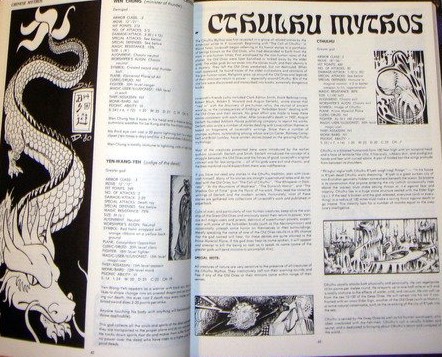
Deities_&_Demigods_(front_cover,_first_edition)One of the most fun, crazy, and controversial tomes to come out of Advanced Dungeons & Dragons was, without a doubt, Deities and Demigods (1980).

More wide-ranging (and less Eurocentric) than Bullfinch’s Mythology and Hamilton’s Mythology combined, here was a smorgasbord of most of the world’s major (and not-so-major) mythologies, presented as a one-stop shop for your player-character to choose a god or otherworldly entity to pledge fealty to and/r worship.

The vitriol of the religious right aside, Deities and Demigods did have its more thoughtful critics. In game terms, the early editions were kinda silly. Even though they assigned crazy-huge hit points and breathtakingly strong armor classes to the gods, said deities still had stats that could be overcome by powerful enough characters. As one critic observed, the book essentially turned the world’s deities into higher-level “monsters” to defeat — “bosses” for your 20th-level party to challenge. No room here for some metaphysical idea of a being that exists above corporeal, material reality and therefore cannot be “hurt” by a sword with a high-enough bonus modifier.

Later editions of Deities and Demigods (or Legends and Lore, as it was known for a time) ameliorated this “big boss” mentality by introducing the concept that some gods that characters physically encountered were but avatars, “aspects” or physical incarnations of gods who, being immortal and transcendent, could not really be killed.

That’s cool. Still, it is kind of fun — in a juvenile way — to leaf through Deities and Demigods asking such questions as “Who would win in a fight: Zeus or Odin?”

Read More Read More

The Ballantine Adult Fantasy Series: Lilith by George MacDonald

The Ballantine Adult Fantasy Series: Lilith by George MacDonald

Lilith Back Cover HRLilith
George MacDonald
Ballantine Books (274 pages, September 1969, $1.25)
Cover art by Gervasio Gallardo

Lilith was the fifth volume in the Ballantine Adult Fantasy series. The cover is one of the darkest in the series to date. The back cover shows the inside of an attic. I normally post an image of the back cover, but I won’t here. It’s almost a monochrome and it’s dark.

In many ways, Lilith was different from the few that came before it. For starters, it was written from a decidedly Christian worldview and there were passages in it that seemed allegorical to me. Lilith was certainly the most metaphysical of the books I’ve read in the series so far. There were several conversations about identity and how a person can know who they are.

A favorite practice of literature majors everywhere is to try to determine symbolism in works and to dissect them for hidden meanings. The structure of Lilith certainly lends itself to this type of thing and, not being an English major, I’m not going to attempt much of that here.

George MacDonald (1824-1905) was a Scottish pastor who retired early to devote himself to literature, although he continued to preach in a lay capacity at times. Much of his output consisted of novels that were set in what for MacDonald was contemporary times, but also contained poetry, collections of sermons, and fairy stories. There are two other volumes by MacDonald in the BAF series: the novel Phantastes and Evenor, a collection of three novellas.

Read More Read More

The Public Life of Sherlock Holmes: All The World’s A Stage

The Public Life of Sherlock Holmes: All The World’s A Stage

Speck_PagetSnake
Sidney Paget’s well-known drawing from The Speckled Band

There are two Holmes stories by Sir Arthur Conan Doyle that have a gothic feel to them. The Hound of the Baskervilles is one of four novels featuring Holmes and the best-known story of the sixty which Doyle wrote. The other, the ninth short story to feature Holmes, is “The Speckled Band.”

A creepy mansion; exotic animals roaming loose, gypsies, an imposing stepfather, eerie whistles in the night and the mysterious death of a daughter some years before: it has all the trappings. Doyle himself listed it as his favorite story and I’m not going to ruin it here. If you haven’t read “The Speckled Band,” you should go do it right now. Well, after you finish this post.

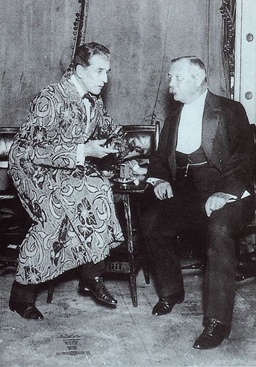
Doyle wrote several plays, two of which featured Sherlock Holmes. The Crown Diamond was and remains a poor one (as does “The Mazarin Stone,” the Holmes short story it mirrors).

But the other, born of financial necessity, was a big hit.

Read More Read More

The Collections of Michael Shea: Polyphemus

The Collections of Michael Shea: Polyphemus

Polyphemus Michael Shea-smallAs much as I respect and admire Michael Shea’s fantasy novels — and many of them are magnificent — I think he did his best work at short length. And I believe his best collection, by a pretty fair margin, is his 1987 Arkham House volume Polyphemus.

I was so impressed with it — really, I was so impressed with a single story, the amazing novella “The Autopsy” — that before I even finished reading the whole volume, I thrust it into the hands of my friend Neil Walsh, the future editor of SF Site. (I never did get it back and eventually had to buy a new copy. But I don’t mind. As the saying goes, never loan books. They should be gifts.)

But I don’t think you should have to take my word for it. Here’s the distinguished Mr. John Hocking, whose taste in fantasy fiction, as we know, is impeccable, with a two-sentence review of “The Autopsy,” as quoted in Mark Rigney’s 2013 article “The Most Terrifying Short Stories Ever?

Creeped me out as badly as anything I ever read. Most ghastly creature ever put on the page.

Amen to that.

“The Autopsy” has been reprinted over a dozen times, in such places as David G. Hartwell’s monumental horror collection The Dark Descent (1988), The Best of Modern Horror (1989), The Best Horror Stories from the Magazine of Fantasy and Science Fiction (1990), Aliens Among Us (2000), Jeff and Ann VanderMeer’s massive anthology The Weird (2012) — and just this month it appeared in the e-book edition of Lightspeed magazine.

Read More Read More

Vintage Treasures: Sentinels of Space by Eric Frank Russell / The Ultimate Invader edited by Donald Wollheim

Vintage Treasures: Sentinels of Space by Eric Frank Russell / The Ultimate Invader edited by Donald Wollheim

Sentinels of Space-smallWe’re back  with our journey through the Ace Double line, this time with one of the earliest volumes in the series: Eric Frank Russell’s SF novel Sentinels of Space, coupled with a Donald Wollheim anthology The Ultimate Invader. It was published in paperback in 1954.

Eric Frank Russell is one of those writers I’m not nearly as well-versed in as I should be. I read his brilliant short story “Dear Devil” in Terry Carr’s YA anthology Creatures From Beyond in the mid-seventies, when I was in Junior High, and that’s all it took for his name to stick with me.

“Dear Devil” — rejected by all the major magazines until Bea Mahaffey pulled it from the slush in 1950, while filling in for the hospitalized Ray Palmer at Other Worlds — established Russell as a major name and it also cemented the 26-year-old Mahaffey’s rep as an editor. She remained as co-editor of Other Worlds when Palmer returned and also edited his magazines Science Stories and Universe Science Fiction in the late 50s.

Russell wasn’t terribly prolific. He wrote only eight novels between 1939 and 1965, plus a posthumous collaboration with Alan Dean Foster, Design for Great-Day (1995), published 17 years after his death. I’m sure there’s a fascinating story behind that — I’ll have to ask Alan next time I run into him at a convention.

His two most famous works are probably his first novel Sinister Barrier, which so impressed John W. Campbell that he reportedly founded Unknown magazine just to get it into print, and “Allamagoosa’ (Astounding, May 1955), the first short story to win the Hugo Award.

My favorite Eric Frank Russell anecdote occurred while I was selling vintage paperbacks in the Dealer’s room at the 2012 Worldcon here in Chicago (Howard’s detailed report is here.) Jo Walton — who won a Hugo the next day for her novel Among Others — was browsing my books when she suddenly let out a shout of glee.

She explained why in a funny and delightful post a few months later at Tor.com., titled “The Book You Don’t Know You’re Looking For.”

Read More Read More

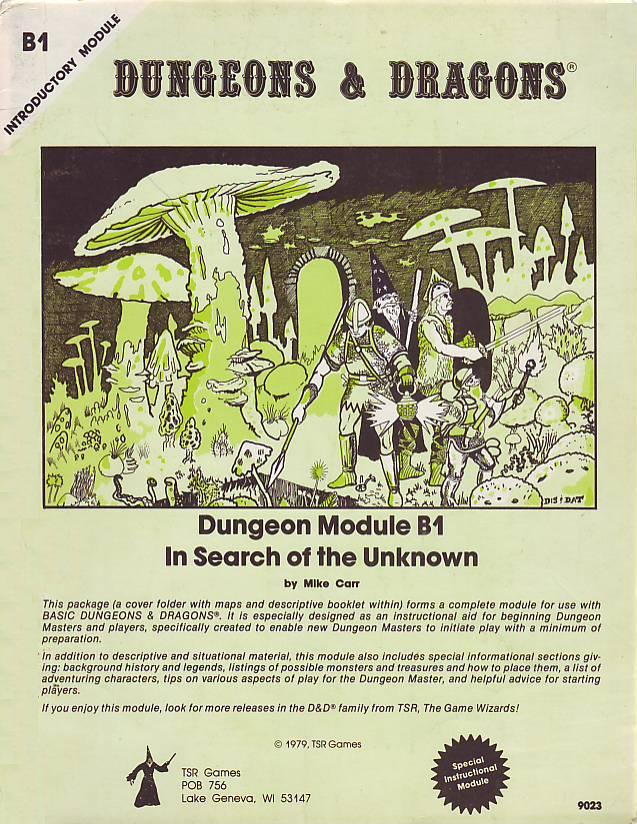
A Classic Moral Panic: The BBC on The Great 1980s Dungeons & Dragons Panic

A Classic Moral Panic: The BBC on The Great 1980s Dungeons & Dragons Panic

D&D boxed sets-smallIf you’re as old (and as good-looking) as I am, you probably remember the occasional media hysterics surrounding Dungeons and Dragons in the late 70s and early 80s. Reports of teens committing suicide after playing D&D, getting lost in steam tunnels, turning to devil worship… it got to be almost routine by the mid-80s. You didn’t even pay attention after a while.

It certainly caused problems for some gamers, though. I knew of a few who were forbidden to play D&D by their parents. My own parents certainly heard the reports, but my Dad had a practical solution… he asked to sit in on a game. He rolled up a character named Drawde (Edward spelled backwards) and trooped down in the dungeon with us.

It was a decent enough session, actually, although my brother Mike and I exchanged a few wide-eyed glances as Dad started busting in dungeon doors. My older sister Maureen tagged along, and even my Mom joined in for a while. I remember Maureen found a +1 ring and when I explained it protected her from attack, she sauntered to the front of the party and started talking smack to the next group of orcs they ran in to.

She got peppered with arrows, and my father had to come to her rescue. She hung out in the rear after that. “Anyone want to buy a magic ring?” she asked.

We never had another family session of D&D. But my father was apparently satisfied that the game wasn’t leading Mike and I towards eternal damnation and we were never questioned after that, even as the press reports about the game got crazier. I think I still have Dad’s character sheet somewhere.

Read More Read More

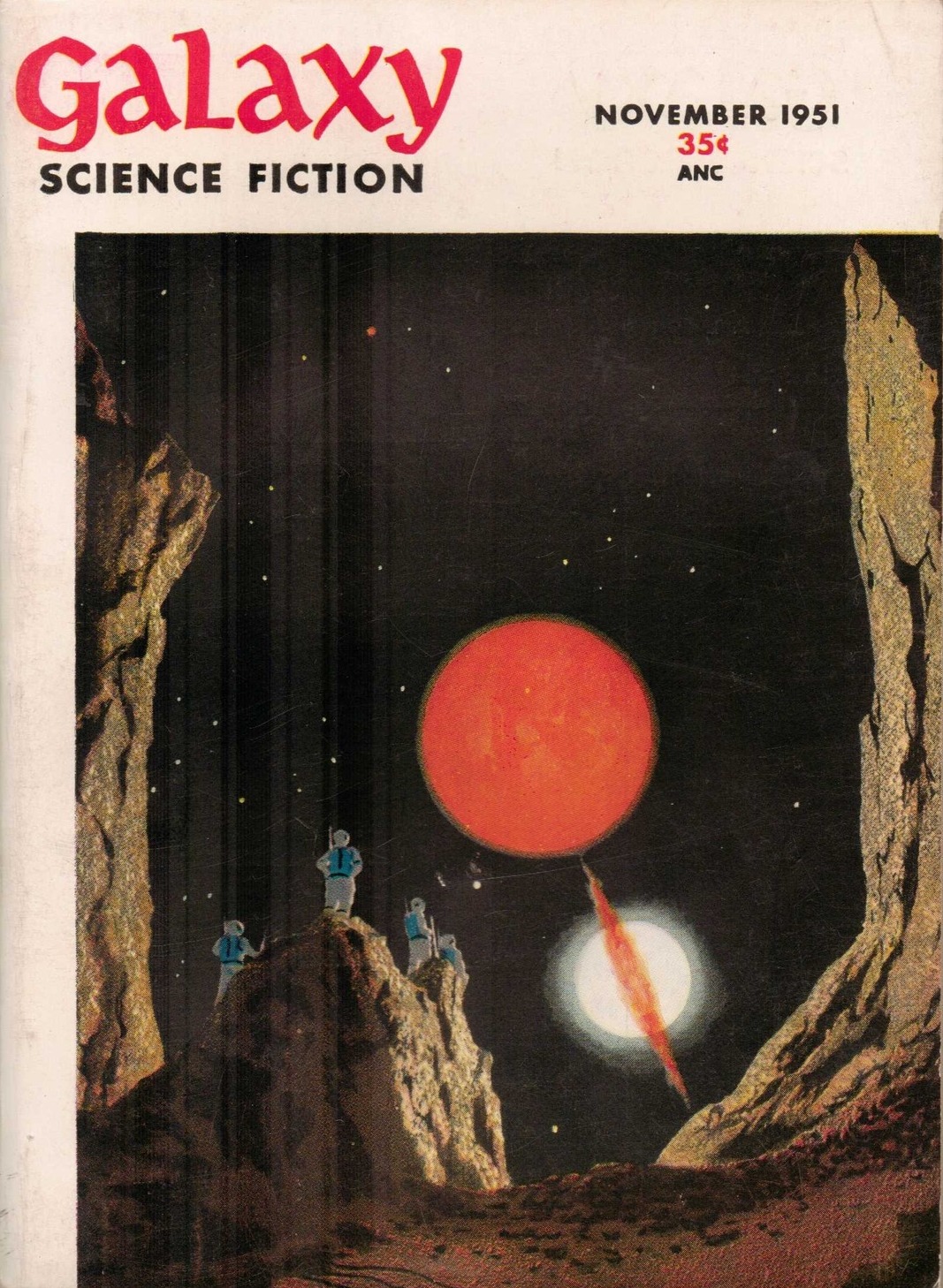
Galaxy Science Fiction, October 1951: A Retro-Review

Galaxy Science Fiction, October 1951: A Retro-Review

Galaxy Science Fiction October 1951-smallGalaxy began its second year of publication with the October 1951 issue. With contributions from both Asimov and Heinlein, it continued to show the strength of its fiction content.

“The C-Chute” by Isaac Asimov — A disparate group of space travelers become prisoners when their ship is stormed by enemy aliens. The Kloro secure the men in a room and leave only two of their own to pilot the ship back to their territory, where it can be prepared for battle.

Not content to sit idly by and become prisoners of war for an indeterminate amount of time, the men formulate a plan. Someone could suit up and go outside the ship, walking the hull to the steam tubes, in order to re-enter the ship at the control room, hopefully surprising the enemy pilots. The only dilemma is figuring out which of the men has the wherewithal and courage to succeed.

There was a lot of point-of-view shifting throughout the story, allowing the reader to enter the mind of each character. I thought this was done well and honestly there was greater variety in these characters than what Asimov produced in his novel The Stars, Like Dust.

“Pleasant Dreams” by Ralph Robin — Chief Watcher Gniss invites a childhood friend to witness how his group uses technology to spy on criminal suspects. Through the telepathic instrument, they can witness the suspects’ dreams, allowing them to learn of co-conspirators without the need for interrogation.

Read More Read More

Forgotten Treasures of the Pulps: Tony Rome, Private Eye

Forgotten Treasures of the Pulps: Tony Rome, Private Eye

Miami HaleMiami PBOThe paperback original (PBO to collectors) was the immediate successor to the pulp magazine as the home of pulp fiction. Marvin Albert was one of the bright lights of the paperback original market for detective fiction.

Albert’s work is revered in France, where he is considered a master of the hardboiled form, but he is largely forgotten stateside since his work lacks the literary polish of Dashiell Hammett or Raymond Chandler and was never shocking like Mickey Spillane. Albert may not have broken new ground, but he did excel at crafting hardboiled private eye stories in the classic tradition from the 1950s through the 1980s.

Much like Max Allan Collins or Michael Avallone, he also supplemented his income by adapting screenplays as movie tie-in novels for the paperback original market. Oddly enough, Albert specialized in bedroom farces for his movie tie-in assignments, in sharp contrast to his tough guy crime novels and westerns.

Albert utilized a number of pseudonyms during his career (although many of these titles were reprinted under his real name towards the end of his life). He published three hardboiled mysteries featuring a tough private eye called Tony Rome in the early 1960s. The books were published under the byline of Anthony Rome, as if to suggest the tales being told were real cases.

Read More Read More