Browsed by
Category: Vintage Treasures

Vintage Treasures: Galactic Derelict by Andre Norton

Vintage Treasures: Galactic Derelict by Andre Norton

Galactic Derelict-smallI came too late to science fiction and fantasy to catch Andre Norton’s true heyday in the 50s and 60s, when she published over two dozen novels — including early classics like Star Man’s Son (1952), Star Rangers (1953), Star Gate (1958), The Time Traders (1958), The Beast Master (1959), Witch World (1963), Three Against the Witch World (1965), and Year of the Unicorn (1965).

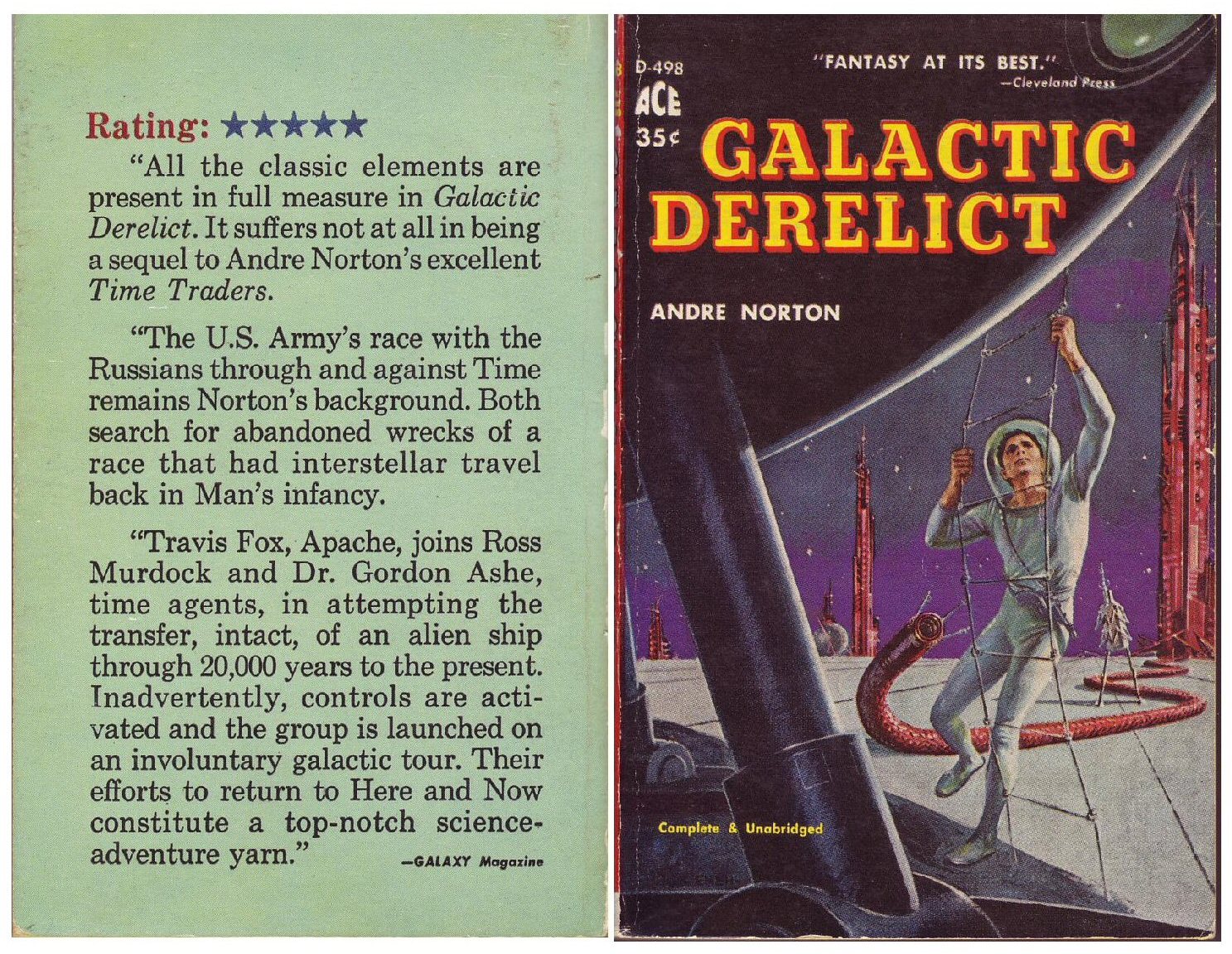
True, she continued to publish books steadily throughout the 70s, 80s, and even the 90s — though by the last decade of her life (she died in 2005), she was writing almost solely in collaboration with other authors. But it was her early Ace paperbacks that really stirred my collector’s soul. Perhaps it was the splendid covers. Here’s the back cover copy from the 1961 Ace paperback Galactic Derelict — with one of those splendid covers — reprinting a review from Galaxy:

“All the classic elements are present in full measure in Galactic Derelict. It suffers not at all in being a sequel to Andre Norton’s excellent Time Traders.

“The U.S. Army’s race with the Russians through and against Time remains Norton’s background. Both search for abandoned wrecks of a race that had interstellar travel back in man’s infancy.

“Travis Fox, Apache, joins Ross Murdock and Dr. Gordon Ashe, time agents, in attempting the transfer, intact, of an alien ship through 20,000 years to present. Inadvertently, controls are activated and the group is launched on an involuntary galactic tour. Their efforts to return to Here and Now constitute a top-notch science-adventure yarn.” – Galaxy Magazine

Galactic Derelict is part of Norton’s Forerunner universe. The other books in the series include The Time Traders (1958), The Defiant Agents (1962), Key Out of Time (1963), and others.

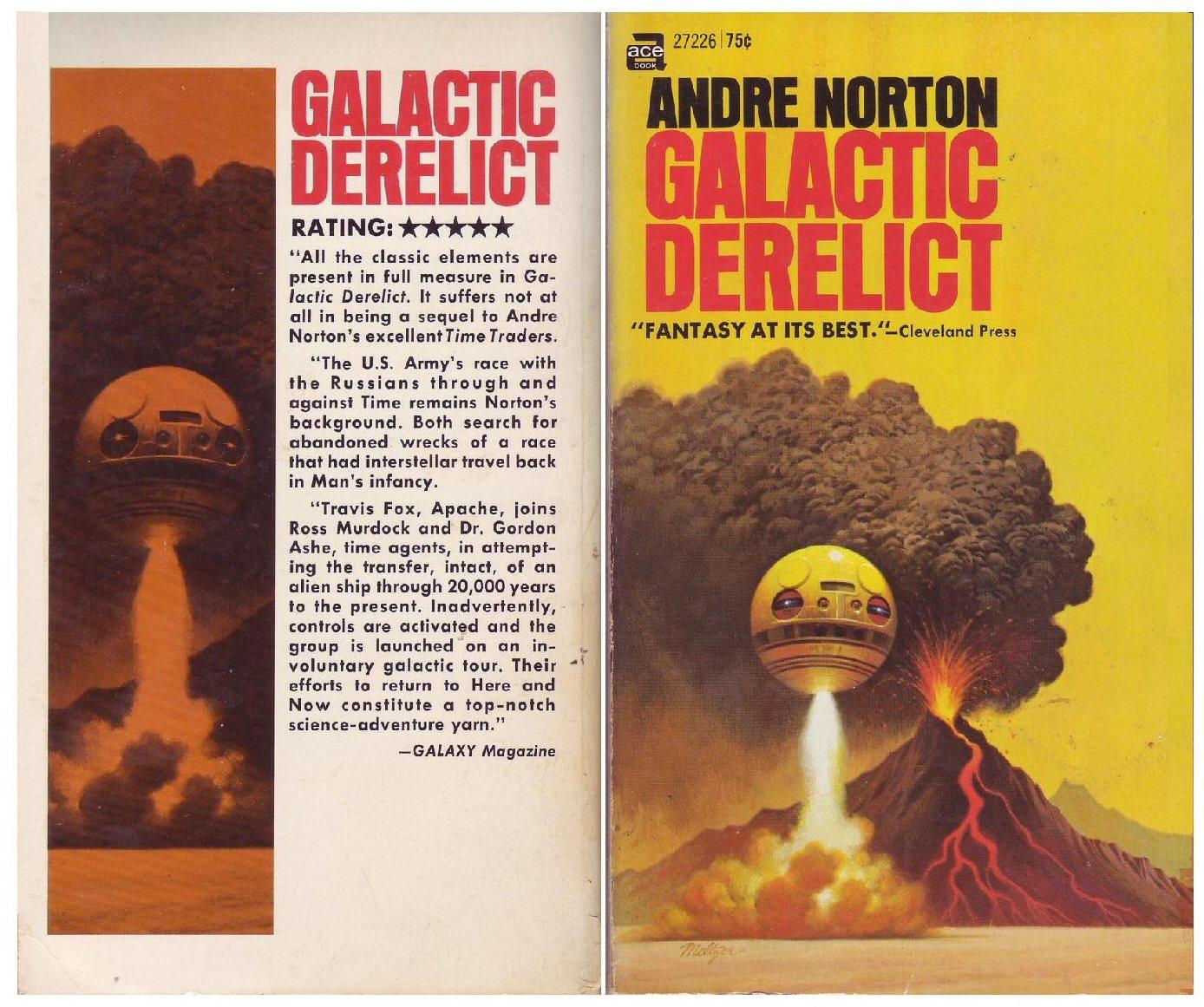
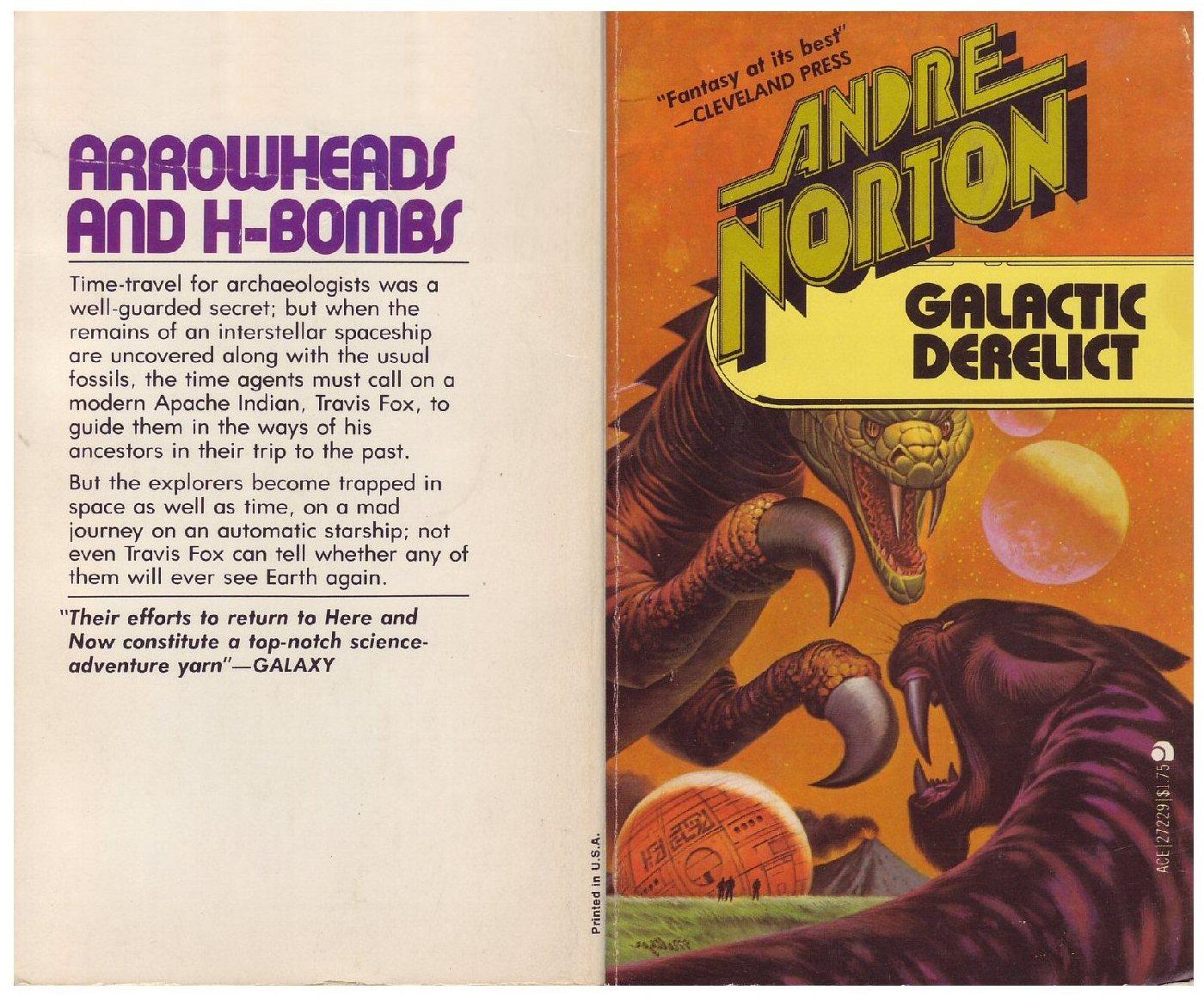
Galactic Derelict was published in 1959 by the World Publishing Company and has been reprinted in eight different editions over the last half-century. It first appeared in paperback from Ace Books in 1961. It is 192 pages in paperback, priced at 35 cents. The cover is by Ed Emshwiller. If I have a few moments this weekend, I may assemble some of the other covers to display them here.

So We Were In This Bar . . .

So We Were In This Bar . . .

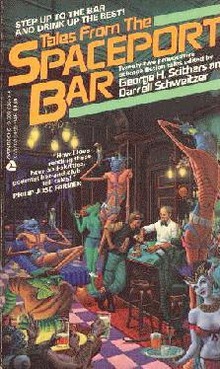
White HartThere’s a long tradition in western literature of the “framing device” – think Chaucer and The Canterbury Tales … or the Thousand Nights and a Night if we want something more obviously in our genre. Or Asimov and his Black Widower Mysteries.

My personal favourite among short story framing devices, however, is the bar story -– and I don’t mean the kind that starts, “We were in this bar…” Though, come to think of it, that’s how all my vacation stories start. Hmmm.

The device itself is fairly straightforward. The bar is a gathering place of disparate, but like-minded, people who exchange stories and anecdotes, usually involving people not present at the time. Sometimes the patrons of the bar take turns telling tales and sometimes, as with PG Wodehouse’s collections Meet Mr. Mulliner and Mr. Mulliner Speaks, one person in particular is the storyteller.

Undoubtedly because the storytellers are in a bar, the stories themselves can get a bit far-fetched, leading to such well-known formats as the Shaggy Dog Story and even the Tall Tale itself.

Which seems tailor-made for SF and Fantasy stories, don’t you think?

Read More Read More

Vintage Treasures: Marianne, The Magus, and the Manticore by Sheri S. Tepper

Vintage Treasures: Marianne, The Magus, and the Manticore by Sheri S. Tepper

Marianne The Magus and the Manticore-smallI’ve written a lot of Vintage Treasures articles (over 400 now, believe it or not.) Most of them feature collectible paperbacks and virtually all of them — even the old Ace Doubles from the 1950s — are inexpensive to acquire for the patient collector. It’s very, very rare that I discuss one that costs as much as a new paperback, for example.

Sheri S. Tepper’s Marianne, The Magus, and the Manticore is an exception. Used copies start at $10 – 15 on both Amazon and eBay and copies in good shape will run you closer to $40. It’s not particularly old — published in 1985 — and it’s not even all that rare. So why is it so expensive? Because it was published just before her groundbreaking novel The Gate to Women’s Country (1988) and the Hugo-nominated Grass (1989). In other words, before Tepper became a Big Name in the industry. The book was reprinted once, in 1988, but has now been out of print for nearly 30 years. Tepper has a great many fans, and the law of supply and demand dictates that the volumes in this trilogy are likely to be hot properties for some time.

Legacy Of Magic

Marianne was born to luxury in the tiny nation of Alphenlicht, nestled in the mountains between Turkey and Iraq. The her parents died, leaving control of their fortune to the older brother she fears. Struggling to make her way as a student in America, Alphenlicht seems as unreal as a fairy tale, her childhood there as distant as a dream…

… Until the Magus comes to claim her, and the Black Madame to destroy her, and the Manticore to hunt her down through the streets of another world. For there is magic in the land of Alphenlicht. Magic in Marianne’s blood, and magic in her soul…

Marianne, The Magus, and the Manticore was followed by two sequels in what’s now known as the Marianne series: Marianne, The Madame, and the Momentary Gods (1988), and Marianne, the Matchbox, and the Malachite Mouse (1989). A 592-page omnibus volume, The Marianne Trilogy, was offered briefly in paperback by Corgi in 1990 — it’s a great value, if you can find it.

Read More Read More

Galaxy Science Fiction, November 1951: A Retro-Review

Galaxy Science Fiction, November 1951: A Retro-Review

Galaxy Science Fiction November 1951-smallGalaxy s November, 1951 issue began (as it usually does) with a foreword from the editor, Horace Gold. Gold addresses the purpose of science fiction, stating:

What science fiction must present entertainingly is speculation. Not prophecy, but fictional surmises based on present factors… When a story hits a future development on the head, it should be considered a minor accident; its main job was not to predict but to conjecture what might happen if certain circumstances followed certain lines of development.

Regarding the basic plotlines around science fiction, such as interplanetary flight, time travel, and the like, he writes: “Will these worlds ever exist? They may or may not; it doesn’t matter. The possibility is what counts in science fiction, not the certainty.” He concludes that writers “are examining prospects, pleasant and unpleasant alike, and that, if it produces good stories, is the legitimate province of science fiction.”

“Sea Legs” by Frank Quattrocchi — Robert Craig leaves a life of deep space service to live on Earth. But Robert has never known that world; in fact, he has never known constant gravity. He finds there are many more regulations on Earth than in space and that loyalty to the government is of utmost concern. Soon, Robert ends up breaking rules he never knew existed and he flees into radioactive territory to try to escape incarceration.

It took me some time to get into this story, but by the point Robert is on the run, I was finally rooting for him. I think there was enough setup for this to be the opening chapters of a novel, so it seemed like too much to me.

Read More Read More

Four Modules

Four Modules

B1 In Search of the Unknown-smallOne of the many interesting divides among devotees of “old school” roleplaying games, particularly those who favor Dungeons & Dragons, concerns the place of the adventure module. An adventure module is a product detailing a locale to be explored or a situation to be resolved. By many reckonings, the first such module appeared in 1976, written by Pete and Judy Kerestan. Entitled Palace of the Vampire Queen, it described the five-level dungeon inhabited by undead – including the Vampire Queen herself – and other unpleasant things. Held captive within the dungeon is the daughter of a dwarf king, providing a motivation for the characters to become involved beyond glory and gold. While it isn’t notably clever in its conceptions, the module was groundbreaking in that it showed there was market for prefabricated, portable adventures rather than relying solely on the referee’s own efforts. It’s little wonder, then, that modules quickly became a staple of TSR’s catalog, as well as those of other publishers.

The issue some old schoolers take with adventure modules is that they, to borrow Gygax’s famous phrase from Volume 3 of the 1974 edition of D&D, “do … your imagining for you.” More importantly, modules unconsciously establish not only a notion of what an adventure is and ought to be, but they also establish the outlines of a fantasy setting rather than leaving all of these up to each referee to decide for himself and his own campaign. I’m somewhat sympathetic to this point of view, since I know well how powerful an influence TSR’s modules exercised over my own youthful imagination. At the same time, many of these modules served as helpful models to me as I started creating my own dungeons, adventures, and settings. Likewise, they provided a point of commonality between myself and other players, regardless of where they lived or with whom they played. When I met others at local games meets or conventions (or, nowadays, online), we can reminisce about our shared experiences fighting through the Caves of Chaos or the wonders we saw when we first beheld dark fairyland of the Vault of the Drow.

Read More Read More

“I rolled a critical hit against Yog-Sothoth!”: Revisiting AD&D Deities and Demigods (4th and Final Part)

“I rolled a critical hit against Yog-Sothoth!”: Revisiting AD&D Deities and Demigods (4th and Final Part)

cthulhu 3I’ve read dozens of H.P. Lovecraft’s stories, some of them (“The Rats in the Walls”, “The Colour Out of Space”) multiple times. I’ve studied his seminal essay Supernatural Horror in Literature. But I never have felt compelled to categorize all the various Great Old Ones and Outer Gods and work out their relationships in the overall “mythos” — for one thing, such an undertaking seems to undermine the intent of these Lovecraftian horrors, which was to represent the awful unknown.

August Derleth was among the first to go about classifying Lovecraft’s monsters in any systematic way, which tended to morph the work from pure horror into something more like metaphysical science fiction. Some fans have also criticized Derleth for using a Judeo-Christian framework for his classification, creating a dualistic good-versus-evil overlay that would be anathema to Lovecraft’s own worldview. The dissonance of this theme with the source texts threatened to jettison the original intent: conveying the cosmic terror of the mystery of existence and our precarious place in it.

Plugging Lovecraft’s cast of cosmic creeps into a Dungeons & Dragons pantheon and assigning stats to them (hit points, armor class, etc.) — as the 1980 first edition of Deities and Demigods did — seems vulnerable to this criticism to the utmost degree. Here are these totally foreign, otherworldly entities — and here’s how you defeat them! But it’s human nature. We love stats. We have to classify, categorize, label, and collate. It’s an inevitable progression that tends to water down the capacity of classic monsters to frighten (we’ve worked out how you destroy a vampire — stake to the heart, full exposure to sunlight — or put down a werewolf — silver bullet — or stop a zombie — head shot — so exhaustively that we have to come up with new variations and altogether new monsters to keep readers on the edge of their armchairs).

Still, I gotta admit it’s kinda fun to see what the game designers thought Cthulhu’s class levels should be, or how many hit points might be possessed by Nyarlathotep. If you’re going to introduce these beings into the hack ‘n slash realm of D&D, it’s bound to happen.

Read More Read More

The Public Life of Sherlock Holmes: Eille Norwood: the Silent Detective

The Public Life of Sherlock Holmes: Eille Norwood: the Silent Detective

Norwood_Doyel
Norwood and Sir Arthur Conan Doyle at the Stoll Pictures Annual Dinner

This may shock you, but there were on-screen Sherlock Holmes before Benedict Cumberbatch! And for you old-time fans, even before Robert Downey Jr. Really! The first great movie Holmes comes from the silent film era. And he shared a last name with another actor who would give arguably the greatest portrayal of the world’s first private consulting detective.

William Gillette had come to personify Sherlock Holmes through repeated performances of his stage play in the U.S. and Europe. His 1916 film version certainly helped as well, but was not a critical part of his success. Anthony Edward Brett would become the first great movie Holmes, though he would achieve it as Eille Norwood.

Born in 1861, Norwood was primarily a stage actor in England when he landed the role that would make him famous throughout the U.K..

In 1921, a British film company named Stoll decided to film a series of shorts based on Doyle’s stories. For the next two years, they would produce forty-five of the twenty-minute films, along with two longer ones. Doyle’s short stories fit the twenty-minute length quite well and Stoll wasn’t forced to add inauthentic filler to them.

The first fifteen, chosen randomly from among Doyle’s stories, were called The Adventures of Sherlock Holmes. That same year, the first version of what would be the most famous film title in the Canon was made, The Hound of the Baskervilles. Maurice Elvey directed all sixteen films. That same year, Elvey made a romantic drama called The Fruitful Vine. The lead was played by a young man named Basil Rathbone. How about that?

Read More Read More

Vintage Treasures: Six Worlds Yonder / The Space Willies by Eric Frank Russell

Vintage Treasures: Six Worlds Yonder / The Space Willies by Eric Frank Russell

Six Worlds Yonder-smallWe’re back with our continued look at some of the most interesting Ace Doubles.

Last time we discussed Eric Frank Russell’s first Ace release, his 1954 novel Sentinels of Space (with a brief aside to look at his 1958 paperback collection from Berkley, Men, Martians, and Machines.) So I thought it apropos to examine his first Ace Double pair: Six Worlds Yonder / The Space Willies, published in 1958.

Six Worlds Yonder is a rather uniquely themed collection: stories of first landings on far planets, all published in Astounding between 1955 and 1957. Here’s the book description:

THE PLANET MAPPERS

One thing’s certain about the exploration of outer space — there’s not going to be two worlds alike! In this new collection of interstellar explorers, the fertile and original mind of Eric Frank Russell presents a half-dozen of the more extraordinary possibilities.

There’s the world where everything moves at a pace so different from ours that it would take a couple of lifetimes to establish communication. There’s the planet of immortals, with all that that really signifies. There’s the puzzling problem of keeping important messages secret when surrounded by truculent aliens. And there’s more…

Every story is different, every world is unique, and every adventure is science-fiction at its best.

Russell’s stories were frequently more whimsical than most others depicting the grim business of interstellar exploration in 1950s SF digests. I think perhaps Bud Webster described Russell’s style best in his book Past Masters, in his appreciation of the stories in Men, Martians and Machines.

Read More Read More

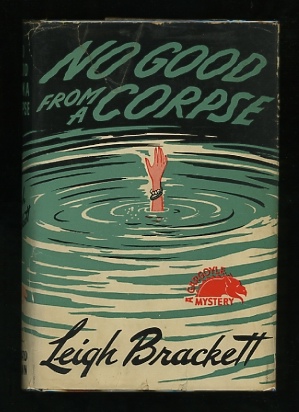
Vintage Treasures: The Book of Skaith: The Adventures of Eric John Stark by Leigh Brackett

Vintage Treasures: The Book of Skaith: The Adventures of Eric John Stark by Leigh Brackett

Leigh Brackett The Book of Skaith-smallI joined the Science Fiction Book Club in the fall of 1975, when I was in my last year at St. Francis Junior High School in Halifax, Nova Scotia. Before I joined, I agonized over my introductory selection — three books for a just a dollar! — for days, reading and re-reading the tiny paragraphs in the brochure, and then waiting impatiently for my selections to arrive in the mail. My friend John MacMaster enrolled me and I’m pretty sure I’ll remember the contents of my enrollment package until the day I die: The Foundation Trilogy by Isaac Asimov, The Hugo Winners, Volumes One and Two, edited by Isaac Asimov, and Before the Golden Age, edited by (can you guess?) Isaac Asimov.

John had introduced me to science fiction earlier that year, loaning me Clifford D. Simak’s Shakespeare’s Planet and Piers Anthony’s Ox when I was home sick from school. I devoured them both and wanted more. John explained how the club worked and it sounded terrific. “They sometimes have these big collections, a bunch of novels gathered into one book,” he said. “They’re the best.”

John was right. The year after I joined, in 1976, the featured selection for the month was The Book of Skaith: The Adventures of Eric John Stark, an omnibus of three novels by Leigh Brackett, under a new cover by Don Maitz. It was a marvelous introduction to one of SF’s great pulp writers, in an attractive and affordable package offered exclusively through the Science Fiction Book Club.

That’s one of the great things about the SFBC: its exclusive omnibus editions, highly collectible as they are, are generally still available at excellent prices. In February of this year, nearly 40 years after it was published, I bought a copy of The Book of Skaith in excellent condition on eBay for just $2.99.

Read More Read More

Blogging Dan Barry’s Flash Gordon, Part Fifteen

Blogging Dan Barry’s Flash Gordon, Part Fifteen

Flash Alpha 1Flash Alpha 2“Return to Mongo” by Dan Barry was serialized by King Features Syndicate from January 2 to March 24, 1956. The story gets underway with a party celebrating Dr. Zarkov’s newly discovered young adult daughter Zara and her arrival on Earth after growing up on an otherwise deserted swamp planet with her mother. Flash, Dale, and the Space Kids are at the party when Zarkov is alerted to the discovery that Mongo is once again entering Earth’s orbit and threatening our world’s stability. Willie, who still has the ability to psychically grant wishes, inadvertently teleports everyone from the party to Mongo.

Flash and the Space Kids are immediately set upon by Queen Azura’s cowled servants, who nearly massacre them. Working as a team to defeat Azura’s servants, Flash and the Space Kids are overcome by a paralyzing gas as they explore a nearby cave. They are subsequently captured and brought to Queen Azura’s palace, where they learn she is plotting to overthrow Prince Barin.

Read More Read More