Fantasia 2020, Part XII: Tezuka’s Barbara
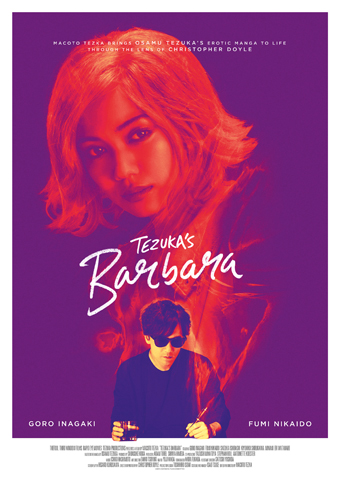 The chain of inspiration behind a work of art can be stunning to behold. Ernst Theodor Amadeus Hoffman was a musician, critic, and fiction writer in the early nineteenth century whose surreal and gemlike short stories are wonders of early fantasy. Some of those stories were worked into the libretto of Jacques Offenbach’s 1881 opera Les contes d’Hoffmann. Adapted to films at least three times, most notably by Michael Powell and Emeric Pressburger in 1951, Offenbach’s work would inspire the great manga creator Osamu Tezuka in 1973. A sexually-charged tale with elements of the occult, Tezuka’s Barbara was an erotic story about a frustrated manga creator who met a woman who might be a literal muse. Now Tezuka’s Barbara is a film directed by Macoto Tezuka, Osamu’s son, with a script from HIsako Kurasawa; and it played at the Fantasia Festival on August 25.
The movie begins with bestselling writer Yosuke Mikura (Gorô Inagaki) meeting an apparently homeless young woman in a subway tunnel, and taking her home with him. This is Barbara (Fumi Nikaido, Fly Me to the Saitama and Inuyashiki). She critiques his writing, accusing him of being too safe and commercial, but soon she’s saving him from voracious women who turn out to be mannequins or dogs. Mikura pursues Barbara, but to win her he must convince her mother, an antique-store owner named Mnemosyne (Eri Watanabe) — but she has strange connections, and tragedy lurks in the wings.
Reality and dreams blur over the course of the film, and I’m not convinced the movie does a good job setting up either a coherent reality or an effective oneiric sense. In part as a result, I also did not feel the movie gained anything in its mix of real and dream. The conclusion in particular moves past tragedy to almost insist it’s a hallucination, but where that hallucination started is less clear. It’s possible, maybe even intended, to read the whole movie as a reverie in the head of Mikura. But I find no particular thematic weight in that approach. Whether viewed entirely or partially as a dream, Tezuka’s Barbara resists cohering into a meaningful story.
Which again might be the point. The movie does strain mightily after a sense of strangeness. I would say it largely fails to reach any consistent surreal atmosphere. There is a lot of sex, but a countervailing coldness leaves these scenes clinical and not passionate; as an asexual I can’t claim to be very perceptive when it comes to sex scenes, at this point in my life I can usually at least see what a film’s trying to do. In this case I think it’s trying to create a feverish sense, trying to speak about a fusion of sex and art. Certainly it investigates the idea of the muse from a number of angles. But nothing comes out of it. It never really takes flight.
 Day 6 of Fantasia 2020 started for me with a panel on folk horror. While you can find the
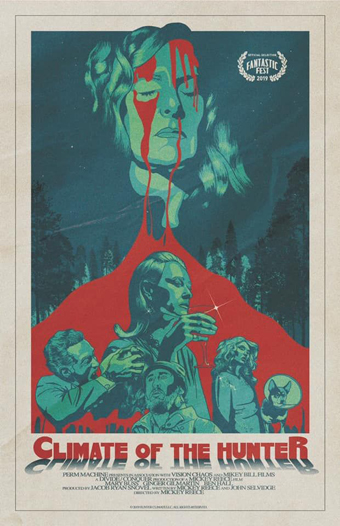 Mickey Reece is a musician turned underground filmmaker with over two dozen features to his credit. In 2019 he came out with Climate of the Hunter, which he directed and wrote with John Selvidge. It streamed on-demand at this year’s Fantasia Festival, and it’s billed as a cross between old-fashioned movie melodramas in the style of Douglas Sirk — what is sometimes called a “
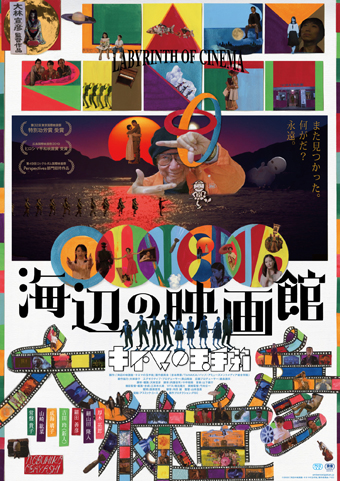 Nobuhiko Obayashi, the director best known for the surreal 1977 horror film House (Hausu, ハウス), died on April 10 this year. His final film is Labyrinth of Cinema (海辺の映画館 キネマの玉手箱), which he wrote as well as directed. Just as visually extravagant as House, it grapples with weightier themes — specifically, the nature of cinema and of war, and how film can be used to protest war. It’s therefore also a rumination on history, specifically the history of Japan in the late nineteenth and early twentieth century, and how that history was depicted in the movies of its time. And Labyrinth gets at these things through the frame of a fantasy story about movie spectators unstuck in time and narrative. Obayashi swung for the fences with this film, a three-hour long experience that feels like a career summation, a director reflecting on his life and craft and art.
 Day 5 of Fantasia began for me by watching Simon Barrett give bad career advice. Barrett’s the writer of horror movies such as The Guest and You’re Next, and he took questions from an online audience for what turned out to be more than two hours in a self-effacing discussion about how the modern movie industry works (or fails to), and how aspiring filmmakers can prepare themselves for entering that world. It was a funny, detailed, and generous discussion, which