Pellucidar on Screen: At the Earth’s Core … The Movie
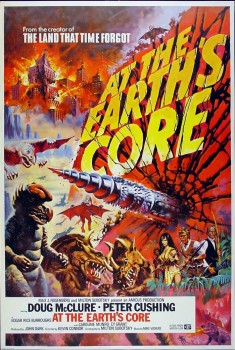 Few of Edgar Rice Burroughs’s books offer as much promise to modern filmmakers as At the Earth’s Core. The inner world of Pellucidar is vast and strange, and the potential to craft astonishing vistas from this concave land with a sun that never moves is immense. Plus, the tyrannical Mahars are ideally suited for realization as complex creatures using mo-cap.
However, nobody appears to be working on an At the Earth’s Core movie at the moment. For shame. We have to settle for a movie made in the last glory days of low-budget SF spectacle, before the advent of Star Wars. That shining era when rubber monsters, matte paintings, and Doug McClure ruled fantasy cinema.
The 1976 At the Earth’s Core isn’t a bad way to settle. For those who grew up with it, the movie still holds a special charm because of its colorful spectacle and practical effects. It had to sacrifice some of the fascinating parts of the setting of Pellucidar because of budget limitations, but it’s an accurate rendition of Burroughs’s plot.
At the Earth’s Core is second of a trio of mid-‘70s ERB adaptations from the team of producer John Dark and director Kevin Connor for Amicus Productions and American-International Pictures. The first and third films are a split adaptation of the novel The Land That Time Forgot, The Land That Time Forgot (1975) and The People That Time Forgot (1977). Dark and Connor produced two more fantasy films afterward, the ERB-esque Warlords of Atlantis (1978), made after they realized it was too expensive to mount a John Carter movie; and the mostly forgotten Arabian Adventure (1979).
Although I’m about to say many admiring things about At the Earth’s Core, it’s my least favorite of the Amicus-AIP Burroughs movies. The director shares my opinion: Kevin Connor has called the movie “clunky” compared to the other two, and it’s easy to see what he means in the studio-bound confines and the more awkward pacing and plotting. But it’s by no means a bad film, and when I place it a notch below The Land That Time Forgot and The People That Time Forgot, that isn’t a harsh slam. The special appeal of this vanished era of imaginative filmmaking is hard to resist.


 Having finally posted reviews of all the movies I saw at the 2016 Fantasia International Film Festival, I want by way of conclusion to think about what I’ve learned. I don’t just mean about film, or about the film industry. But about genre, and what genre does, and how it works on film.
 Wednesday, August 3, was the last day of the Fantasia International Film Festival. Three full weeks of genre films would wrap up here, and I was looking forward to the three last films of the year. The day would begin with the Chinese martial-arts film Judge Archer (Jianshi liu baiyuan). After that came the independent American movie If There’s a Hell Below, promising a paranoid thriller about whistleblowers and government surveillance. Finally came a movie I’d been eagerly anticipating since the start of the festival, the Polish science-fictional classic from 1977 On the Silver Globe (Na srebrnym globie), a space opera about colonization and war on an alien planet. All three were rewarding, and all three were pleasantly (and increasingly) elliptical.
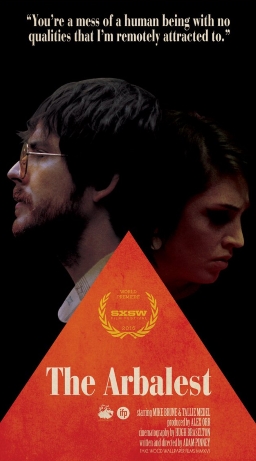 Tuesday, August 2, was the next-to-last day of the 2016 Fantasia festival. I had two movies lined up. First would come The Arbalest, at the De Sève Theatre: a period fantasy about a man who made an addictive puzzle in a slightly alternate 1970s. That would be followed by The Piper (Sonmin), a Korean film that reimagined the Pied Piper story as set in a postwar Korean village. Both looked promising. One delivered on that promise.