Fantasia 2016, Day 21: Aiming Low to Hit a Silver Heaven (Judge Archer, If There’s A Hell Below, and On the Silver Globe)
 Wednesday, August 3, was the last day of the Fantasia International Film Festival. Three full weeks of genre films would wrap up here, and I was looking forward to the three last films of the year. The day would begin with the Chinese martial-arts film Judge Archer (Jianshi liu baiyuan). After that came the independent American movie If There’s a Hell Below, promising a paranoid thriller about whistleblowers and government surveillance. Finally came a movie I’d been eagerly anticipating since the start of the festival, the Polish science-fictional classic from 1977 On the Silver Globe (Na srebrnym globie), a space opera about colonization and war on an alien planet. All three were rewarding, and all three were pleasantly (and increasingly) elliptical.
Judge Archer was written and directed by Xu Haofeng. Set in 1917 in a China divided among rival armies, it follows a man (Yang Song) who becomes a supremely skillful archer and uses those skills to judge disputes between martial arts schools. When one of those warlords kills the father of a beautiful woman (Yenny Martin), she asks the man — who has taken the cursed name Judge Archer from his master — to bring him to justice. But the warlord has a beautiful wife (Li Chengyuan), who is tempting the judge to abandon his beliefs. Betrayals and duels follow as the story finally, inevitably, works itself out in a semi-mystical duel.
Xu’s background is worth describing here. A long-time student of martial arts, he wrote a bestselling memoir of one of his masters in 2006, The Bygone Kung Fu World (Shiqu de wulin), then followed with another bestselling book in 2006, Dao Shi Xiao Shan (a title translated as alternately Monk Comes Down the Mountain or A Taoist Monk Plunging Into the Madding Crowd). His books have been characterised as less fantastical than most wuxia tales, with a fascination for cultural elements such as painting and calligraphy, as well as an abiding sense of the loss of a traditional kung fu culture. He directed his first movie, The Sword Identity (Wo kou de zong ji), in 2011. Judge Archer was completed in 2012, but not released until this year; in the interim Xu wrote the script for Wong Kar-wai’s The Grandmaster (Yi dai zong shi), then wrote and directed another film, The Final Master (Shi fu). His films tend to shun spectacular wire work in favour of more realistic and intense martial arts duels, often evoking a sense of the importance of kung fu traditions and the passing of those traditions in the modern world.

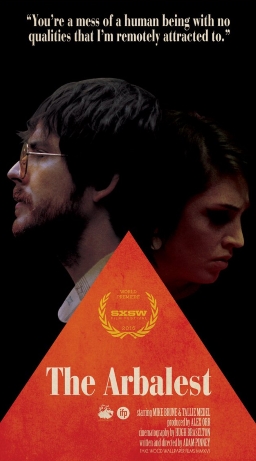 Tuesday, August 2, was the next-to-last day of the 2016 Fantasia festival. I had two movies lined up. First would come The Arbalest, at the De Sève Theatre: a period fantasy about a man who made an addictive puzzle in a slightly alternate 1970s. That would be followed by The Piper (Sonmin), a Korean film that reimagined the Pied Piper story as set in a postwar Korean village. Both looked promising. One delivered on that promise.
 By Monday, August 1, the end of the 2016 Fantasia Film Festival was in sight. Two more days, and it’d be over for another year. Bearing that in mind I was determined to pass by the Festival’s screening room and catch up with some films I’d missed earlier in the festival. First, though, I was headed to the De Séve Theatre for a showing of the American-Polish science-fiction movie Embers, about a world struck by a plague of forgetting. After that I’d go to the screening room, where I’d watch the French absurdist comedy L’Élan and the Mexican horror-fantasy We Are the Flesh (Tenemos la carne).
 Lately I’ve been looking at adaptations, both novel-to-movie, and novel or movie to TV series. I been talking about them in terms of what I thought was successfully done, and occasionally pointed at my favourites. In their comments people observed that while they agreed, for the most part, with my suggestions, they had suggestions of their own. All of us had to admit, however, that we were sometimes unfamiliar with either the source work, or the adaptation, or even both.