Blogging Alex Raymond’s Flash Gordon, Part Nine – “The Tusk Men of Mongo”
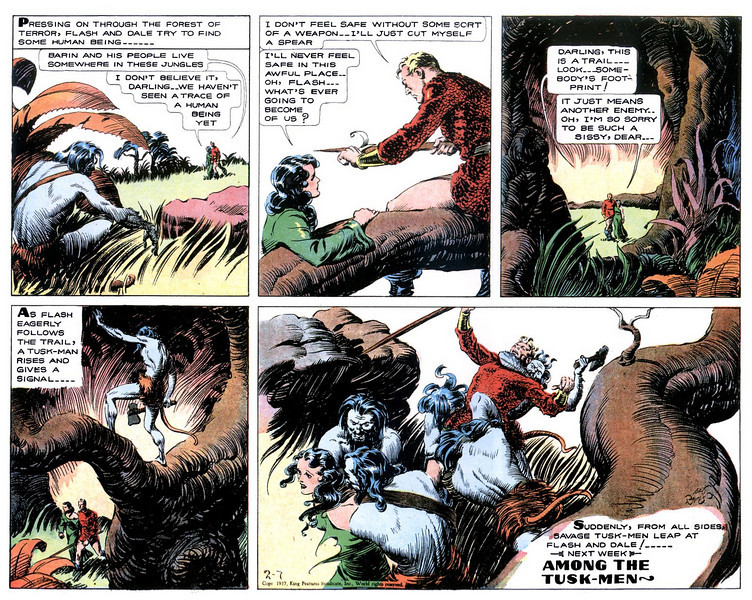 “The Tusk Men of Mongo” was the ninth installment of Alex Raymond’s Flash Gordon Sunday comic strip serial for King Features Syndicate. Originally printed between February 7 and April 18, 1937, “The Tusk Men of Mongo” picks up the storyline where the eighth installment, “The Forest Kingdom of Mongo” left off with Flash and Dale unknowingly venturing into Tusk Men territory. The Tusk Men are a Neanderthal-like race of blue-skinned men with prehensile tails. They live in tribes and have fashioned crude tools such as axes. One of their scouts spies Flash and Dale and despite Flash carrying a makeshift spear, they are quickly overwhelmed by five of the Tusk Men.
Flash and Dale are bound and led many miles away to a vast network of caves where the Tusk Men dwell. There, we learn that the Tusk Men can speak a simple form of English as well as their own bestial language, and that they are cannibals who have captured Flash and Dale to devour them. The tribe is ruled by One-Tusk who claims Dale for his mate. Dale pleads for Flash’s life is to be spared to no avail. Just as he is about to be pitched into the flames, Flash breaks free of his bonds and fights against his captors. The Tusk Men greatly outnumber him and the Earth man is quickly recaptured. Death appears unavoidable.
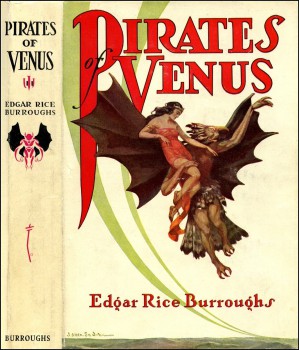 Next year brings the hundredth anniversary of Edgar Rice Burroughs’s first two published novels:
 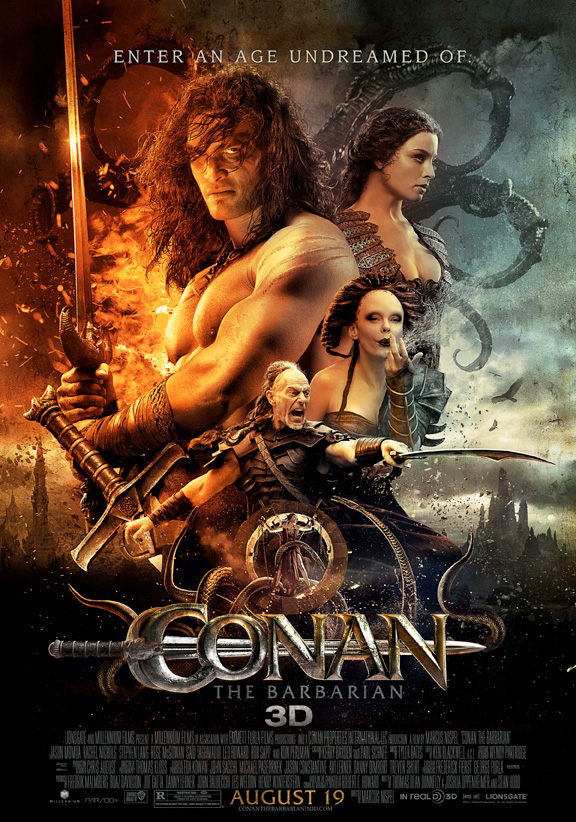 Friends, Bloggers, Conan Fans, lend me your ears! I come not to defend the new CONAN movie, but to present an informal overview that examines what works and what doesn’t work. To begin, I’ve seen a lot better movies … and I’ve seen a LOT worse movies.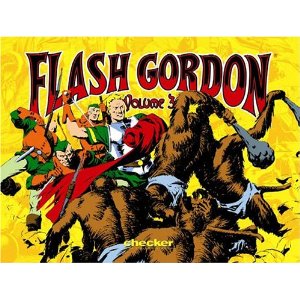
 Sunday was the fiftieth anniversary of the death of Clark Ashton Smith. We morbid fans of a writer with a delectable taste for morbidity love to celebrate death anniversaries as much as birth ones, and the seduction of the half-century mark is too great to dismiss.
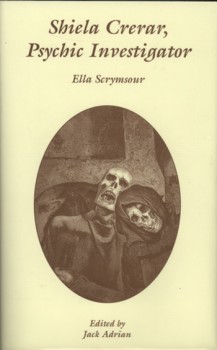 Shiela Crerar, psychic investigator and adventuress, first burst into public view in the pages of The Blue Magazine in 1920 with “The Eyes of Doom”. The obscure creation of the
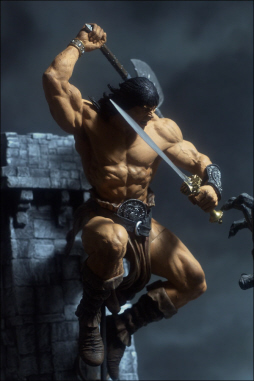 Imagine Conan in Shadizar, meeting with a beautiful woman calling herself Fortuna who pays him to find Thuris, the man who kidnapped her younger sister. Conan accepts the woman’s coin but finds himself in the middle of double and triple crosses as Fortuna — known as Brigid the Bold in the underworld — seeks for the Falcon of Maltus along with her betrayed confederates, Jubliex Cairo, Wilmer the Younger, and Gutmar.
  As usual, the kind of stories I was reading and writing bled into the kind of games I was playing, and this took me down a path I did not expect. I ended cobbling together a system that was purpose built to play “sword noir.” In order to do that, I had to define the term.