Browsed by
Category: Games

New Treasures: Wizards of the Coast Releases Dungeon Command
New Treasures: Wizards of the Coast Releases Dungeon Command

dungeon-commandI’ve been relieved and gratified to see the resurgence in fantasy board gaming over the last decade.

With the demise of the great board game companies of my youth — SPI, Yaquinto, Avalon Hill, FASA, GDW, Metagaming, Task Force, and many others — it looked like the hobby that fired my imagination and gave me such pleasure for decades was headed for extinction. But Fantasy Flight, Wizards of the Coast, Days of Wonder, and a handful of other companies have turned that around in the last few years, releasing terrific titles that have rejuvenated the entire genre, like RoboRallySmall World, Ikusa, and the epic Conquest of Nerath.

It hasn’t happened in a vacuum. Part of the credit goes to the explosion of interest in miniatures. Games Workshop’s Warhammer, Privateer Press’s WarMachine and Iron Kingdoms, Wizkids’s HeroClix, and collectible miniature games from Wizards of the Coast and many others, have made table top gaming cool again, getting young gamers to put down their game controllers and pick up dice.

Wizards of the Coast has really been at the forefront of fantasy board gaming, especially recently. Just in the past few years they’ve released a surprising number of innovative and successful titles, including Lords of WaterdeepThe Legend of Drizzt, Castle Ravenloft, and many others.

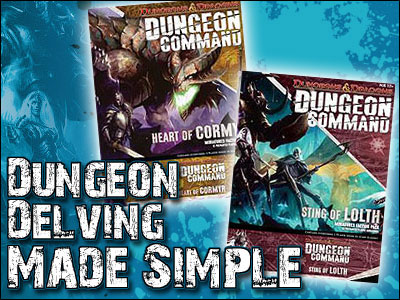
Now they’re at it again with a major new launch: Dungeon Command, a head-to-head miniatures skirmish game designed for two or more players.

It looks like a lot of fun. And best of all, the components of Dungeon Command are 100% compatible with other popular Wizards of the Coast games: the miniatures and dungeon tiles can be used with the D&D RPG, and the unique cards provided with each miniature can be used with D&D Adventure System board games like Castle Ravenloft, Wrath of Ashardalon, and The Legend of Drizzt.

Read More Read More

New Treasures: Clockwork and Cthulhu

New Treasures: Clockwork and Cthulhu

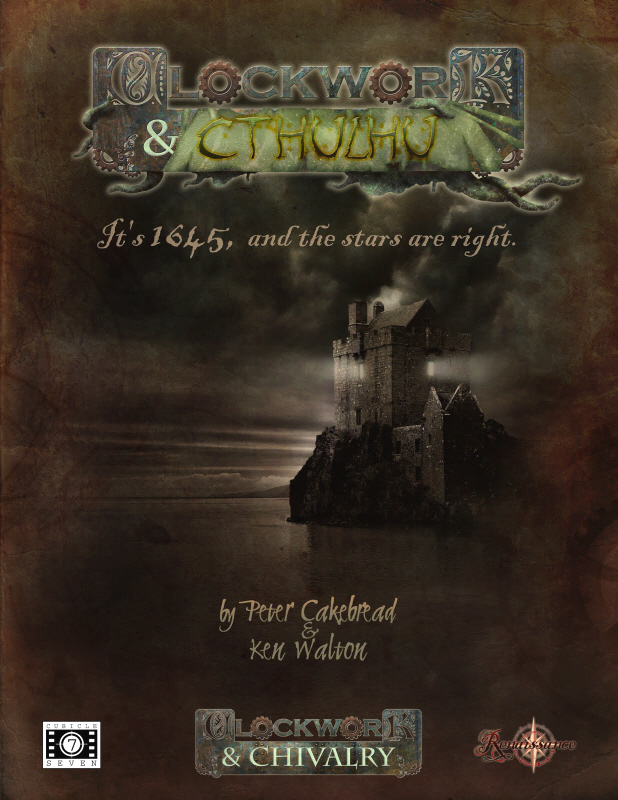
clockwork-cthulhu-smallI don’t know much about this little artifact; but the moment I laid eyes on it, I knew I had to blog about it. It combines two of my favorite things: Cthulhu and Clocks.

Okay, not really. Would you believe Cthulhu and role-playing games? How about Cthulhu and giant clockwork war machines that lumber across the land?

Clockwork and Cthulhu is a supplement for the 17th century alternate historical fantasy world Clockwork & Chivalry, one of the most innovative settings ever produced for RuneQuest 2. And yes, I realize that if you don’t play RPGs, that sentence will not parse no matter how hard you mess with it. Just go with it.

England has descended into civil war. The earth is tainted by alchemical magick. Giant clockwork war machines lumber across the land. In the remote countryside, witches terrorise entire villages, while in the hallowed halls of great universities, natural philosophers uncover the secrets of nature.

War, plague and religious division make people’s lives a constant misery. But even greater threats exist. Witches whisper of the old gods. Royalist alchemists pore over John Dee’s forbidden translation of the Necronomicon, dreaming of powers that will allow them to win the war. Parliamentarian engineers consult with creatures from beyond the crystal spheres and build blasphemous mechanisms, unholy monuments to their alien overlords. Vast inter-dimensional beings seek entry into the world, while their human servants, corrupted, crazed and enslaved, follow the eldritch agendas of their hidden masters.

Clockwork & Cthulhu brings the horror of H.P. Lovecraft’s Cthulhu Mythos to the 17th century alternate historical fantasy world of Clockwork & Chivalry.

You have to admit that sounds cool. Don’t you wish you played role-playing games now?

Clockwork and Cthulhu was written and designed by Peter Cakebread and Ken Walton, authors of Clockwork & Chivalry. It is 156 pages, and sells for $29.99. It is published by Cubicle 7 Entertainment; you can find more information here.

Art of the Genre: The GameMaster Series Covers

Art of the Genre: The GameMaster Series Covers

axisandalliesboxBack in the mid-80s, I would go out to my dad’s house in Las Vegas and spend a few weeks of every summer seeing how he lived his life in the city of sin. It always had its ups and downs, but certainly even twenty-five years later I’ve got some lasting memories that bring a smile to my face.

One such memory is that of going to my first Toys “R” Us, at age 14, with my father to look for a game to bring to his cabin in Utah. Even to this day I can see a ‘wall of games’ in my head, so much bigger than life and beyond what I’d ever thought possible for a kid from the small town cornfields of Indiana.

The game my father and I chose was a huge one, the box seemingly larger than a board game had the right to be. It was called Axis & Allies and it had the most brilliant painted cover you could imagine.

It was produced by Milton Bradley, part of their GameMaster Series, something that took a step beyond what any other company in those days dared to do, make a mass market adult game. To this point, games were almost exclusively for children, and the graphics of such games were similarly geared.

Read More Read More

Superbrothers: Sword & Sworcery EP

Superbrothers: Sword & Sworcery EP

superbrothers-sword-and-sworcery2We find Swords and Sorcery in unusual places these days. When I was a kid you had to dig around in the 50-cent bin at the used book store until you unearthed a battered Lancer paperback, or a worn copy of Fantastic magazine. Sometimes it would show up at the supermarket in one of those spinning paperback islands, but good luck getting your mother to buy it for you. Too many lurid colors on the cover, too much nudity. Sword and Sorcery was something underground, forbidden, even dangerous, like pornography and posters of Weird Al Yankovic.

Not today. You can’t walk into a movie theater or game store without tripping over Sword and Sorcery. It shows up in Disney movies, in role playing games, and virtually every online multiplayer game ever made. It has permeated our culture, become strangely mainsteam. Just like Weird Al Yankovic. God help us.

But that doesn’t mean that the soul of Sword & Sorcery has been wholly compromised. It just means that if want to find the truly original, the weird and different, you need to wander a little farther afield. Look beyond the big budget titles, to those Indie games that are the modern equivalent of Lancer paperbacks and Fantastic magazine. Games like the amazing Superbrothers: Sword & Sworcery EP.

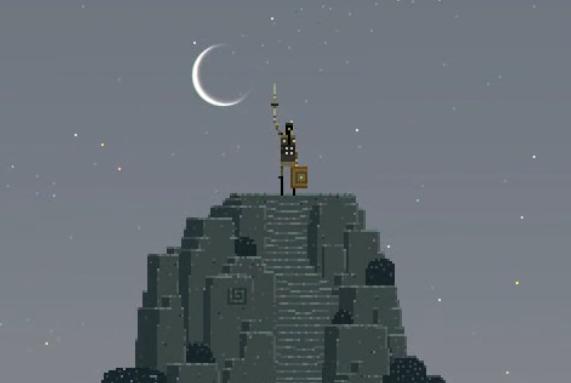
On the surface Sword & Sworcery looks like a point-and-click adventure game, circa 1995. But the artistic design and innovative touches make this unlike any game you’ve ever seen. You play as a warrior woman named Scythian, on a mysterious mission that’s not entirely explained up front. The retro graphics look crude at first, until you notice the incredible details — bushes that shift in the wind, the small forest animals that dart out of your way. Like most point-and-click adventures there’s a lot of text to read, but here the text is charming and occasionally laugh-out-loud funny. Early in the game you encounter a girl (named Girl), a woodcutter (Logfella) and their dog Dogfella. Clicking on the dog rewards players with this message:

Logfella knew all about our woeful errand & he agreed to lead us up the old road. Still we definitely got the feeling that he wasn’t super jazzed about this.

No review of Superbrothers: Sword & Sworcery EP (what does the EP mean?) would be complete without mentioning the music of Jim Guthrie, a crucial component of the whole experience. The first time you face a monster in combat, you’ll know what I mean.

Superbrothers: Sword & Sworcery was developed by Capybara Games, and released on April 16, 2012, for both the PC (via Steam) and iOS platforms (Mac, iPhone and iPad) for $4.99. Learn more at their website.

Better Fantasy Gaming Through Traveller

Better Fantasy Gaming Through Traveller

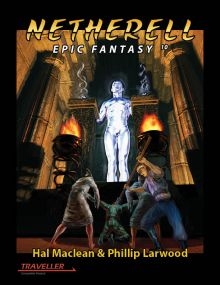
netherell1Netherell Epic Fantasy
Hal Maclean & Phillip Larwood
Terra/Sol Games (148 pp, $24.99, Softback; $14.99, Download)
Reviewed by Howard Andrew Jones

It’s one of my distinct pleasures as a reviewer to highlight overlooked books. All sorts of RPG books crossed my desk last year, and my fellow game reviewers and I tackled a lot of deserving ones in the last issue of Black Gate, but inevitably some fine ones got overlooked.

I’ve been impressed with the line of products I’ve seen from Terra/Sol Games, starting with their Twilight Sector sourcebook and continuing into their sector companion, Tinker, Spacer, Psion, Spy. I can heartily recommend both for the Traveller fan. But their Netherell supplement, released toward the middle of last year, has even broader appeal. It is an epic fantasy setting implemented with the Traveller rule set. You’d think that it would read like something awkwardly shoehorned into place – like rules for a Star Trek game using the classic D&D experience point system – but it works, and it works well. Any fantasy fan looking for a new way to approach their game play should give it a look.

Read More Read More

Dungeon Crawl Classics – Growing Fresh from Old Roots

Dungeon Crawl Classics – Growing Fresh from Old Roots

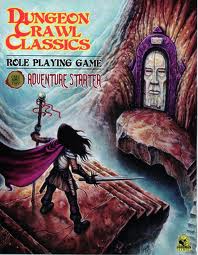
dcc1Dungeon Crawl Classics Role Playing Game
Joseph Goodman
Goodman Games (480 pp, $39.99, Hardback; $24.99, Download)
Reviewed by Howard Andrew Jones

I’m afraid that the Dungeon Crawl Classics role-playing game will hit the modern game audience the way a hard rocking band with great guitar hooks hits teenagers who think greatness is held by those auto-tuned voices and dancing lip-syncers. It might be that they’ll have the sense to understand something good, done right, even if it is artistically out of style, but I can’t help thinking they’ll be too hypnotized by flash and swagger to see the beauty.

Well, I use the term beauty loosely, because the plethora of art in DCC is old-school, in your face, evocative, bloody, and dynamic. It has some of the same aesthetics as counter-culture comics from the 60s, but it’s waaay cooler. Where else can you randomly flip through pages and come first to a wizard riding through a harbor on a giant marauding tentacled thing while being assaulted by an elf riding a hawk? Another quick flip takes you to an armored warrior pointing the way to a sinister cavern carved like the open maw of a monster, and a charismatic spell-caster launching a spray of firebolts.

But the book isn’t just the art – though the art sure aids in suggesting the atmosphere of the game itself. This isn’t your brother’s role-playing game. For that matter, it isn’t your dad’s AD&D, either. Primary creator Joseph Goodman is on record as saying that it’s the first game based on a thorough reading of Appendix N from the original Dungeon Master’s Guide. If you’re not in the know, Appendix N was a list of recommended reading featuring the likes of Robert E. Howard, Michael Moorcock, Fritz Leiber, and all kinds of other creators of literary fantasy goodies, most of which my local library didn’t have back when I was in junior high, or I would have been swept away into some realms of adventure a lot earlier.

Read More Read More

New Treasures: Dungeons & Dragons Into the Unknown: The Dungeon Survival Handbook

New Treasures: Dungeons & Dragons Into the Unknown: The Dungeon Survival Handbook

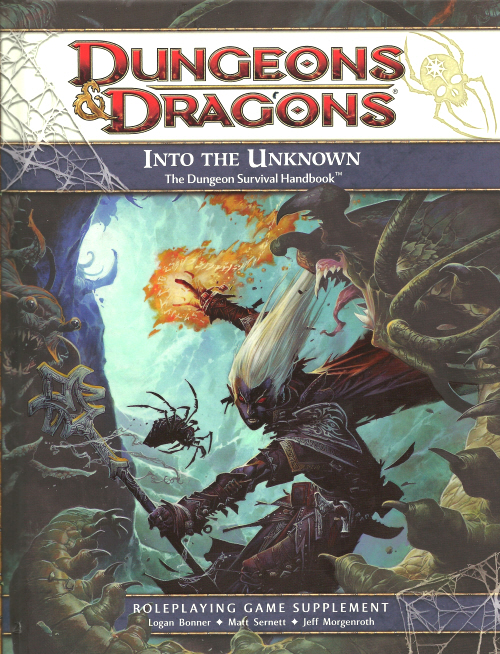
into-the-unknownI don’t get to play D&D as much as I’d like these days. Which means that my enjoyment of the latest supplements chiefly depends on how fun they are to read. By that measure, Into the Unknown: The Dungeon Survival Handbook is one of the best books to come from Wizards of the Coast in a while.

What makes this one stand out? On the surface it’s pretty lightweight, described as

A guide for players and Dungeon Masters who want to play in a Dungeons & Dragons game that explores dungeons and plumbs the blackest reaches of the Underdark… Players will find an assortment of new powers, equipment, feats, character themes, and player races, including the kobold and the goblin. For Dungeon Masters, the book is a trove of dungeon-building advice and details, including lore on classic dungeon monsters, some quirky companions for adventurers, a few timeless treasures, and tips for incorporating players’ character themes into an adventure.

Yeah, we’ve seen this book a few times over the decades. A collection of vague dungeoneering advice, some monsters that didn’t make the cut for other modules, and a few new feats. Reminiscent of the 1986 title that finally convinced me I could ignore future TSR hardcovers, The Dungeoneer’s Survival Guide.

At least, that’s what I thought until I opened it.

My favorite section is a 17-page chunk of Chapter 2 titled “Infamous Dungeons,” which takes a detailed look at some of the most popular publications in D&D history, from Castle Ravenloft to The Temple of Elemental Evil to The Gates of Firestorm Peak. Not half-hearted marketing pieces, but warts-and-all descriptions of classic dungeons alongside pics of the original modules. Here’s a brief excerpt from the assessment of 1980’s The Ghost Tower of Inverness:

That publication was preceded by a tournament version that one could purchase only at WinterCon VIII in 1979 in a zip bag containing 40 loose-leaf pages. But even its more professionally published form, the adventure’s tournament pedigree was on full display. Discussions of scoring the players’ efforts riddle the adventure text, which presents an oftentimes nonsensical dungeon full of desperation-inducing challenges… Since then, the Ghost Tower of Inverness has appeared from time to time in various products. Most recently, it was featured in the D&D Encounters season March of the Phantom Brigade.

Read More Read More

New Treasures: Zombiegeddon

New Treasures: Zombiegeddon

zombiegeddon2I’m still unpacking from the horrible bout of auction fever I suffered back in March. I uncovered a box of games buried by loot from the April Windy City Pulp and Paper Show in my library on Friday … man, I go to too many auctions.

It’s fun to dig through unexpected boxes of games, though. It’s sort of like archaeology, especially since each item still has the auction tag and price on it. Man, what kind of primitive barbarian would pay 28 bucks for a copy of StarSoldier?? Since it’s in the box … me, apparently.

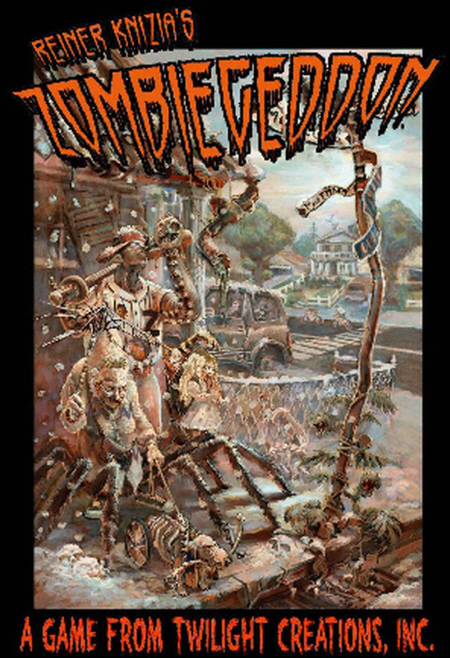
Still, there’s some intriguing surprises. Like this copy of Reiner Knizia’s Zombiegeddon I found. [Click on the image at right to embiggen.]

I don’t remember buying this game. In truth, twenty minutes ago, I didn’t even know it existed.

But I can imagine what happened. They rattle through items pretty fast at the Games Plus Spring Auction. The auctioneer held it up, I got a quick glimpse of a rare and mysterious gaming artifact with an old lady with spider legs and an undead dog on the cover, I heard the words “mumble mumble ZOMBIE mumble,” and everything went black.  Three months later, I’m holding a copy of Zombiegeddon and someone has fifteen bucks of my money.

Zombiegeddon looks pretty neat, though.  I mean, how could it not? Here’s the text on the back:

Well, it was nice while it lasted! You have gotten word that the end is near, and Armageddon is right around the corner. (Actually, it begins tonight!) Since it may be a while before you can get to the store, today would be a good time to gather as many supplies as possible. After all, tomorrow might be the beginning of a long, cold, (nuclear) winter!

Reiner Knizia’s Zombiegeddon is a fast-paced, perfect-information, strategy game. Each player spends the first half of the game rushing around the board collecting supplies and trying to stop your pesky neighbors from taking stuff that is rightfully yours … The second half of the game is spent trying to survive. Sure their is some good stuff around, but it certainly isn’t plentiful and let’s face it, everyone is still trying to take it before you do! (Whoever has the most stuff at the end of the game wins!)

The board looks pretty pedestrian — essentially just a blank grid — but the components are sturdy, and the rule book is only two pages. Maybe Drew will play this with me, once we finally find that frickin’ holy grail.

Reiner Knizia’s Zombiegeddon is available from Twilight Creations. It was published in March 2009, and retails for $24.99. The complete rulebook in PDF is here.

June Page XX Available — get the latest Pelgrane Press News

June Page XX Available — get the latest Pelgrane Press News

the-13th-ageSimon Rogers, publisher of Pelgrane Press, tells us a bumper-sized issue of their newsletter Page XX is now available.

I’ve been a huge fan of Pelgrane Press since they published the superb The Dying Earth role playing game nearly a decade ago, and began supporting it with one of the best small press gaming magazines ever published, The Excellent Prismatic Spray, which included articles by Gary Gygax, Robin D. Laws, Phil Masters, Steven Long, and many others.

More recently Pelgrane Press has produced Trail of Cthulhu, Mutant City Blues, Night’s Black Agents, and the highly acclaimed science fiction RPG Ashen Stars.

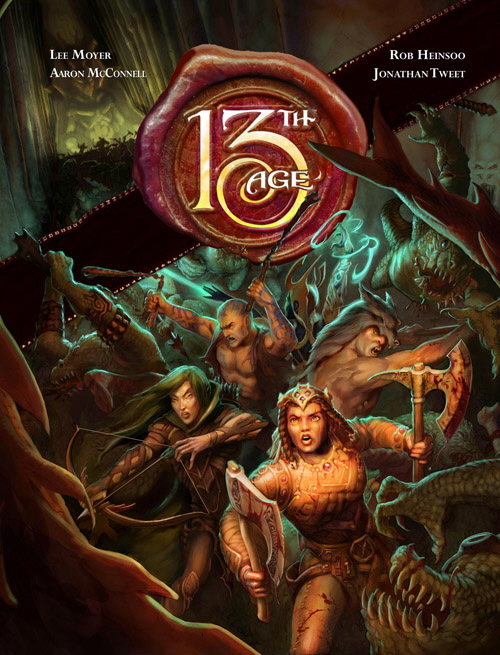
This latest issue of Page XX is packed with updates on three major new releases and lots of news, including the latest on their new fantasy RPG 13th Age by D&D designers Jonathan Tweet and Rob Heinsoo:

And lots more! Check out the latest issue of Page XX here.

Vintage Treasures: Swordquest, by Task Force Games

Vintage Treasures: Swordquest, by Task Force Games

swordquest-task-force-games2It’s almost Summer, and my teenage boys will be out of high school in a matter of days. Which means I need to get serious about finding a board game to play with my son Drew.

Recently Drew and I have been playing Grail Quest, a 1980 solitaire RPG from Metagaming. But sooner or later, we’re going to find that grail, damnit, and there’s not much point to replaying those old Fantasy Trip programmed adventures once you’ve solved them.

We’ve also playing the occasional round of RoboRally and of course Barbarian Prince, but to round out his education I need to include an assortment of fantasy board games, and I prefer something we can play in 90 minutes or so. This week, I’m considering Swordquest because I found a dusty copy in the basement that hadn’t been filed away yet.

Swordquest was designed by R. Vance Buck and originally published in 1979 as Task Force Game #7, part of Task Force Games Pocket Games line. Humble in origin and slim in production values (the original price was $3.95), these little zip-locked games proved extremely popular, and many are still fondly remembered three decades later.

Altogether, they published a total of 21 Pocket Games, including some of the most popular titles of the 70s and 80s, such Star Fleet Battles, which launched an entire line of game merchandise, and Starfire, which went through five editions and was the inspiration for the line of SF novels primarily written by Steve White and David Weber. The most popular Pocket Games were re-published in a second edition in more sturdy boxes in the early 80s, including Swordquest.

The inspiration for Swordquest — as with most fantasy boardgames of the era — was clearly J.R.R. Tolkien. The races of the kingdom of Tirrane consist of elves, dwarves, and giants, and there’s also a powerful dragon and winged creatures named wrogs rather obviously inspired by Balrogs.

Read More Read More