A Review of The Time Ships by Stephen Baxter
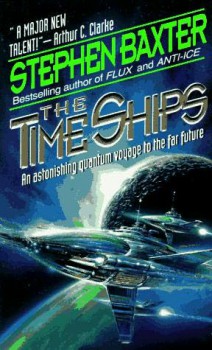 I’m not entirely sure how to review a sequel that’s written by a different author. I’m even less sure how to proceed if that sequel happens to be for a classic.
It’s not enough that it be a good book on its own. It also has to carry over themes from the original, and ideally, it should measure up to the original — which is almost impossible, because classics tend to become classics because the ideas in them are unique, cutting edge, or at least presented in a fascinating new way.
The Time Ships, by Stephen Baxter, is a sequel to H. G. Wells’ The Time Machine, and that’s one of the most impossible legacies in science fiction.
It’s a very good book, but it isn’t revolutionary in the way the original is — in part because it really can’t be. To top The Time Machine, you’d pretty much have to invent a new genre.
When The Time Machine ends, the nameless Time Traveller promises to be right back, departs for the future, and vanishes forever. The Time Ships repeats this scene from his perspective (in the original, we see it from the Writer’s point of view) and explains what happened to him.
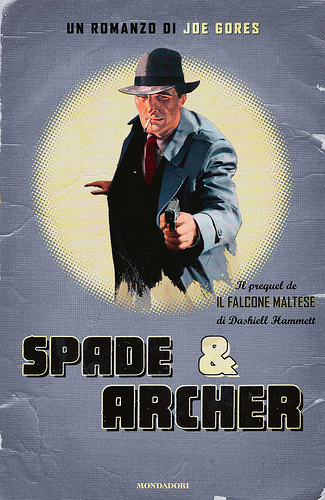
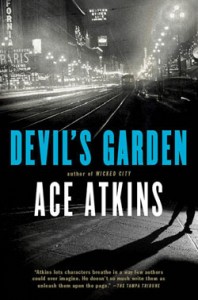 Thirty-five years earlier, Gores had likewise fictionalized Hammett’s Pinkerton days when he immersed himself in real and imagined political corruption in Roaring Twenties San Francisco in his novel, Hammett.
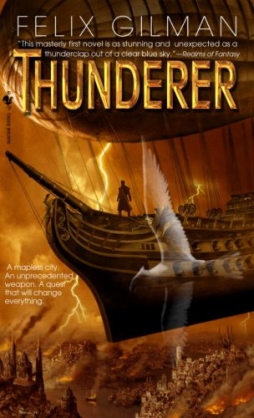 I want to write about the novels of Felix Gilman, who I believe is one of the strongest new novelists in fantasy fiction today. He’s written three books, Thunderer, Gears of the City, and The Half-Made World, all of them accomplished and powerful, fusing imaginative range with a compelling style and real insight into character and voice. I’ve written about Thunderer
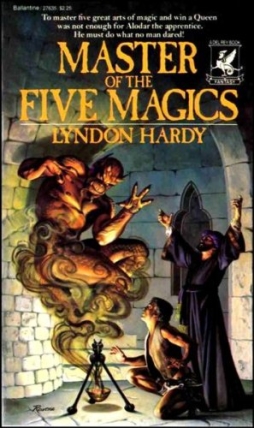 I’ve been thinking lately about fantasy in the 1980s. More specifically, about the wave of fantasy fiction that began to be published in the late 70s, in the wake of The Sword of Shannara and the first Thomas Covenant books, and which over the following years developed into fantasy as we know it now. So far as I can learn, it seems that this was when fantasy really took root as a novel category — that is, when fantasy novels stopped being relatively rare events and began to flourish as a genre. As a result, I think, it was a time when the idea of fantasy broadened; new ideas and forms and voices were tried, even if certain assumptions (like a quasi-medieval-European setting) were often unquestioned. What I wonder is whether certain things tried then and since almost forgotten are in fact worth revisiting.