Browsed by
Category: Books

Welcome to Bordertown: What Would Eilonwy Do?

Welcome to Bordertown: What Would Eilonwy Do?

gnomesThis morning on my walk to work, I spotted a man crossing a lawn. His arms were very full. Of garden gnomes.

You know, gnomes? With the blue coats and the red hats? The Rien Poortvliet kind?

“Morning!” I said.

“Morning,” he said. “I got a delivery. Gnome delivery.”

After we’d passed each other, and I’d spent a good while grinning, I thought to myself, “I know why that just happened. That happened because I started reading Welcome to Bordertown on the train today.”

(Hey! Heads up! If  you follow the above link to the Bordertown website, then click through the fancy links there to Amazon to purchase any of the new books on that page, then Terri Windling’s Endicott Studio gets a small kick-back from Amazon.com. And all of that money is donated to a shelter for homeless kids. More info here.)

Now, I’m only half a story in — the first one. But half a story in means I’ve already read the two introductions, by Terri Windling and Holly Black respectively, and also the “Bordertown Basics” which is sort of like a mix of the Not for Tourists Guide to Chicago, and Wolfe and Gaiman’s wicked little chapbook, A Walking Tour of the Shambles. It includes a weekly advisory about gang movement, monster sightings, pickpockets and missing gargoyles.

This bit made me chortle:

“The Mock Avenue street association would like to apologize to everyone for fixing the church tower clock last week, which caused widespread confusion. It has now been restored to its usual wrong time.”

But let me back up a little. Reading the introductions, I started to get a strange feeling. Gene Wolfe described a poem once as giving him “that fairy tale feeling.” He may have been quoting someone famous, like Dunsany or something. He does that. This was like that feeling, but it was also another feeling mixed in.

Read More Read More

A Review of George MacDonald’s Phantastes: A Faerie Romance for Men and Women

A Review of George MacDonald’s Phantastes: A Faerie Romance for Men and Women

phantastes-carterWarning: Some spoilers ahead

Advancing a claim that something is the “first” anything is daring a slippery slope, but saying a book is the “first fantasy” is rather like taking a leap onto a Slip and Slide greased with the gelatin exudate of Cthulhu. George MacDonald’s Phantastes: A Faerie Romance for Men and Women (1858) could be the first fantasy story … but then, what about Shakespeare’s The Tempest, or Edmund Spencer’s The Faerie Queene, or the Epic of Gilgamesh, or … you get the picture. I happen to agree with our own Matthew David Surridge that Phantastes is likely not the first pure fantasy novel, for the fact that, although it involves another world, it “never quite [leaves] the real world behind.” It’s the stuff of dreams, with a clear path back to earth.

Regardless, Phantastes is without question one of the cornerstones of the genre, and stands poised at the cusp of early works containing fantastic elements, to those that feature fully developed, independent secondary worlds.

Read More Read More

Lord Dunsany and “The Fortress Unvanquishable, Save For Sacnoth”

Lord Dunsany and “The Fortress Unvanquishable, Save For Sacnoth”

Lord DunsanyLord Dunsany’s short story “The Fortress Unvanquishable, Save for Sacnoth” has been called the first sword-and-sorcery story ever written. That attribution has been contested elsewhere, though. I don’t particularly intend to grapple with the question — it seems to me that genres are defined by conventions, which is to say by expectations held by a reader; whether a story fits a genre therefore depends on whether the conventions it uses are the ones that the individual reader expects, and while many stories use conventions in such standard ways that there’s broad agreement about sort of tale they are, some, like ‘Sacnoth,’ will vary in definition from person to person. But as a story, I think “Sacnoth” is worth discussing. Like most of Dunsany’s early short stories, it’s really quite brilliant.

(You can find it online here, and if you’ve not read it before I strongly urge you to give it a try.)

Read More Read More

A Review of Deep Secret

A Review of Deep Secret

deeep-secretDeep Secret, by Diana Wynne Jones
Tor Books (383 pages, hardcover, March 1999)

Diana Wynne Jones was born August 16, 1934 and died on March 26, 2011. Various writers who knew her have made some excellent biographical posts; I especially recommend stopping by Neil Gaiman’s blog. I never met Ms. Jones myself, but I’ve been a fan of her work since I stumbled upon Howl’s Moving Castle as a teenager. Because of that, I thought perhaps I should review one of her novels this week; preferably something other than Howl’s Moving Castle, which is quite well-known.

Deep Secret is a typical Jones book: it’s complicated. Rupert Venables, junior Magid for Earth, has a number of problems which all seem to converge on him at once. The empire at the center of the multiverse is falling. The late emperor was a paranoid, unpleasant man who hid his heirs and executed them if they discovered their own identities. He also worshipped an evil thornbush goddess. Rupert’s mentor has died, and he has to find a replacement Magid and he hates the most likely candidate on sight. When he decides to simplify matters by gathering all the candidates at a speculative fiction convention, his very odd neighbor wanders through his spell and becomes wrapped up in it. Also, his mentor is now haunting his car and won’t stop playing baroque music.

Maree Mallory, most likely candidate for Magid, has her own set of troubles, albeit more mundane ones. She’s had a bad breakup, she’s broke and living with relatives who dislike her — all except her younger cousin Nick, who she finds charming but slightly amoral. She keeps having dreams about a horrible and insulting old lady who is somehow also a thornbush. And she keeps encountering a person she thinks of as The Prat, also known as Rupert Venables.

Read More Read More

An Interview with Author Bradley Beaulieu

An Interview with Author Bradley Beaulieu

bradleybeaulieuI’m pleased to interview my great friend and writer buddy, Brad Beaulieu. We’ll be discussing his new novel, The Winds of Khalakovo, Book One of The Lays of Anuskaya, which comes out the first of April 2011 from Nightshade Books as a trade paperback and as an eBook. Winds is a sweeping epic fantasy with a Czarist Russian and Persian feel, a unique combination to be sure. I’m so proud of Brad’s accomplishment with the world building and the story. I’ve been involved with this novel for several years now, and have had a part in the revisions, so I’ve seen it go from an awesome book with an amazing concept to a truly exceptional one with a fully fleshed-out world.

Brad has had his short stories published in the most prestigious speculative fiction publications including Realms of Fantasy, The Intergalactic Medicine Show, Writers of the Future, and several anthologies from DAW Books. He’s also the father of two and the husband to a wonderful woman, Joanne. They live in Wisconsin and besides being an excellent writer, Brad is an amazing cook.

Now on to the interview…

Read More Read More

Pathfinder Tales: “The Walkers from the Crypt” by Howard Andrew Jones

Pathfinder Tales: “The Walkers from the Crypt” by Howard Andrew Jones

pathfindertales_360Howard Andrew Jones’ four-part story “The Walkers from the Crypt” has now been posted in its entirety at The Pathfinder Tales site at Paizo.com:

Elyana had no time to waste educating the young bard. There were but a few minutes left before the hounds would reach them.

She’d caught sight of the animals almost a half hour ago as she and her four companions fled across the grasslands of southern Galt. The seemingly inexhaustible hounds had slowly gained on their horses, and the party had finally picked out a rise from which to make a stand.

Vallyn gazed apprehensively out at the wedge-shaped formation of hounds sprinting forward through the high grass. “How can they keep running like that?”

“They’re dead,” Arcil said in his low, smooth voice. “They need neither breath nor rest.”

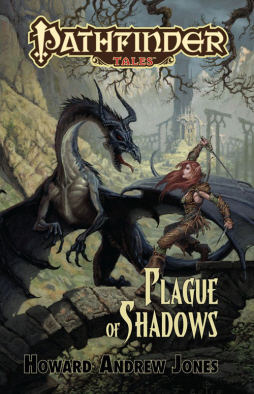
Pathfinder Tales are complete short stories set in the detailed world of Golarion, home to the Pathfinder role playing game. Novels released under the Pathfinder Tales brand include Prince of Wolves by Dave Gross, Winter Witch by Elaine Cunningham, and Plague of Shadows by our own Howard Andrew Jones. Pazio has also begun presenting complete tales set in the same setting on their website — including pieces from Monte Cook, Ed Greenwood, Dave Gross, Richard Lee Byers, and others.

“The Walkers from the Crypt” features the continuing adventures of Elyana, Vallyn, Stelan, and other characters from Howard’s new novel Plague of Shadows, in a complete standalone adventure. Read more about Plague of Shadows here.

You can read Part One of “The Walkers from the Crypt” here, and all four parts are now available at Paizo.com.

I Am Number Four: Why Movies Are Rarely As Good As Books

I Am Number Four: Why Movies Are Rarely As Good As Books

i-am-number-fourI am in my mid-thirties and my wife is in her mid-twenties. The eight-year difference between us can be jarring at times, especially because I am a pop culture junkie and she grew up without cable television (and rarely watched the network television she did have access to, as I learned when I discovered she’d never seen an episode of The Dukes of Hazzard, even in rerun).

Recently, this generation gap has became particularly evident. A close friend of hers has formed a book club, of which I am the only male attendee and also about the only thirty-something. As such, the books that we’re reading tend to track toward chick lit, much of it in the Twilight-like realm of paranormal, horror, or fantasy-related romance novels, many targeted toward young adults.

Some of the books that fall into this category these days are truly outstanding, such as The Hunger Games, but many of them have serious issues … which brings us to last month’s book, chosen in part to coincide with the release of its film version: I Am Number Four.

I Am Number Four: The Premise

As the planet Lorien was being destroyed by a race known as the Mogadorians, a group of Loriens came up with a plan that would have put Jor-El to shame. They cram 9 of their young on a spaceship to Earth, along with 9 mentors. The Lorien youth are of a class known as the Garde, who will eventually develop powers, called Legacies, intended to defend Lorien. The mentors are part of the class known as Cepan, who help train the Garde.

Read More Read More

Selling SF & Fantasy: 1969 Was Another World

Selling SF & Fantasy: 1969 Was Another World

seas-with-oystersI think what many aspiring writers today fail to grasp — very much as a result of not having been there — is that 1969 was another world.

Books were sold and distributed very differently. Big chain bookstores barely existed. There were many times more distributors than there are today. Science fiction mass-market paperbacks could be found in drugstores or bus stations, as could the digest magazines.

It was the time of the much maligned “science fiction ghetto” but really a time of innocence, in which we tended to assume that if you made it into the pro ranks, you were there for life. (How else could a writer as unimportant as, say, Robert Moore Williams have continued to publish over 40 years?)

There were no post-novelist writers, i.e. good, respected writers still writing but unable to sell novels anymore.

As somebody commented in one of those very early SFWA Forums I have been reading (I have them back to issue #3), “It’s a seller’s market. We’ve never had it so good.” This from about 1968.

It was a time in which a writer did not have to worry about selling his fourth novel because of the sales record of the previous three.

Read More Read More

Inheritance by Christopher Paolini to be Released November 8

Inheritance by Christopher Paolini to be Released November 8

inheritanceI share a lot of books with my kids. I have two sons, ages 15 and 13, and an 11-year-old daughter. As you can imagine, they have a wide range of tastes. It’s uncommon for two to enjoy the same book (or series), and virtually unheard of for all three to agree. They couldn’t even agree on Harry Potter – my youngest two enjoyed the books, but my oldest turned up his nose.

The solitary exception is Christopher Paolini’s Inheritance Cycle. All three have devoured every book in the series, and all three have been clamoring for more.

For years. The first novel, Eragon, famously completed when when Paolini was only 19, was released in 2002. My oldest, Tim, read it first, and immediately started asking me when the next one was coming out.

Eldest arrived in 2005, and by then Tim’s brother Drew had read the first one.  Within two weeks of Eldest‘s publication date, both of them were asking me to check Amazon.con for news of the third. Brisingr landed in 2008, and by then (of course) my daughter had leaped enthusiastically on the bandwagon.

It’s now been almost three years that I’ve put up with endless questions about the arrival of the fourth book (the most recent was last Saturday. Man, these kids do not give up). So it was with considerable relief that I saw news articles this week about the fourth and final volume, Inheritance, scheduled for release by Knopf Books on November 8, 2011. Thank. God. I thought I was going to be pestered about this book until retirement.

You’re on your own for a plot summary, or any further details. I’m already tired of hearing about this book, and I first heard about it yesterday.  Read all about it on Paolini’s website Alagaesia.com, or better yet ask a nearby teenager. They’re sure to have all the details.

Dragons + Napoleon = MIGHTY FINE READING!

Dragons + Napoleon = MIGHTY FINE READING!

temeraireOh, gosh! I’ve been reading Naomi Novik’s Temeraire books. My buddy (and dread Goblin Queen) Jessica Wick has been telling me I should read them for ages. And then the most fair and perilous Patty Templeton chimed in. And then my cool co-worker Janelle “I’m totally surviving the Zombie Apocalypse” McHugh started harping about them too, and I finally got a clue.

So I was all like, “FINE! I will read your 19th Century Dragons-as-Aerial-Calvalry in the year ‘O6 book, and I will see if it’s REALLY as good as all y’all are saying it is.”

Oh, it is. It is. Sea battles! Sea Serpents! Terrible storms! Travels to China! To Prussia! Blockades! Border patrols! Abolitionists and Assassins and fire-breathing Kazilik dragons, oh my!

I ordered His Majesty’s Dragon through Amazon.com and then I sort of ate it. And then I wheedled Patty (who works at a library to which I have no card) into checking out the next three books (Throne of Jade, Black Powder War and Empire of Ivory) for me (the latter of which I’m currently on). Last week, in anticipation of running out, I batted my not terribly impressive eyelashes at Janelle  (who happened to be going to the library that day) and asked if she might, just might, be willing to check out Victory of Eagles for me.

In the meantime, I ordered them all for our bookstore, so that I can hand-sell them  to unsuspecting customers in search of something bright and new and rambunctiously scrumptious in Fantasy. They’re sitting on my Employee Recommendation Shelf, right beside James Enge’s The Wolf Age, Terry Pratchett’s Nation, and Robin McKinley’s Sunshine. So they’re in good company!

Now, I’ve actually read (and watched) Patrick O’Brian’s Master and Commander, and also I love Susanna Clarke’s work, so I knew whereof Stephen King spoke when he wrote:

“Is it hard to imagine a cross between Susanna Clarke, of Norrell and Strange fame, and the late Patrick O’Brian? Not if you’ve read this wonderful, arresting novel.”

Only, see, I liked these books even better than Master and Commander, coz there were actually WOMEN in the pages. Female dragons as well as pilots — and boy, does that disturb our doughty protagonist Will Laurence! Before he got accidentally bonded to his Imperial Dragon Temeraire, he was just your ordinary, average (awesome) naval captain, with all that being British, a guy, and a naval captain in the 19th century implies. His time with the Aerial Corps, but most especially with Temeraire, works on him, until by the fourth book in, Laurence thinks and acts in ways that surprise even himself. It’s wonderful!

But really. I’m not here to write an in-depth review. I’m just here to alert you. You can be stubborn like me and wait a year or three before taking my advice and reading these books. YOUR LOSS THOUGH!