Browsed by
Category: Books

Dossouye: The Dancers of Mulukau
Dossouye: The Dancers of Mulukau

Dossouye The Dancers of Mulukau-smallDossouye: The Dancers of Mulukau
Charles R. Saunders
Sword & Soul Media (326 pp, $20.00, Paperback, 2011)
Reviewed by Bill Ward

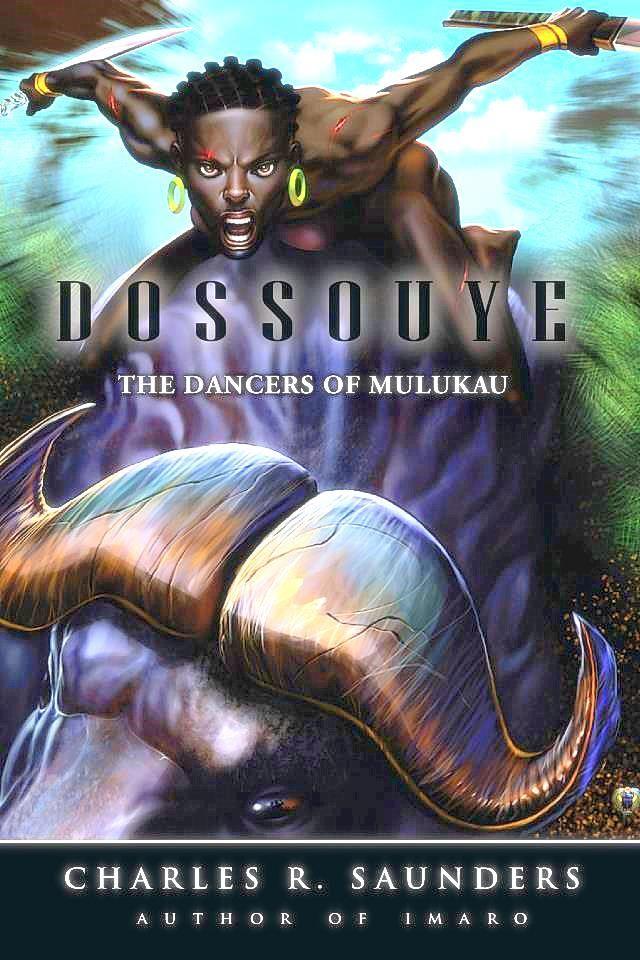
Dossouye: The Dancers of Mulukau will feel a bit like new territory for fans of Charles R. Saunders. Unchanged, of course, is the terrific action and imagination of Saunders, and the fidelity to character and setting — indeed everything there is to love about Saunders’ Imaro and Dossouye stories is evident in this latest offering. But The Dancers of Mulukau is Saunders’ first full-length sword & sorcery offering of recent years that is not based wholly or in part on existing material, and represents the Saunders of today, not of decades ago. After the various ups and downs of Saunders’ publishing career, it feels good to at last come to a place in which this author’s classic works are now safely preserved and easily available. Now he is able to move forward into as yet uncharted territory to tell new stories and develop new themes, reminding us once again why he must be counted among the giants of the field of heroic fantasy adventure fiction.

Dossouye herself is in new territory at the start of The Dancers of Mulukau. The story of how Dossouye, formidable warrior woman of the Abomey, came to leave her people and wander the land is told in the first book, a picaresque fix-up novel based on classic novellas penned by Saunders in the 70s and 80s, with additional unpublished material and a new story added for the book’s release in 2008. I won’t trouble to repeat much of what I said about Dossouye in my original review of that book, but readers can be assured that all of the hallmarks of those foundational stories have returned and are enlarged upon in The Dancers of Mulukau.

Read More Read More

How I Met Your Cimmerian (and other Barbarian Swordsmen)

How I Met Your Cimmerian (and other Barbarian Swordsmen)

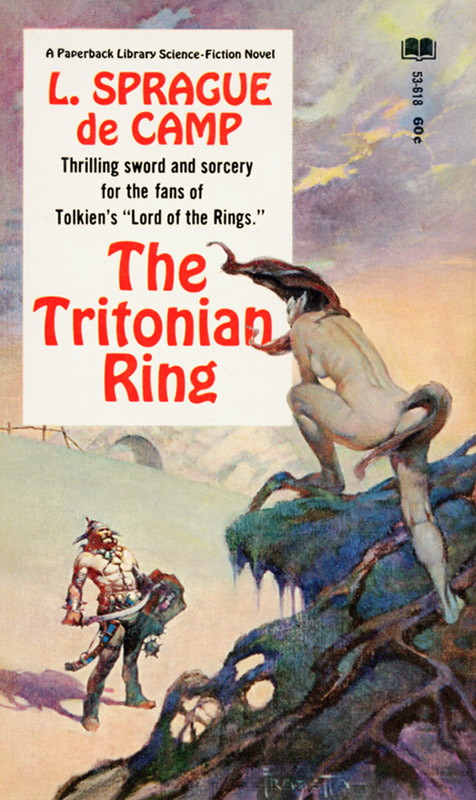
the-tritonian-ring2It was the summer of 1969. Very much like the one described in the song by Bryan Adams.

I quit the rock and roll band I’d been playing with since high school, went to work with my Dad, and had just finished reading The Lord of the Rings; a year earlier, while still in high school, I’d read The Hobbit. Now, after completing my magical journey through Middle-earth, I was totally hooked. I had found a liking — no, a craving for Heroic and Epic Fantasy.

Not long after that I discovered the Ballantine Books Adult Fantasy Series, wonderfully edited and championed by Lin Carter. Novels by Mervyn Peake, Lord Dunsany, E.R. Eddison, David Lindsay, William Morris, James Branch Cabell, Poul Anderson, and others fanned the flames of my passion.

To say I was addicted would be a gross understatement. No, I had found novels that had changed my life and would continue to do so for the next 40-plus years!

Then one day, while browsing through a used book store on State Street and Congress in downtown Chicago, I came across three more novels that would further alter my life. The Tritonian Ring by L. Sprague de Camp, The Swords of Lankhmar by Fritz Leiber, and an anthology of short-stories by Lin Carter, Beyond the Gates of Dream.

What was this new and exciting genre of fantasy fiction I had discovered? Sword and sorcery, of course! I was not only caught like an unwary Hyrkanian soldier, I was taken captive — axe, mace, and broadsword.

Read More Read More

World War Z Film Appears Headed for Armageddon

World War Z Film Appears Headed for Armageddon

world-war-zZombie fans everywhere should be outraged at the hot mess that is the film adaption of Max Brooks’ World War Z. Bringing in a new writer to salvage a script after principal filming surely isn’t a sign of a healthy film, nor is delaying the release date by six months. But that’s apparently what has happened to the project.

For those that aren’t familiar with it, World War Z (the book) is written in the style of Letters from Vietnam or the war documentaries of Ken Burns, as a series of flashbacks told by survivors of the great zombie war. The best part is the multiple perspectives from survivors around the globe, which lend it a high degree of realism while allowing Brooks the opportunity to insert pointed political and social commentary. The zombie plague of World War Z is deliberately left unexplained — it starts in the heart of China, half-hinted as the result of some undescribed industrial waste leak. But beginning with “Patient Zero,” an infected, gray-skinned, 12-year-old-turned zombie, Brooks manages to paint a very convincing picture of how the plague quickly spreads and threatens to overwhelm all of humanity. Brooks has done his research on politics, world economics, plague outbreaks, military tactics and technology, combat fatigue, and climate conditions.  The result feels like history, an event that really happened (or, chillingly, could actually happen).

But the one-sentence description of the film on its IMDB page is a head scratcher:

A U.N. employee is racing against time and fate, as he travels the world trying to stop the outbreak of a deadly Zombie pandemic.

Trying to shoehorn the events of the wide-ranging narrative through one character’s perspective (apparently Brad Pitt) because it conforms to the conservative Hollywood hero formula is the safe bet, but an awful idea. According to the film’s Wikipedia page, the screenplay was written by Babylon 5 and Rising Stars creator J. Michael Straczynski, who identified the challenge in adapting the work as “creating a main character out of a book that reads as a UN Report on the zombie wars”.

Huh? Why is a main character needed? You’ve got a book that’s universally loved; granted changes are always needed to convert page to screen, but why ditch the one element that made World War Z so unique? Why even bother acquiring the rights to the book only to completely rewrite it, top to bottom, save for the obvious reason of cashing in on the name value? The conceit of the “UN report” on the zombie war works in the novel, and works really well. Zombies are red-hot right now and World War Z is the hottest zombie property this side of The Walking Dead. People will pay to see worldwide zombie carnage without a hunky male lead. Or at least I would.

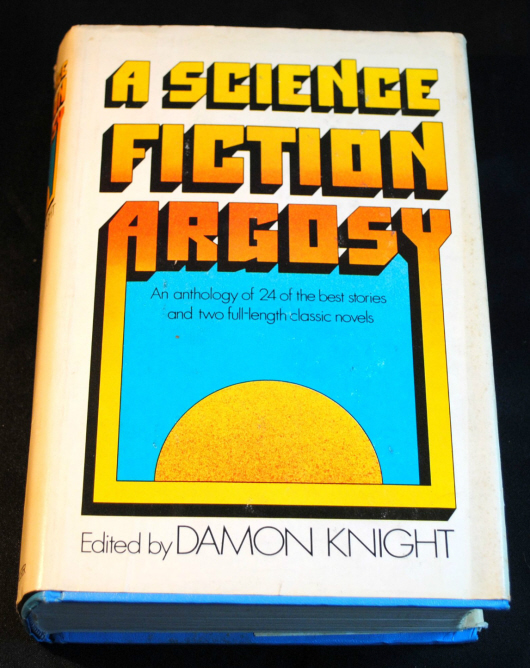
Vintage Treasures: A Science Fiction Argosy, edited by Damon Knight

Vintage Treasures: A Science Fiction Argosy, edited by Damon Knight

a-science-fiction-argosy2Damon Knight’s massive anthology A Science Fiction Argosy was published in 1972, when I was eight years old. It’s over 800 pages, packed with 24 novellas and short stories plus two complete novels, Theodore Sturgeon’s More Than Human and The Demolished Man by Alfred Bester. It’s one of those big, heavy books I’d often glance at on my bookshelf, thinking “I should really read that. As soon as I finish this game of Solitaire.”

I know Damon Knight mostly as an editor — of the highly acclaimed Orbit series, and dozens of other SF anthologies — but he was also a novelist and short story writer. Late in his career he wrote some exceedingly weird SF novels. Check out the article I published at SF Site in 1997, Jim Seidman’s review of his last novel Humpty Dumpty: An Oval, which centers on a lingerie salesman whose skull is fractured by a stray bullet, and who abruptly finds himself dodging both deadly meteorite storms and the society of dentists that secretly rules the world. Glad Jim read it, as I’m sure he made more sense out of it than I would have.

Damon Knight was also a highly respected critic, famous for his dislike of popular pulp writer A. E. van Vogt (“A pygmy who has learned to operate an overgrown typewriter”), for founding the Science Fiction and Fantasy Writers of America, and co-founding both the Milford Writer’s Workshop and the Clarion Writers Workshop. He was a busy guy.

I finally started reading A Science Fiction Argosy this morning (after blowing nearly four decades of dust off it). And you know what? It’s pretty good. I was particularly charmed by Knight’s introduction, which can be nicely encapsulated with its first and last sentences:

Some few years ago, when I was only teen-aged science fiction addict in Hood River, Oregon, I prowled the stacks of the local library… like a pornographer looking for pornography, I ferreted out science fiction… but I never got enough…

This is the kind of big meaty selection I wish someone had given me when I was a teen-aged science fiction addict in Hood River, Oregon.

That may be the most honest intro I’ve ever read, and it explains a good deal about what Knight was trying to accomplish with A Science Fiction Argosy — and indeed, perhaps, his entire life as a critic and highly vocal advocate for science fiction. The first story, John Collier’s “Green Thoughts,” is from 1931, but the anthology quickly leaps forward (skipping nearly the entire pulp era) to 1949 for the second, Isaac Asimov’s talky SF puzzler, “The Red Queen’s Race.” Henry Kuttner and C.L. Moore’s “The Cure” is even better, a dark and twisted fantasy of a New York lawyer trying to understand an oddly recurring hallucination of suffocation.

That puts me barely 50 pages in. I’m tempted to stop here and write a review, but Knight the critic would not be impressed. So I’ll reserve final judgment until I turn a lot more pages. In the meantime, consider this un-critical word of advice: find your own copy, and don’t wait as long as I did to crack it open.

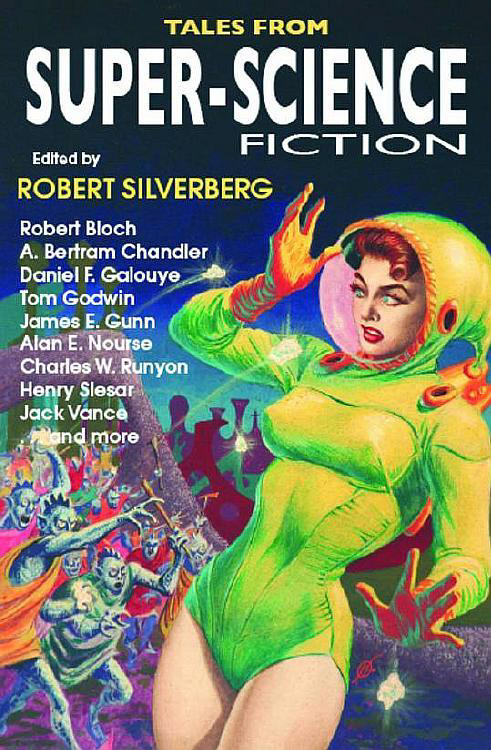
New Treasures: Tales From Super-Science Fiction, edited by Robert Silverberg

New Treasures: Tales From Super-Science Fiction, edited by Robert Silverberg

tales-from-super-science-fiction2You really have to admire the team at Haffner Press. These guys must work night and day. Hot on the heels of their last release just two months ago — the gorgeous Kuttner collection Thunder in the Void — they’ve now published Tales From Super-Science Fiction, a thick anthology of fourteen stories from the legendary 50s SF magazine Super-Science Fiction. I’m not sure how they do it.

As usual the team at Haffner is firing on all cylinders, and both the marketing team and the production staff deserve kudos for a top-notch production. The Art Director and Book Designer have hit it out of the park, and —

What’s that? There is no “team” at Haffner Press? It’s just one guy, Stephen Haffner?

Ha. Like I’m going to believe that. Just take a look at their schedule of upcoming titles. There’s nearly a dozen. Maybe Stephen is the front man, but nothing can convince me he doesn’t have two dozen gnomes in a sweatshop in his basement. There’s no other explanation.

However he does it, I hope he keeps it up. Tales From Super-Science Fiction contains fiction by A. Bertram Chandler, Robert Bloch, Jack Vance, Robert Moore Williams, Daniel L. Galouye, Alan E. Nourse, Tom Godwin, Robert Silverberg, and others. Here’s the book description:

Super-Science Fiction was launched during the sf boom of the mid-1950s. Paying a princely rate of 2 cents a word the magazine attracted fiction by Isaac Asimov, Robert Bloch, Harlan Ellison. James Gunn, Jack Vance, and Donald Westlake, and featured cover art by Frank Kelly Freas and Ed Emshwiller. Running for 18 bi-monthly issues (Dec ‘55 to Oct ‘59), the magazine eventually devolved into a publication capitalizing on the then-current craze of “monster” stories. Editor Silverberg traces the genesis of Super-Science Fiction from its beginnings as an outlet for numerous colonization/expedition stories to its conclusion with such stories as “Creatures of the Green Slime,” “Beasts of Nightmare Horror” and “Vampires from Outer Space.”

Tales From Super-Science Fiction is 400 pages, with a cover price of $32. It is illustrated by Ed Emshwiller and Frank Kelly Freas, with cover art by Freas. You can find the complete Table of Contents at the Haffner website.

See the complete list of recent New Treasures here.

Leigh Brackett: American Writer

Leigh Brackett: American Writer

shannach
The 4th and final Leigh Brackett hardback from Haffner Press, a set collecting all her short fiction.

This 4th of July I thought I’d take a look at one of my very favorite writers, the late, great Leigh Brackett, queen of planetary adventure.

Only a few generations ago planetary adventure fiction had a few givens. First, it usually took place in our own solar system.  Second, our own solar system was stuffed with inhabitable planets. Everyone knew that Mercury baked on one side and froze on the other, but a narrow twilight band existed between the two extremes where life might thrive. Venus was hot and swampy, like prehistoric Earth had been, and Mars was a faded and dying world kept alive by the extensive canals that brought water down from the ice caps.

To enjoy Brackett, you have to get over the fact that none of this is real — which really shouldn’t be hard if you enjoy reading about vampires, telepaths, and dragons, but hey, there you go. Yeah, Mars doesn’t have a breathable atmosphere, or canals, or ancient races. If you don’t read her because you can’t get past that, you’re a fuddy duddy and probably don’t like ice cream.

A few of Brackett’s finest stories were set on Venus, but it was Mars that she made her own, with vivid, crackling prose.

Here. Try this, the opening of one of her best, “The Last Days of Shandakor.” You can find it in two of the three books featured as illustrations in this article, Shannach — the Last: Farwell to Mars, and Sea-Kings of Mars and Otherworldly Stories.

Anyway. On to Brackett.

He came alone into the wineshop, wrapped in a dark red cloak, with the cowl drawn over his head. He stood for a moment by the doorway and one of the slim dark predatory women who live in those places went to him, with a silvery chiming from the little bells that were almost all she wore.

Read More Read More

Going Digital with The Crow God’s Girl

Going Digital with The Crow God’s Girl

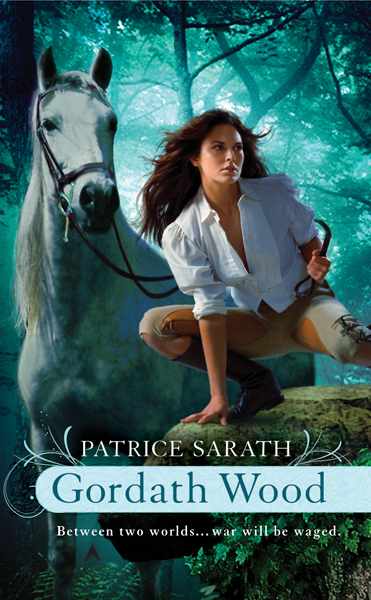
gordath-woodEditor’s Note: Patrice Sarath is offering a copy of The Crow God’s Girl to a lucky Black Gate reader — just post a comment for a chance to win either an electronic copy or a paperback.

Thanks to John O’Neill and the Black Gate team for letting me share some of my experiences in publishing.

In 2007 I sold my first two novels to Ace Fantasy. I was ecstatic. This was a dream realized. I had doggedly achieved publication after years of writing, submitting, shrugging off the rejections, and celebrating the acceptances.

I cried tears of joy when I held Gordath Wood in my hands. It was awesome. The awesome lasted all that year and the next. I had a very quick turnaround for Red Gold Bridge, but I made that deadline because I was a professional writer.

And then…

That was 2009. It was the height of the recession. No one was buying books, least of all the sophomore effort of a new writer.

And so, after the results were in, Ace turned down the third book in the series, The Crow God’s Girl.

The good news after that, and I won’t pretend it wasn’t a crushing blow, was that publishing had changed. No longer was an orphaned book destined to stay that way. Established writers were selling respectably in e-book form, and I knew there were fans of the series out there who wanted to know what happened next.

So I turned to self publishing.

Read More Read More

The Historical Urban Fantasy of Thieftaker

The Historical Urban Fantasy of Thieftaker

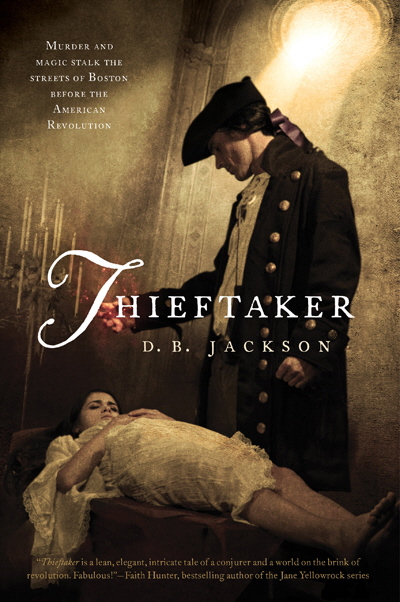
thieftakerThieftaker, the first volume in my new series, The Thieftaker Chronicles, is due out from Tor on July 3, just in time for the July 4th holiday. Why is that relevant? Well, Thieftaker is what I call historical urban fantasy. It is set in Colonial Boston in the 1760s, just as the unrest that will eventually lead to the American Revolution is starting to disrupt life in the city. My lead character, Ethan Kaille, is a thieftaker, a sort of 18th century private investigator who, for a fee, retrieves stolen items and returns them to their rightful owner. He is also a conjurer and an ex-convict with a dark past — he is, in my opinion, the most interesting and complex character I’ve ever written.

The novel begins on the night of the Stamp Act riots. While a mob is rampaging through the city streets, a young woman, the daughter of a wealthy merchant, is found murdered. Some want to blame the mob for her death, but naturally our hero has other ideas, and soon he’s drawn into a web of intrigue that puts him at odds with representatives of the Crown, with leaders of the revolutionary movement, including Samuel Adams, with a rival thieftaker — the beautiful and deadly Sephira Pryce — and with a mysterious conjurer who is far more powerful than anyone Ethan has encountered before. I won’t say more than that, because I don’t want to spoil any surprises. But basically the book combines fantasy, mystery, and historical fiction in a way that I think turned out pretty well.

This book, my thirteenth (I’ve written a dozen novels, most of them epic fantasy, as David B. Coe; and by the way, pay no attention to the omen of this being my 13th published book — nothing to see here…) has long meant more to me than any of my others, and, to be perfectly honest, I’ve been trying to figure out why. Part of it might be the very fact of the pseudonym. I’m trying something new here — writing historical urban fantasy instead of the epic, alternate world stuff that I’ve done in the past. I’m enjoying myself, and I want to keep writing this series. If the first book does well, I can.

Read More Read More

Beth Dawkins Reviews Honeyed Words

Beth Dawkins Reviews Honeyed Words

honeyed-wordsHoneyed Words
J.A.Pitts
TOR (416pp, $14.99, Paperback, July2011)
Reviewed by Beth Dawkins

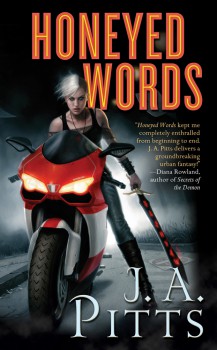
Honeyed Words is the second book in the Sarah Beauhall series. Sarah decides to take her girlfriend Katie to a concert in Vancouver for her birthday. When it is over Sarah snags passes for the after-party. There Sarah tries to stop the singer, Ari, from being abducted by what they believe to be dwarves. Afterwards Sarah and Katie run into two trouble-making elves, Gletts and Skella, who only make the couple’s stay in Vancouver even more confusing. There are also some issues back home when Sarah is asked to help Anezka the blacksmith out. The moment Sarah steps onto Anezka’s property she knows something is wrong. Soon Anezka starts acting crazy, and Sarah must ask for help from an unlikely source. While these events don’t seem connected, they come together to unleash a hell storm Sarah and Katie must clean up.

Sarah, the heroine for Honeyed Words, is a strong female lead. She has grown as a character since the first installment, Black Blade Blues, and it shows. She is working past her issues with her sexuality, and shows much more attention to her girlfriend, Katie. There is even a steamy shower scene between the couple. While she has worked things out with Katie, she isn’t carrying around the magic sword she reforged, Gram. She mentions a great deal of how the sword calls to her, how it is dreaming of blood, but we don’t see the sword blazing a path of destruction until the very end.

The story is told mostly in first person — Sarah’s POV, but some chapters switch to third person, and followed the perspective of a scheming character. These chapters were by far not as interesting. They felt jarring in the over-all flow, and the characters themselves were less fun to read.

Read More Read More

Sung in Blood by Glen Cook

Sung in Blood by Glen Cook

Sung in Bloodcookg-sung-in-blood
Glen Cook
Night Shade Books (190 pp, $23.95, 2006)
Reviewed by Jason M. Waltz

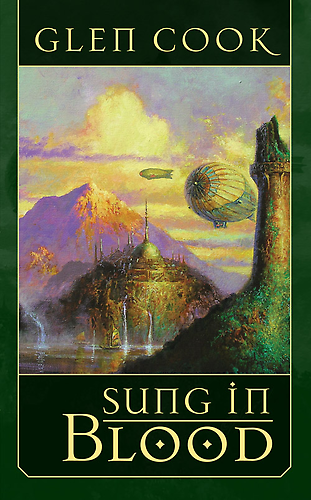
A high fantasy Fu Manchu meets Doc Savage in this formerly long out-of-print and impossible to find short novel from Glen Cook.

So says the Night Shade Books bookstore page. It’s more than accurate. And for any fan of Doc Savage, it’s a pleasant must-read. Sparse and pulpy, with evil sorcerers and demons, swords- and shadow-men, this less-than-200-page-novel is a fun romp amid the glorious romance of a former era.

My thanks to John O’Neill who, as always, guides my purchasing choices at the Windy City Pulp and Paper Convention every April in Chicago. While I found the book this year, tucked on the lower shelf beneath a vendor’s table, it was he who convinced me to buy it.

In truth, it is not reminiscent of Cook’s other better-known writings. This is nothing like his Black Company or Dread Empire tales — consider that both recommendation and caution.

Read More Read More