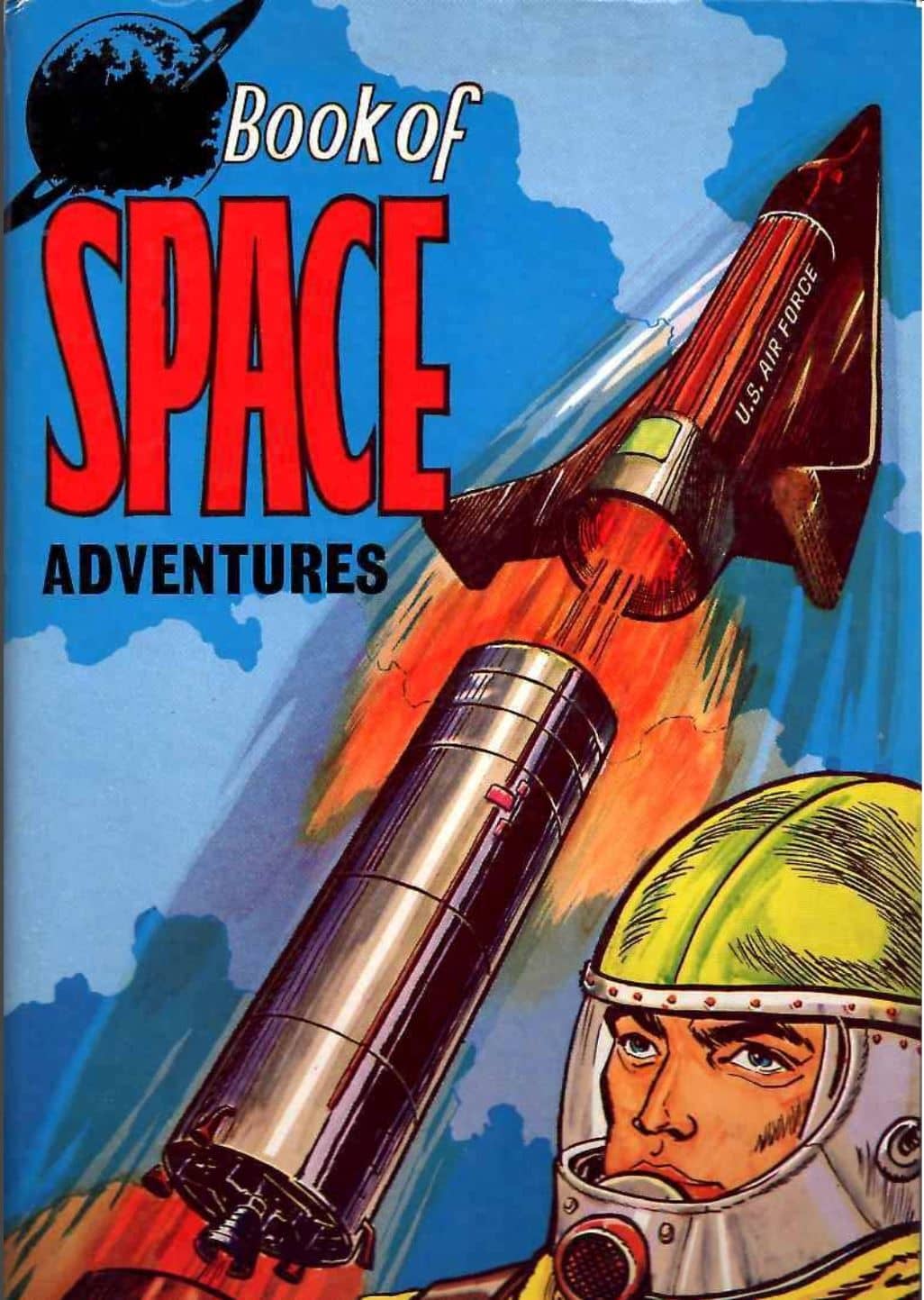
British kids thrilled to real-world rockets and space travel as did American kids. Sputnik conquered space in 1957. By 1963 both the Russians and the U.S. boasted about astronauts circling the Earth. Canada launched the Alouette 1, Valentina Tereshkova became the first woman to enter space, signals had been bounced off communications satellites, probes flew by the Moon and Venus. The Dyna-Soar project promised a reusable space craft that looked like the coolest rocket plane ever.
Publishers around the world jumped on the trend. A UK firm called Atlas Publishing & Distributing Ltd. wanted a piece. It released Book of Space Adventures, called on the inside the “Boys’ Book of Space : With factual features on the World’s space programme AND fictional adventures of SPACE ACE – intrepid Commander of the Galactic patrol”.
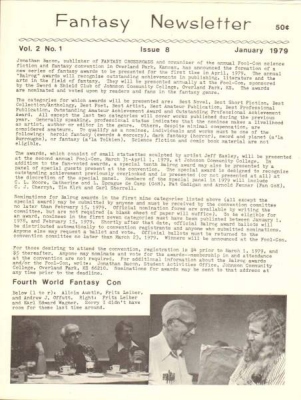
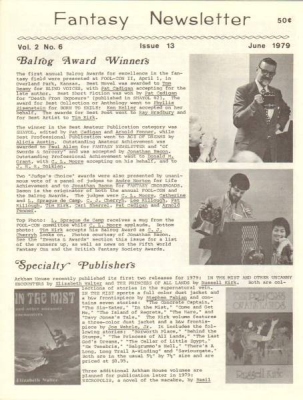
The Balrog Award, often referred to as the coveted Balrog Award, was created by Jonathan Bacon and first conceived in issue 10/11 of his Fantasy Crossroads fanzine in 1977 and actually announced in the final issue, where he also proposed the Smitty Awards for fantasy poetry. The awards were presented for the first time at Fool-Con II at the Johnson County Community College in Overland Park, Kansas on April 1, 1979. The awards were never taken particularly seriously, even by those who won the award. The final awards were presented in 1985. Both categories in which Allen was nominated, Amateur Achievement and Amateur Publication, lasted the entire run of the Balrog Awards. Allen had won the Achievement award the first year the awards were presented.
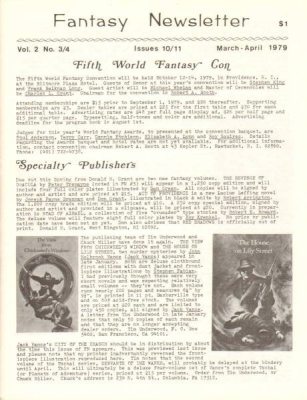
The World Fantasy Awards are presented during the World Fantasy Convention and are selected by a mix of nominations from members of the convention and a panel of judges. The awards were established in 1975 and presented at the 1st World Fantasy Convention in Providence, Rhode Island. Traditionally, the awards took the form of a bust of H.P. Lovecraft sculpted by Gahan Wilson, however in recent years the trophy became controversial in light of Lovecraft’s more problematic beliefs. The Non-Professional Special Award has been part of the award since its founding. In 1980, the year Allen received the award for his work on Fantasy Newsletter, the convention was held in Baltimore, Maryland.
Gaming on the high seas! Or at least medium seas. My wife and I went on the 2019 Dice Tower Cruise, a sold-out floating board-gaming convention of 600 adults plus 200 children. Five days aboard the Independence of the Seas, with stops in Jamaica and Haiti and access to the Dice Tower library of games.
Some of those 600 adults and most of the children didn’t participate in the gaming action, and some only dabbled. It’s a cruise, with usual huge array of activities available. This makes it an excellent vacation getaway for gamers whose families are less than enthused about the hobby.
Independence of the Seas holds about 4,400 passengers, so the DTC was a sizeable group, warranting its own dining room. We had the conference center for round-the-clock gaming, and additional table space was available in various restaurants at certain times of day. We also had the big theater for recording a live episode of the Dice Tower podcast, and a smaller venue for a few other Dice Tower gatherings/shows.
A while back at Can*Con 2017, I had the pleasure of meeting author and journalist Waubgeshig Rice for a panel discussion on post-apocalyptic fiction and First Nations perspectives in Canada. The panel came together partly because Waub was beginning to promote his then-forthcoming novel Moon of the Crusted Snow, which released in 2018 from ECW Press (and I reviewed a little while ago here). Despite being incredibly busy with different projects, Waub was game for a one-on-one interview to discuss Moon and some of his other work, which I’ve included in full below. Before that, here’s a little more information about Waub, courtesy of his website:
Waubgeshig Rice is an author and journalist originally from Wasauksing First Nation. His first short story collection, Midnight Sweatlodge, was inspired by his experiences growing up in an Anishinaabe community, and won an Independent Publishers Book Award in 2012. His debut novel, Legacy, followed in 2014. A French translation was published in 2017.
He got his first taste of journalism in 1996 as an exchange student in Germany, writing articles about being an Anishinaabe teen in a foreign country for newspapers back in Canada. He graduated from Ryerson University’s journalism program in 2002. He currently works as a multi-platform journalist for CBC News in Sudbury, where he lives with his wife and son. In 2014, he received the Anishinabek Nation’s Debwewin Citation for excellence in First Nation Storytelling.
The Ditmar Awards are named for Australian fan Martin James Ditmar Jenssen. Founded in 1969 as an award to be given by the Australian National Convention, during a discussion about the name for the award, Jenssen offered to pay for the award if it were named the Ditmar. His name was accepted and he wound up paying for the award for more years than he had planned.
The Best Australian Fantasy/SF Artist category was not one of the original Ditmar Award categories in 1969, and the award had several names after it was introduced. The first art awards given by the Ditmar Awards occurred in 1980 when the category was called Best Australian Fantasy/SF Artist and was won by Marilyn Pride. Over the years, the category has changed titles and direction several times, sometimes being for “Best Australian SF or Fantasy Artist,” sometimes being for Best SF or Fantasy Artist, without concern about origin, sometimes being specifically for Best Fan Artist, and once being for Best Australian SF or Fantasy Artist, Cartoonist, or Illustrator. There have also been times that the award has disappeared or replaced by an away for Best Artwork (or given in addition to a Best Artwork Award. The most recent Best Fan Artist Award was presented in 2016, with Best Artwork being awarded as recently as 2018.
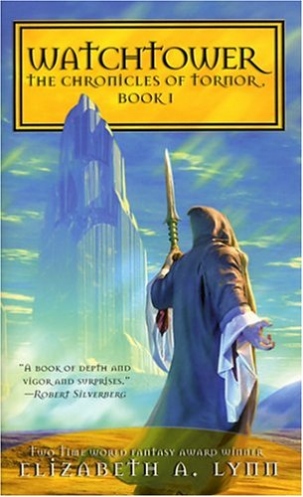
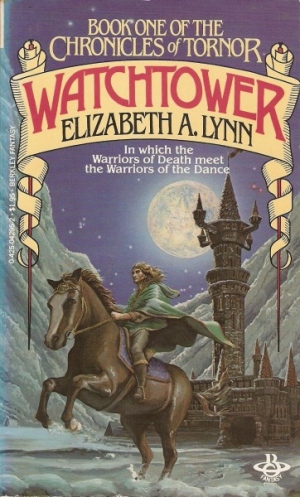
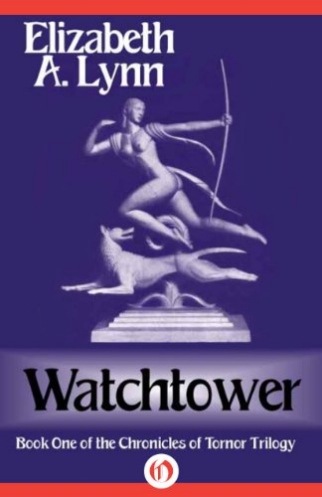
The World Fantasy Award was established in 1975 as part of the World Fantasy Convention. Seen as a fantasy version of the Hugo and the Nebula Awards (neither of which are strictly for science fiction), the nominees and winners are selected by a panel of judges, although currently, two positions on the ballot are opened up to nominations from members of the World Fantasy Convention. The Novel Award has been presented since the first year, when it was won by Patricia A. McKillip for her novel The Forgotten Beasts of Eld. There have been six years in which the award resulted in a tie, most recently in 2018, when Fonda Lee and Victor LaValle both received the award. Originally, the trophy was a Gahan Wilson created grotesque bust of H.P. Lovecraft. In recent years as more and more authors, fans, and winners of the award spoke out against Lovecraft’s misogyny and racism, the trophy was replaced by a sculpture of a tree created by Vincent Villafranca. In 1980, the award was won by Elizabeth A. Lynn for her novel Watchtower.
Watchtower is the first volume of Elizabeth Lynn’s Chronicles of Tornor series, the second volume of which, The Dancers of Arun, was not only released in the same year, but also appeared on the World Fantasy Award ballot opposite this volume. The series was completed the following year with the publication of Northern Girl.
It was front page news in the Pocono Record, serving Stroudsberg, PA, on August 8, 1955. The headline read: “‘Mr. Rivets’ Show Filmed for Television/At Waterfront Farm Near Marshalls Creek.” Intrepid Record reporter Leonard Randolph drove his ancient station wagon the seven miles from town to check out the famous Philadelphia television star for the locals.
Look, I says to an intelligent-looking young boy of about seven standing near a tree, what’s this Mr. Rivets like?
In the manner children reserve for their plodding elders, the boy turned and said, he’s funny.
He turned back to the tree. Another man, standing nearby, spoke up, rather ill-advisedly it turned out. Well, he says, what makes him funny?
The boy fixed this innocent bystander with a gaze you might imagine someone giving to a soggy pork chop left over from lunch three days before. What makes anything funny? he asked.
That answer is so perfect that I’m tempted to end this article here, even before the Read More jump. What can I say that would top such wisdom? Nevertheless, join me after the jump and I’ll fill in the backstory of “Television’s original mechanical man.”
Peter Graham is often quoted as saying that the Golden Age of Science Fiction is 12. I was reminded of this quote last year while reading Jo Walton’s An Informal History of the Hugo Awards (Tor Books) when Rich Horton commented that based on Graham’s statement, for him, the Golden Age of Science Fiction was 1972. It got me thinking about what science fiction (and fantasy) looked like the year I turned twelve and so this year, I’ll be looking at the year 1979 through a lens of the works and people who won science fiction awards in 1980, ostensibly for works that were published in 1979. I’ve also invited Rich to join me on the journey and he’ll be posting articles looking at the 1973 award year.
The Locus Awards were established in 1972 and presented by Locus Magazine based on a poll of its readers. In more recent years, the poll has been opened up to on-line readers, although subscribers’ votes have been given extra weight. At various times the award has been presented at Westercon and, more recently, at a weekend sponsored by Locus at the Science Fiction Museum (now MoPop) in Seattle. The Best Book Publisher Award dates back to 1972, although in 1975 and 1976 the Publisher Award was split into paperback and hardcover categories. Ballantine Books won the award each year from its inception through 1977 (winning the paperback for the two experimental years with the Science Fiction Book Club winning the hardcover award). In 1978, when Del Rey was established as an imprint of Ballantine, Ballantine/Del Rey began winning the award. The award was not presented in 1979 for works published in 1978, but when it was reinstituted in 1980, Ballantine/Del Rey picked up its winning streak. In 1980, the Locus Poll received 854 responses.
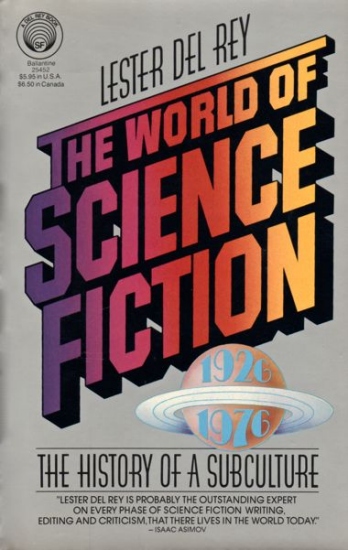
Del Rey published eight hardcovers in 1979, including Anne McCaffrey’s Dragonquest, Katherine Kurtz’s Camber of Culdi, Roger Zelazny’s Roadmarks, Han Solo at Stars’ End and Han Solo’s Revenge, by Brian Daley, and Dark Is the Sun and The Lovers, by Philip José Farmer. The three trade paperbacks they published included a reprint of Raymond Healy & J. Francis McComas’s landmark anthology iAdventures in Time and Space, the collection The Fantasy Worlds of Peter S. Beagle, and Lester del Rey’s non-fiction work The World of Science Fiction: 1926-1976: The History of a Subculture. They also published more than 100 mass market paperbacks with several, such as McCaffrey’s Dragonflight and Stephen R. Donaldson’s The Power That Preserves having multiple reprints throughout the year.
Peter Graham is often quoted as saying that the Golden Age of Science Fiction is 12. I was reminded of this quote last year while reading Jo Walton’s An Informal History of the Hugo Awards (Tor Books) when Rich Horton commented that based on Graham’s statement, for him, the Golden Age of Science Fiction was 1972. It got me thinking about what science fiction (and fantasy) looked like the year I turned twelve and so this year, I’ll be looking at the year 1979 through a lens of the works and people who won science fiction awards in 1980, ostensibly for works that were published in 1979. I’ve also invited Rich to join me on the journey and he’ll be posting articles looking at the 1973 award year.
The John W. Campbell Award for Best New Writer was established by the publishers of Analog magazine in 1973 shortly after Campbell’s death. Eligibility for the award begins with an author’s first professional sale and runs for two calendar years. This stipulation has meant that some major authors who didn’t make a splash at the beginning of their career were not eligible for the award when people began to recognize their names. The award may be given out on the bases of either short fiction or novels.
The John W. Campbell Award are currently administered by the Hugo Award committee on the same ballots and is presented at the Hugo Award ceremony at Worldcon, but it is emphatically not a Hugo, to the extent that some joke the awards name is the John W. Campbell-not-a-Hugo Award.
Prior to the establishment of the award, the Hugos did, on occasion, recognize new authors. In 1953, Philip José Farmer won the Hugo Award for New Author and Robert Silverberg won the award in 1956. The award was attempted in 1959, but the (not-insignificant) authors on the ballot, including Brian W. Aldiss, Paul Ash/Pauline/Ashwell (appearing separately under both bylines), Rosel George Brown, Louis Carbonneau, and Kit Reed, lost out to No Award.
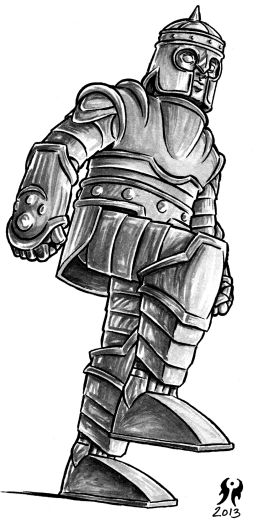
Bronze Golem by Luigi artikid Castellani“A rules-light game system modeled on the classic RPG rules of the early 1980’s”
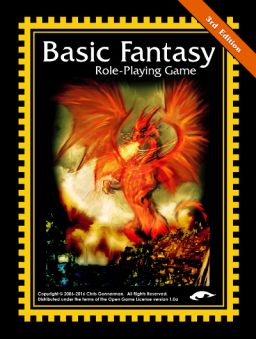
I just purchased a copy of the Basic Fantasy Role-Playing Game, “a rules-light game system modelled on the classic RPG rules of the early 1980’s”, which is code for an Old School Revival (OSR) game based on the old D&D mechanics that Wizards of the Coast released under open license some twenty(!) or so years ago.
The thing about OSR games is you never quite know whether they are reviving the experience or just the rules of yesteryear’s roleplaying. The two are different because the world has changed.
Sure, the rules generate the experience, but the same way music generates the gig. This isn’t the sound of one hand clapping in the woods. The context matters. Just as Bill Haley and the Comets wouldn’t trigger a cinema (!) riot these days, the uneven rules of yesteryear aren’t going to conjure up the edge-of-seat experience of our youthful roleplaying, because things have changed.
I’m old enough to have played 1st EditionAD&D as a teenager, just at the point when the supplements were stacking up to obscure the original mechanical simplicity. I yearn for the cosy shared world — the Vancian magic, the stock monsters and magical items, the delightful abstraction of character classes — but have no nostalgia for epicycle-heavy non-recursive mechanics — ascending armor class, anybody? — nor the nerdily statted list of polearms, nor the tribble-like burgeoning of scene-stealing new character classes. Luckily, we were fortunate enough to have an adept DM (Hello Andy, Calum!) who could act as a layer between the mechanics and the flaky teens (Sorry, Andy, Calum…). Nor have I any interest in revisiting old controversies — Wot? No thief?
And this is the first way that the world has changed: standards.