Browsed by
Category: Blog Entry

Tillie the Toiler and Rosie the Robot
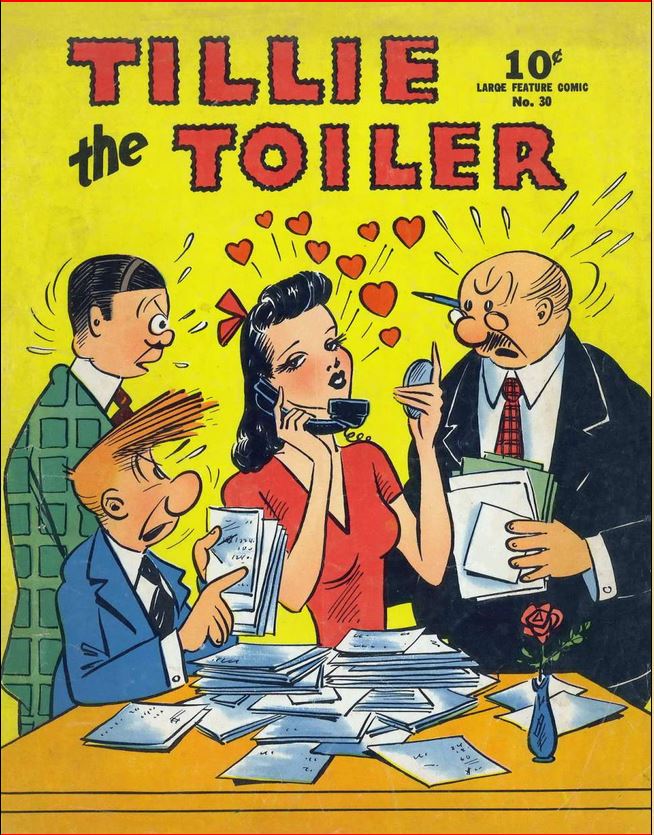
Tillie the Toiler and Rosie the Robot

Tilie the Toiler, Large Feature Comics #30 1942

The history of comic strips sometimes seems like a roll call of male names. The Katzenjammer Kids, Little Nemo, Tarzan, Moon Mullins, Li’l Abner, Barnaby, Terry and the Pirates, Flash Gordon, Buck Rogers, Joe Palooka, Barney Google, Mutt and Jeff, Dick Tracy, Harold Teen, and the name of names, Rube Goldberg’s Boob McNutt. Even Blondie heads a strip that’s 99.9% about Dagwood.

Probably the most famous female comic strip heroine is Little Orphan Annie. Digging into archives brings up a roster of mostly forgotten others: Ella Cinders, Etta Kett, Winnie Winkler, Invisible Scarlet O’Neil, Little Annie Rooney, Dixie Dugan, Betty, Nancy, and Dimples, a roster that will bring few images to mind.

Only a handful of comic strips ever ran a major series starring robots, and those were mostly in the male-oriented science fiction strips. Two rare exceptions occurred in Invisible Scarlet O’Neil and Ella Cinders, but both robots were drawn and referred to as males. (How do you sex a robot? The top set of swimmerets on a female’s tail are soft, translucent, and crossed at the tips. A male’s swimmerets are bony, opaque, and point up toward his body. Sorry. That’s how you sex a lobster. You sex robots by the length of their hair and the size of their breasts, just like humans. Check below if you don’t believe me.) Finding a strip with a female star going up against a female robot is the rarity of rarities.

Today’s unique find is Rosie the Robot in Tillie the Toiler. (Not the far more famous Jetson’s Rosie. Rosie is to girl robots what Robbie is to boy robots: hideously overused.)
Read More Read More

The Golden Age of Science Fiction: Omni

The Golden Age of Science Fiction: Omni

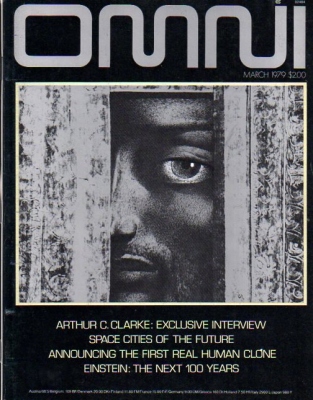
Cover by De Es Schwertberger

Cover by Pete Turner

Cover by Ernst Fuchs

The Balrog Award, often referred to as the coveted Balrog Award, was created by Jonathan Bacon and first conceived in issue 10/11 of his Fantasy Crossroads fanzine in 1977 and actually announced in the final issue, where he also proposed the Smitty Awards for fantasy poetry. The awards were presented for the first time at Fool-Con II at the Johnson County Community College in Overland Park, Kansas on April 1, 1979. The awards were never taken particularly seriously, even by those who won the award. The final awards were presented in 1985. The Best Professional Publication Balrog was presented each year from 1979 to 1985. Won by either Omni or F&SF from its second year to its sixth year, it was won by the book Age of Dreams, and art book by Alicia Austin in its first and J.N. Williamson’s anthology Masques in its last year.

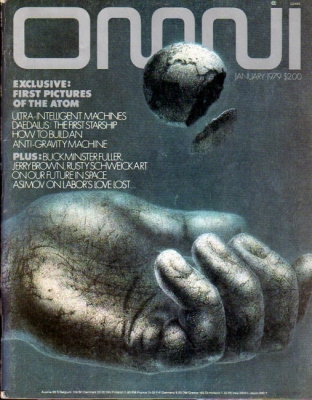
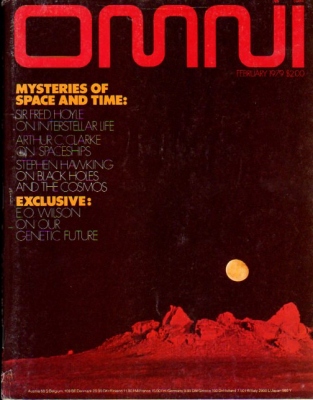
1979 was Omni magazine’s first full year of publication. The magazine had been founded in 1978 by Bob Guccione, best known as the publisher of Penthouse, and Kathy Keeton. Omni, with a focus on science, science fiction, and the paranormal was a glossy magazine that acquired some level of prestige, in part because Guccione was able to hire Analog editor Ben Bova to co-edit the magazine, along with Frank Kendig. Keeton described the magazine as exploring “all realms of science and the paranormal, that delved into all corners of the unknown and projected some of those discoveries into fiction.””

Read More Read More

J. Barton Mitchell Reads from The Razor with Audience Q&A

J. Barton Mitchell Reads from The Razor with Audience Q&A

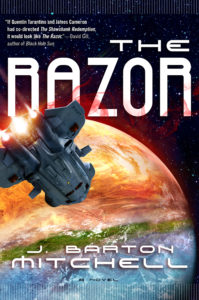
jbm21J. Barton MitchellIMG_1627-199x300 (the J. stands for “Jack”) is the author of the science fiction YA novel series Conquered Earth (published by St. Martin’s Press), and The Razor (published by Tor Books). He has also sold screenplays to Warner Bros. and 21st Century Fox, and created the comic book series POE for ‘Boom! Studios’.

I had the privilege of interviewing him (see the video below), and in preparation for that interview, read The Razor, and let me just say: Wow. It is excellent.

Here’s the back cover copy:

J. Barton Mitchell’s The Razor is a riveting science fiction thriller about a man struggling to survive the chaos on a prison planet.

Brilliant engineer Marcus Flynn has been sentenced to 11-H37 alongside the galaxy’s most dangerous criminals. A hard labor prison planet better known as the Razor, where life expectancy is short and all roads are dead ends.

At least until the Lost Prophet goes active…

In a few hours, prison guards and staff are evacuated, the prisoners are left to die, and dark mysteries begin to surface.

Only Flynn has the skills and knowledge to unravel them, but he will have to rely on the most unlikely of allies — killers, assassins, pirates and smugglers. If they can survive each other they just might survive the Razor… and claim it for their own.

Black Gate covered the release of The Razor last October.

Read More Read More

The Golden Age of Science Fiction: Elayne Pelz

The Golden Age of Science Fiction: Elayne Pelz

Photo by Chaz Boston-Baden

Photo by Chaz Boston-Baden

The E. Everett Evans/Paul Freehafer Award is named after two members of the Los Angeles Science Fantasy Society (LASFS) and is presented for service to the club at Loscon.

E. Everett Evans, who also went by the nom de fan Triple E or Tripoli, was the first member of LASFS to make the transition from fan to professional author while he was an active member. Evans was born in 1893. He published his story “Guaranteed” in the January 1948 issue of Startling Stories. His first novel, The Planet Mappers, appeared in 1955. He published more than two dozen stories as well as a collaboration with E.E. “Doc” Smith before Evans’s death in 1958. In addition to the Evans Freehafer Award, the Big Heart Award was established in his honor and named for him from 1959 until 2006, when it was renamed in honor of Forrest J Ackerman.

Paul Freehafer was an active fan within LASFS who helped carry club projects to completion during his short time with the club. Born in 1918 in Idaho, he moved to Los Angeles to attend Cal Tech. Freehafer discovered science fiction when he was 13, fandom the following year, and joined the Science Fiction League in 1934. From 1939-1941, Freehafer published the fanzine Polaris and was noted for avoiding many of the trends and fads that fans of the era often got caught up in, such as Esperanto, simplified spelling, etc. He is often credited with maintaining unity among the club’s various factions and keeping the club together. Knowing he was ill, Freehafer resigned his directorship in 1942 and returned to Idaho. In 1944, when he was 27 years old, Freehafer suffered a fatal heart attack, becoming the first LASFS member to die. Following his death, Ackerman published the tributezine Polaris: Paul Freehafer, Only the Good Die Young. In addition to the Evans/Freehafer Award, for many years, one of the buildings at the LAFS Clubhouse was named Paul Freehafer Hall. Remembered in these ways 75 years after his death, Freehafer embodies the LASFS ideal “Death will not release you.”

Read More Read More

That Horrid Question

That Horrid Question

INT. SMALL CONVENTION ROOM – EARLY EVENING

A young AUTHOR, new to pitching, steps cautiously into the room clutching a binder full of papers to their chest. An EDITOR for a well-regarded publisher sits at a table with an empty chair opposite. The EDITOR smiles at the AUTHOR and beckons them to the chair. So nervous they’re shaking, the AUTHOR sits down.

AUTHOR

Thanks so much for seeing me. I really appreciate it.

EDITOR

My pleasure.  So what have you got for me today.

AUTHOR

Well, it’s a [insert genre of choice].  The audience is quite adult.  I think.  I’m not sure.  The young adult/adult distinction is not something I’m all that familiar with.

EDITOR

All right.  So, what’s it about?

AUTHOR

Well, uh, it follows [character] and their team of [insert any kind of unit you like, knights? Rangers? Robot Space Marines?] and they —

EDITOR
(interrupting)

No, that’s what happens.  That’s the plot.  I want to know what the book is about.  What is the theme?

AUTHOR

Internal Screaming

Read More Read More

Cheque Please

Cheque Please

Canadian FlagWe’ve got a odd thing here in Canada that I’m not certain exists anywhere else. Oh I’m sure that other provinces, states and countries have Arts Councils, but I’m not sure that any of them do what the Canada Council for the Arts does for writers. Specifically, they have a little program called Public Lending Rights.

For those of you who don’t already know about this, it’s money the government gives us writers (thank you Canadian tax-payers everywhere, including myself) to compensate authors for the royalties they miss from the use of library books.

Read More Read More

The Assured Place of Superheroes in American Popular Culture

The Assured Place of Superheroes in American Popular Culture

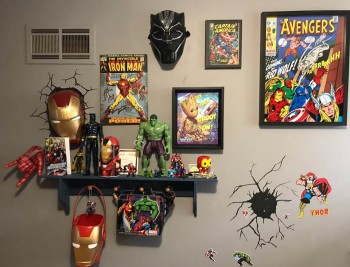
avengers assemble!Some people, 24 (or 25?) movies in, are expressing MCU superhero movie fatigue. (Certainly not me or most of my friends — the films continue to be some of the more fun, thrilling entertainments to be had at the cineplex two or three times a year. Is the quality dropping off? Hell no — try to rank ‘em; I’ll bet several of the ones at the top of the list came out just in the last couple years.) I’m talking about a few critics (some of whom were saying the genre was getting “tired” and “played out” 15 films ago), and a few newcomers who didn’t grow up on four-color comics but jumped on the bandwagon when the culture went crazy for costumed crime-fighters.

I can imagine how it must look to them: Now they turn on their TV and it seems like a dozen streaming and broadcast tv shows are about caped crusaders; they check the movie listings and half the films filling up theater screens are about super-powered beings.

They suggest it will eventually play out. They think audiences will finally be sated, the fad will pass. Everyone will grow tired of beautiful people in spandex.

I’ve got news for them.

Read More Read More

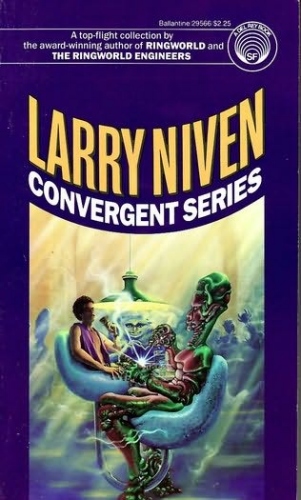
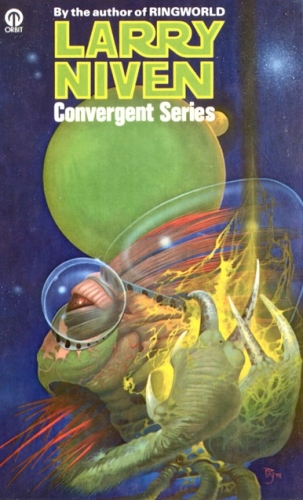
The Golden Age of Science Fiction: Convergent Series, by Larry Niven

The Golden Age of Science Fiction: Convergent Series, by Larry Niven

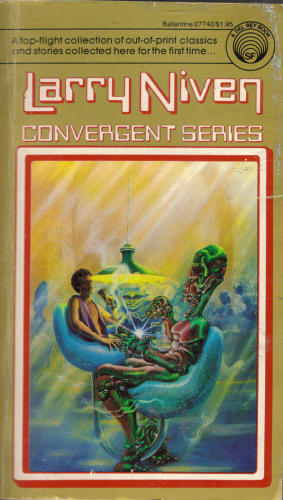
Cover by Eric Ladd
Cover by Eric Ladd

Cover by Eric Ladd
Cover by Eric Ladd

Cover by Peter Jones

The Locus Awards were established in 1972 and presented by Locus Magazine based on a poll of its readers. In more recent years, the poll has been opened up to on-line readers, although subscribers’ votes have been given extra weight. At various times the award has been presented at Westercon and, more recently, at a weekend sponsored by Locus at the Science Fiction Museum (now MoPop) in Seattle. The Best Collection Award was first presented in 1975, when it was won by Fritz Leiber for The Best of Fritz Leiber. Up until that year an award was presented for best reprint anthology/collection, with that award’s final winner also being announced in 1974. In 1980. The Locus Poll received 854 responses.

By 1979, Larry Niven had already delved deep into his Known Universe series, publishing World of Ptaavs, Ringworld, A Gift from Earth, Protector, and Ringworld Engineers as well as numerous stories that had been collected in Tales of Known Space in 1975. Niven was so associated with these stories that when he published the collection Convergent Series in 1979, which did not include any Known Space stories, he felt the need to spell the lack of connection out in the afterword to the first story, “Bordered in Black,” which had the feel, if not the details, of a Known Space story.

Read More Read More

The Monster and the Ape

The Monster and the Ape

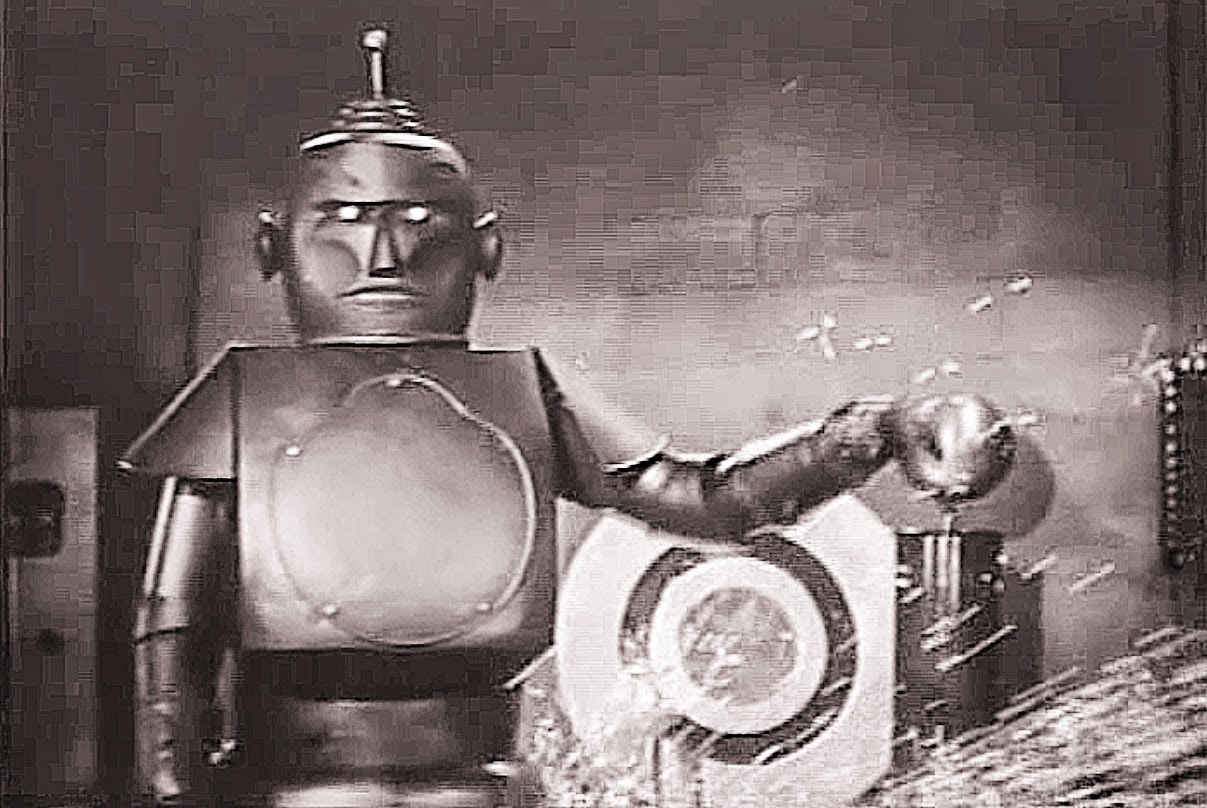
The Monster and the Ape still

A true oddity in the history of robots is the complete absence of robot films in American cinema before the 1950s. By my count studios made exactly zero full-length feature films with a major robot character. Not even Universal, at its twin peaks of fabulously successful and highly profitable monster movies in the 1930s and 1940s, thought to include a robot hero, antihero, or villain.

Would-be robot historians have to cheat mightily to drag a robot into their texts. For unknown reasons they credit Universal’s low-budget Man-Made Monster as a robot film. The title monster is a circus freak who can absorb electricity. Feeding him with ever-greater amounts of volts turns him into a mind-controlled, rampaging but still-human monster. The Wonderful Wizard of Oz is a favorite because of the Tin Man. The Tim Man – Nick Chopper as he would be named in a later Oz book – has a metal body but retains his human (or Ozian) personality. He’s a cyborg, not a robot. His greatest wish is for a heart, to make him even more human. (Baum created a true mechanical man, Tik-Tok, but just try finding him in a movie.) You might even see a mention of Basil Rathbone’s Fingers at the Window, whose newspaper ads scream “Mystery of the Robot Murders,” but whose monsters are hypnotized humans.

Therefore, even in an era we fondly remember for its pure cheeziness, robots are low-grade Gheeze Whiz. To find any, cinemaphiles need to descend to the bottom of the Hollywood pecking order, the serials.

Read More Read More

The Golden Age of Science Fiction: Douglas Adams

The Golden Age of Science Fiction: Douglas Adams

Douglas Adams
Douglas Adams

Pat Terry was an Australian fan who was born in the mid-1880 and died in 1970. The Sydney Science Fiction Foundation established an award in his name to recognize Humour in science fiction. The award was only presented 8 times over the course of 12 years, from 1970, when it was given to John Sladek for Mechasm until 1982, when it was presented to Randall Garrett. Despite being an Australian Award, in 1971 and 1980, the award was presented at the Worldcon, which happened to be in Boston both of those years. The 1980 award, for work done in 1979, was presented to Douglas Adams for The Hitchhiker’s Guide to the Galaxy and was accepted on his behalf by Chris Priest at Noreascon II.

Douglas Adams was born on March 11, 1952. He attended Cambridge, where he formed a comedy troupe called Adams-Smith-Adams with Will Adams and Martin Smith before becoming a member of the Footlights. His work with Footlights brought him to the attention of Graham Chapman, and the two wrote a few sketches together, with Adams being one of only two non-Pythons to receive a writing credit on Monty Python’s Flying Circus. Adams would also later contribute to Chapman A Liar’s Autobiography.

I first became aware of Douglas Adams in the late 1970s when I received recordings of The Hitchhiker’s Guide to the Galaxy radio show sometime between the first series and the second series, before the publication of the first book based on them. By that time, of course, I had already seen some of his work on Monty Python’s Flying Circus.

Read More Read More