Browsed by
Category: Blog Entry

Can SF Save the World From Climate Change?

Can SF Save the World From Climate Change?

A-Canticle-for-Leibowitz-smallSince its inception in the 19th Century, science fiction has inspired technological innovation and progress, utilizing creativity to prod the minds of scientists and engineers into designing wonders beyond the factories and smokestacks of the Dickensian world. Jules Verne and H.G. Wells, the godfathers of SF, imagined submarines, airships, rockets, spacecraft, and even atomic energy, and their “science fantasy” stories inspired generations of scientists, inventors and engineers, not to mention countless artists and writers.

In the early 20th Century, the Golden Age of SF helped pioneer many of the modern technologies we now take for granted. Arthur C. Clarke conceptualized the geostationary satellite. Isaac Asimov laid the groundwork for robotics and artificial intelligence. E.E. “Doc” Smith’s Lensmen novels inspired the US Navy to create the first naval combat information center. In the early 1980s, at a time when personal computers were still in their infancy, William Gibson imagined cyberspace.

At the same time, SF writers have also warned us about the dangers of our rapidly changing world. Pre-dating Verne and Wells, Mary Shelley’s Frankenstein is a bleak cautionary tale of what can happen when scientists try to alter life itself (a warning that seems more prescient than ever in an age of cloning and GMOs). In response to the Second Industrial Revolution, E.M. Forester wrote the first modern dystopia, The Machine Stops, a short novel that depicts a future race of humans that have become helpless, fat, and slug-like due to their complete reliance on technology.

And then, of course, there are the classic dystopian tales, warning us of the dangers of taking social and political ideologies to their extreme ends: A Brave New World, 1984, Animal Farm, and Yevgeny Zamyatin’s We. Similarly, the post-apocalyptic novel A Canticle for Leibowitz, penned by Walter M. Miller during the height of the Cold War, warns of the dangers of nuclear proliferation coupled with imperialism.

Read More Read More

2013 Nebula Award Winners Announced

2013 Nebula Award Winners Announced

Ancillary Justice Ann Leckie-smallThe 2013 Nebula Awards were presented yesterday at a solemn SFWA ceremony in downtown San Jose. Folklore tells us these events occur at carefully planned intervals every year, but I suspect the truth is that Nebula Awards erupt spontaneously whenever a critical mass of science fiction and fantasy writers gather together. Like bar fights and flash mobs.

Here’s the complete list of winners.

Novel

Ancillary Justice, Ann Leckie (Orbit)

Novella

“The Weight of the Sunrise,” Vylar Kaftan (Asimov’s SF, February 2013)

Novelette

“The Waiting Stars,” Aliette de Bodard (The Other Half of the Sky, Candlemark & Gleam)

Short Story

“If You Were a Dinosaur, My Love,” Rachel Swirsky (Apex, March 2013)

Read More Read More

New Treasures: The Dark Rites of Cthulhu edited by Brian M. Sammons

New Treasures: The Dark Rites of Cthulhu edited by Brian M. Sammons

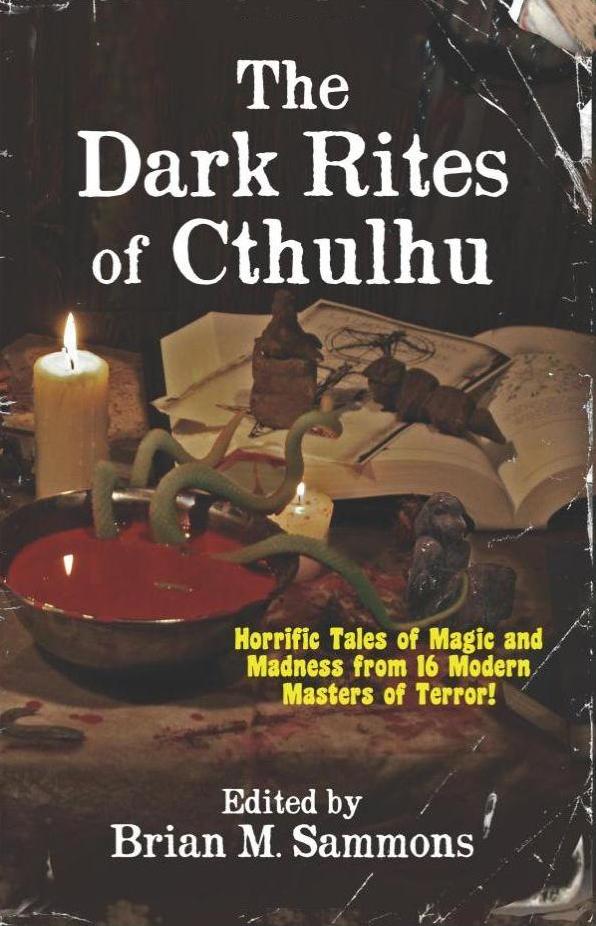
The Dark Rites of Cthulhu-smallI first met Neil Baker over a decade ago and was surprised by how much we had in common, including our shared love of genre films. He told vastly more entertaining stories than I did — especially his tales of the British film industry, and working on films like Lifeforce. So I wasn’t at all surprised when he told me late last year that he was joining the noble and distinguished brotherhood of small press publishers.

In an article for Black Gate last month, Neil told us that his first release, The Dark Rites of Cthulhu, was a collection of stories dealing with “the more magical aspects of Lovecraft’s tales, smaller, more intimate stories that explored the consequences of humans meddling in powers beyond their understanding.” In a marketplace crowded with a multitude of Cthulhu volumes, this one stands out, with terrific reviews, fabulous design, and excellent interior art by Neil himself. Here’s the book description.

For centuries, students of the forbidden arts have probed the inky recesses of the spaces inbetween. Hapless mortals have invoked monstrous entities from beyond through foul magicks, incantations and rituals. When will they learn that there can be no profit nor joy to be gained through relations with the insidious old ones? These sixteen tales of depravity, sorcery and madness may offer some illumination, but ultimately there can be no salvation for those who dabble in The Dark Rites of Cthulhu.

Featuring terrifying new stories by Glynn Owen Barrass, Edward M. Erdelac, John Goodrich, Scott T. Goudsward, T. E. Grau, C.J. Henderson, Tom Lynch, William Meikle, Christine Morgan, Robert M. Price, Pete Rawlik, Josh Reynolds, Brian M. Sammons, Sam Stone, Jeffrey Thomas and Don Webb and edited by Brian M. Sammons, The Dark Rites of Cthulhu shares cautionary tales set in a multiverse of jealousy, greed, desperation and naivety and is guaranteed to delight students of the Dark Arts and followers of the Great Old Ones alike.

The Dark Rites of Cthulhu was edited by Brian M. Sammons and published by April Moon Books on March 28, 2014. It is 224 pages, priced at $18.99 in trade paperback and just $2.99 for the digital version. Buy it directly from the April Moon website. It gets our highest recommendation.

The Technology of Medieval China

The Technology of Medieval China

The Bell Tower
The Bell Tower

I just spent a few weeks in Beijing as a tourist with my son. We hit a lot of temples and museums to see the classical medieval Chinese architecture and technology. I was struck by the beauty and strangeness of some medieval technology, especially astronomy and the measurement of time.

Concept of Time

Medieval Beijing tracked time for lots of reasons and they divided their night into five blocks of two hours:

First Geng       Xu (dog) Shi:   19:00-21:00
Second Geng  Hai (pig) shi:   21:00-23:00
Third Geng     Zi (rat) shi:       23:00-1:00
Fourth Geng  Chou (ox) shi:  1:00-3:00
Fifth Geng      Yin (tiger) shi: 3:00-5:00

Two towers, the Drum Tower and the Bell Tower, signaled time for the city. The 1.4m in diameter drums were beaten and 7m-tall bell rung with a log as a clapper at the first and fifth gengs. The other gengs were marked by bell alone, and at the first geng, the city gates were closed and streets cleared.

But how did they know what time it was in medieval Beijing?

Read More Read More

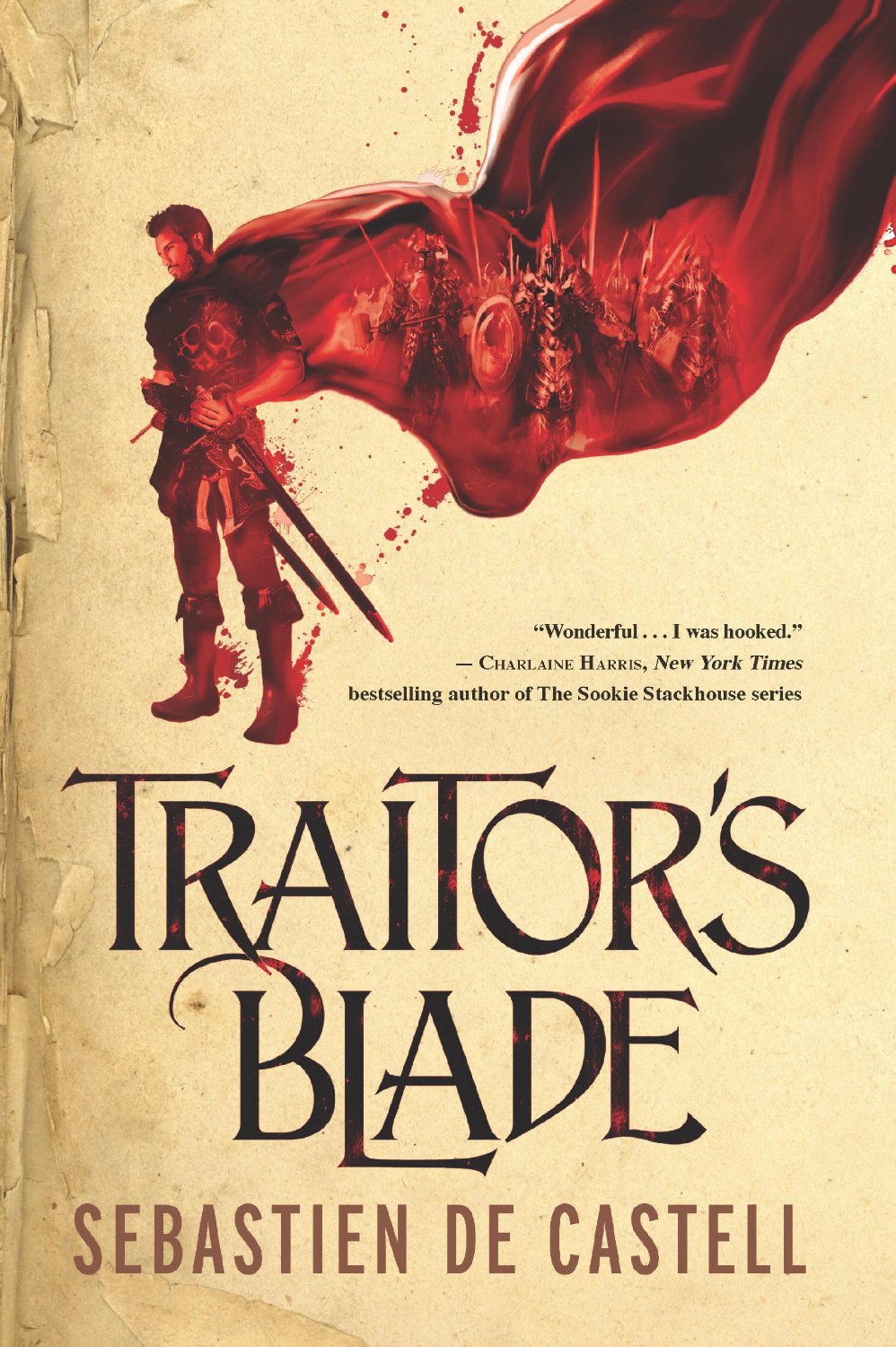
Future Treasures: Traitor’s Blade by Sebastien de Castell

Future Treasures: Traitor’s Blade by Sebastien de Castell

Traitor's Blade-smallThere’s been a lot of pre-publication buzz about Canadian Sebastien de Castell’s debut novel Traitor’s Blade. Dave Duncan called it “A wild dance of fights, treachery, and jaw-dropping surprises,” and Fantasy Book Critic said it was “The first ‘new’ fantasy of 2014 that met and even exceeded my expectations.”

But it was Niall Alexander’s review over at Tor.com that really piqued my curiosity. He called it “A bunch of fun from one cover to the other. Recommended especially to readers who’ve had it up to here with unhappy heroes.” Sounds like just what I need. Here’s the book description.

Falcio is the first Cantor of the Greatcoats, the elite corps of 144 men and women whose mission is to travel the land and uphold the King’s Law. Highly trained in the sword-fighting, diplomatic, and judicial arts, the Greatcoats are heroes. Or at least they were heroes, until the powerful Dukes, feudal noblemen with ambitions of their own, overthrew the king and placed his head on a pike as a warning to his supporters.

In the power vacuum left by the death of the king, Tristia is on the verge of collapse and the barbarians are sniffing at the borders. As the power struggle among the Ducal powers brings chaos to the land, the Greatcoats are scattered far and wide; reviled as traitors to the king they failed to protect, their reputation and legendary leather coats are both in tatters.

All the Greatcoats have left is the secret set of instructions given to each one by King Paelis before his death. If Falcio and his best friends Brasti and Kest have any hope of fulfilling the king’s final mission, the Greatcoats must reunite — or else they must stand aside and watch as the world they were sworn to protect burns.

Traitor’s Blade will be published July 1, 2014 by Jo Fletcher Books, a division of Quercus. It is 372 pages, priced at $26.99 in hardcover and $13.99 for the digital edition.

Vintage Treasures: Galactic Derelict by Andre Norton

Vintage Treasures: Galactic Derelict by Andre Norton

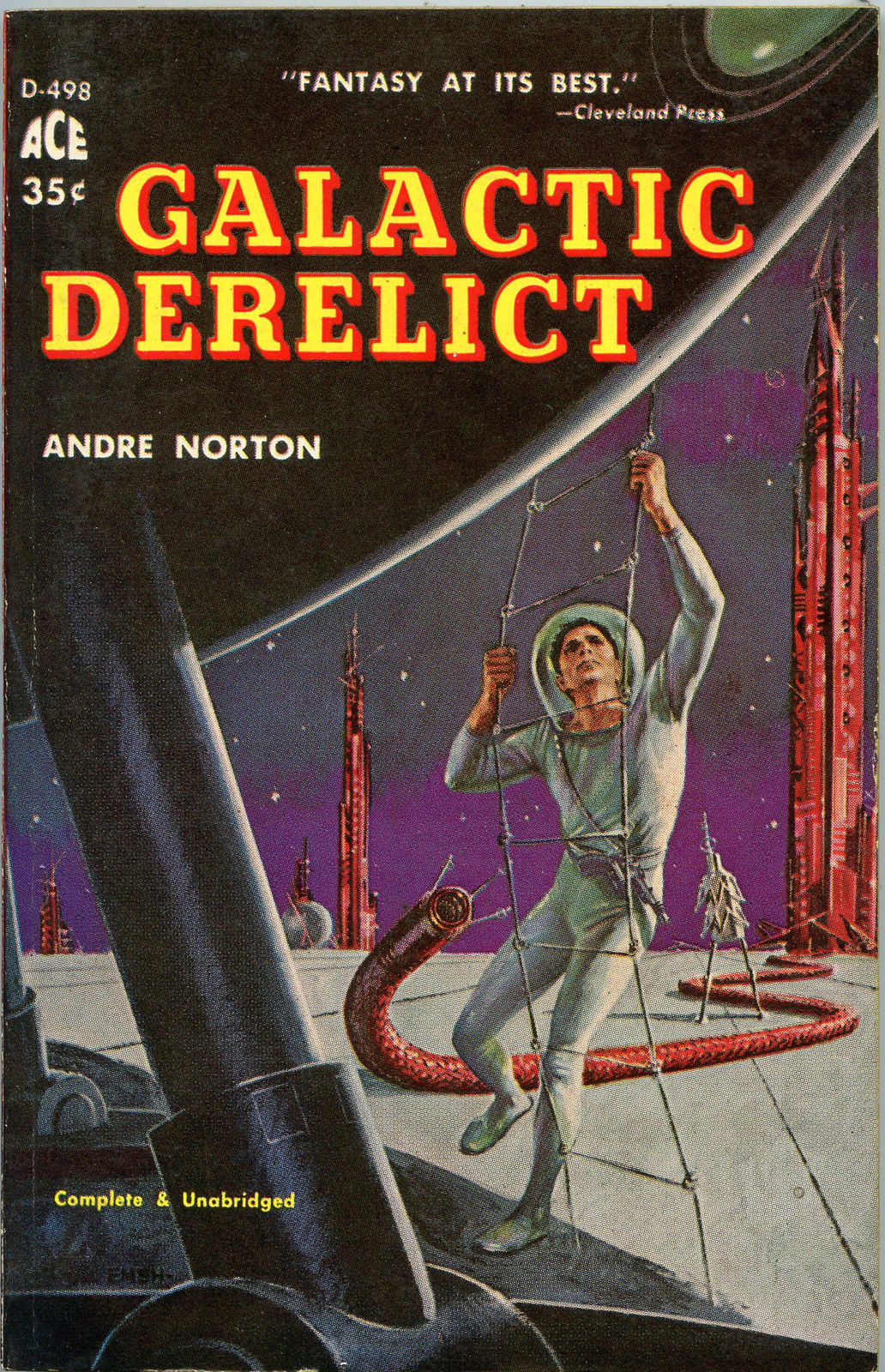
Galactic Derelict-smallI came too late to science fiction and fantasy to catch Andre Norton’s true heyday in the 50s and 60s, when she published over two dozen novels — including early classics like Star Man’s Son (1952), Star Rangers (1953), Star Gate (1958), The Time Traders (1958), The Beast Master (1959), Witch World (1963), Three Against the Witch World (1965), and Year of the Unicorn (1965).

True, she continued to publish books steadily throughout the 70s, 80s, and even the 90s — though by the last decade of her life (she died in 2005), she was writing almost solely in collaboration with other authors. But it was her early Ace paperbacks that really stirred my collector’s soul. Perhaps it was the splendid covers. Here’s the back cover copy from the 1961 Ace paperback Galactic Derelict — with one of those splendid covers — reprinting a review from Galaxy:

“All the classic elements are present in full measure in Galactic Derelict. It suffers not at all in being a sequel to Andre Norton’s excellent Time Traders.

“The U.S. Army’s race with the Russians through and against Time remains Norton’s background. Both search for abandoned wrecks of a race that had interstellar travel back in man’s infancy.

“Travis Fox, Apache, joins Ross Murdock and Dr. Gordon Ashe, time agents, in attempting the transfer, intact, of an alien ship through 20,000 years to present. Inadvertently, controls are activated and the group is launched on an involuntary galactic tour. Their efforts to return to Here and Now constitute a top-notch science-adventure yarn.” – Galaxy Magazine

Galactic Derelict is part of Norton’s Forerunner universe. The other books in the series include The Time Traders (1958), The Defiant Agents (1962), Key Out of Time (1963), and others.

Galactic Derelict was published in 1959 by the World Publishing Company and has been reprinted in eight different editions over the last half-century. It first appeared in paperback from Ace Books in 1961. It is 192 pages in paperback, priced at 35 cents. The cover is by Ed Emshwiller. If I have a few moments this weekend, I may assemble some of the other covers to display them here.

So We Were In This Bar . . .

So We Were In This Bar . . .

White HartThere’s a long tradition in western literature of the “framing device” – think Chaucer and The Canterbury Tales … or the Thousand Nights and a Night if we want something more obviously in our genre. Or Asimov and his Black Widower Mysteries.

My personal favourite among short story framing devices, however, is the bar story -– and I don’t mean the kind that starts, “We were in this bar…” Though, come to think of it, that’s how all my vacation stories start. Hmmm.

The device itself is fairly straightforward. The bar is a gathering place of disparate, but like-minded, people who exchange stories and anecdotes, usually involving people not present at the time. Sometimes the patrons of the bar take turns telling tales and sometimes, as with PG Wodehouse’s collections Meet Mr. Mulliner and Mr. Mulliner Speaks, one person in particular is the storyteller.

Undoubtedly because the storytellers are in a bar, the stories themselves can get a bit far-fetched, leading to such well-known formats as the Shaggy Dog Story and even the Tall Tale itself.

Which seems tailor-made for SF and Fantasy stories, don’t you think?

Read More Read More

The Resurrection of Dr. Mabuse, Part Two

The Resurrection of Dr. Mabuse, Part Two

etipomarMabuseLess than six months ago, I reviewed indie wunderkind Ansel Faraj’s 21st Century update of Dr. Mabuse. The Rondo-nominated film garnered more attention from genre fans for Faraj’s stunt casting of veterans of the 1960s Gothic soap opera Dark Shadows than it did for his faithful recreation of Expressionism in the digital age of indie filmmaking.

I won’t claim Faraj is the equal of Fritz Lang or that his Hollinsworth Productions offers the resources of UFA at its peak, but this is a young man who impresses in spite of the limitations of budget and time. There is a dreamlike quality to his work which is helped rather than hindered by the Spartan production values. One wonders just what he would be capable of rendering given studio backing.

Faraj’s latest production, Etiopomar, is the second half of his Dr. Mabuse reboot and deftly blends elements of Norbert Jacques’s original novel that Fritz Lang and his screenwriter wife Thea Von Harbou jettisoned from their 5-hour two-part adaptation of the book in 1922, while incorporating characters from Lang and Von Harbou’s Metropolis (1927). When one considers Lang’s silent masterpieces, the visionary Metropolis easily supersedes his Mabuse pictures. Metropolis is a stunning sci-fi epic that is still influential nearly 90 years on.

Read More Read More

A Knight Dies in Bed

A Knight Dies in Bed

Marshall Versus the Assassins-small
(Nobody but I know what really happened during the Marshal’s last two missing years in the Holy Land.)

This week, in AD 1219, Sir William the Marshal died in his bed.

The Marshal was old by the standards of the time — 72! — and made a good end: heard his daughters sing, gave alms to the poor, made sure his knights would get their Christmas cloaks, bade his much-younger wife farewell, then joined the Order of the Temple to die in seclusion a few hours later.

So, 795 years ago a knight succumbs to old age. What of it?

The Marshal died in his bed, not because he avoided hazarding himself in battle, but because when he did take the field, no man might withstand him.

Two years previously, at the grand age of 70, the Marshal led the charge into the City of Lincoln.

It was a key battle in one of those messy civil wars the Middle Ages did so well. Lords who had rebelled against King John now fought on against the young King Henry III. Worse, they had French backing and Prince Louis of France was rampaging around England with a large army.

When the council named the Marshal as the King Protector, the old knight had wept. He’d literally fought his way up from landless tournament knight to powerful magnate (think Conan meets William Thatcher from Knight’s Tale), had won a reputation as the Greatest Knight, but now History would remember him as — I translate liberally from the Norman French — “That stupid old codger who lost England to the French.”

However, he took up the challenge and, along with a gang of aging action heroes, set out to put to bed the results of a generation of misrule.

The turning point was the Siege of Lincoln, a strategic city in the Midlands. (If you play Medieval II Total War, think “Nottingham, but to the north east.”) The French had carried the town, but the castle still held.

Read More Read More

Goth Chick News: 2013 Bram Stoker Award Winners

Goth Chick News: 2013 Bram Stoker Award Winners

Doctor SleepBack in March, we gave you the list of nominees for the The Horror Writers Association’s 2013 Stoker Awards for superior literary achievement in horror, in a variety of categories. The Bram Stoker Awards were instituted in 1987 and the eleven award categories are: Novel, First Novel, Short Fiction, Long Fiction, Young Adult, Fiction Collection, Poetry Collection, Anthology, Screenplay, Graphic Novel, and Non-Fiction.

The 2013 awards were distributed at the Association’s annual award banquet on May 10, 2014, at the World Horror Convention in Portland. Black Gate and Goth Chick News would like to congratulate the following authors and editors for their superior achievements and suggest you start loading up your Amazon wish list immediately.

Lifetime Achievement Awards

  • R.L. Stine
  • Stephen Jones

For Superior Achievement in a Novel

  • Stephen King – Doctor Sleep (Scribner)

Read More Read More