Browsed by
Category: Blog Entry

Discovering Robert E. Howard: Bobby Derie on REH in the Comics – Beyond Barbarians

Discovering Robert E. Howard: Bobby Derie on REH in the Comics – Beyond Barbarians

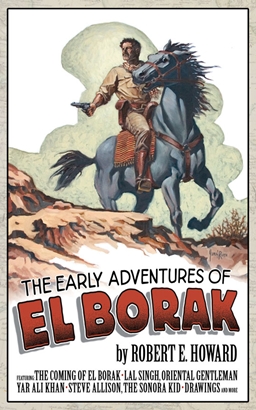
REHComics_REHOur summer of Robert E. Howard is just rolling along here at Black Gate. The latest entry delves into the comic book/graphic novel world of Howard’s works. I don’t know much about this area, but even I’m aware of Roy Thomas.

Bobby Derie is going to take us on a tour focusing on the non-Conan adaptations of Howard’s works. You’re going to learn about a quite a few you’ve missed. So, on we go!


The Golden Age of Comics passed Robert E. Howard by completely. The Silver Age treated him almost as poorly, save for in Mexico, where La Reina de la Costa Negra spun out the fantastic adventures of a blond Conan as second-mate to the pirate-queen Bêlit, and “The Gods of the North” found a few pages in Star-Studded Comics #14 (Texas Trio, 1968), and Gardner F. Fox borrowed liberally from Conan in crafting “Crom the Barbarian” for Out of this World (Avon, 1950).

In an era when DC Comics and their contemporaries felt no qualms stealthily adapting the horror and science fiction stories of H. P. Lovecraft, Arthur Machen, and Ray Bradbury without permission or credit, they apparently did not touch the evocative weird tales of Robert E. Howard; neither did the sport comics or westerns or detectives.

In 1970 when Marvel Comics licensed the character of Conan the Barbarian from Glenn Lord, acting as the agent for the Howard estate, they were on unsure ground; up until this point, Marvel had mostly worked on their own characters and properties. Yet the barbarian proved an unexpected success as the issues wore on, with writer Roy Thomas receiving permission even to adapt some of Howard’s original Conan stories to the comics, including such classics as “The Tower of the Elephant” and the novel The Hour of the Dragon.

The success of Conan led Marvel to license additional of Howard’s characters for adaptation — Kull of Atlantis, the Pictish king Bran Mak Morn, and the Puritan adventurer Solomon Kane — as well as the creation of original spin-off characters, most notably Red Sonja, based in part on Howard’s Red Sonya of Rogatino.

Read More Read More

The Public Life of Sherlock Holmes: Shovel’s Painful Predicament

The Public Life of Sherlock Holmes: Shovel’s Painful Predicament

Shovel_Martin
Yeah, it’s Shovel. You were expecting Philip Marlowe?

I wanted to have a little bit of fun this week. You, enlightened reader, have heard about William Gillette’s curtain raiser play, The Painful Predicament of Sherlock Holmes, because you wouldn’t dare miss a PLoSH post, right?

I am a serious fan of both Sherlock Holmes and the hard boiled genre of mystery fiction (which you also know because you’ve read the many columns I’ve written on both subjects…). Since Painful Predicament.. is a parody of Holmes, I decided to write a parody of a hard boiled private eye short, using Gillette’s mini-play as the model. So, I give you “Shovel’s Painful Predicament.”

I sat in my office, watching dust motes dance in the sunlight. The slats were pulled halfway, and they made a regular pattern on the floor. Unfortunately, this was the most action the office had seen in a week. Being a shamus in this town meant dry spells in jobs, not just the weather. The phone wasn’t ringing, but I wasn’t all that certain I’d paid the bill, either. I wouldn’t need an armored truck if I withdrew my bank account. Hell, I wouldn’t even need a wallet.

I heard tentative footsteps in the hallway. It sounded as if their maker was reading the doors, looking for the right one. They stopped in front of mine. I stayed behind my desk and waited. Someone pounded on the door and it rattled on its hinges. I grunted an “It’s open” in surprise. I hoped the hinges remembered how to work.

Read More Read More

Things Your Writing Teacher Never Told You: Tricks for Writing in Public

Things Your Writing Teacher Never Told You: Tricks for Writing in Public

Tricks for writing in publicLast week, I talked about how to find the right space at home for writing. As a part of that, I touched on the fact that, sometimes, the primary purpose of a room can interfere subconsciously with your writing efforts.

In our condo, I made the second, tiny, bedroom my office space. But since I spend a lot of time in there grading student papers, modifying my class curriculum, prepping for the next class, doing administrative and publicity work for the Gumbo Fiction Salon reading series, writing non-fiction, handling business correspondence, doing travel planning, and other writing-related-but-not-fiction-writing work, sometimes, even with the playful decor of the room, my office is not the best place to write fiction. I’m too aware of the other tasks that need to be done.

In other rooms, I’m often distracted by the visual To-Do List that pops up everywhere I look. There’s always laundry that’s piling up, a few dishes in the sink, a closet or cabinet or shelf that needs organizing, administrative work to do. And while making sure the clutter or items that need attention are behind me, I’m aware of the chores, even if they aren’t in my peripheral vision.

Sometimes, the only way I can escape the visual To-Do List, is to get out of the house. I do some of my best fiction writing out in public. Part of that is the “out of sight, out of mind” concept, but there’s also an element of helpful coercion. I don’t have to prioritize and make judgments about whether my writing or housework or grading or administrative stuff should be done first. If the only work I have with me is my writing, then I might as well be productive and do it.

Read More Read More

Is That Your Sword, Or Are You Just Happy to See Me?

Is That Your Sword, Or Are You Just Happy to See Me?

By the SwordI love sword-fights. By which I mean I love them in movies and on TV. Not so much in books. Mostly in books they take too long, and illustrate more how much research the writer has done and not so much the moving ahead of the story. And that’s how swords and sword fighting came to mind when I started thinking about what real life things do and don’t happen in fiction, or in movies or TV. If you’d like to see what I’ve already said about this, look here, and here.

So, in the spirit of what does and doesn’t happen in real life vs TV or movies – or even books – just what happens with people’s swords when they aren’t using them to kill someone? And what about other weapons? As I’ve suggested before, this type of thing is fairly easily handled in books. More easily than, say, why characters never (ie. hardly ever) go to the bathroom. In books, when they’re not using them, characters simply sheath their swords, or hang them from their harnesses, or hang them up by the belt on a hook. Or put them down on a table. As the reader, your eyes are directed elsewhere, and you rarely give it another thought.

Sure, sometimes a writer will have a character clean their sword, or other weapons. But there are reasons for this. One, it gives the characters something to do with their hands while dialogue is taking place. Two, how the cleaning gets done tells the reader something about the character’s personality.

Read More Read More

The Top 50 Black Gate Posts in June

The Top 50 Black Gate Posts in June

Irene Gallo
Irene Gallo

Everyone loves an underdog, and last month the underdog was definitely Irene Gallo, the Creative Director of Tor Books and Associate Publisher of Tor.com.

Ms. Gallo had a rough month in June, as she endured a series of scathing attacks from Sad Puppies, writers, and others who took offense to a personal comment she made to a friend on her Facebook page. The industry rallied strongly to her defense, however, and the two articles we wrote covering the affair, “Internet Explodes Around Irene Gallo” and “Support For Irene Gallo Continues to Grow” were by far the most-read posts at the BG blog in June. Based on the high volume of e-mail we received, BG readers largely sympathized with Ms. Gallo.

It seems that those of you who weren’t caught up with the latest controversies were busy writing. Our third most popular article last month was M Harold Page’s “Some Writing Advice That’s Mostly Useless (And Why).” His first article in the series, “Help! I Want to Write a Novel But Don’t Have Any Ideas!!!” was also in the Top 10.

Fourth on the list was Emily Mah’s interview and Kickstarter announcement, “Call for Backers! Tales of the Lost Citadel Campaign on Kickstarter, in Conjunction with a Video Interview with C.A. Suleiman, in the DARK!” Rounding out the Top Five was the most recent installment in our series of omnibus collections of interest to fantasy fans, “The Omnibus Volumes of Steven Brust: The Adventures of Vlad Taltos.”

Also in the Top Ten was our report on the Best New Fantasy Releases in June, the first “Dear Prudentia” advice column by Marie Bilodeau, and two reviews by Fletcher Vredenburgh: Death Angel’s Shadow by Karl Edward Wagner, and Heroika 1: Dragon Eaters edited by Janet Morris.

The complete list of Top Articles for June follows. Below that, I’ve also broken out the most popular blog categories for the month.

Read More Read More

The Public Life of Sherlock Holmes: Sherlock Season 3 – What Happened?

The Public Life of Sherlock Holmes: Sherlock Season 3 – What Happened?

Sherlock Season 3Now, it’s certainly possible that I’m clueless (and I do LOVE Without a Clue), but I don’t think I’ve got the following all wrong regarding BBC’s Sherlock.

Except for the grumpy old man contingent (‘Get Sherlock out of modern day!’), fans of Holmes, including scholarly geeks like me who make their own newsletter, overwhelmingly liked this new show and the three episode season one.

I don’t know too many Holmes fans (other than GOM group: see above) who disliked this show. Even those who were moderately approving seemed pleased and intrigued with it and willing to tune in for another season.

So, season two came along, and more huzzahs and approval. I don’t remember Holmes friends of mine thinking it was going south. I certainly didn’t: I thought the first two seasons were brilliant and fun updatings of the great detective. I found cool references to Doyle’s tales all over the place.

Once again, no comments that it jumped the shark. Folks were absolutely looking forward to seeing how Holmes survived his Reichenbach Fall. It was one of my five all time favorite tv shows and probably battling Justified for number one.

Read More Read More

Things Your Writing Teacher Never Told You: Location, Location, Location! or How to Find and Maintain Your Writing Space

Things Your Writing Teacher Never Told You: Location, Location, Location! or How to Find and Maintain Your Writing Space

Write in the tub-smallIn a perfect world, we could all write anywhere, anytime. But even seasoned writers sometimes have problems sitting down and starting a writing session or staying in a writing session once it’s started. While we all have these problems  – the pros find ways to get past it. Here are some suggestions on how to fight the urge to do absolutely anything but write. The causes are too numerous to deal with in a single blog post, but lets start with some basics.

Location of Your Workspace

Don’t try to work in the line of fire. Don’t place your workspace near the TV or PlayStation. Even if you’re not tempted to watch or play (And aren’t we all?), almost no one can write when there’s that much background noise. Don’t fight the battle of “I ought to be able to work anywhere.” Save that mental sword arm for your plot and prose.

Wherever your family most often gathers, whether it’s the den or the kitchen, is the worst possible place for you to try to write. For most, writing requires a measure of silence and solitude, and time away from distractions.

The amount of silence, and the type, vary from writer to writer. You’ll have to experiment to see what works best for you. I often write to music. Others find the white noise and anonymity of cafes creates a protective bubble they can concentrate in – so long as you’re not sitting with a companion who keeps asking if they can interrupt for just a moment.

Read More Read More

Discovering Robert E. Howard: Frank Schildiner on Solomon Kane

Discovering Robert E. Howard: Frank Schildiner on Solomon Kane

Kane_MoonMartial arts expert Frank Shildiner has forgotten more about Adventure Pulp than I’ve ever known. His writings have included new tales starring  pulp characters Richard Knight and Thunder Jim Wade (if you’re a Doc Savage fan, you should check big Jim out).

Solomon Kane is probably Robert E. Howard’s second best-known character after a certain well-muscled barbarian, and one which influenced Frank very early on. So, I turned to Frank for a look at the puritan sword slinger, as Black Gate continues its summer look at Robert E. Howard.


Solomon Kane. I can still remember when I first read the name. I was 11 and looking through books and comics at a flea market, my mother one row over looking through the Robin Cook section. I pulled a slim paperback from the pile, the cover showing a cold eyed Puritan staring at me with open condemnation (at least that’s how I interpreted the visual). But then I read the name… SOLOMON KANE. And there wasn’t a prayer on Earth of getting me to let go of this book that day.

And that first short story, “Red Shadows,” changed me forever. I became a fan for all things Robert E. Howard, but especially Solomon Kane. Caught by the enemy he’d chased from Europe into Africa, Kane looked up at this man he’d hounded relentlessly for years, and the following thought summed up why this hero became my favorite.

Read More Read More

How to Properly Retreat

How to Properly Retreat

You too could be this productive.

I don’t mean retreat from battle – I WOULD NEVER ADVOCATE FOR THAT! Fight until the end, my warrior friends!

I’m talking about a personal retreat to achieve certain goals, such as mastering a new weapon, learning a new fighting style or, for the cerebral among you, writing a book. Or a good chunk of one, anyway.

As I’m about to undertake a writing retreat myself, and have done quite a few successful ones in the past, I’ll focus on wordsmithing. But you may decide to apply some tricks to other types of retreats, as well.

1. Choose your Location


Can you achieve this at home? Or will there be a thousand interruptions? I’m an awesome procrasti-cleaner and procrasti-cooker, so I find home dangerous. I’m trying it this weekend, but usually I head to a place made for retreats: a convent. (A silent retreat where I don’t have to attend religious activities, as evidenced by the fact that I’ve not spontaneously combusted.) Wherever you go, make sure you have headspace and time. Make sure you’ll have a writing space all your own, and make sure that distractions are at a minimum (convents rarely have TVs or wi-fi. I’m weak-willed and know it.) Find your perfect spot.

Read More Read More

Ancient Worlds: Arachne and Hubris

Ancient Worlds: Arachne and Hubris

minervaIn the entryway of the temple of Apollo at Delphi, there was an inscription that read Gnothi Seauton, Know Thyself. This aphorism has been popular with various segments of Western society, particularly in the last century. When we use it, we typically mean it in the context of self-understanding or enlightenment, of introspection or even psychoanalysis. We mean self-knowledge as a deep delving into our own personality, our tastes, our desires, and our goals.

Which is slightly funny, because that is not at all what the Greeks had in mind when they carved it on the wall.

If we were to translate the intention of the inscription rather than the words themselves, it would read something like, “Remember your place.” Not nearly so satisfying, I’m afraid, but to the Greeks this was an immensely important concept. And from it, we get one of the most critical notions of characterization that we see in modern literature: that of hubris.

Hubris is the idea that there are screw-ups, and then there are cosmic screw-ups. Saying you’re prettier than the girl next door is obnoxious. Saying you’re prettier than the goddess Leto, mother of Apollo and Artemis, is a grave offense on a cosmic level, and terrible things are going to happen to you. This isn’t (just) because the gods have delicate egos and are easily offended by mean humans. It’s because they are fiercely protective of their status as gods. Were one to read a less religious and more temporal lesson in this, it is also a warning to the majority of mankind to always be cautiously respectful of those who have more power than you and to those in power over others that the gods are above all.

Ovid plays with this traditional idea in his retelling of the myth of Arachne. Arachne is classically portrayed as having broken this most important rule: she has forgotten that she is merely a mortal and that she owes respect to the gods. Arachne is a weaver, one of the greatest who has ever lived. But she refuses to give worship and thanks to the goddess Minerva (the Romanized Athena) as the goddess of weaving, and denies that she has been in any way blessed.

Read More Read More