Forgotten Authors: Harry Stephen Keeler

Harry Stephen Keeler was born in Chicago on November 3, 1890. His father died when he was two and his mother subsequently remarried. After her new husband, who was a gambler, lost Keeler’s mother’s savings and mortgaged the family home that was left to her by Keeler’s father, he killed himself. Keeler’s mother subsequently remarried again, but her third husband died of illness when Keeler was only 13 years old. Following the suicide of his first step father, Keeler’s mother took in boarders, mostly theatrical workers, to make ends meet and keep the family home.
The trauma of losing a father and two step fathers by the age of 13 appears to have had an impact on Keeler’s mental state and his mother had him committed to an insane asylum when he was a child. He apparently had multiple sessions in the asylum, including one that ended with his discharge on July 29, 1914, when he was declared recovered and had his property and voting rights restored.
Keeler often skipped school to attend to a paper route, but eventually he managed to earn a degree in electrical engineering from the Armour Institute. From 1912 to 1914, he worked in a steel mill in Chicago. He began writing in earnest in 1913, publishing his first short story that year. 1914 saw him publishing his first piece of crime fiction, the novella “Victim No. 5.” His early fiction appeared in magazines such as Argosy and Top-Notch Magazine.
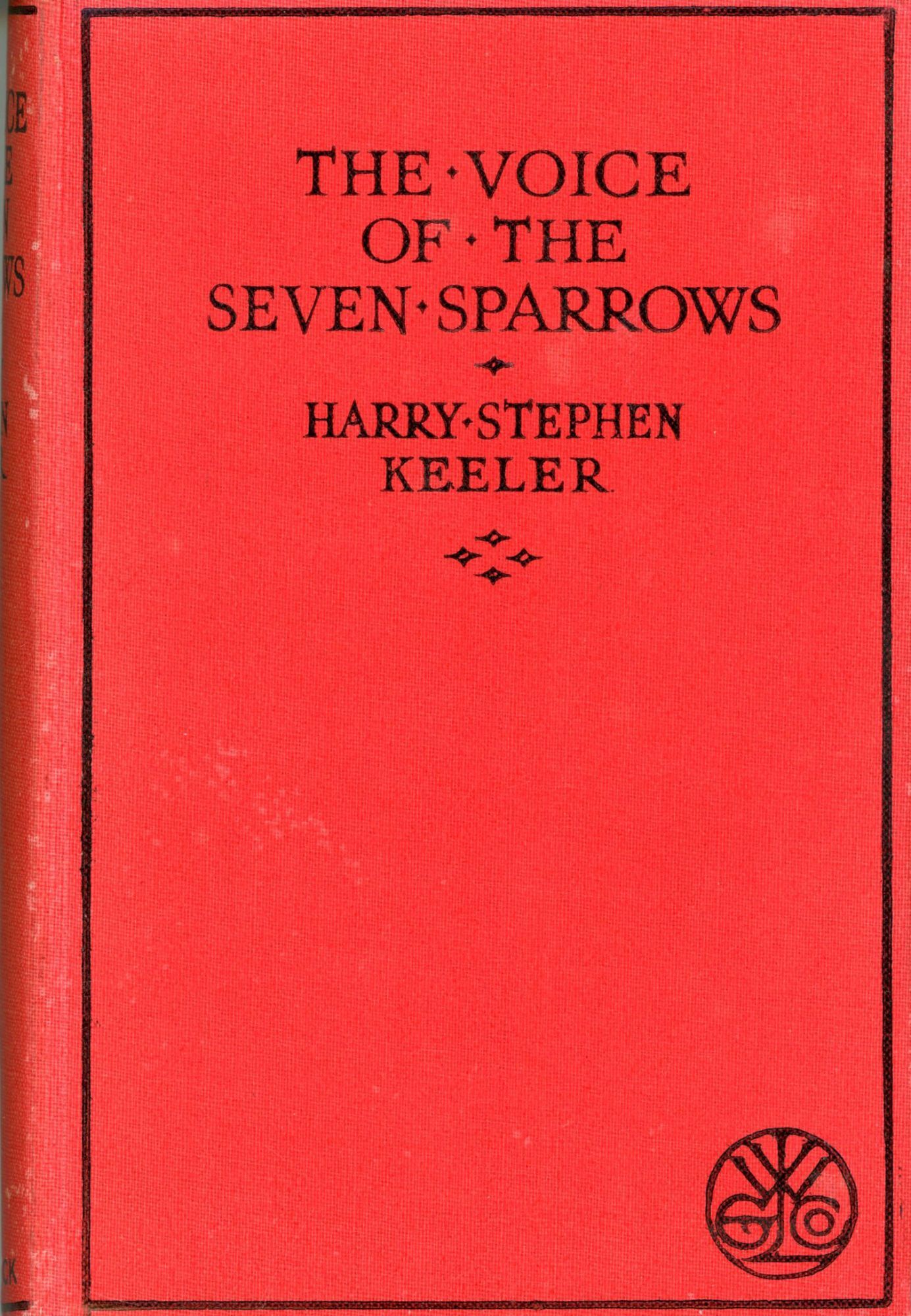
Many of Keeler’s stories deal with children in asylums, either drawing on his past, or because he wasn’t able to put that part of his life behind him. His stories, in general, had a surreal quality to them, even if they were not fantasy or science fiction stories. His stories were not known for their tightness, and often seemed to go off the rails to introduce strange concepts that occurred to him.
In 1919, he married Hazel Goodwin and they remained married until her death in 1960. Goodwin was also an author, much more mundane and mainstream than Keeler. They often collaborated, including collaborations in which Keeler dropped Hazel’s stories into his own novels. Keeler based at least six of his novels around the main character of Hazel’s 1930 short story “Spangles.”
In 1921, a notice appeared in the pulp 10 Story Book that Keeler had signed a contract for short stories which would appear in the magazine through 1922. Although no editor is named for the magazine, which was published in Chicago, David Langford notes that from 1919 to 1940 Keeler was the magazine’s editor.
The height of his popularity occurred in the 1930s, but that also gave him the freedom to be more experimental in what he wrote and how he wrote it. It also meant that in 1942, Dutton, his American publisher dropped him. He was picked up by a small publisher, Phoenix Press, and his wife began playing a larger role in his work. Hazel Goodwin Keeler was an author as well and Keeler would insert Hazel’s short stories in the middle of his novels as his characters came across her story in a magazine they were reading. Phoenix Press dropped him in 1948 and his British publisher, Ward, Lock & Co., ended their relationship with him.
In 1934, two films, Sing Sing Nights and The Mysterious Mr. Wong were made based on Keeler’s work. The former is based on a novel of the same title. The latter was “suggested” by the story “The Twelve Coins of Confucious” and stars Bela Lugosi in the title role.
Keeler could not always be easy to read. The founder of the Harry Stephen Keeler Society, Richard Polt, described his The Portrait of Jirjohn Cobb as “one of the most astoundingly unreadable novels ever written” and further calls it “the Waiting for Godot of the Keeler canon, drawn out to the length of Finnegan’s Wake.” On multiple occasions, Keeler’s mysteries don’t introduce the guilty party until the final pages, or, in one case, the final line.
His genre fiction (as opposed to just weird fiction), included the 1915 stories “When Time Ran Backward” and “John Jones’s Dollar,” both published in Black Cat. William Poundstone states that “John Jones’s Dollar” is Keeler’s “best-known story and would rate extensive anthologization if the writing wasn’t so bad, even by stiff Keeler standards of badness.” On the other hand, Robert Jennings, writing in Fadeaway #41 calls the story “superb,” His genre novels included The Face of the Man from Saturn, The Man with the Magic Eardrums, and The Man Who Changed His Skin, the latter only published in Spanish during his lifetime.
Hazel died in 1960. Three years later he married his former secretary, Tertza Rinaldo (also called Thelma). Keeler died on January 22, 1967 in Chicago and is buried in the city’s Rosehill Cemetery. In the early 1980s, Tertza donated Keeler’s papers to Columbia University (Chicago), which maintains the collection in their Rare Book and Manuscript Library.
Amazingly, Ramble House has brought many of Keeler’s novels back into print (or for the first time) and many of his books are available at on-line booksellers if you want to see how good (or awful) Keeler’s writing really is.
 Steven H Silver is a twenty-two-time Hugo Award nominee and was the publisher of the Hugo-nominated fanzine Argentus as well as the editor and publisher of ISFiC Press for eight years. He has also edited books for DAW, NESFA Press, and ZNB. His most recent anthology is Alternate Peace and his novel After Hastings was published in 2020. Steven has chaired the first Midwest Construction, Windycon three times, and the SFWA Nebula Conference numerous times. He was programming chair for Chicon 2000 and Vice Chair of Chicon 7.
TBR++
What an interesting gentleman. And that he’s proof a person can have a successful career with controversial writing ability, while not in high literature, is rather encouraging.
Detective fiction expert Art Scott was a Keeler fan and, around 50 years ago, loaned me SK’s Five Silver Buddhas, but it didn’t take hold on me and I didn’t finish it.
I wrote about Keeler from a gamer’s perspective earlier this year, concentrating specifically on the late 1920 and early 1930s. He’s interestingly terrible.
David Earle’s Re-Covering Modernism (2009) gives Keeler a reasonable amount of attention.
https://the180fantasyproject.wordpress.com/2026/03/29/steely-automatic-frilly-panty/