Weird Times 7: Labour and the Economy
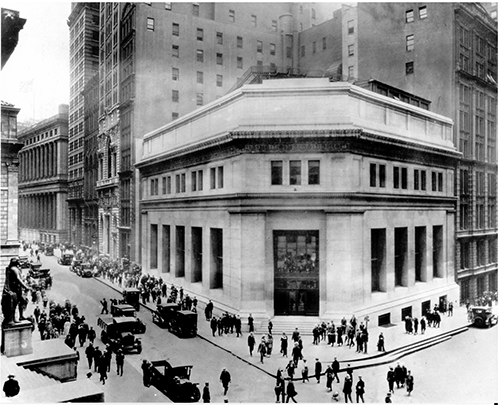
The J.P Morgan Bank at 23 Wall Street, New York, built in 1914.
Perhaps you’ll see a bank. Bank architecture in the 1920s typically follows traditions going back to the 18th century, in terms of what the architecture is supposed to convey and how. Neo-classical buildings speak of power and security. You can leave your money in one of these temple-like structures, and feel safe. The bank will not disappear, it will not collapse, it will not fall before the bombs of a robber or a revolutionary. That matters; in an age before the Federal Deposit Insurance Corporation the collapse of a bank can wipe out a depositor’s savings. And certainly this is an age that has recently seen many panics and controversies revolving around money and the economy; therefore often also revolving around politics, and around labour.
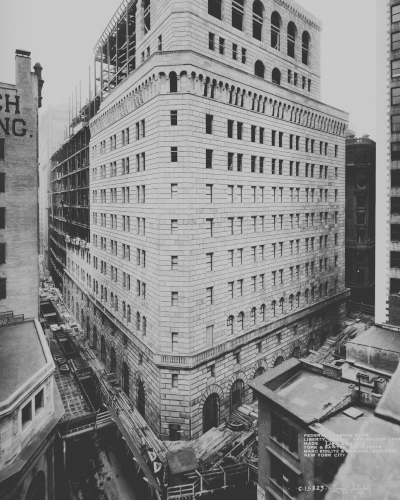
The Federal Reserve Bank of New York Building, 33 Liberty Street, during its construction between 1919 and 1924.
The overall economy’s good at the moment. These years will be called the Roaring Twenties (a phrase first recorded in 1930). People have put the Great War and the terrible 1918-1920 influenza epidemic behind them and are looking to the future with optimism. The economy’s strong; after a brief depression in 1920 and 1921 things have bounced back and then some, though agriculture’s still suffering and inequality’s becoming worse and more visible. But more and more people are getting rich: between 1924 and 1927 the number of Americans paying taxes on income of more than than a million dollars will increase 277 percent. Wages are rising. People are buying expensive goods (especially cars) on the newly-popular system of installment plans, increasing the sense of abundance. And the stock market’s rising, which matters to many more people in the wake of the Great War; the purchase of Liberty Bonds introduced a lot of Americans to stock investments, some of whom have continued to play the market — which is rising as though it’ll never drop again.
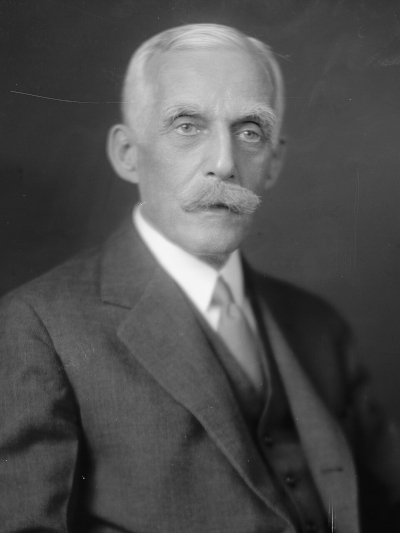
Andrew Mellon
There are some dark shadows on the economic statistics. The Harding administration has raised tariffs on European goods, and in retaliation European countries have imposed tariffs of their own. And the concentration of wealth frightens some; 90 percent of the wealth of the US is owned by 13 percent of the population, and the richest tenth of a percent of the population have the same income as the bottom 42 percent. If the number of rich people keeps increasing, from 7000 millionaires in 1914 to 40,000 by 1928, unemployment is also rising, and will hit four million in 1928; it has been estimated that the jobless rate this decade is around 11 percent, at a time when there’s no unemployment insurance. The phrase ‘skid row’ was first recorded in 1921.
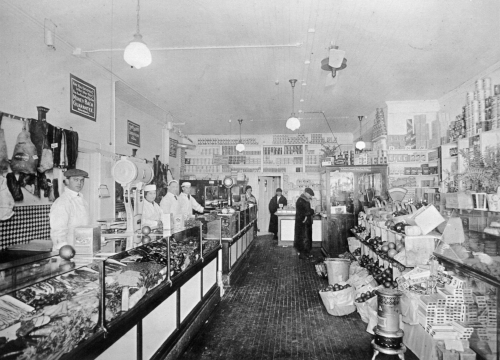
An A&P in Carthage, New York, in the 1920s.
And mail-order thrives, as a glance at the ads in Weird Tales will demonstrate. That speaks to the development of mail services generally. The Railway Mail Service carries a large fraction of the letters and packages mailed within the country, and that mail is sorted and processed en route in special train cars called Railway Post Offices (which advertise for employees in early issues of Weird Tales). The speed and spread of mail services has allowed mail-order businesses to flourish, especially after the inauguration of rural free delivery in 1892 (which brought the mail directly to rural houses rather than forcing people to pick up their mail at a post office), and of parcel post service in 1913 (which allowed for the delivery of packages of increasingly heavier size). Chain stores will eventually put even mail-order companies out of business — except Sears, who will cleverly open their own chain in 1925 — but for the moment mail-order’s expanding. 3.6 of American households received catalogs in 1902 and 15.2 percent in 1908; by 1928 the number will be 25.7 percent.
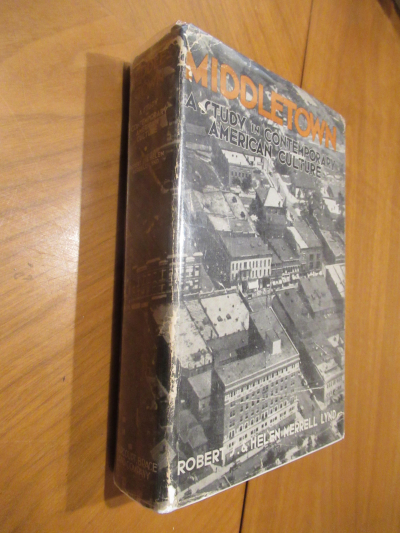
First edition of Middletown, by Robert Staughton Lynd and Helen Merrell Lynd
In 1924 husband and wife sociologists Robert Staughton Lynd and Helen Merrell Lynd will start collecting data for Middletown, their pioneering 1929 sociological study of the white population of Muncie, Indiana; they will find that for many people work even in major industrial plants is seasonal, uncertain, and precarious with respect to long-term financial security and old-age pensions in a way that (it was believed) earlier generations did not have to face. Those who did have work had long hours. The Lynds note that according to the 1919 census, 33 percent of Muncie industrial workers worked more than 60 hours a week, and another 35 percent worked from 55 to 60 hours per week; they state that “the coming of the now almost universal Saturday half-holiday is the outstanding shift in industrial hours of work since 1890.” (The half-holiday was a 19th-century British innovation; the full two-day weekend wouldn’t become common until the 1930s.) Much of this industrial work is in fields largely or entirely unknown a generation before. As the Lynds write:
The sweeping industrial changes since the end of the eighties are suggested by the fact that the evolution of the iron and steel industry, second in the 1919 census in value of product, did not begin on a large scale until about 1887; the automobile industry, third in value of product in 1919, was non-existent in the late eighties; the motion picture industry was non- existent ; the chemical and electrical industries were in their infancy. “Ninety per cent. of the total growth of the electrical industry as a whole has occurred during the past twenty-five years.” (Electrical World, Fiftieth Anniversary Number, Vol. 84, No. 12, September 20, 1924, p. 640.) “In the early eighties there was no college in this country where one could take a course in electrical engineering.’ (Ibid. p. 566.)
I noted in an earlier post that more women are working in the 1920s than previously, and not only as domestic servants and teachers but as clerks and secretaries. The Lynds’ survey of high schoolers in 1924 will show that 89 percent of the girls in the upper three classes intend to find work after graduating, with only 3 percent specifically intending to become housewives. But the Lynds also will find that married women who worked were not accepted as easily, with a common belief that there was an “ethical” problem with working wives, as well as a frequent belief among husbands that if a wife worked it implied the husband was failing to be a “good provider.” But economic realities often lead married women, particularly among the working class, to take jobs; it is not difficult to find, as the Lynds did, wives who hold factory jobs while their laid-off husbands do housework for the family. Note also that segregation, a reality in work as in every other aspect of 1920s life, of course intersects with gender bias. Thus, for example, Kim Kelly (in her 2022 book Fight Like Hell) has observed that “During the 1920s, between 65 and 85 percent of Black women worked domestic service jobs — double the workforce participation rate of American-born white women, and triple the rate for immigrant women.”
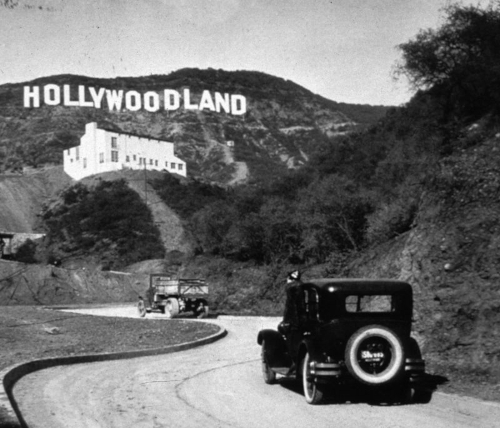
Sign for the Hollywoodland housing development, raised late in 1923; the last four letters will be removed in 1949.
The Coal Wars can be seen as part of a series of labour conflicts in the past few decades. Very briefly, and very broadly, as the United States industrialised in the late 19th century monopolies and trusts developed, making huge fortunes for men often already rich, like J.P. Morgan (banking), John D. Rockefeller (oil), and Andrew Carnegie (steel); organised labour unions grew, demanding things like 8-hour working days and five-day working weeks, and their strikes against the big business owners were frequently met with violence and government repression (railroad strikes in 1877, for example, left over 100 people dead); and, in the 1890s, some agricultural workers in the West and South formed the anti-monopoly People’s Party, soon renamed the Populist Party, calling for reforms including regulation of monopolies, an income tax, and direct election of Senators. The Populists in the rural states and the labour organisations of the more urban states never cohered into a bloc despite having overlapping ideals and political programs, but the Populists nevertheless carried four states in the 1892 election.
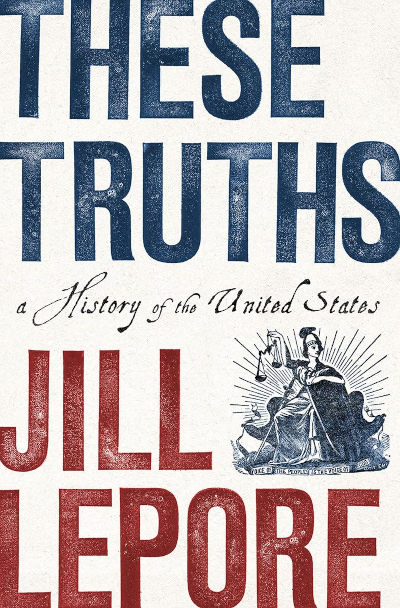
These Truths, by Jill Lepore
There has been much written about the connections, similarities, and differences between Populists and the later Progressives. Broadly, Progressives believed in extending the government’s role in restraining the abuses of capitalism rather than in abandoning capitalism entirely, and indeed often supported the era’s drive toward efficiency and modernisation in business. Beyond politicians, notable progressives included social scientists and muckraking journalists (named from a character in The Pilgrim’s Progress, muckrakers exposed corruption by searching through the muck). Jill Lepore writes that Progressivism was “the middle-class version” of Populism: “indoors, quiet, passionless. Populists raised hell; Progressives read pamphlets. Populists had argued that the federal government’s complicity in the consolidation of power in the hands of big banks, big railroads, and big businesses had betrayed both the nation’s founding principles and the will of the people, and that the government itself was riddled with corruption. … [W]hile Populists generally wanted less government, Progressives wanted more, seeking solutions in reform legislation and in the establishment of bureaucracies, especially government agencies.”
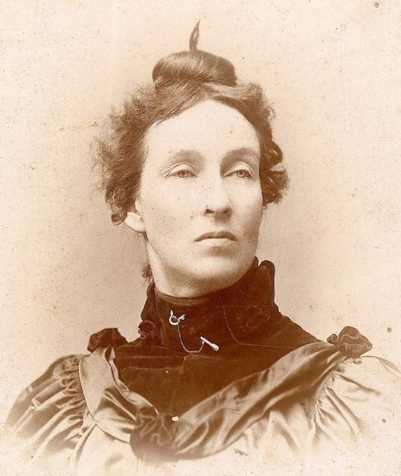
Mary Elizabeth Lease
Despite the Progressives, the monopolists continued to attempt to crush the labour movement, often in collusion with various levels of government. In 1894, for example, when the American Railway Union conducted a strike against the Pullman Company, who manufactured railway cars, the federal government sent in the army, killing 30 workers and arresting the head of the ARU, Eugene V. Debs. This backfired, as Debs read radical literature during his prison stint and emerged a convinced socialist. As labour unions grew — the American Federation of Labour, for example, expanded from 265,000 members in 1897 to over 4 million in 1920 — fears among the wealthy about socialism and anarchism grew as well.
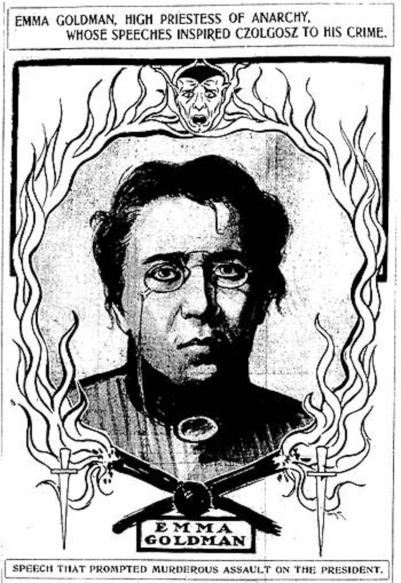
Emma Goldman, as depicted by the Chicago Daily Tribune as the “high priestess of anarchy.”
One of Jones’ most lasting actions came when she joined with many other union leaders in 1905 to found the International Workers of the World. The IWW, or ‘Wobblies,’ was intended as not only a more radical alternative to the AFL but a more inclusive one, welcoming women, non-whites, and immigrants. The IWW and its leaders swiftly became famous, celebrated or feared depending on one’s political sympathies; the Wobblies were not shy about fighting back when attacked. The colourful “Big Bill” Haywood was known for his ability to get across complex ideas to a mass audience (stating in one speech “tonight I am going to speak on the class struggle and I am going to make it so plain that even a lawyer can understand it”). Songwriter and poet Joe Hill wrote popular songs for the IWW, until his execution following a highly questionable murder trial in 1914. Famous disability rights activist Helen Keller, a socialist from 1909, became an IWW member in 1912. In 1923 the IWW’s still at the height of its influence, though it’ll decline in 1924 due to governmental repression and a schism within the organisation over Russian communism; it had already split with the socialists in 1913 over the IWW’s preference for strikes and direct action over electoral politics.
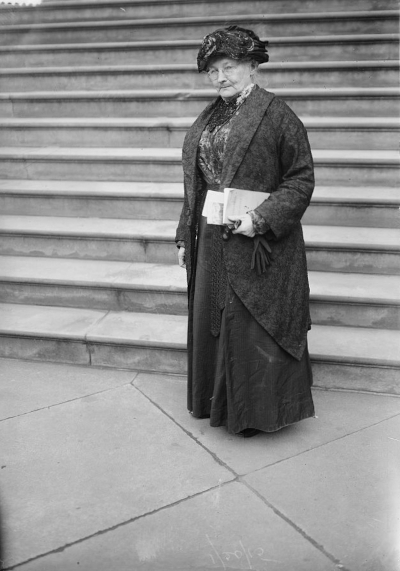
Mother Jones in 1915.
A notorious example of the terrible conditions the labour movement fought against came in 1911. The owners of the Triangle Waist Company had a factory in New York City in which roughly 500 seamstresses and 100 men worked. On the afternoon of March 25 a fire broke out, and feasted on the cloth in the factory. Doors had been locked to prevent theft, there was no sprinkler system, and the fire escape collapsed under the weight of fleeing workers. 129 women and 17 men died. The factory owners, notorious for underplaying workers and for using police as strikebreakers in 1909, were indicted for manslaughter but acquitted; the owner of the building paid $75 in compensation to the families of some of the victims, while the factory owners received the equivalent of more than $400 per dead worker from their insurance company.
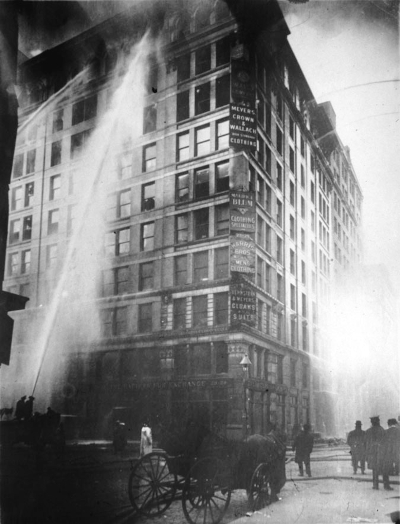
The Triangle Shirtwaist Factory fire
In 1913 Ford began using the relatively new technique of the assembly line to construct his cars, giving workers repetitive tasks involving interchangeable parts. The monotony led to high employee turnover and dissatisfaction. With the price to produce his cars plummeting due to the efficiency of his process, Ford announced in January 1914 that he’d provide all his employees with wages of at least $5 for an eight-hour day (previously the lowest pay grade had been $2.34 for nine hours of work per day). The Wall Street Journal called this economic madness; it drew thousands of job-seekers, in chaotic crowds that led the police to turn fire hoses on the crowd (again, this in January). To earn the full $5, employees had to maintain a standard of behaviour, ranging from not abusing their spouses to staying away from drink to keeping their homes clean, and Ford investigators did keep watch. But turnover dropped and productivity increased. Ford lowered the retail price of his cars, enough so that his workers were able to afford cars of their own. The automobile became the first large machine Americans would commonly own; and Ford’s rivals had to match his employment terms or lose workers.
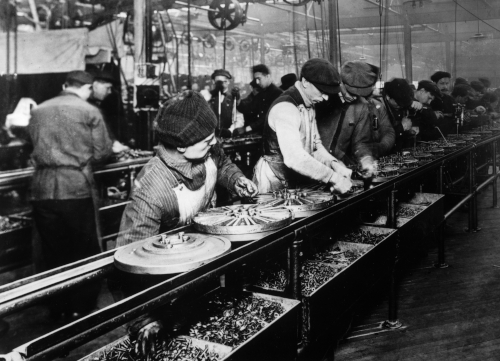
A Ford assembly line in 1913.
And note that the Lynds’ Middletown study will find that this desire for efficiency is having the effect of increasing the value of younger workers, who are better able to perform mechanical tasks swiftly for longer periods of time, while older workers are given lower-value tasks in their shop or simply let go. Workers and their families are aware that as they age their pay is liable to drop and their employment to be jeopardised, and that awareness often creates a long-term haunting dread.

The Principles of Scientific Management, by Frederick Winslow Taylor
The War ended but political tensions did not. In April 1919 three dozen bombs disguised as department store packages were mailed to the homes of various powerful men, believed to have been sent by a radical anarchist faction. Most were intercepted, but one package maimed the maid who opened it and burned the face of the wife of the Senator to whom it was sent. Attorney General A. Mitchell Palmer, who had urged a peacetime equivalent to the Sedition Act, launched a major campaign against anarchists, which grew into a nationwide crusade dubbed the Red Scare. On June 2, 1919, anarchists launched nine assassination attempts against nine different targets, including Palmer. (Large-scale strikes continued during these months, often repressed violently; in February, 1919, a general strike shut down the city of Seattle, while in September in Pennsylvania 100,000 steelworkers went on strike with 250,000 other workers walking out in sympathy.)
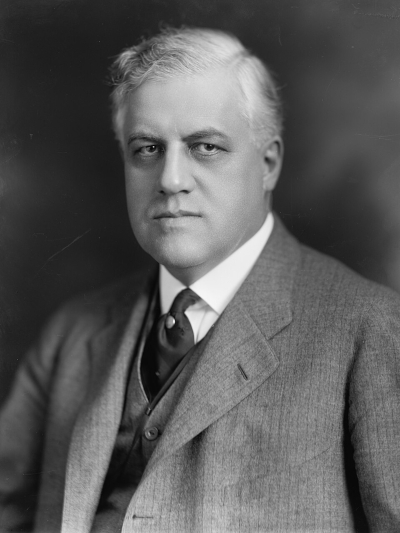
A. Mitchell Palmer
The violence did not entirely stop. On September 16, 1920, a bomb (most likely a bomb, though cause and perpetrator were never certainly established) went off in New York City at 23 Wall Street, in a horse-drawn wagon outside J.P. Morgan’s bank. Thirty people died, along with the horse, and 150 were injured. But, with the fever of the Red Scare broken, the response from officials and the press was relatively measured. The Sedition Act was repealed in December of 1920.
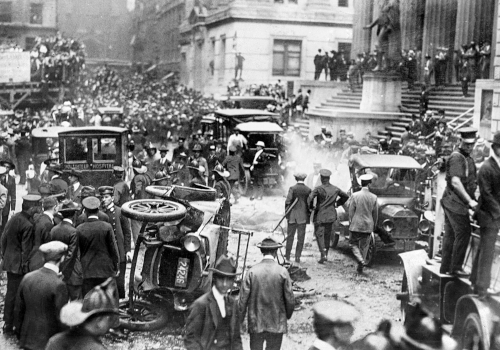
The aftermath of the explosion in front of 23 Wall Street, September 16, 1920.
At the same time, some basic financial structures are not yet in place. Harding has established the Bureau of the Budget (which will become the Office of Management and Budget), and the Federal Reserve was created in 1913, but there is no Securities and Exchange Commission, no Chapter 11 bankruptcy. And it is important to recognise that although women can now vote, they are not necessarily allowed equality to men in handling money. The Equal Credit Opportunity Act is decades in the future. Banks routinely refuse women credit, or require a husband to co-sign a credit application.
Money, politics, and recent history are the sort of subjects that are often just below the level of consciousness as one takes a walk through a city, as for example one might to buy a magazine. But they don’t always remain buried when you reach the newsstand. In the January 1924 issue of Weird Tales there will be a two-paragraph space-filling non-fiction text headlined “Rule Of Terror Threatened,” describing a planned action in the fall by the IWW against a judge in Sacramento who has ruled that IWW membership will be punished by six months in jail. The piece further claims there are plans for a general strike. I can’t find any reference to an IWW action in Sacramento late in 1924; but as I noted above, the organisation would decline over the course of that year. The article’s a sign of how the IWW was seen in that historical moment, I think. And so it is an example of how the magazine’s embedded in its time, and in the controversies of its time.
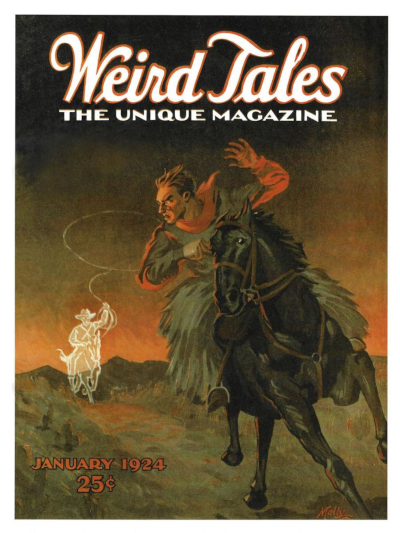
Weird Tales, January 1924
Find all my posts about Weird Tales here!
Matthew David Surridge is the author of “The Word of Azrael,” from Black Gate 14. You can buy collections of his essays on fantasy novels here and here. His Patreon, hosting a short fiction project based around the lore within a Victorian Book of Days, is here. You can find him on Facebook, or follow his Bluesky account, @bookofdays.