Three by John Bellairs
I write scary thrillers for kids because I have the imagination of a ten-year old. The center of my books is always the childhood of which I seem to have a nearly total recall.
John Bellairs

It’s perhaps fitting I follow up a years worth of writing about JRR Tolkien with something about John Bellairs‘ young adult stories. In response to reading Tolkien’s books, he wrote The Face in the Frost (1969). It’s a comic tale of two wizards, Prospero (not the one you’re thinking of) and Francis Bacon fighting to save the world from the machinations of the evil Melchius. When he wrote his next book, The House With a Clock in Its Walls (1973) as an adult supernatural thriller, he was encouraged to rewrite it for children. His publisher didn’t see enough of a market for the sort of adult fiction he had created.
Over the remaining eighteen years of his life, Bellairs created three similar series of stories and completed fourteen additional novels. House was the first of three tales about Lewis Barnavelt, an orphan who comes to live with his uncle in the small Michigan town of New Zebedee. The town is modelled on Bellair’s own hometown, Marshall, Michigan. The second series is four books featuring Anthony Monday and his friend, the elderly librarian Myra Eells. The first book, The Treasure of Alpheus Winterborn is a straightforward mystery, but the later books introduce supernatural elements. I suspect both Bellairs and his publisher understood what his audience wanted. Finally, there is the eight book long Johnny Dixon and the Professor series, starting with The Curse of the Blue Figurine. Set in 1951, Johnny has been, following the death of his mother and his father being sent to Korea as a fighter pilot, to live with his grandparents in Massachusetts. As you can see, each series features a young boy, displaced from his home or isolated and befriended by a older adult who is willing to help him face whatever adventures come his way. Despite a similar framework, there’s a very different feel to each of the books.
I first encountered John Bellairs through a cheaply made adaptation of The House With a Clock in Its Walls presented by Vincent Price. It’s not very good, though Severn Dardern is a fun addition to any movie. It starts at 21:48. It was enough to make me go find the book.
Lewis Barnavelt is a young and bookish fat boy. When his parents are killed in car crash, he’s forced to go live with his uncle Jonathan. Quickly enough, he learns that his uncle and his neighbor, Florence Zimmerman, are good sorcerers. His uncle’s house was once owned by a terrible, evil magician, Isaac Izard and his wife Selena. Izard created a magical clock that will bring the world into alignment and destroy the world and hid it inside his house.
Fortunately, for the world, Izard died before he could trigger the clock. Now, every night, Jonathan stops the numerous clocks that fill his house so he can try to focus on the ticking of the doomsday device and discover its location. In an effort to maintain the friendship of a classmate, Lewis decides to show him a display of magic and raise the dead. Inadvertently, perhaps, he selects the mausoleum of Selena Izard, triggering her husband’s return and a race to find the evil clock.
Looking at Bellairs’ quote at the top of the page, he’s really good at recreating the feel of childhood, with all its anxieties, fears, and dreams. The rise and fall of his friendship the popular Tarby Corrigan feels perfect in its miserableness.
There are also several wonderful scenes. The standout is a magical presentation by Jonathan and Mrs. Zimmerman put on for Lewis and Tarby.
And now Uncle Jonathan’s back yard came to life. It was full of strange sights and sounds. The grass glowed a phosphorescent green, and red worms wriggled through the tall blades with a hushing sound. Strange insects dropped down out of the overhanging boughs of the willow tree and started to dance on the picnic table. They waltzed and wiggled in a shaking blue light, and the music they danced to, faint though it was, sounded to Lewis like “Rugbug,” the famous fox trot composed by Maxine Hollister. This was one of the tunes that Jonathan’s parlor organ played. Uncle Jonathan walked over to the tulip bed, put his ear to the ground, and listened. He motioned for the others to join him. Lewis put his ear to the damp earth, and he heard strange things. He heard the noise that earthworms make as they slowly inch along, breaking hard black clods with their blunt heads. He heard the secret inwound conversations of bulbs and roots, and the breathing of flowers. And Lewis knew strange things, without knowing how he came to know them. He knew that there was a cat named Texaco buried in the patch of ground he knelt on. Its delicate ivory skeleton was falling slowly to pieces down there, and its dank fur was shrivelled and matted and rotten. The boy who had buried the cat had buried a sand pail full of shells near it. Lewis did not know the name of the boy, or how long ago he had buried the cat and the pail, but he could see the red and blue pail clearly. Blotches of brown rust were eating up the bright designs, and the shells were covered with green mold.
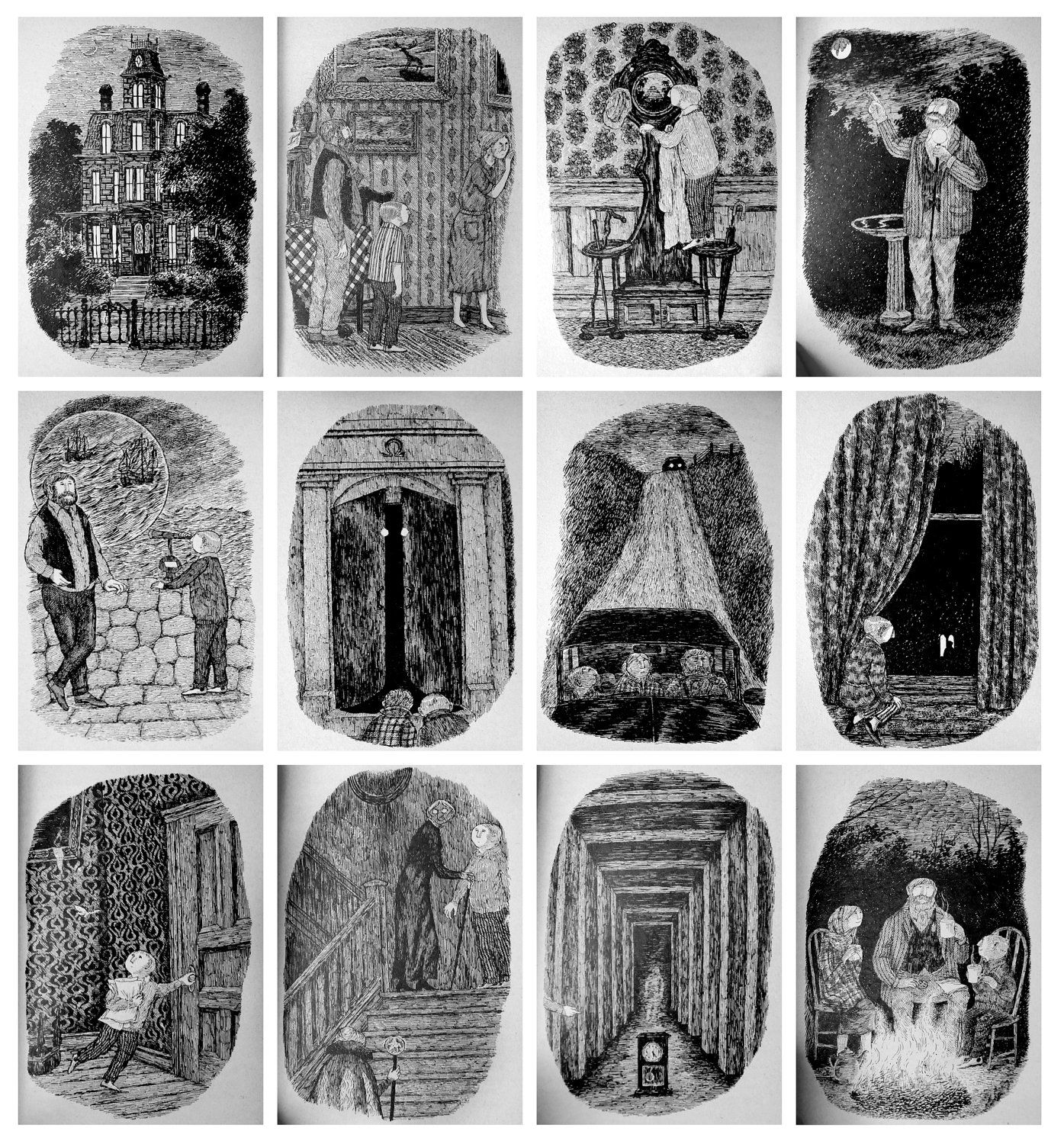
One of the most wonderful things about House are the illustrations by Edward Gorey, something I only recognized when I reread it in my thirties. I knew him first from his animated credits for PBS’s Mystery anthology series, his War of the Worlds illustrations, and I had heard about his sets for the Broadway production of Dracula starring Frank Langella. He would go on to do the covers and frontpieces for most of Bellairs’ other books.
In fact, according to Brown, later in his life, Gorey wanted to disown his cover illustrations for Bellairs. “He called me up one day and said, ‘Let’s get all of the Bellairs work out of the archives.’ He just didn’t think it represented him and what he was trying to do. He saw it as his grunt work.”
Be that as it may, the illustrations, like most of Gorey’s work are wonderful and perfectly weird and spooky. If you aren’t familiar with Gorey’s work, I recommend you find any one of his books or collections. His work is finely detailed and black & white, usually set in some sort of Edwardian or post-WWI setting, featuring strange characters and often delightfully disturbing rhymes. It’s also wickedly funny. Unfortunately, while House retains the interior illustrations, the covers and frontpieces are no longer used for the current editions.
Below are his illustrations for The House With a Clock in Its Walls. Not only are they wonderful, they’re also so specific. He clearly had a good reader’s instinct for the perfect moments in the story to illuminate.
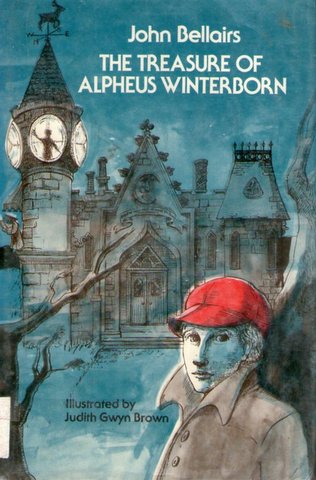 Anthony Monday is not a orphan or half-orphan, just the son of a sickly father and an overbearing mother. In The Treasure of Alpheus Winterborn (1978) as something of an escape, he spends much time in the Hoosac Public Library where he befriends the librarian, Myrna Eells. Working in the library, he discovers something that convinces him the long rumored secret treasure left behind by eccentric millionaire and self-taught Biblical archaeologist, Alpheus Winterborn is real. With doggedness driven by fear of his family falling into poverty, he convinces Ms. Eells to help him follow a trail of riddles and other clues.
Unfortunately, this brings him up against Hugo Philpotts, vice-president of the First National Bank of Hoosac and disinherited nephew of Alpheus. He knows the legend of the treasure too, and has been keeping his eyes open for it for nearly thirty years. Soon, Anthony is struggling to keep the banker at bay as disaster strikes the town and the treasure seems tantalizingly out of reach.
Treasure is not as colorful a book as House. In fact, it’s much darker. The two adults featured in House are kind and protective of Lewis. While Ms. Eells is helpful to Anthony, his father is disliked for running a saloon and is sickly, while his mother is often shrewish and dismissive of her son. The threat of losing what little money and security they have hangs over the Monday family and drives Anthony to take increasingly foolhardy risks. Anthony’s sense of desperation permeates the book. So much so, that when author Brad Strickland was engaged by the publishers to write books based on unfinished manuscripts and outlines by Bellairs as well as completely new stories, he asked about writing Anthony Monday books and was told no. Apparently, the publishers disliked the character, finding him too downbeat and depressing.
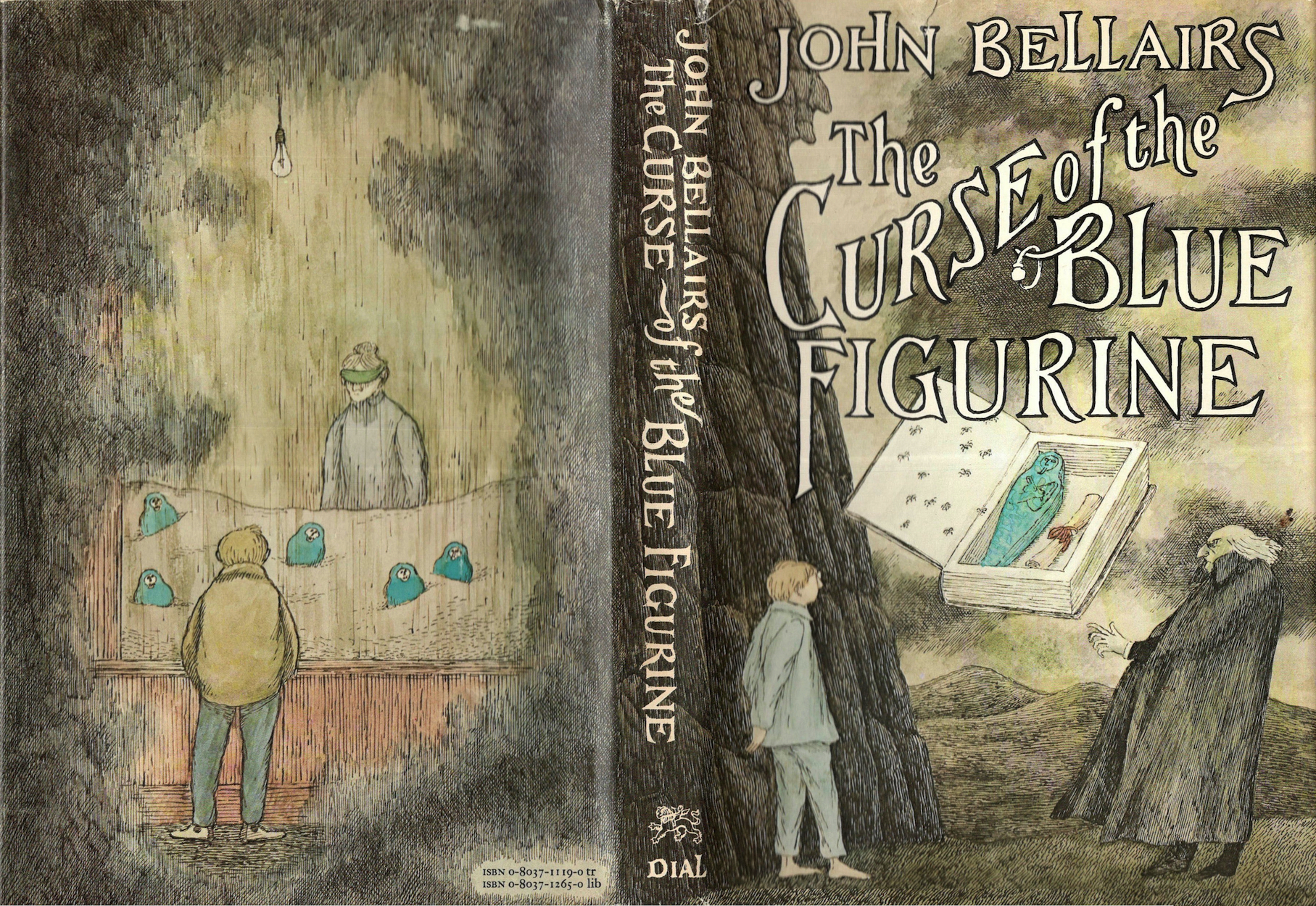
In The Curse of the Blue Figurine (1983), Johnny Dixon comes up against the malign ghost of Father Baart, a priest given over to black magic. Fortunately, he is aided and watched over by his grandfather’s friend, Prof. Roderick Childermass. The professor is steeped in all sorts of knowledge as well as a baker extraordinaire. As Johnny falls prey to the ghost’s manipulations, only the professor stands to save him. A growing atmosphere of evil fills the book, culminating in desperate fight during a storm on a New Hampshire mountaintop.
Curse is more expansive than either of the other two books. There are more characters, more settings, and much more background and atmosphere. It’s longer than them, so Bellairs had room to develop everything just a bit more. Of the three books, it’s the best written and the one I’m looking most forward to reading at least one or two more of its sequels. The next book is titled The Mummy, the Will, and the Crypt, so from the title alone, I’m hooked.
I don’t know how kids today would react to these books, but I hope they’d still find them fun and just spooky enough. They’re good, fast reads, and don’t talk down to their intended readers. I imagine there must be enough of an audience for them still, though, because in 2018 they made a big Hollywood version of The House With a Clock in Its Walls starring Jack Black and Cate Blanchett.
Sadly, I have to report that for all its flash and special effects, it isn’t very good, no matter how much I wanted it to be. Aside from Blanchett being far too young as Mrs. Zimmerman and Owen Vaccaro too svelte as Lewis, the movie suffers from the usual theatrical need to jazz things up too much and overwhelm some of the very things that make the book so charming. In lieu of Lewis’ elaborate adlibbed spell to find they clock there’s a cheesy magical battle that’s been done a thousand times since Harry Potter.
Fletcher Vredenburgh writes a column each first Sunday of the month at Black Gate, mostly about older books he hasn’t read before, though not always. He also posts at his own site, Stuff I Like when his muse hits him.
I always buy a copy of The House With a Clock in Its Walls for the younger readers in my extended family. On my own shelves, I have Treasure of Alpheus Winterborn, The Dark Secret of Weatherend (Anthony Monday), and The Curse of the Blue Figurine. (Oh, and The Face in the Frost, over in the more growny-up section.)
I might reread Face in the Frost later this year. I remember it being a blast
I adore John Bellairs (I wrote my own piece about him here years ago). I love that he never pulled his punches when it got time to be scary.
I agree that The Curse of the Blue Figurine is the best of the books you deal with here, and I think there’s an extra disturbing element in it. Bellairs was raised a Catholic (I don’t know if he was an observant one when he died). Blue Figurine deals with a boy oppressed by the ghost of an evil priest, and a large part of Johnny’s dilemma is his feeling that he can’t tell anyone; the boy’s experience and knowledge completely isolate him. The intensity of Johnny’s feelings is conveyed very strongly.
I know almost nothing about Bellairs’ life – there’s not that much out there – but a story like that coming from someone who had a Catholic boyhood… well, it does make you wonder.
I never saw the House with a Clock in Its Walls movie; I didn’t see any way that it wouldn’t be terrible.
Bellaire wrote in 1966 St. Fidgeta and Other Parodies, which included an attempt to answer the question “Does the olive in the martini break the Lenten fast, or is it considered part of the drink?” As a life-long Lutheran, I’m sure I missed many of the Catholic insider jokes/references, but still found this very amusing.
I’m definitely curious about St. Fidgeta. Sendups of Second Vatican stuff is pretty darn niche, and as another Lutheran, I’m curious about what I might miss, too.
I meant to link to the other Bellairs pieces, but I was falling asleep as I polished this off late last night. Interesting thought about Curse. And, yes, the depiction of Johnny’s isolation is done potently.
Mr. Bellairs has a truly infectious smile, in that photograph. The boyhood mischief comes through in full force, along with the “you really can’t get mad” aspect. It would not be at all difficult to believe he was writing pieces of his childhood into his characters.
“The House With a Clock in Its Walls” was several times one of those “pick one or the other” choices in book assignments as I grew up. I always picked the other book, because I used to be squeamish about horror and thrillers. Perhaps it would be good to try now, after career has taken so much edge off of fiction. Pity that the movie got so much of the charm wrong.
I looked at a couple of his books for children, but they didn’t give me anything like the delight of The Face in the Frost, one of my favorite fantasies.
You have used several images for this article that I personally generated and published on my goreyana.blogspot.com. It would be professional to give credit for the images that you have borrowed to illuminate your text.
If I did, I apologize and will endeavor to add a credit.