Browsed by
Category: Blog Entry

Another View: The Difficult Experiment of Scott Oden’s A Gathering of Ravens
Another View: The Difficult Experiment of Scott Oden’s A Gathering of Ravens

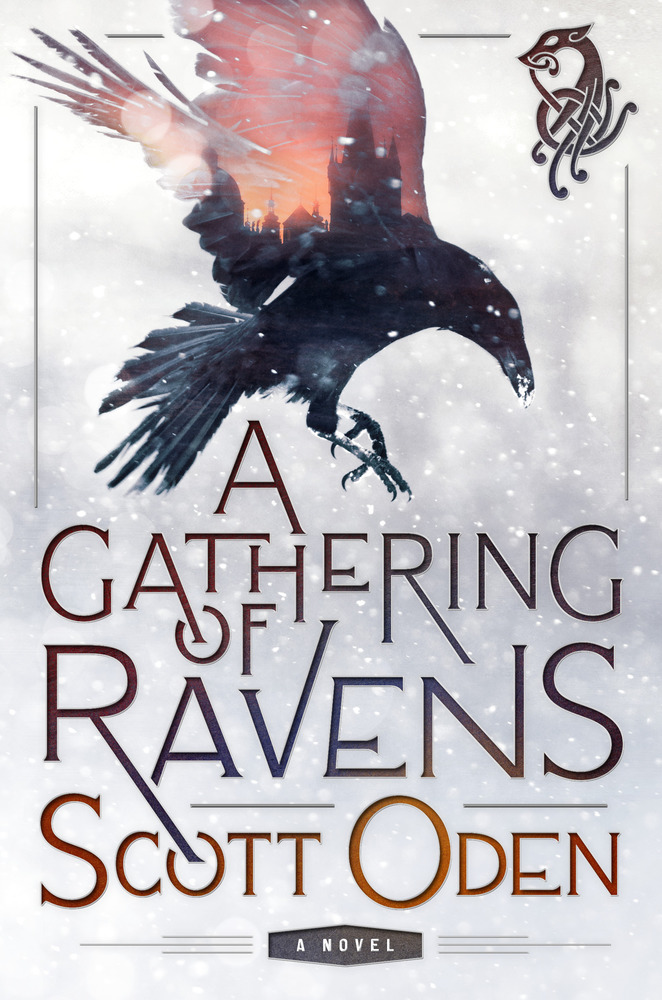
A-Gathering-of-Ravens-smallerI really wanted to like this book. With pleasure I listened to Oden speak on The Literary Wonder and Adventure Show. He talked at length about Tolkien (my own spiritual and literary master), and it seemed that Oden’s and my dials were approximately set. Oden’s book, like Tolkien’s most popular works, deals with “that northern thing” (though I just today learned that Tolkien objected, in part, to this characterization from W.H. Auden).

But Oden’s book is so grimdark that, while reading, I couldn’t find my feet. The work ostensibly is about an orc Hel-bent on revenge — and here is my first objection: the attitudes and actions of this orc, our “protagonist,” are indistinguishable from those of the larger majority of characters in the book. Grimnir, our orc, seems capable only of speaking and thinking in profanities. He murders even when there absolutely is no reason to. The only thing (in this book) we can’t accuse Grimnir of is the sin of rape. That assault remains to be committed by many of the other “human” characters you will find therein: your average male, in this portrayal, seems hardwired to enter rape mode the moment he lays eyes upon any “unprotected” female. Now, remember, Grimnir is supposed to be the “orc,” yet he doesn’t behave much differently from the novel’s many other human characters. Moreover, even when it doesn’t cost a character anything necessarily, few characters are liable to show any shred of kindness for one another. Oden’s narrator summarizes this world’s milieu thusly: “She [the character Etain] knew the score … and she knew sooner or later there would be a reckoning. Men did nothing — undertook no good deed, performed no kindness — without first attaching a price to it.” Oden’s characters, I suppose, are consummate Dark Age businesspersons.

“But that’s the Way It Was,” a number on Goodreads might say, defending Oden’s work from the very few negative reviews I can find there (here and here are two well-said assessments). What these apologists are claiming is that the worldview of the so-called Dark Ages is exactly this: murder whenever you can get away with it, rape whenever you like (for those who like it, I guess, who are all young pre-modern men). I don’t entirely agree with this representation. In the worst possible reading, this might represent the author’s views of the natural state of humankind freed from the fetters or checks thankfully supplied by modernity. In the best possible reading, this representation assumes that, at least in the area of moral development, humans who happened to live a mere millennia ago might be considered pre-human in these respects. Granted, the spread of more nation-building and socializing beliefs and philosophies such as Christianity might have a civilizing influence on a pre-modern worldview, might even be of some aid in the sense of an evolving moral consciousness. But this book barely acknowledges even this. It ostensibly presents two competing worldviews, that of northern paganism and that of Christianity, but, in this book, in practice adherents to either faith might as well be indistinguishable. They merely serve one team in a two-sided competition that is drawn as equal in every respect. Again, apologists should be quick to point to aspects of history that reveal a number of Christians as hypocritical and intolerant throughout their persecutions. Granted, but are you going to deny that there remain some fundamental differences and worldviews between the two perspectives, and therefore requisite actions and behaviors on behalf of the religion’s adherents? To this point Oden seems to relent, to some measure, in the second and much-preferred half of the book, in the figures of King Brian and his freed thrall Ragnar. But we’ll get to that in a moment.

Read More Read More

Star Trek: Discovery and Star Trek: Desperate Hours – A One-Two Combo

Star Trek: Discovery and Star Trek: Desperate Hours – A One-Two Combo

saru-star-trek-discovery-small

This week saw the first new Star Trek TV show debut in a long time. If you missed it, or because subscribing to CBS All-Access for a single show irks you, it was more than pretty good. In fact, I downright enjoyed myself in a way I haven’t since the Star Trek: Enterprise debuted in 2001. And it was my 12-year old son’s first real experience of Star Trek.

Read More Read More

Readings Right, and Readings Wrong

Readings Right, and Readings Wrong

chizineLike most other writers, I’ve given all kinds of readings, from story books to pre-schoolers (supporting early literacy) to academic papers on 18th-century pastoral poetry (supporting my academic career). I’ve had everything from great experiences (the kids really liked the animal noises) to eye-rolling ones (someone should have told the hotel hosting the NEASECS Conference that we would need lecterns) to amazing ones (people turned out at 8:30 on a Saturday morning to hear about the georgic).
I’ve had a room full of people show up, and I’ve had no one show up at all. I’ve arrived at places that invited me, only to find no one there who knew I was expected, and, I’ve been taken out for dinner first. I’ve read the same piece to both thunderous applause, and polite smiles. Altogether, a pretty mixed bag, and I don’t think there’s a single writer out there who can’t match me, story for story. So why am I taking you on this trip down readings-I-have-done lane? Because, while there’s not much you can do about the audience, there are organizers out there who get everything else right.

Read More Read More

The Evolution of Process — A Writerly Tale

The Evolution of Process — A Writerly Tale

A Julie as Young Writer-small

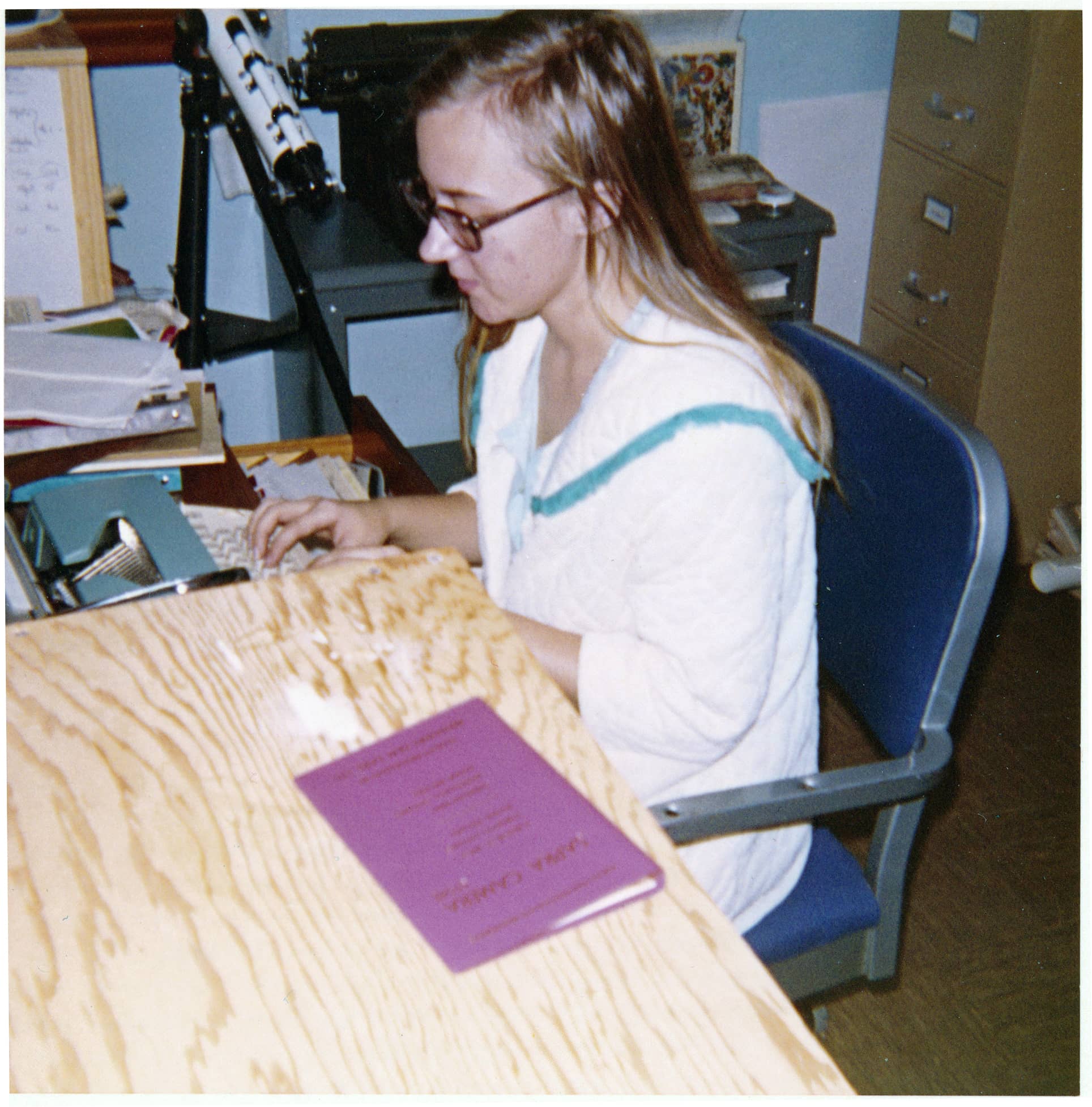
The young author with her first electric typewriter!

This guest post by Julie Czerneda is part of the #againstthedark blog tour. Enter a comment below to be entered to win her latest book in hardcover, To Guard Against the Dark, plus a mass market of The Gulf of Time and Stars (US and Canada entries only, please). To enter the tour-wide giveaway of the entire nine-book series, click here before October 16th at 5pm EST.

Once upon a time, there was an unpublished, (and never-thinking-to-be-published) writer named Julie, who would scribble her stories on paper (which she scrunched up to make taller stacks that whispered and rustled in a lovely, ever-so-literary way), when not typing with two fingers on the ancient and indestructible Underwood typewriter her mother gave her. (Then, yes, would scrunch up the paper to make taller stacks.) Eventually, Julie’s stacks burst from her desk drawer. Her mother found her a used portable electric typewriter and filing cabinet, suggesting she stop scrunching and write.

Read More Read More

September Short Story Roundup

September Short Story Roundup

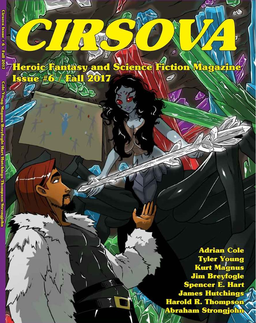
oie_265816EcRH9xZLAnother month, another roundup. While I’m still dubious of any sort of serious swords & sorcery revival, there is most definitely a renewed interest in the older roots of fantasy and science fiction going on. Howard Andrew Jones is editing a new magazine, Tales from the Magician’s Skull, that is inspired by Gary Gygax’s fabled Appendix N. The folks at Castalia House have built up a serious following based on their love of pulp and Appendix N. One of the most serious proponents of some sort of pulp restoration is P. Alexander, editor of Cirsova magazine.

The latest issue of Cirsova, #6, is 126 pages long and contains seven stories and an installment in an ongoing epic poem about John Carter of Mars. There’s more of a science fiction emphasis in this issue than suits my tastes at present, but that doesn’t detract from its general high quality.

The magazine kicks off with “The Last Job on Harz,” by Tyler Young. When a party of miners is wiped out in horrible fashion on the planet Harz, two government agents are sent out from Earth to investigate and protect the interests of the Company. The Company, properly known as Universal Resources, is one of those monolithic businesses found across science fiction. The agents quickly discover that some heretofore unknown entity, in fact a whole herd of entities, is at large on Harz.

Aside from the overly familiar basic plot of the story and its too-obvious conclusion, “The Last Job on Harz” skips out on most of the action. Maybe it’s just me, but in a story featuring creatures described as a cross between a praying mantis and a kangaroo and with “an armored, segmented body, long arms ending in curved claws, and a narrow insect-like head,” I want more of them. Too much of the tale is given over to not very exciting detective work, and the most interesting of that takes place off camera.

“Death on the Moon” by Spencer H. Hart, flips the setup of the previous tale. Bert Henderson is an agent from one of those sci-fi monopolies, in this case, Phillips Atomics. He’s sent to the Moon to investigate a murder and soon finds himself swept up in a plot involving gangsters, a scientist, and his (of course) lovely daughter. Set in a mythical post-WWII world where space travel and lunar colonies came to pass, it has a good hardboiled atmosphere, and plenty of whiz-bang chrome-plated-rocketship details.

Read More Read More

Modular: Starfinder Under the Hood – Character Creation

Modular: Starfinder Under the Hood – Character Creation

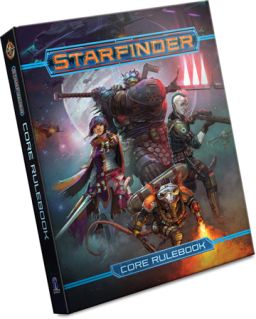
256 Starfinder CoreWhen playing Dungeons & Dragons or other fantasy RPGs, have you ever wanted to play a space wizard? A gnome with a jet pack? Or a fighter with a flaming laser sword and a force field?

These options are all available to you in the new Starfinder RPG (Paizo, Amazon). Paizo has built the new science fantasy game to explore the distant future of their Pathfinder universe. Though I’ve been excited about it for over a year, since it was first announced, I’ve only just gotten the opportunity to play a full game of it.

So now that the game is more than an abstraction … now that I’ve actually rolled the dice and taken some damage … does it still hold up like I was hoping? Honestly: Even better.

But rather than just singing the praises of the game (which I’ve and others have already done here and here and elsewhere), I’m going to dive a bit deeper into how the game is similar – and different – from the Pathfinder game that we know and love.

Read More Read More

Modular: A First Look at Starfinder 1: “OMG! All Your Trope Are Belong To Us”

Modular: A First Look at Starfinder 1: “OMG! All Your Trope Are Belong To Us”

256 Starfarer Combat Technician Pic
Well-authored and beautifully illustrate
256 Starfinder Core
Does for Science Fantasy what Dungeons and Dragons did for “traditional” Fantasy.

“Dad, we can’t get the Starfinder combat system working…”

“Look, Son, it’s a D20 system, so Armor Class reduces the chance of being hit, rather than absorbs damage.”

“OK. I get it now! You’re the best, Dad!”

(Tousles hair) “That’s what Dad’s are for, Son.”

OK it didn’t quite go like that. For a start, I did not in fact tousle my 13-year-old son’s hair since (a) it’s shoulder length and he gets cross if you tangle it, and (b) he’s 13. Even so, it was a “life’s full circle” Country and Western moment of the same order as when non-geeks teach their kids to throw a rabbit or skin a baseball or whatever.

However, Kurtzhau was indeed encountering a D20 system for the first time, the engine at the heart of Starfinder, Paizo’s new Science Fantasy (it uses that term in the text!) system, with which he’s pretty much fallen in love. The blurb says it all.

The Starfinder Roleplaying Game puts you in the role of a bold science-fantasy explorer, investigating the mysteries of a weird and magical universe as part of a starship crew. Will you delve for lost artifacts in the ruins of alien temples? Strap on rune-enhanced armor and a laser rifle to battle undead empires in fleets of bone ships, or defend colonists from a swarm of ravenous monsters? Maybe you’ll hack into the mainframe of a god-run corporation, or search the stars for clues to the secret history of the universe or brand new planets to explore. Whether you’re making first contact with new cultures on uncharted worlds or fighting to survive in the neon-lit back alleys of Absalom Station, you and your team will need all your wits, combat skill, and magic to make it through. But most of all, you’ll need each other.

Inspired by my son’s enthusiasm, I decided to take a look myself…

Read More Read More

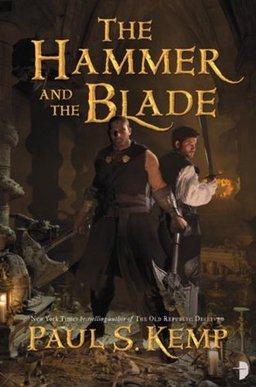
The Hammer and the Blade by Paul S. Kemp

The Hammer and the Blade by Paul S. Kemp

oie_19118350rehVg1zWith the hammer-wielding (sort of) priest Egil and the (not really) rogue Nix, Paul S. Kemp created his entry for the classic swords & sorcery duo contest. They made their debut in The Hammer and the Blade (2012).

We meet them media res as, in search of treasure, they prepare to penetrate the last defenses of an ancient tomb. Like characters in a classic buddy movie, they bicker and banter.

“You may have heard but you didn’t reply, so let me restate. Are you acquainted with a door I couldn’t open? I press the question only to illustrate your softheadedness, as demonstrated by a faulty memory. It’s important you understand your limits.”

Egil tossed the sliver to the ground, tore a strip of cloth from his shirt, and pressed it to his leg wound. “There was that time in the Well of Farrago–”

Nix shook his head emphatically. “That was not a door.”

Egil looked up, thick eyebrows raised. “It had hinges, a handle. It opened and closed. How can you say–”

“It was a hatch.”

“A hatch?”

“Of course it was a hatch, and only a fool priest of the Momentary God would confuse a door with a hatch. A hatch is a different thing from a door. A hatch is troublesome. You see? Does having an eye inked on your head make your other two blind, or otherwise detrimentally affect your cognition?”

“Well enough,” Egil said at last. “It was a hatch.”

“Now you’re mocking me? I hear mockery.”

Read More Read More

Robert E. Howard Wrote a Police Procedural? With Conan?? Crom!!!

Robert E. Howard Wrote a Police Procedural? With Conan?? Crom!!!

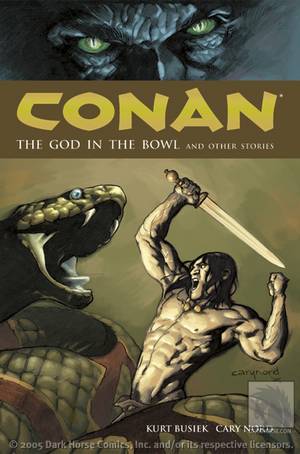
BG_GodBowlComicCoverReportedly, Ernest Hemingway bet Howard Hawks that the director couldn’t make a good movie out of his worst book. Hawks took the bet and we ended up with Humphrey Bogart in To Have and Have Not (it’s not Bogie’s best, but I vote Hawks the winner of the bet). Suppose I told you I could show you that one of what’s commonly considered among the worst Conan stories isn’t really that bad – and that it’s a pre-genre police procedural? Ready to take on the challenge?

In 2015, Black Gate‘s Discovering Robert E. Howard series showcased the breadth and diversity of REH’s writings. Boxing stories, westerns, science fiction, Solomon Kane, El Borak: Howard was an immensely talented author who wrote in a variety of genres. My first entry in the series was about Steve Harrison, Howard’s take on the hardboiled private eye with a weird menace twist. As you can read in that essay, Howard didn’t care for the genre and he abandoned it almost as quickly as he entered it. Today, I’m going to look at his lone police procedural. Yep – Robert E. Howard wrote a police procedural before the term was even in use. And it features Conan!

The general consensus is that Howard hit the mark with his fourth Conan story, “The Tower of the Elephant,” published in March of 1933. His first was “The Phoenix on the Sword,” which appeared in Weird Tales in December of 1932 and was a rewrite of an unpublished Kull story, “By This Axe I Rule.” Farnsworth Wright, editor of Weird Tales, rejected the second, “The Frost Giant’s Daughter,” which to me, reads more like a chapter in a longer work than a self-contained story.

“The God in the Bowl” was probably written in early 1932 and was Howard’s third Conan story. Wright rejected this one as well and it did not see print in any form until an edited version by L. Sprague de Camp was published in 1952’s Space Science Fiction, Volume 1, Number 2 (the story has nothing to do with either space or science fiction…). De Camp did less chopping on this one than most of his Conan edits, but fans could finally read Howard’s original text in Donald Grant’s The Tower of the Elephant in 1975.

Read More Read More

Early Peek at 2000AD Prog #2050: A Jumping-On Issue

Early Peek at 2000AD Prog #2050: A Jumping-On Issue

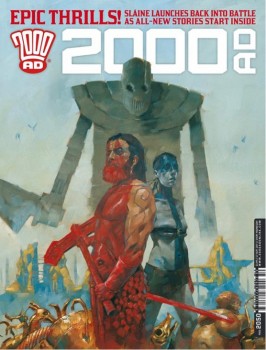
2000AD is a weekly anthology book, typically with 4 stories running at a time, with some at the middle while others are ending, which makes it hard to find a meaty run to review. Several times a year, 2000AD publishes issues (pronounced progs if you’re speaking with a British accent) for new people to jump on — where every story is beginning.

Picture-Device-Independent-Bitmap-1-600x788

Prog #2050 is such an issue and will be hitting newsstand (and the internet as a digital issue) on September 25th, so I thought I’d get into it. This was a large-sized issue (48 pages) and contained 7 new stories that you don’t have to know much at all about the world of 2000AD to start reading.

Read More Read More