Browsed by
Author: John ONeill

The Secret Supplement: Greyhawk, Gygax, and Outdoor Survival

The Secret Supplement: Greyhawk, Gygax, and Outdoor Survival

Outdoor Survival-smallA while ago, my 13-year-old daughter Taylor told me her friend Will had seen the famous “Advanced Dungeons and Dragons” episode of Community and wanted to learn how to play.

“Sure,” I said. “Tell him to come over on Saturday and I’ll put together a quick adventure for both of you.” My 15-year-old son Drew joined in, creating a fighter, and even Tim, my 17-year old, got in on the action, rolling up a 1st level magic user.

That was over six months ago. What began as a simple session, involving a bunch of farm kids rescuing a dwarven thief named Jasper from marauding gobins, has evolved into an epic campaign, a desperate adventure to stop an army of hobgobins and orcs from completing a railroad that will bring war to their frontier home.

It’s the most fun I’ve had role playing in decades.

I introduced my kids to D&D years ago, but we played only intermittently, and the campaign — such as it was — never really built up steam. The addition of a fourth player, from outside the family, has brought with it a regular Saturday morning schedule, and the result is a much heightened level of interest from everyone involved.

Things are happening faster, they’re leveling up quicker, and they spend the days between sessions talking excitedly, planning, and trying to puzzle out how all the clues they’ve uncovered fit together to reveal the sinister plan behind events.

It’s brought a change in how I dungeon master, too. When I was DM for a group my own age, from roughly 1980 to 2000, there was a certain level of performance anxiety. Every session had to be bigger and better, each adventure more ambitious and epic than the last. I couldn’t just create a fun, two-hour subterranean module… I had to bring an entire underworld civilization to life, with a believable backstory and vast cast of heroes and villains.

Read More Read More

Jack Vance and Appendix N: Advanced Readings in D&D

Jack Vance and Appendix N: Advanced Readings in D&D

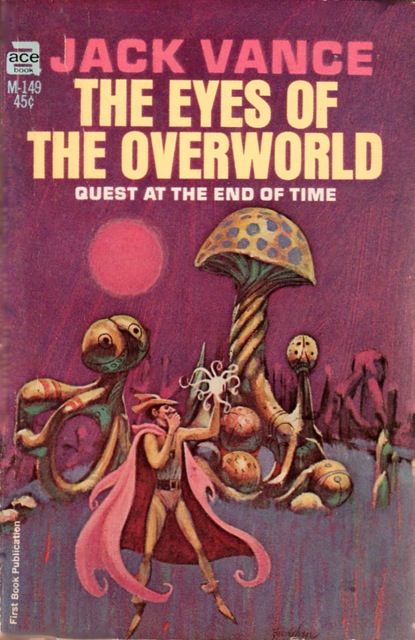
The Eyes of the Overworld-smallAh, Appendix N, the gift that keeps on giving. In the years before the Internet, it’s how young readers discovered great fantasy.

Over at Tor.com, Tim Callahan and Mordicai Knode continue with their ambitious and well-researched journey through Gary Gygax’s famous Appendix N, the library of fantasy and SF titles in the back of the Dungeon Master’s Guide. They’ve already covered Fritz LeiberEdgar Rice BurroughsSterling E. Lanier and Robert E. Howard. Here they are on Jack Vance:

Mordicai Knode: Also worth noting that everybody’s favorite evil wizard turned lich turned demigod turned major deity, Vecna, is named after a “Vance” anagram. & while we are pointing out bits and pieces — like the prismatic spray, which is such an amazing piece of writing, such a great turn of phrase, that it inspired a whole range of spells — I want to mention the ioun stones. In Dungeons & Dragons they are these little gemstones that float around your head—I always imagined the Bit from Tron — but in The Dying Earth story that inspired them, the IOUN stones are much more sinister and are gleaned from the center of a dwarf star that has been cut in half by the shrinking edges of the universe. Just let that sink in; that is really an incredible idea… And those sorts of ideas are scattered all over the book, like some pirate with holes in his pocket idly scattered gold doubloons all over it.

Tim Callahan: It’s kind of like, for me anyway, when I was a kid, and I’d read the AD&D Player’s Handbook or Dungeon Master’s Guide and just read through some of the spell names or magic item titles (without reading the descriptions below) and imagine what weird and wonderful things these powers and items could do. Vance reminded me of that world of possibilities, almost on every page.

Read the complete article here.

Read More Read More

Summer 2013 Subterranean Magazine now Available

Summer 2013 Subterranean Magazine now Available

Subterranean Magazine Summer 2013-smallThe Summer installment of online dark fantasy magazine Subterranean is a special K. J. Parker issue, with two short stories by the pseudonymous author of The Folding Knife and The Engineer trilogy, “The Sun And I” and “Illuminated,” and an article, “Rich Men’s Skins; A Social History of Armour.”

I wonder if the editors have any inside info on who the mysterious K.J. Parker really is? Those Subterranean guys are pretty connected; it’s their job to be in the know on industry secrets and stuff. They’ve published Parker plenty times before — most recently with “Let Maps to Others” (Summer 2012), “The Life and Sad Times of the Western Sword” (Fall 2011), and the World Fantasy Award-winning novella, “A Small Price to Pay for Birdsong” (Winter 2011).

After a lengthy association like that, you’d think they’d have shelled out a couple bucks for a private eye, and maybe have some fuzzy photos and a database of incriminating leads by now. Like the fact that K.J. Parker and John R. Fultz have never been seen in the same room together. Hmmmm.

If Lee Moyer’s cover looks familiar, it should — it was first used as the cover for Weird Tales 357 (see it here). No crime in re-using great art I guess, but you’d think they’d have chosen something less recent. That issue of WT came out just two years ago! Maybe they’re on a budget. Private eyes aren’t cheap.

They didn’t skimp on the contents though — as usual, this issue is packed with great fiction from some of the top names in the industry, including Joe R. Lansdale, Catherynne M. Valente, and Kat Howard.

Read More Read More

New Treasures: The Crown of the Blood by Gav Thorpe

New Treasures: The Crown of the Blood by Gav Thorpe

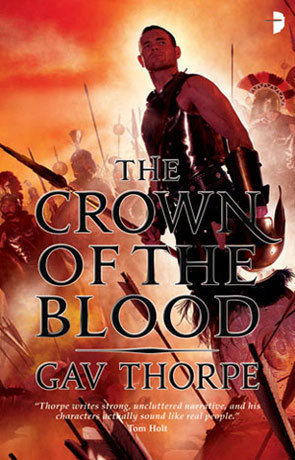
The Crown of the Blood-smallIt’s Friday. Already. Which means I’m a little tardy getting my latest New Treasures selection up.

I usually decide what book to highlight by glancing over the new arrivals for the week and selecting which one I’m going to read on the weekend. Except this weekend, I’ll have my nose in the 358-page rulebook for Black Crusade, the Warhammer 40k role playing game from Fantasy Flight, learning how to play so I can host an adventure for my kids, who’ve been begging me for weeks. (Why don’t kids play softball any more? Or frisbee? What does that take — 45 seconds prep time?)

So instead, I’m staring longingly at the review books that arrived this week, wishing I could read them. Still, all this Warhammer immersion reminds me of the great adventure fiction set in that universe, and as a result I find the book calling loudest for my attention is Gav Thorpe’s The Crown of the Blood, the first novel in his trilogy of the same name.

Ullsaard has conquered the known world. All have fallen before his armies.

Now it’s time to take the long journey home, back to the revered heart of the great Empire he had helped create for his distant masters. But when he returns to the capital, life there is so very different from what he had believed. Could it be that everything he has fought for, has conquered and killed for, has been a lie?

A sweeping fantasy of immense battles, demonic magic and dark politics.

No waiting around for the sequels, either — they’re already here: The Crown of the Conqueror and The Crown of the Usurper. (Great — more books I can’t read this weekend.) Gav Thorpe has written over a dozen novels in the Warhammer universe for Black Library, including Angels of Darkness and the Sundering trilogy.

The Crown of the Blood was published by Angry Robot in September, 2010. It is 528 pages in paperback, priced at $7.99 ($6.99 for the digital edition). More details at the Angry Robot website.

The Doom That Came to Kickstarter

The Doom That Came to Kickstarter

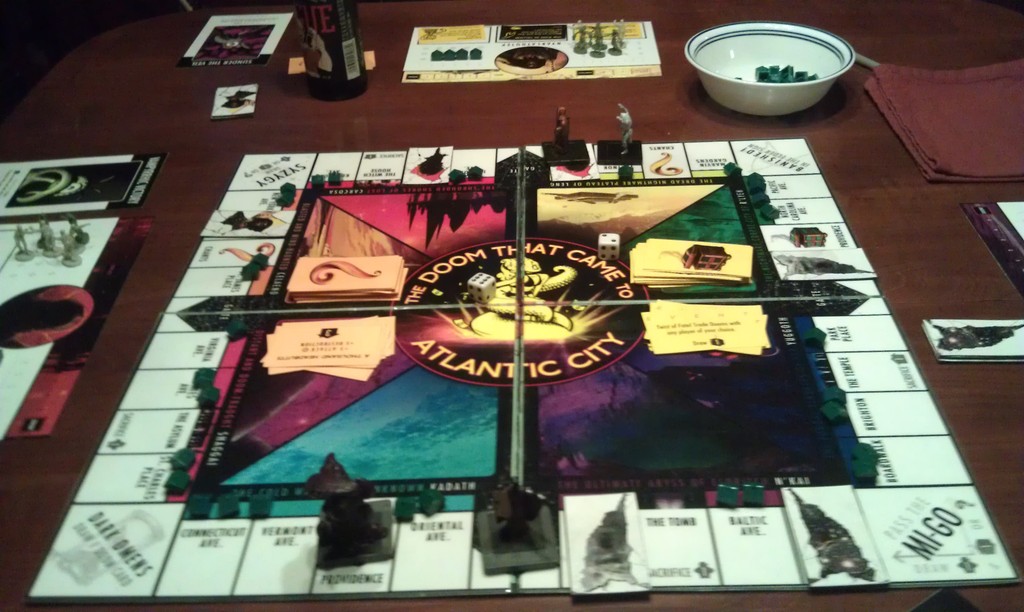
The Doom That Came to Atlantic City-smallReports are coming in that Erik Chevalier, the man behind one of the most high-profile Kickstarter game successes of 2012, The Doom That Came To Atlantic City, has admitted that he will never produce the game.

The Doom That Came To Atlantic City, created by Eberron designer Keith Baker and artist Lee Moyer, was a Monopoly-style game with a distinct Cthulhu flair. Described as “A light hearted Lovecraftian game of urban destruction,” the game invited players to take the roles of Great Old Ones in a race to be the first to destroy the world. The Kickstarter campaign launched May 7, 2012 with a $35,000 goal; by the time it closed on June 6, 2012 it had raised an astounding $122,874.

However, over the past 13 months, Chevalier has been releasing increasingly bleak progress reports, culminating in this post Tuesday:

This is not an easy update to write. The short version: The project is over, the game is canceled…

From the beginning the intention was to launch a new board game company with the Kickstarted funds, with The Doom that Came to Atlantic City as only our first of hopefully many projects… Since then rifts have formed and every error compounded the growing frustration, causing only more issues. After paying to form the company, for the miniature statues, moving back to Portland, getting software licenses and hiring artists to do things like rule book design and art conforming the money was approaching a point of no return. We had to print at that point or never. Unfortunately that wasn’t in the cards…

Predictably, the feedback from backers has been scathing.

Read More Read More

“We Thought We Were Immortal”: Robert Bloch on J. Francis McComas, Eric Frank Russell, and Leigh Brackett

“We Thought We Were Immortal”: Robert Bloch on J. Francis McComas, Eric Frank Russell, and Leigh Brackett

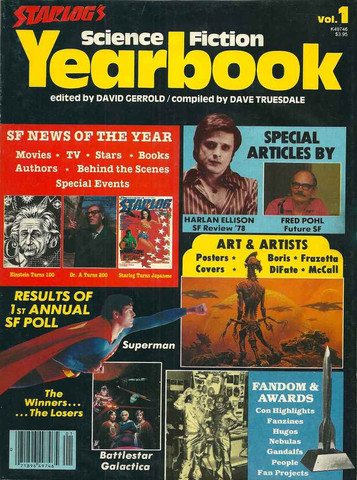
Starlog Science Fiction Yearbook-smallLast week, as part of my ongoing look at Lester Del Rey’s Best of… paperbacks from the 1970s, I wrote a brief piece on The Best of Robert Bloch. In the Comments section, Tangent editor and uber-fan Dave Truesdale offered up this fascinating tidbit:

Back in 1978 David Gerrold and I edited the Starlog SF Yearbook… For the section titled In Memoriam I wrote Robert Bloch and asked if he would do the honors (Kerry O’Quinn, Starlog publisher had given me a budget and so I was of course paying authors). Bob agreed and turned in well over a thousand words on three people who had passed away in 1978: J. Francis “Mick” McComas, co-founder of F&SF; Eric Frank Russell, and Leigh Brackett. It was a marvelous piece, bookended with how the field had begun so small when everybody knew everybody else and it was a big deal when someone died — and today (1978) when hardly anyone noted the passing of folks like Hugo Gernsback or Raymond Palmer…

After Bob got the check for his piece, he wrote back to express his thanks and that Mrs. Bloch would no doubt enjoy spending it on several bags of groceries.

After thinking on it a bit more, Dave got in touch with Robert Bloch’s daughter, Sally (Bloch) Francy, to ask for permission to reprint the piece. Here’s part of her reply:

I’m sure Dad would be very pleased, and I hope he and Rich Matheson are chatting about it as I ‘speak.’ I babysat for Matheson’s kids and rode horseback with their oldest daughter, Tina… Rich’s passing, though not a surprise, given his age and health issues, was still a shock. He and Harlan Ellison are the two people I knew from when I was a teenager, and to whom I still feel strong emotional ties to my father. They are the last of his generation of the people I knew. I miss my dad every day, still!

Thanks to Dave’s efforts, the complete text of her letter and her father’s 1978 piece are reprinted on the Tangent Online website.

Vintage Treasures: The Comic Times

Vintage Treasures: The Comic Times

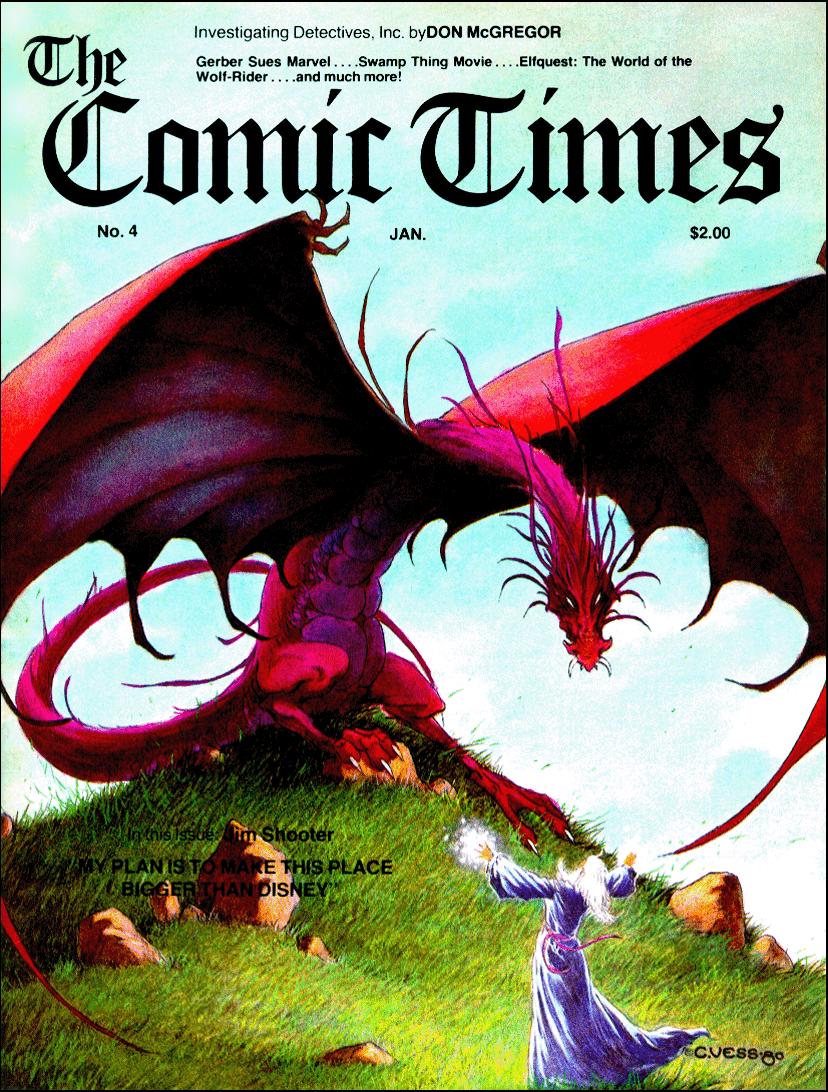
The Comic Times 4-smallJust check out that 1980 Charles Vess cover at right. Isn’t it neat? I sure thought so, when I accidentally stumbled across it on eBay.

It is now mine. Mine mine mine. Because, Charles Vess. Also, poor impulse control.

Strange thing happened when it arrived, though. I thought I was buying an early issue of The Comics Journal. As soon as I unpacked it — and stopped cooing over the Charles Vess cover — I noticed that it was not an issue of The Comics Journal. It was something called The Comic Times.

I’m embarrassed to admit that I never heard of The Comic Times. Had to look it up and everything.

I’m embarrassed because the early 80s was when I was pretty much completely immersed in the comics scene. I was buying and reading comics by the truckload, from Arthur’s Place in downtown Ottawa. Frank Miller’s Ronin, Cerberus, Love and Rockets, Alan Moore’s Swamp Thing, Keith Giffen’s Legion of Super Heroes, Howard Chaykin’s American Flagg, Pacific Comics… I didn’t need something called The Comic Times. I was living The Comic Times.

I’m sure enjoying reading it now, though. It’s a fun and informative little zine, and I bet I would have gotten a lot out of it back in 1980. Near as I can figure out, it only lasted six issues. It was edited by Dennis Cieri and Mark Gasper, and published out of New York. Like The Comics Journal, it was printed on newsprint and looks like it was typeset with a Smith Corona.

Read More Read More

When the 21st Century was Far Future: Frank R. Paul: The Dean of Science Fiction Illustration

When the 21st Century was Far Future: Frank R. Paul: The Dean of Science Fiction Illustration

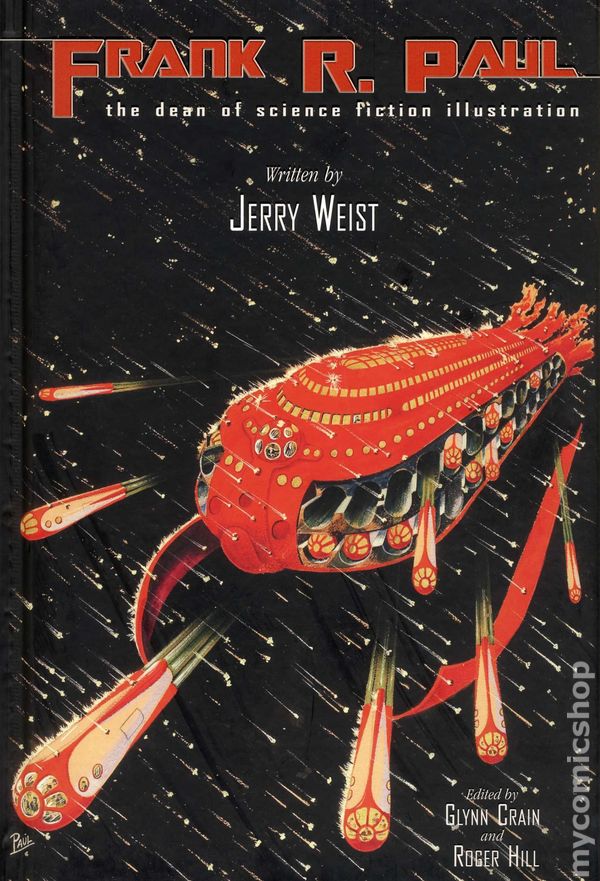
Frank R Paul The Dean of Science Fiction Illustration-smallI consider Frank R. Paul to be one of the most important — if not the most important — artist in the history of science fiction.

It’s odd then that so few readers today are familiar with his work. Jerry Weist set out to correct that with Frank R. Paul: The Dean of Science Fiction Illustration, a dream project of his that was released only after Weist’s death in 2011.

Paul virtually created American Science Fiction, alongside Hugo Gernsback, in the late 1920s. He was the cover artist Gernsback chose for the first science fiction magazine, Amazing Stories — every single issue, for over three years, until Gernsback lost control of it in 1929.

That meant Paul crafted many of the defining images of early science fiction, including his interpretation of Buck Rogers (on the cover of Amazing August 1928), H.G. Wells’s The War of the Worlds (August 1927), and Edgar Rice Burroughs’s John Carter of Mars (Amazing Stories Annual 1927). He made exciting new concepts like space travel, picture-phones, aliens, and robots vivid and real to an America where most people didn’t even own a telephone.

When Gernsback left Amazing behind and founded a new stable of magazines — including Science Wonder Stories and Air Wonder Stories — he took Paul with him. Altogether, Paul painted over 300 magazine covers before his death in 1963, most of them for Gernsback.

Paul had numerous artistic firsts. He was the first to paint a space station, for the cover of the August 1929 Science Wonder. He painted the cover for Marvel Comics #1 in October, 1939, giving the world its first look at the Human Torch.

Paul did countless interior illustrations as well. In addition to his striking cover art, he executed a famous series of original paintings imagining life elsewhere in the solar system for the back covers of many of Gernsback’s magazines.

Read More Read More

The Top 20 Black Gate Fiction Posts in June

The Top 20 Black Gate Fiction Posts in June

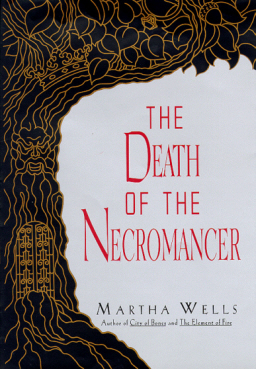
The Death of the NecromancerWe were pleased and honored to present Martha Wells’ Nebula-nominated novel The Death of the Necromancer as part of our Black Gate Online Fiction lineup last month. The complete text of the novel — all 22 chapters — was offered here for free, for the first time anywhere.

Not surprisingly, The Death of the Necromancer was far and away our most popular fiction offering last month. But it was by no means the only widely-read tale we had for you. Our exclusive excerpt from Howard Andrew Jones’ second Dabir and Asim novel, The Bones of the Old Ones, was our second most popular post, and Aaron Bradford Starr’s 35,000-word epic fantasy mystery featuring Gallery Hunters Gloren Avericci and Yr Neh, “The Sealord’s Successor,” was a close third, followed by Joe Bonadonna’s adventure fantasy “The Moonstones of Sor Lunarum,” and Judith Berman’s sword & sorcery novella “The Poison Well.”

Also making the list were exciting stories by Ryan Harvey, E.E. Knight, Michael Penkas, Jason E. Thummel, Mary Catelli, Robert Rhodes, Emily Mah, Vaughn Heppner, and many others.

If you haven’t sampled the adventure fantasy stories offered through our new Black Gate Online Fiction line, you’re missing out. Every week, we present an original short story or novella from the best writers in the industry, all completely free. Here are the Top Twenty most-read stories in June:

  1. The Death of the Necromancer,” by Martha Wells
  2. An excerpt from The Bones of the Old Ones, by Howard Andrew Jones
  3. The Sealord’s Successor,” by Aaron Bradford Starr
  4. The Moonstones of Sor Lunarum,” by Joe Bonadonna
  5. The Poison Well,” by Judith Berman
  6. The Sorrowless Thief,” by Ryan Harvey
  7. The Terror in the Vale,” by E.E. Knight
  8. The Daughter’s Dowry,” by Aaron Bradford Starr
  9. The Worst Was Yet to Come,” by Michael Penkas
  10. Assault and Battery,” by Jason E. Thummel


  11. Read More Read More

New Treasures: The Lives of Tao by Wesley Chu

New Treasures: The Lives of Tao by Wesley Chu

Steven Silver, Holly McDowell, and Mary Robinette Kowal in at the Without a Summer launch party
Steven Silver, Holly McDowell, and Mary Robinette Kowal in at the Without a Summer launch party. Click for bigger version

Back in April, I was invited to Mary Robinette Kowal’s Without a Summer launch party here in Chicago, to celebrate the publication of the third volume of her Glamourist Histories fantasy series (which we covered right here at Black Gate on April 6).

It was a great chance to catch up with a lot of local writers, including Steven Silver, Holly McDowell, and Kelly Swails — and to meet Mary’s husband Rob, who is a winemaker (seriously!) at City Winery Chicago.

I’d like to pause here to note that I don’t get to write a sentence like that every day.

And, of course, it was a chance to see Mary, who was modeling one of her trademark empire style dresses. Brilliant writer, killer fashion sense, married to a winemaker… you can see why one just doesn’t turn down an invitation from this woman.

About an hour after I arrived, Mary introduced me to Wesley Chu, another local Chicagoan and recently published author.

Now, this never gets old. I’ve been in publishing a long time now, and I meet aspiring writers, wannabee writers, and Gee-I’ve-got-a-great-idea-for-a-novel writers all the time. But introduce me to someone who’s published an honest-to-God novel, and I turn into an instant fanboy.

I can’t help it. At heart I’m still a reader, and I’m not so jaded by this industry that I can’t appreciate that behind all the marketing spin, crushing deadlines, commercial pressures and compromises, is true magic — the fragile creative spark nurtured and nudged onto the stage by the diligent and the brave. I’m in awe of these people, and when I meet a new author I want to hear all about their creations.

I had a great talk with Wesley, and he was gracious enough to indulge me a little and tell me about his book. And the more I heard, the more fascinated I became.

Read More Read More