Browsed by
Author: John ONeill

The Fantasy of Lucius Shepard: The Dragon Griaule
The Fantasy of Lucius Shepard: The Dragon Griaule

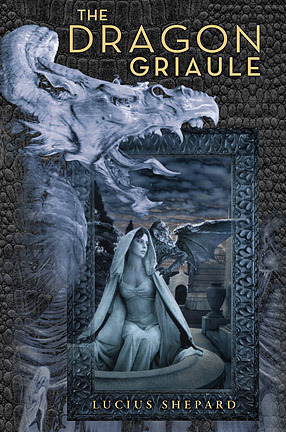
The Dragon Griaule-smallLucius Shepard died last month and, to commemorate his profound contributions to the genre, we are surveying his fantasy books here. Today, we continue with one of his most famous books, The Dragon Griaule.

The point could be made that Shepard made his greatest contributions to fantasy at short length and certainly this volume supports that theory. A collection of six linked stories, including two of his most famous — “The Man Who Painted the Dragon Griaule” and “The Scalehunter’s Beautiful Daughter” — The Dragon Griaule collects all the tales of the massive corpse-dragon Griaule, including a new story, “The Skull,” which connects the mythical world of the Carbonales Valley to one of Shepard’s most prevalent literary concerns, 21st Century Central America.

More than twenty-five years ago, Lucius Shepard introduced us to a remarkable fictional world, a world separated from our own “by the thinnest margin of possibility.” There, in the mythical Carbonales Valley, Shepard found the setting for “The Man Who Painted the Dragon Griaule,” the classic account of an artist — Meric Cattanay — and his decades long effort to paint — and kill — a dormant, not quite dead dragon measuring 6,000 feet from end to end. The story was nominated for multiple awards and is now recognized as one of its author’s signature accomplishments.

Over the years, Shepard has revisited this world in a number of brilliant, independent narratives that have illuminated the Dragon’s story from a variety of perspectives. This loosely connected series reached a dramatic crossroads in the astonishing novella, “The Taborin Scale.” The Dragon Griaule now gathers all of these hard to find stories into a single generous volume. The capstone of the book — and a particular treat for Shepard fans — is “The Skull,” a new 40,000 word novel that advances the story in unexpected ways, connecting the ongoing saga of an ancient and fabulous beast with the political realities of Central America in the 21st century. Augmented by a group of engaging, highly informative story notes, The Dragon Griaule is an indispensable volume, the work of a master stylist with a powerful — and always unpredictable — imagination.

Read More Read More

New Treasures: Crack’d Pot Trail by Steven Erikson

New Treasures: Crack’d Pot Trail by Steven Erikson

Crack'd Pot Trail-smallIt was Jason Waltz, the hard-working mastermind behind Rogue Blades Entertainment, who first introduced me to the twisted and entertaining adventures of Bauchelain and Korbal Broach, the famed necromancers from the Malazan Book of the Fallen. With little in the way of redeeming qualities, Bauchelain and Korbal Broach — and their hard-drinking manservant, Emancipor Reese — are the unlikely protagonists in a series of short novels that mix comedy and horror in equal measure. This time they find themselves on the run from a group of skilled hunters determined to bring them to justice for their foul misdeeds.

It is an undeniable truth: give evil a name and everyone’s happy.  Give it two names and… why, they’re even happier.

Intrepid necromancers Bauchelain and Korbal Broach, scourges of civilization, raisers of the dead, reapers of the souls of the living, devourers of hope, betrayers of faith, slayers of the innocent, and modest personifications of evil, have a lot to answer for and answer they will. Known as the Nehemoth, they are pursued by countless self-professed defenders of decency, sanity, and civilization. After all, since when does evil thrive unchallenged? Well, often — but not this time.

Hot on their heels are the Nehemothanai, avowed hunters of Bauchelain and Korbal Broach. In the company of a gaggle of artists and pilgrims, stalwart Mortal Sword Tulgord Vise, pious Well Knight Arpo Relent, stern Huntsman Steck Marynd, and three of the redoubtable Chanter brothers (and their lone sister) find themselves faced with the cruelest of choices. The legendary Crack’d Pot Trail, a stretch of harsh wasteland between the Gates of Nowhere and the Shrine of the Indifferent God, has become a tortured path of deprivation.

Will honor, moral probity, and virtue prove champions in the face of brutal necessity? No, of course not. Don’t be silly.

Bauchelain and Korbal Broach previously appeared in Blood Follows, The Healthy Dead, The Lees of Laughter’s End (all previously collected in a single volume, Bauchelain and Korbal Broach: Three Short Novels of the Malazan Empire, Volume One), and The Wurms of BlearmouthCrack’d Pot Trail was published September 13, 2011 by Tor Books. It is 204 pages, priced at $12.99 in trade paperback and $9.99 for the digital edition. I bought mine remaindered from Amazon.com for just $5.20; a handful of copies are still available at the discounted price.

Kirkus Looks at The Meteoric Rise and Fall of Gnome Press

Kirkus Looks at The Meteoric Rise and Fall of Gnome Press

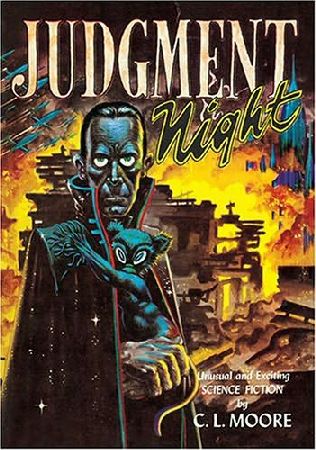
judgment-nightThe legendary Gnome Press, founded by David Kyle and Martin Greenberg in 1948, put some of the most important SF and fantasy ever written between hard covers for the first time — including C.L. Moore’s Judgment Night and Shambleau and Others, The Coming of Conan and Conan the Conqueror by Robert E. Howard, Clifford D. Simak’s City, Robert A. Heinlein’s Sixth Column and Methuselah’s Children, Two Sought Adventure by Fritz Leiber, plus Arthur C. Clarke, Edward E. Smith, L. Ron Hubbard, Leigh Brackett, Murray Leinster, A. E. van Vogt, and dozens of others. It kept the genre’s most important writers in print, at a time when they appeared only in magazines, and in the process introduced them to a whole new generation.

Andrew Liptak at Kirkus Reviews has dug into the history of the press with an excellent piece, part of his ongoing look at the origins of SF and fantasy in America. Here’s his retelling of one of Gnome Press’s most famous acquisitions:

In 1950, Isaac Asimov began looking for a new home for some of his short stories… Rebuffed by his current publisher, Doubleday (who wanted new material, rather than repackaged short stories), Asimov approached Greenberg, who was eager to publish his stories. Asimov pulled together nine of his robot stories… into a single volume called I, Robot. Gnome released the collection at the end of 1950, with some of the stories reworked to include his character, Susan Calvin, telling a larger story of the evolution of robotics. The collection was a successful one, and Asimov brought Greenberg another series of books for which he would be well known: Foundation. First serialized in magazines, Gnome brought Asimov’s Foundation trilogy to hardcover between 1951 and 1953.

Read More Read More

Descend Into the Depths of the Earth in Forgotten Realms: Underdark

Descend Into the Depths of the Earth in Forgotten Realms: Underdark

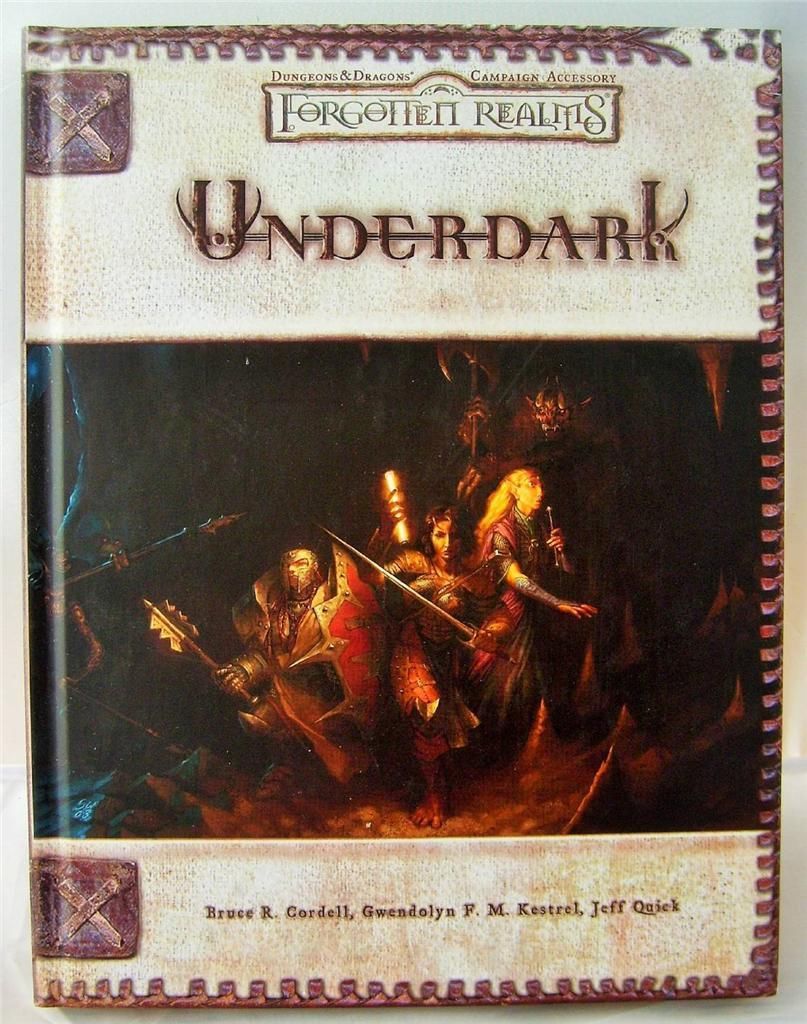
Forgotten Realms Underdark-smallI’ve been fascinated with underground gaming ever since I took my first steps in Gary Gygax’s imaginative underworld in the classic 1978 AD&D module D1: Descent into the Depths of the Earth. That adventure — which first introduced the complex and sinister machinations of the drow — was one of the most popular ever released for AD&D and it has been much copied and imitated over the decades since.

A message not lost on TSR and WotC over the years, who have explored and expanded on Gygax’s concept of ancient and hostile subterranean civilizations in several releases — especially the popular Underdark products. With the publication of D&D Third Edition, the masterminds at WotC commissioned an updated version of Underdark for their Forgotten Realms setting, and it appeared in hardcover in 2003.

All of which is background to explain why I was sitting in the front row at the Spring Games Plus Auction and nimbling up my bidding arm when I saw a brand new copy of Underdark make its way to the auction block.

Bidding opened at a buck and was never very enthusiastic. D&D supplements one or two editions out of date don’t seem to command much interest these days and I walked away with it for the criminal price of seven bucks.

Their loss. Underdark is a terrific buy for any D&D gamers looking to add a fully fleshed-out subterranean setting to their existing campaign.

Read More Read More

Vintage Treasures: The Vizier’s Second Daughter by Robert F. Young

Vintage Treasures: The Vizier’s Second Daughter by Robert F. Young

The Vizier's Second Daughter-smallI don’t know much about Robert F. Young. His first short story, “The Black Deep Thou Wingest,” appeared in Startling Stories in 1953; it was followed by roughly 140 more in Astounding Science Fiction, Science Fiction Quarterly, Science Fiction Stories, IF, Fantastic Universe, The Saturday Evening Post, Collier’s, and many other places. His story “Little Dog Gone,” from the February 1964 issue of Worlds of Tomorrow, was nominated for a Hugo Award.

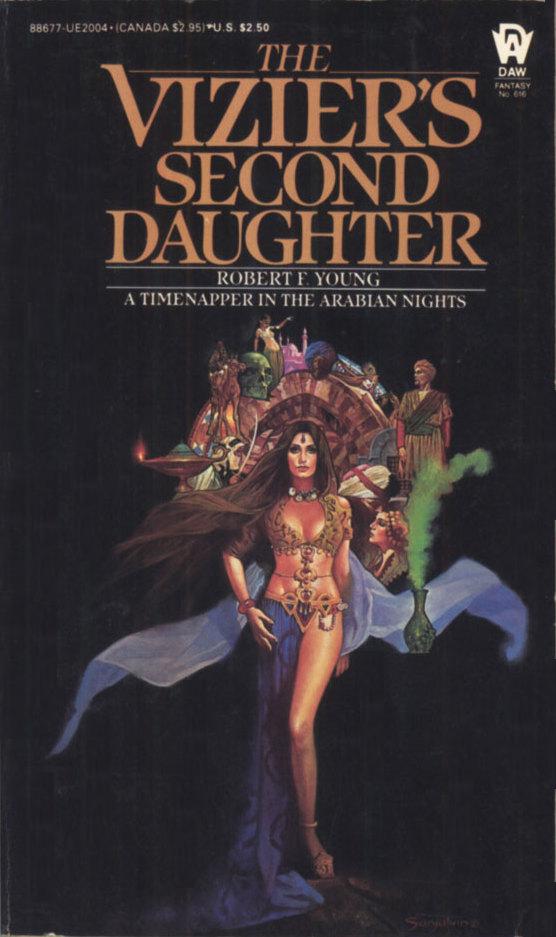
His first novel, La Quete de la Sainte Grille (1975), was written in French; it was released only in France and has never appeared in the U.S. He only wrote four novels in English, including Starfinder (1980), The Last Yggdrasill (1982), and Eridahn (1983). His last, The Vizier’s Second Daughter (1985), was a time traveling science fantasy romp, featuring genies, Ali Baba, and the kid sister of Sheherazade. It looks like a great place to start my education in the the work of Robert F. Young.

They sent him into the past to kidnap and bring back Sheherazade, the famous narrator of the Thousand and One Nights. But when he had grabbed a lovely lady out of the Sultan’s harem and scooted away on his “magic carpet” time machine he discovered that he had muffed it — for she was the Vizier’s second daughter — Sheherazade’s kid sister!

He thought he could rectify the mistake before going back to the 21st Century — but it was already to late. Because the ifrits were on his trail, Ali Baba had jumped aboard, and the enchanted Castle of Brass awaited his arrival with ghoulish glee.

It’s a wonderful romp through time and legend with the kid sister pulling marvels out of her hair faster than you could pull the cork on a djinn bottle!

Robert F. Young died in June 1986, at the age of 71; he continued writing right until his death. The Vizier’s Second Daughter was published by DAW in February 1985. It is 203 pages, priced at $2.50 in paperback; the cover is by Sanjulian. It has never been reprinted and there is no digital edition.

New Treasures: Dream London by Tony Ballantyne

New Treasures: Dream London by Tony Ballantyne

Dream London Tony Ballantyne-smallI’ve never read anything by this Tony Ballantyne fellow and I’m probably overdue. He’s a British science fiction writer who’s had an impressive career for a decade now, starting with the Recursion trilogy, Recursion (2004), Capacity (2005), and Divergence (2007), all published in the US by Bantam Spectra. He’s also written two volumes of The Robot Wars, Twisted Metal (2009) and Blood and Iron (2010), and I really don’t know how I missed that one — if it’s got battling robots, I’m usually all over it.

But it’s his first fantasy novel that has really piqued my curiosity and it’s getting some serious attention from both sides of the Atlantic. Set in a constantly shifting London that’s gradually getting weirder every night, and apparently throwing off the laws of physics, it’s — as Chris Beckett put it in his excellent Tor.com review —  “a place you feel you might have visited yourself, if only you’d been able to hold it in your mind when you woke up.”

In Dream London the city changes a little every night and the people change a little every day. Captain Jim Wedderburn has looks, style and courage by the bucketful. He’s adored by women, respected by men and feared by his enemies. He’s the man to find out who has twisted London into this strange new world, and he knows it. But the towers are growing taller, the parks have hidden themselves away and the streets form themselves into strange new patterns. There are people sailing in from new lands down the river, new criminals emerging in the East End and a path spiralling down to another world. Everyone is changing, no one is who they seem to be, and Captain Jim Wedderburn is beginning to understand that he’s not the man he thought he was…

Dream London was published by Solaris Books on October 29, 2013. It is 404 pages, priced at $7.99 in paperback and $6.99 for the digital edition.

See all of our recent New Treasures here.

Win a Copy of The Collected Edmond Hamilton, Volume Four from Haffner Press

Win a Copy of The Collected Edmond Hamilton, Volume Four from Haffner Press

The Collected Edmond Hamilton Volume Four-smallHaffner Press has released the long-awaited fourth volume of The Collected Edmond Hamilton and we have a copy to give away to one lucky winner.

How do you enter? Just send an e-mail to john@blackgate.com with the title “Edmond Hamilton” and a one-sentence review of your favorite Hamilton novel or short story (don’t forget to mention the title of the story). One winner will be drawn at random from all qualifying entries and we’ll publish the best reviews here on the Black Gate blog. To give you the idea, here’s my one-sentence review of my favorite Hamilton story, “The Man Who Evolved.” (read the complete story here)

Arthur Wright and Hugh Dutton visit Dr. John Pollard on the night he first tests a ray that allows him to experience millions of years of human evolution… and witness a deadly experiment that threatens the entire human race.

See how easy that was? If you need more inspiration. we recently covered several Edmond Hamilton books — including Starwolf and The Best of Edmond Hamilton — and we reprinted his very first story, “The Monster-God of Mamurth” (from the August 1926 issue of Weird Tales) in Black Gate 2.

All entries become the property of New Epoch Press. No purchase necessary. Must be 12 or older. Decisions of the judges (capricious as they may be) are final. Not valid where prohibited by law. Or anywhere postage for a hefty hardcover is more than, like, 10 bucks. Seriously, this thing is huge and postage is killing me.

The Reign of the Robots, The Collected Edmond Hamilton, Volume Four was published by Haffner Press on December 30, 2013. It is 696 pages, priced at $40 in hardcover. There is no digital edition. Learn more at the Haffner website.

New Treasures: The Six-Gun Tarot by R.S. Belcher

New Treasures: The Six-Gun Tarot by R.S. Belcher

The Six-Gun Tarot-smallI’ve mentioned my fondness for this new Weird Western genre before. In the right hands, it’s an invigorating mix of mythic adventure and the straight-out gonzo weird. There’s been no shortage of fine examples recently, including Lee Collins’s She Returns From War, Guy Adams’s Once Upon a Time in Hell, Mercedes Lackey & Rosemary Edghill’s Dead Reckoning, and the Bloodlands novels of Christine Cody. Heck, even Firefly is a weird western, if you squint at it right.

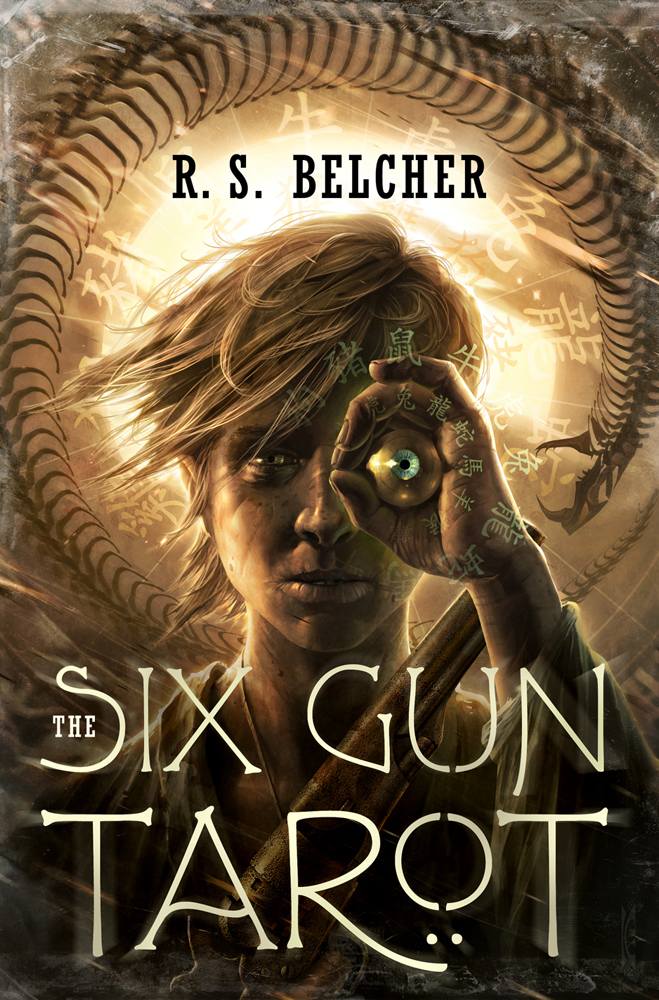
The latest volume to cross my desk, hot off the presses last week in paperback, is the debut novel by R.S. Belcher. In a starred review, Library Journal called it “an astonishing blend of first-rate steampunk fantasy and Western adventure,” which sounds like just the right mix in my book.

Nevada, 1869: Beyond the pitiless 40-Mile Desert lies Golgotha, a cattle town that hides more than its share of unnatural secrets. The sheriff bears the mark of the noose around his neck; some say he is a dead man whose time has not yet come. His half-human deputy is kin to coyotes. The mayor guards a hoard of mythical treasures. A banker’s wife belongs to a secret order of assassins. And a shady saloon owner, whose fingers are in everyone’s business, may know more about the town’s true origins than he’s letting on.

A haven for the blessed and the damned, Golgotha has known many strange events, but nothing like the primordial darkness stirring in the abandoned silver mine overlooking the town. Bleeding midnight, an ancient evil is spilling into the world, and unless the sheriff and his posse can saddle up in time, Golgotha will have seen its last dawn… and so will all of Creation.

The Six-Gun Tarot was published on January 22, 2013 by Tor Books. It is 368 pages, priced at $25.99 in hardcover and $11.99 for the digital edition. It was re-issued in paperback on March 25, 2014.

Vintage Treasures: Starwolf by Edmond Hamilton

Vintage Treasures: Starwolf by Edmond Hamilton

Edmond Hamilton Starwolf-smallLast week, I wrote about a delightful collection of 80′s paperbacks I bought on eBay for just 10 bucks — including John Silbersack’s Buck Rogers novel Rogers’ Rangers, well worth $10 all on its own. Sometimes it’s good when no one else shares your hobbies.

I’m still digging through the remaining 74 volumes and continuing to make marvelous finds. Like the omnibus collection of pulp novels by Edmond Hamilton, gathering together all three volumes in his classic Starwolf trilogy. It contains The Weapon From Beyond (1967), The Closed Worlds (1968), and The World of the Starwolves (1968), all originally published by Ace. That’s a lot of classic space adventure from one of the greatest pulp writers of the 20th Century. Well worth tracking down, if you can find a copy.

The only mercy a Starwolf could expect was death…

Morgan Chane was a Starwolf – a member of the most infamous band of interstellar pirates in the galaxy. He had flown with the raiding packs, rockets screaming, to plunder the rich and slaughter the helpless.

But Morgan Chane was also a Terran, adopted as a child into the Starwolf clan. And when a quarrel erupted, Chane discovered that the Starwolves weighed his alien birth more heavily than all the years of comradeship. Now he is cast out of the clan – and running for his life.

But where, in all the galaxy, can a Starwolf expect to find refuge?

Starwolf was published by Ace Books in October 1982. It is 456 pages, priced at $3.50. It went through multiple printings between 1982 and 1990, but has otherwise never been reprinted. There is no digital edition. The cover is by David Schleinkofer, who was obviously influenced by one too many viewings of Battlestar Galactica.

See all of our recent Vintage Treasures here.

Future Treasures: The Leopard by K.V. Johansen

Future Treasures: The Leopard by K.V. Johansen

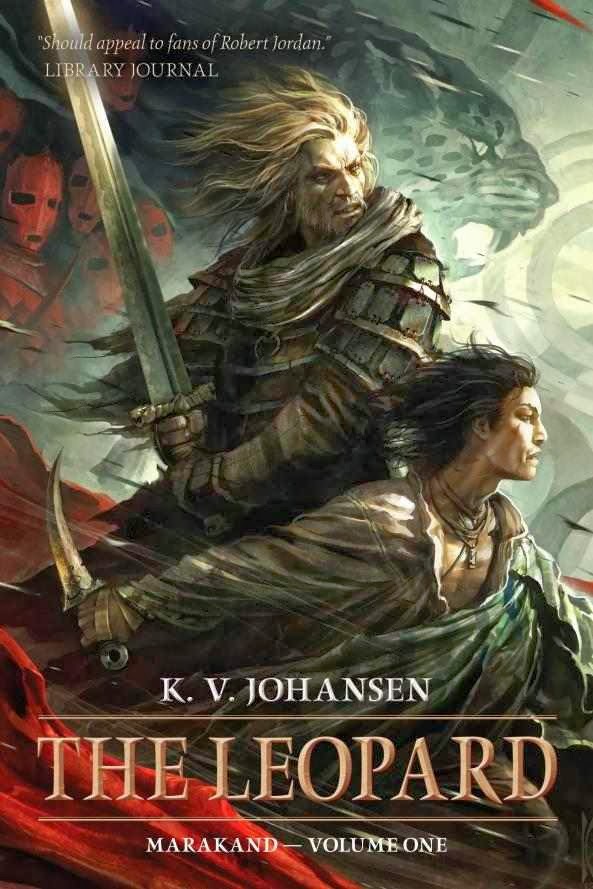
The Leopard K V Johansen-smallLou Anders, editorial director of Pyr Books, may be the closest we have to Lin Carter in the field today: an editor with impeccable taste and boundless energy, who has also been a tireless champion for sword & sorcery. The latest he’s offering us is the opening volume in a new series from K.V. Johansen, the Canadian author of Blackdog (2011). Black Gate’s own James Enge blurbs The Leopard with a stylish tip of the hat to the great Harold Lamb: “I’m hooked. This mix of magic, Tibetan-style religion, and Harold Lamb-style adventure is pretty addicting.” Sounds pretty darn good to me.

Ahjvar, the assassin known as the Leopard, wants only to die, to end the curse that binds him to a life of horror. Although he has no reason to trust the goddess Catairanach or her messenger Deyandara, fugitive heir to a murdered tribal queen, desperation leads him to accept her bargain: if he kills the mad prophet known as the Voice of Marakand, Catairanach will free him of his curse. Accompanying him on his mission is the one person he has let close to him in a lifetime of death, a runaway slave named Ghu. Ahj knows Ghu is far from the half-wit others think him, but in Marakand, the great city where the caravan roads of east and west meet, both will need to face the deepest secrets of their souls, if either is to survive the undying enemies who hunt them and find a way through the darkness that damns the Leopard.

To Marakand, too, come a Northron wanderer and her demon verrbjarn lover, carrying the obsidian sword Lakkariss, a weapon forged by the Old Great Gods to bring their justice to the seven devils who escaped the cold hells so long before.

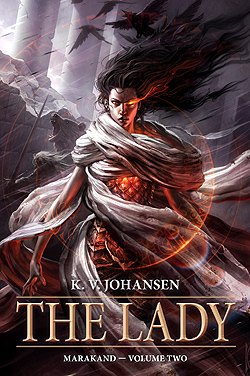
The Leopard is Volume One of Marakand. It will be published on June 10 by Pyr Books. It is 370 pages, to be priced at $18 in trade paperback and $11.99 for the digital version. The second volume, The Lady, is scheduled to arrive in December (see the cover here).