January/February 2017 Asimov’s Science Fiction Now on Sale
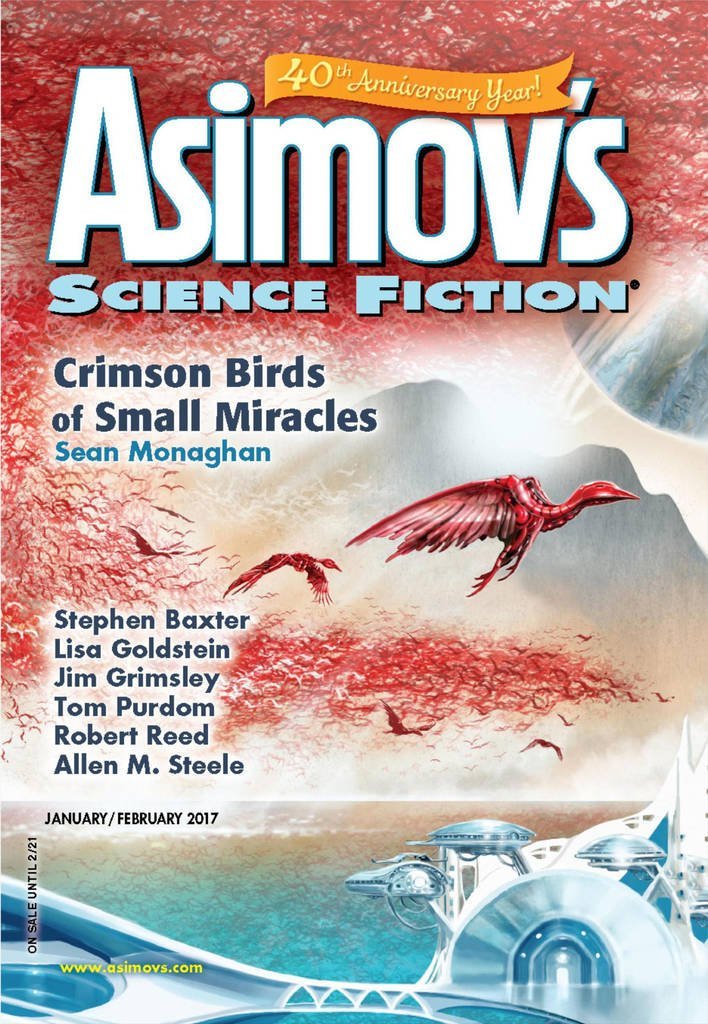 The January/February 2017 issue of Asimov’s Science Fiction marks the beginning of the magazine’s 40th year. I remember buying the second issue off the racks in the summer of 1977, when I was 13 years old. It was one of the first SF magazines I ever bought and, as Obiwan Kenobi put it later that year, it was my “first step into a wider world.”
The January/February 2017 issue is a landmark for another reason, as it’s the first issue in the new bimonthly format. I always enjoy the big double issues, and getting six of them a year is something I look forward to — especially since the magazine has added an additional 16 pages (bringing it up to 208), making it the thickest issue of Asimov’s in years.
Here’s Sheila’s full description from the website:
We’re celebrating our fortieth anniversary all year long. The party starts with the super-stuffed double January/February 2017 issue! Two dramatic stories frame the issue. Allen M. Steele’s famous frontier planet, Coyote, has been settled for some time, but terrifying dangers still lurk around the bend of an unexplored river. Members of a scientific expedition soon learn that it takes more than bravado to survive “Tagging Bruno.” In Robert Reed’s new novella, crewmembers from the Big Ship encounter a very strange and very intelligent alien who puts their own spin on “The Speed of Belief.”
Octavia Cade escorts us to the Siberia of Stalinist Russia for “The Meiosis of Cells and Exile”; Jack Skillingstead arrives at a chilling “Destination”; Jim Grimsley paints a “Still Life With Abyss”; denizens of Fire Island will “Blow Winds, and Crack Your Cheeks” in John Alfred Taylor’s new story; Tom Purdom reveals the powerful strength of a “Fatherbond”; Robert R. Chase helps pick up the “Pieces of Ourselves”; Lisa Goldstein exposes us to “The Catastrophe of Cities”; Ray Nayler imbues a hazardous “Winter Timeshare” with new meaning; young people attempt a first contact with the help of Stephen Baxter’s mysterious “Starphone”; while beauty and sorrow are stunningly portrayed in Sean Monaghan’s evocative depiction of “Crimson Birds of Small Miracles.”