Centurion: How Many Times Can I Use “Brutal” in a Review?
Centurion: How Many Times Can I Use “Brutal” in a Review?

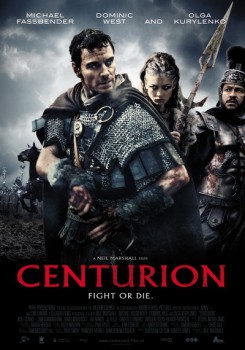
2852-FINAL_CENTURION 70x100op 50 %.inddCenturion (2010)
Directed by Neil Marshall. Starring Michael Fassbender, Dominic West, Olga Kurylenko.

If you did not see Centurion during its U.S. theatrical release, that’s probably because you blinked. The British film ran in only a small number of theaters in August on limited engagements, with a simultaneous release on Video on Demand. It played at the Nuart Theater a few miles from my home for a week, and I was unable to get to it. I regretted it at the time because the trailers got my thrill glands pumping: a bloody historical action movie starring a Roman legion. Now that is my kind of fun! I also had faith in director Neill Marshall; I had enjoyed all of his previous movies, and they more than proved that he could handle violent mayhem.

Now that Centurion is on DVD and Blu-Ray, I’ve been able to see what Mr. Marhsall did with the murky historical legend of the Ninth Legion: he made a bloody historical action movie out of it.

Centurion is as straightforward as they come, something the director admits: “It’s not meant to be historically perfect. I’m picking up on a legend and exploring it . . . it’s an action thriller.” The Ninth Legion, which supposedly vanished on an expedition to Scotland in the second century, serves as a springboard for Marhsall to return to the territory of “soldiers-behind-the-lines” from his first movie, the werewolf thriller Dog Soldiers, and sprinkle it with Xenophon’s Anabasis and various World War II movies featuring tough guys doing what has to be done. It is a stripped-to-the-bone bloodletting, filled with decapitations, throat-slittings, head-crushings, and any other mutilation you care to mention.

Not every movie needs deep psychological character explorations or nuanced drama. Centurion knows what it wants, runs after it, and spikes it gorily to the ground. If you think you might enjoy this film, then you will enjoy it — Marhsall delivers the goods as promised.
Read More Read More

Happy 100th Birthday, C. L. Moore!

Happy 100th Birthday, C. L. Moore!

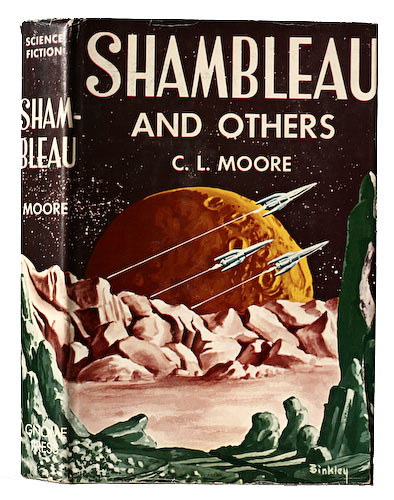
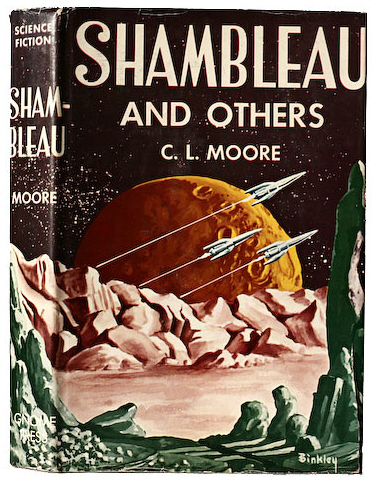
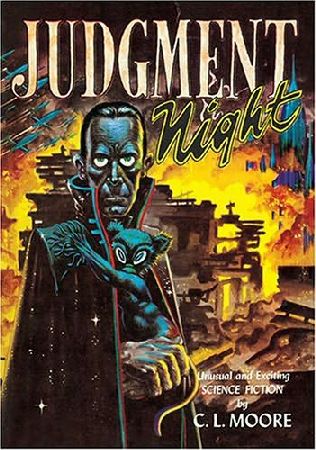
shambleau1Catherine Lucille (C.L.) Moore, one of the great pulps writers of the 20th Century and author of Judgment Night, Shambleau and Others, Northwest of Earth, and Jirel of Joiry, was born 100 years ago today, on January 24, 1911.

Moore’s first story, “Shambleau,” the tale of a beautiful alien vampire, introduced interplanetary adventurer and pulp hero Northwest Smith  in the November 1933 issue of Weird Tales. The next year she published “Black God’s Kiss,” the first tale of Jirel of Joiry. They remain two of the most famous stories Weird Tales ever published.

Much of Moore’s early science fiction and fantasy stories were collected by Gnome Press in handsome volumes that are still highly collectible today, including Judgment Night (1952), Shambleau and Others (1953), and Northwest of Earth (1954).

Moore married fellow science fiction author Henry Kuttner in 1940, and they collaborated on many classic tales for the pulps, including “Mimsy Were the Borogroves,” (filmed in 2007 as The Last Mimzy), “The Twonky,” and “Vintage Season.” Much of their work together appeared in Astounding Science-Fiction,  usually under the name Lewis Padgett or Laurence O’Donnell.

judgment-nightMoore published three novels before her death in 1987: Doomsday Morning(1957), and two with Kuttner: Earth’s Last Citadel (1943) and The Mask of Circe (1948).

Unlike most pulp authors, C.L. Moore’s fame continued to grow after her death, and the past decade alone has seen several major collections of her work including two Planet Stories editions from Paizo: Black God’s Kiss (2007) and Northwest of Earth (2008); as well as Volume 31 in the Fantasy Masterworks series from Gollancz, Black Gods and Scarlet Dreams (2002); and two huge retrospectives: Two-Handed Engine (Centipede Press, 2006) and Detour to Otherness (Haffner Press, 2010).

Over the years we’ve done our own tributes to C.L. Moore, including Ryan Harvey’s Jirel of Joiry: The Mother of Us All, Paul Di Filippo’s review of Judgment Night, and C.S.E. Cooney’s recent Jirel, Ma Joie!

Celebrate the life of one of our finest writers this week — pick up and enjoy a C.L. Moore story. You’ll thank us later.

[Thanks to Stephen Haffner of Haffner Press for the tip.]

A Review of The Time Ships by Stephen Baxter

A Review of The Time Ships by Stephen Baxter

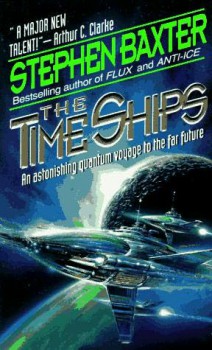
time-shipsI’m not entirely sure how to review a sequel that’s written by a different author. I’m even less sure how to proceed if that sequel happens to be for a classic.
It’s not enough that it be a good book on its own. It also has to carry over themes from the original, and ideally, it should measure up to the original — which is almost impossible, because classics tend to become classics because the ideas in them are unique, cutting edge, or at least presented in a fascinating new way.

The Time Ships, by Stephen Baxter, is a sequel to H. G. Wells’ The Time Machine, and that’s one of the most impossible legacies in science fiction.

It’s a very good book, but it isn’t revolutionary in the way the original is — in part because it really can’t be. To top The Time Machine, you’d pretty much have to invent a new genre.

When The Time Machine ends, the nameless Time Traveller promises to be right back, departs for the future, and vanishes forever. The Time Ships repeats this scene from his perspective (in the original, we see it from the Writer’s point of view) and explains what happened to him.

Read More Read More

Robert E. Howard: The Barbarians

Robert E. Howard: The Barbarians

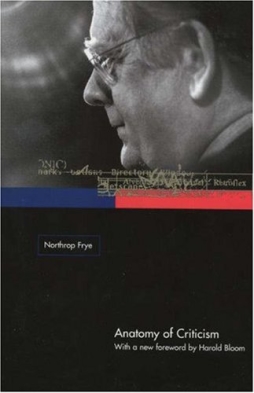
The Anatomy of CriticismIn the opening pages of The Anatomy of Criticism, Northrop Frye introduced a theory of modes, of types of stories, based on the power of action held by a story’s hero. If the hero has powers superior in kind to other characters, the story is a myth; if the hero has powers superior in degree, like a Launcelot or a Charlemagne, then the story’s a romance (in the old sense of a fantastic adventure story). A hero superior to other characters but not to the world around him is a leader, the kind of protagonist you might have in an epic or a tragedy, like Macbeth or Odysseus, and so belongs to the high mimetic mode: a mode imitating life, but at a higher pitch than life is commonly lived. A hero “superior neither to other men nor to his environment” impresses us with a sense of shared humanity, and exists in the low mimetic mode. A hero with less power or agency than ourselves creates the ironic mode, a story about “bondage, frustration, or absurdity.”
Frye has a lot more to say about all these different modes, but that’ll do for a start. I’ve been thinking about Frye and his theory of modes with respect to Robert E. Howard and to Howard’s three great barbarian heroes: Kull, Conan, and Bran Mak Morn. It seems to me that the theory of modes helps to explain the substantive difference between the three characters; why their stories, as far as I’m concerned, feel so different one from another. All of them are characters of the romance mode, but a story in one mode can be pulled toward another, and I think that’s what’s happening with these characters.

Read More Read More

Chris Braak Reviews The Magicians

Chris Braak Reviews The Magicians

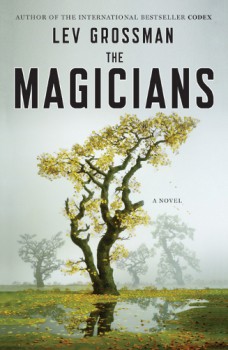
the-magicians-by-lev-grossmanThe Magicians
Lev Grossman
Viking (416 pp, $16.00, August 2009 – May 2010 paperback edition)
Reviewed by Chris Braak

Lev Grossman’s The Magicians makes an admirable attempt at an ambitious premise: is it possible to use the form and structure of Harry Potter to tell a story about ennui, dissipation, and cynicism? What is the difference between the childhood wonder evoked by the “you’re such a special child” childrens’ fantastic literature — with its black and white morality, its uplifting sense of meaning and hope — and the obdurate, insistent messiness of real grown-up life?

The Magicians follows Quentin Coldwater, a brilliant, industrious high school student who spends his time working obscenely hard at schoolwork for ends that are not entirely clear to him, as he is selected for and matriculates at a secret school for wizards in upstate New York. The story self-consciously mimics such similar novels as Harry Potter and the Sorcerer’s Stone, except it equally self-consciously subtracts the moral clarity, the battle against ultimate evil, and the soul-building trials of its main character’s childhood.

Read More Read More

Rogue Blades Entertainment Announces eSsassins Electronic Anthologies

Rogue Blades Entertainment Announces eSsassins Electronic Anthologies

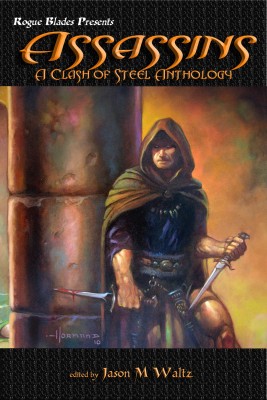
assassins1Jason M. Waltz at Rogue Blades Entertainment tells us the distinguished heroic fantasy publishing house has added a series of electronic anthologies to its already-crammed slate of planned publications for the year:

RBE is proud to introduce not only four additional titles under the Clash of Steel series, but its first four e-only anthologies as well! Better yet, these four e-anthologies deliver even more of the eagerly desired Assassins: A Clash of Steel print anthology to be released later in 2011! These 4 eSsassins titles carry over the same steel-bearing protagonists in dangerous, powerful prose, and the same eye-catching cover art from Didier Normand that the print anthology pledges.

Each volume in the eSsassins line will contain four stories, totalling 15,000 – 18,000 words in length.  They will be sold in multiple electronic formats for $3.00 each.

The volumes will be released monthly, starting in February.  The RBE website lists the complete contents of each upcoming volume, including stories from Laura J. Underwood, Yeoryios Pantazis, Amy Sanderson, Charles Kyffhausen, and G.K. Hayes.

RBE’s previous Clash of Steel anthology was last summer’s Demons, which I’m currently reading and quite enjoying. Cover art for each of the upcoming volumes will be unveiled soon, so keep your eye on their website for updates.

Philip K. Dick Award Nominees Announced

Philip K. Dick Award Nominees Announced

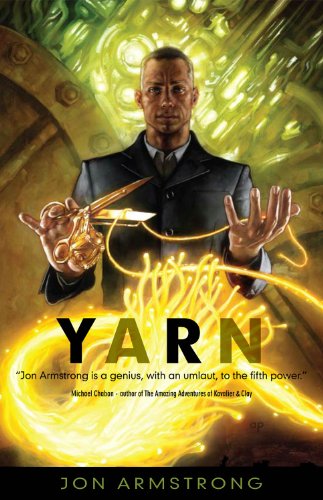
yarnThe nominees for the Philip K. Dick Award were announced by the Philadelphia SF Society and the Philip K. Dick Trust on Tuersday, January 18.

The Philip K. Dick Award is presented “for distinguished science fiction published in paperback original form in the United States.” It honors the legendary science fiction author Philip K. Dick, many of whose classic early novels, including Eye in the Sky, Solar Lottery, Martian Time-Slip and The Game-Players of Titan, appeared originally in paperback.

This is a juried award, so don’t bother hunting online for a way to vote. The judges for 2010 are Andy Duncan (chair), William Barton, Bruce McAllister, Melinda Snodgrass, and David Walton. The award is administered by David G. Hartwell and Gordon Van Gelder. Previous winners include William Gibson’s Neuromancer, Richard Paul Russo’s Ship of Fools, Carol Emshwiller’s The Mount, and C. L. Anderson’s Bitter Angels.

Wikipedia has a complete list of the nominees and winners for each year. Nominees this year are:

Yarn by Jon Armstrong (Night Shade Books)
Chill by Elizabeth Bear (Ballantine Books/Spectra)
The Reapers Are the Angels by Alden Bell (Henry Holt & Co.)
Song of Scarabaeus by Sara Creasy (Eos)
The Strange Affair of Spring Heeled Jack by Mark Hodder (Pyr)
Harmony by Project Itoh, translated by Alexander O. Smith (Haikasoru)
State of Decay James Knapp (Roc)

Congratulations to all the nominees! The winner will be announced on Friday, April 22, 2010.

The Best KULL Comic Ever: “Demon in a Silvered Glass”

The Best KULL Comic Ever: “Demon in a Silvered Glass”

kullsmall-1Happy Birthday, Robert E. Howard…

I am a huge Conan fan, but I have to admit that I like Howard’s King Kull stories even better. The Kull tales are more poetic, more lyrical, more mystical … and they reveal more of Howard’s Shakespearean influence than any of his Conan tales.

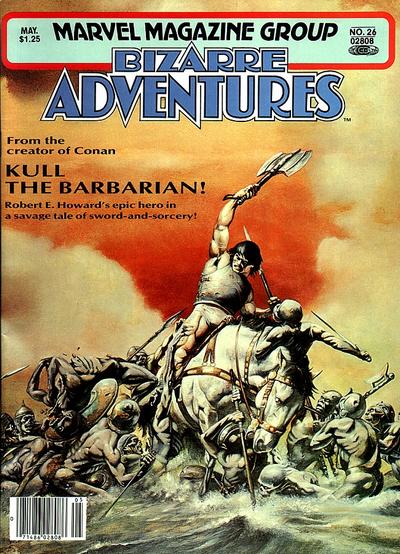
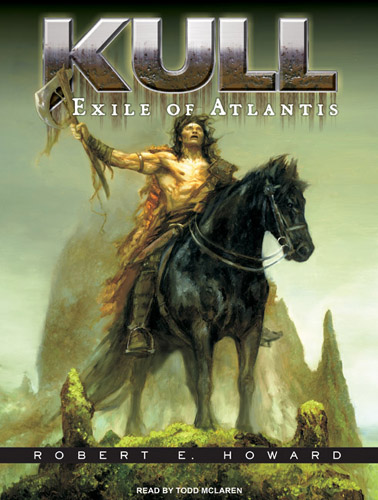
All of those terrific Kull tales are collected in a terrific illustrated volume from Del Rey entitled Kull: Exile of Atlantis.  If you want the true Kull experience, this book has it all. Yet of all the Kull and Conan comics produced by Marvel Comics in the 70s and 80s, there is one that stands head-and-shoulders above them all: Bizarre Adventures #26, featuring Kull the Barbarian. John Bolton’s dark, lush artwork brought Kull, Brule, and the City of Wonders alive in a work of timeless excellence.

Kull always had it rougher than Conan in the comics world. When the fantastically talented Barry Windsor-Smith put his unique stamp on the Conan character in 1971’s Conan the Barbarian #1, he and writer Roy Thomas ensured it would become a Marvel mainstay. Yet when Marvel added a Kull the Conqueror comic a few years later, they weren’t lucky enough to strike gold again. Various artists did the Kull series, and despite a terrific run by Marie Severin and a couple of great Mike Ploog issues (and later work by Alfredo Alcala and Ernie Chan), the series never approached Conan in popularity or longevity. However, in 1981 King Kull finally got his due in a true masterpiece of sword-and-sorcery: “Demon in a Silvered Glass.”

Read More Read More

Robert E. Howard in his Own Words

Robert E. Howard in his Own Words

kull-atlantisIn honor of what would be his 105th birthday, I thought I’d let Robert E. Howard’s own words do the talking.

Here’s a few of my favorites culled from his Conan, Kull, and Solomon Kane stories. There’s so many to pull from but I chose these because they capture the ferocity, humor, and poetic qualities of Howard’s writing.

If you got any favorite passages to share, post ‘em here.

There comes, even to kings, the time of great weariness. Then the gold of the throne is brass, the silk of the palace becomes drab. The gems in the diadem and upon the fingers of the women sparkle drearily like the ice of the white seas; the speech of men is as the empty rattle of a jester’s bell and the feel comes of things unreal; even the sun is copper in the sky and the breath of the green ocean is no longer fresh.

–“The Mirrors of Tuzun Thune”

Read More Read More

Robert E. Howard Birthday Celebration

Robert E. Howard Birthday Celebration

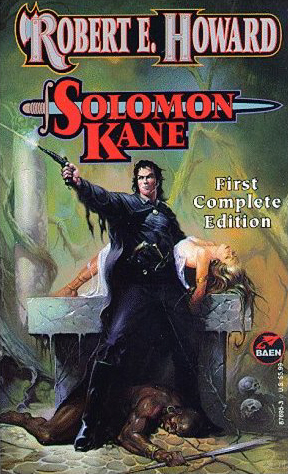
solomon-kane3Here’s to Robert E. Howard, creator of my favorite genre, sword-and-sorcery, on the anniversary of his birth. Raise high your goblets and drink deep.

What is best about Robert E. Howard’s writing? The driving headlong pace, the seemingly inexhaustible imagination, the splendid cinematic prose poetry, the never-say-die protagonists? It is hard to pick one thing, so it may be simpler to state that Robert E. Howard possessed profound and often astonishing storytelling gifts. Without drowning his readers in adjectives (he had the knack of using just enough adjectives or adverbs, and knew to let the verbs do the heavy lifting) or slowing pace, he brought his scenes to life. Vividly.

Writer Eric Knight may have most succinctly described this particular aspect of Howard’s power in an article on Solomon Kane:

“’Wings of the Night’ features a marathon running fight through ruin, countryside, and even air that only a team of computer animators with a sixty-million dollar budget and the latest rendering technology (or a single Texan from Cross Plains hammering the story out with worn typewriter ribbon) could bring properly to life.”

Read More Read More