Literature and Ideas: Olaf Stapledon’s Star Maker
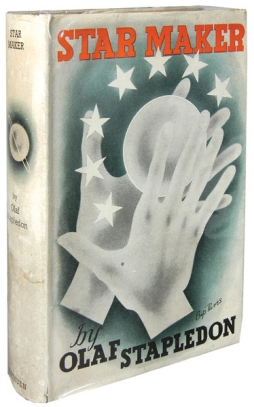 It’s often said that science fiction (or speculative fiction, whatever term you prefer) is a ‘literature of ideas’. I’ve never been able to agree with that statement. In part, I feel much the same way this writer does, though perhaps not as strongly; that is, to say that sf is a literature of ideas is to overlook the fact that the best mainstream literature is every bit as engaged with ideas, if not more so. Consider, say, Iris Murdoch’s use of Wittgenstein’s imagery and philosophy. Is that not writing engaged with ideas?
But I think also that there’s another difficulty with considering sf as a literature of ideas. That being: it seems to me sf very often fails to realise the promise contained in that phrase. What I mean is that ‘a literature of ideas’ would seem to imply a literature with a different structure than traditional literature; a literature with a different sense of how to shape a narrative, or how to use language. A literature actually shaped and structured by ideas, not plot or even character. I feel Murdoch goes some distance toward that sort of thing in a book like Under the Net, playing about with forms like farce and bildungsroman, and tying them together with the Wittgensteinian ideas about the representation of reality — with which, as somebody writing a basically mimetic work, she’s already engaged. What’s the science fiction equivalent of that?
It seems to me that an example of the true literature of ideas in sf is something like Olaf Stapledon’s Star Maker. Stapledon was a novelist, but a philosopher perhaps more so; and Star Maker seems often less like a traditional narrative than an extended philosophical meditation or anthropological field report. The whole book is essentially one big infodump. But a fascinating infodump.
 The first

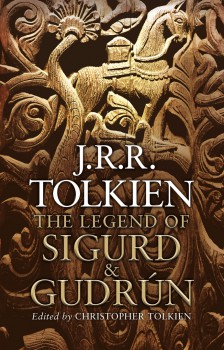 If you like the sound and rhythm of words — and if you’re a hopeless J.R.R. Tolkien junkie — you’ll like The Legend of Sigurd and Gudrun (2009, Houghton Mifflin Harcourt). Lacking either of these prerequisites, you probably won’t. And there’s not much more to say than that.