“Classic Sword & Fantasy”: Tangent Online on Vaughn Heppner’s “The Pit Slave”
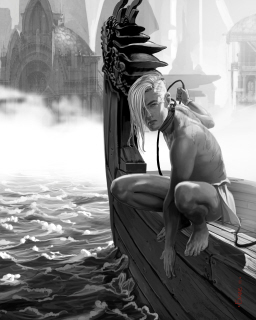 Louis West at Tangent Online reviews Vaughn Heppner’s swords & sorcery short story, “The Pit Slave,” published here on Sunday, February 2:
A classic sword & fantasy tale. Lod had urged the last of the human soldiers, who worship the god Elohim, to rise up and rebel against the conquering Nephilim giants since “it was better to die on your feet than live on your knees.”
But all the soldiers were killed or captured. Now Lod is prisoner of the Nephilim, slated to die in the arena as a pit slave…
“The Pit Slave” is a 7,000-word short story offered at no cost. It is the sequel to “The Oracle of Gog” (from Black Gate 15), and part of Lost Civilizations, a six-book series. A slightly different version of “The Pit Slave” appears in The Lod Saga, available now at Amazon.com and Barnes & Noble.com.
Read the complete story here, and Louis’s review at Tangent Online here.
The complete catalog of Black Gate Online Fiction, including stories by E.E. Knight, Jason E. Thummel, Gregory Bierly, Mark Rigney, C.S.E. Cooney, Judith Berman, Howard Andrew Jones, Dave Gross, Harry Connolly, and others, is here.
 I’m secretly haunting an 8th grade English class at Hammarskjold Middle School. I tutor some students who are in the same class, so I get to see their teacher’s assignments, comments on student writing, and most recently, study guides for midterm exams. I glimpse the teacher through the fog of my physical absence from the classroom–I even forget from week to week whether the teacher is a man or a woman–but traces of my spectral influence may be detectable in my students’ work.
 Different people have different explanations for why horror fiction exists, and why it’s worthwhile. It’s always seemed to me that, whatever else it does, good horror writing expresses some kind of fear or terror that is both deep and common. Insofar as the fear’s deep, the horror story touches a profound well of emotion, as good fiction usually does; insofar as it’s common the story links readers together and reminds us that we share the same dreads. So at its best, horror fiction is empathic and profound.