Browsed by
Category: Vintage Treasures

Sterling E. Lanier and Appendix N: Advanced Readings in D&D

Sterling E. Lanier and Appendix N: Advanced Readings in D&D

Hiero-s JourneyTor.com writers Tim Callahan and Mordicai Knode have been reading Gary Gygax’s famous Appendix N, the list of fantasy and SF titles in the back of the Dungeon Master’s Guide. This time Tim Callahan tackles Sterling E. Lanier, author of Hiero’s Journey.

It’s a terrific article, but I note that the editors chose Darrell K. Sweet’s cover for the 1983 Del Rey edition to accompany it, featuring our hero next to his mutant giant moose, chatting amiably with a bear. Dudes. (Or Dames, I dunno.) That’s waaay too sedate a cover for Lanier’s classic. The Vincent di Fate cover for the 1974 Bantam paperback (at right) is the one you want. (Click for a much bigger version, showing that toothy dino in all his glory).

It’s… an incredibly enjoyable book. Lanier may not be even close to as famous as Robert E. Howard, Jack Vance, or Roger Zelazny or some of the others from Gygax’s list, but Hiero’s Journey constantly surprised me with its inventiveness and slow built toward a satirical climax. It also moves with a pace appropriate to a story about a guy riding a giant moose and unleashing the occasional psychic fury on mutated howler monkeys and other nefarious creatures….

It’s also a book that seems to have informed one of the weirder seemingly-slapped on aspects of Dungeons & Dragons — I’m speaking about psionics, which seemed out of place in the original AD&D Dungeon Master’s Guide — and almost the entirety of the later Gamma World game setting. Gygax isn’t credited with designing Gamma World, but James Ward’s original rulebook for Gamma World cites Hiero’s Journey as an influence, and with that game’s post-nuclear-holocaust setting and mutated animals and cities with names like primitive spellings of our own, it’s like playing scenes straight out of Lanier’s novel…

What Hiero and his companions find, as they explore and escape capture from the new breed of machine-friendly beings who don’t seem to recall what trouble technology hath wrought, is a deep and treacherous dungeon. This part is almost pure D&D adventuring, with roving monsters (mutated beasts) and foul threats from below.

Read More Read More

Vintage Treasures: The Color Out Of Time by Michael Shea

Vintage Treasures: The Color Out Of Time by Michael Shea

The Color out of TimeI had a hard time deciding whether a book from 1984 qualified as vintage or not.

Then I realized that back in 1984, Ronald Reagan was still in his first term as president. A little checking also showed that the Nr. 1 song in September 1984 was “Missing You” by John Waite and the top film was Ghostbusters.

The final proof that 1984 can be considered vintage is that I was 23 years old back then. So, yeah, I figure that a book from 1984 qualifies as vintage.

So back in 1984, I stumbled across The Color Out of Time at one of our two bookstores in Newark, Ohio. (As added trivia, Newark is the real world counterpart of Gary Braunbeck’s haunted town of Cedar Hill, the fictitious setting for many of his stories). Anyway, this book was especially special back then, as Cthulhu Mythos-themed fiction was scarce. It wasn’t the thriving sub-genre that it is today. So when you found some you grabbed it, paid for it, and then ran like hell to get home and start reading.

Color is one of my favorite Mythos-related books, and it won’t be leaving my collection any time soon. Its rarity on the collectors market shows that those who have it aren’t in any rush to get rid of it. To me, that says a lot about the quality and re-readability of a book.

Michael Shea is one of those rare writers who don’t have a high output, but everything they do produce is of extremely high quality. I’ve been a fan since the 1970s, when I first read A Quest for Simbilis way back in junior high school.

Read More Read More

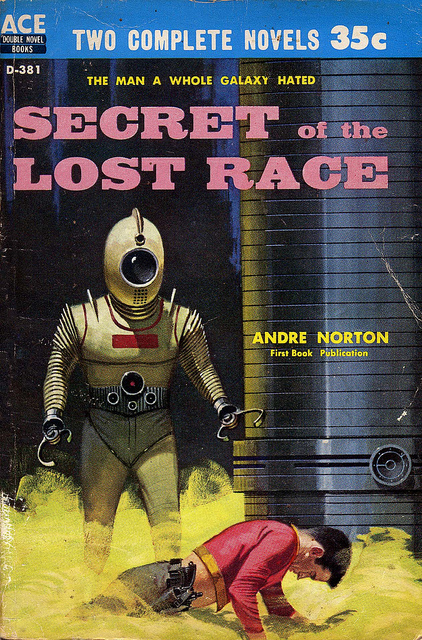
Vintage Treasures: Tales of Outer Space, edited by Donald A. Wollheim

Vintage Treasures: Tales of Outer Space, edited by Donald A. Wollheim

Tales of Outer SpaceSometimes I think I owe Donald A. Wollheim for a big chunk of my childhood.

Today we’re looking at Tales of Outer Space, a collection of interplanetary adventure tales edited by Wollheim in 1954, a decade after he invented the mass-market SF anthology with The Pocket Book of Science Fiction in 1943 (the first book with the words “Science Fiction” in the title), and not long after he produced  the first original SF anthology, The Girl With the Hungry Eyes, in 1947.

That’s some pioneering stuff. But Wollheim spent most of his career as a pioneer. From 1947 to 1951, he was the editor of Avon Books, where he introduced mainstream America to mass-market editions of some of the best fantasy from the pulp era — including Ralph Milne Farley’s An Earth Man on Venus (which I discussed last month), A. Merritt’s The Moon Pool, and eighteen issues of the highly sought-after fantasy paperback magazine, The Avon Fantasy Reader, among many other accomplishments. He even published C. S. Lewis’s Silent Planet space trilogy.

In 1952, Wollheim left Avon to spearhead a new paperback imprint, Ace Books, where he remained for 20 years. While there, he added science fiction to their lineup for the first time and, in a stroke of brilliance which endeared him to future generations of paperback collectors, invented the Ace Double in 1952.

You may have heard of some of his other successes at Ace as well: he first introduced Tolkien’s The Lord of Rings to the US in 1964 (against Tolkien’s wishes, as it happened) and published Frank Herbert’s obscure hardcover Dune in a paperback edition that made it a bestseller in 1965.

That ought to be enough for anyone. But of course, as many of you know, it wasn’t enough for Wollheim. In 1971, he left Ace to found his own publishing company, which bore his initials. DAW was the first mass market publisher to specialize in SF and fantasy, and before his death in 1990, it had acquired and published over a thousand titles, making it one of the most successful genre publishers of all time.

Of course, most of that was in Wollheim’s future when he released Tales of Outer Space — but the seeds of greatness were already there for anyone who looked.

Read More Read More

Maureen F. McHugh’s China Mountain Zhang

Maureen F. McHugh’s China Mountain Zhang

China Mountain ZhangThere’s a distinctive kind of surprise some science fiction books can generate: surprise that a book which seems to be speaking to the beliefs, fears, or world-view of a given time was in fact written well beforehand. I remember being taken aback, for example, that A Clockwork Orange was first published in 1962, before hippies and punks and the coining of ‘generation gap’ (first recorded 1967). And it’s interesting to me that Maureen F. McHugh’s China Mountain Zhang, published in 1992, calmly and thoroughly imagines a future dominated by China — something much discussed today, but a less common idea before the turn of the millennium. McHugh’s book is a twentieth century novel, lacking a world wide web or smartphones, that speaks to the twenty-first.

It does so because it’s a very strong book. And because the world it imagines is credible; the setting doesn’t seem a product of the anxiety of an ebbing imperial power, but a depiction of life as it is lived in the future. Characters go about their business, negotiating with the structures of their society as we do ours. We recognise them, and what they do, and their attempts to plan out their lives. As in much of the best science fiction, the imagined society’s complex and deeply imagined, existing in a dynamic relationship with character; it’s realistic, but not mimetic, and uses both its differences and similarities to the world we know as a way of getting at its thematic interest.

The book’s made up of long chapters that have the shape of short stories. Most follow an engineer surnamed Zhang, whose given names are ‘Rafael’ and ‘Zhong Shan,’ the latter of which can be translated ‘China Mountain.’ We follow Zhang as he finds his way to a career and builds a life for himself, a task complicated by ethnicity and sexual orientation. In and around the chapters dealing with Zhang are stories following other characters, minor figures in his life who broaden the story and add depth to the novel’s setting and structure. One of the metaphors that emerges in the book is chaos theory, and the now-familiar image of the butterfly fluttering its wings and causing a hurricane on the far side of the world; so these characters help demonstrate the interconnectedness of the world, affecting each other slightly or significantly, a structural embodiment of the chaos imagery.

Read More Read More

New Treasures: Titan

New Treasures: Titan

Titan Avalon HillThere are classic fantasy games and there are classic fantasy games. Jai Kamani and David A. Trampier’s Titan, a massive game of conflict between mythological armies of ogres, unicorns, griffons, and other creatures, was perhaps the most ubiquitous fantasy game of my youth. There were copies everywhere, tucked under arms at gaming conventions and on the shelves of department stores.

Titan was first published in an ultra-rare first edition in 1980 by tiny Gorgonstar, Inc. It was later made a hit by Avalon Hill, and remained in print for nearly two decades until Avalon Hill was sold and ceased operations in 1998. After that, copies of the most popular fantasy board game of the 80s and 90s gradually became harder and harder to find.

I remember getting my boys excited about Titan by nostalgically telling tales of epic battles between behemoths, dragons, and trolls. They clamored to play it.

I’d never owned Titan, but that’s not a problem in the age of the Internet. I found a pristine copy on eBay and hung on during a spirited bidding war. 90 bucks later, it was on my kitchen table.

Still in the shrink wrap.

It was perfectly preserved. My boys stood at my side, ready to go, anxious to throw down some dice, and experience some of that legendary Titan action. To shred the shrink and punch out counter sheets that had staunchly stood fast for over twenty years. My hands gripped the game, hesitating.

I couldn’t do it.

Read More Read More

Vintage Treasures: The Best of Murray Leinster

Vintage Treasures: The Best of Murray Leinster

The Best of Murray LeinsterI first encountered Murray Leinster… wow, I don’t even know when. Probably in The Hugo Winners, Isaac Asimov’s 1962 anthology collecting the first short stories to win science fiction’s coveted prize.

It featured Leinster’s 1956 novelette, “Exploration Team,” about a desperate rescue attempt on a distant planet — involving an illegal settler blackmailed into helping a lost colony, and his team of Kodiak bears. Lost colonies, deadly aliens, and even more deadly bears… that’s the kind of story that sticks in your mind when you’re twelve, believe me.

Leinster died in 1975; he published his last book, a novelization of the Land of the Giants TV series, in 1969. But he was a steady presence on bookstore shelves during my formative reading years for well over a decade after his death, with reprint titles like The Med Series (Ace, 1983) and The Forgotten Planet (Carroll & Graf, 1990).

The mass market reprints have tapered off over the last few years. The last were all from Baen, a trio of excellent collections all edited by Eric Flint and Guy Gordon: Med Ship (2002), Planets of Adventure (2003), and A Logic Named Joe (2005).

Since then, the wheels of publishing have ground on, as they do, abandoning Leinster by the side of the road. We did our part to keep his memory alive, of course. I reprinted one of Leinster’s earliest pulp tales, “The Fifth-Dimension Catapult,” from the January 1931 Astounding Stories of Super-Science, in Black Gate 9.

There have also been low-budget digital editions of his out-of-copyright pulp fiction, sure, but by and large the genre — as living genres should — has focused instead on new and emerging authors.

I used to think that was inevitable. Readers have long memories, but publishing industries don’t, and when an author has been out of print for over a decade, she’s likely to remain that way.

But the brilliant Lester del Rey, publisher of Del Rey Books, proved me wrong. In fact, he proved me wrong nearly four decades ago, with a fabulous line of top-selling paperbacks collecting the best short science fiction and fantasy from the writers of the Golden Age of SF — including The Best of Murray Leinster, a collection of some of the best short SF and fantasy of the 20th Century.

Read More Read More

Kirkus Looks at Galaxy Science Fiction

Kirkus Looks at Galaxy Science Fiction

Galaxy February 1951Over the last few months, Matthew Wuertz and Rich Horton have been tag-teaming a series of Retro Reviews here at Black Gate, looking at science fiction digests from the 1950s and 60s — especially H.L. Gold’s Galaxy, which Matthew has been covering issue by issue since the very first, cover-dated October 1950.

Meanwhile, Andrew Liptak at Kirkus Reviews has done his own retrospective, “Changing the Playing Field: H.L. Gold & Galaxy Science Fiction,” a detailed and affectionate look at Gold and the superb magazine he created:

Galaxy appeared in October 1950 as a monthly publication. It paid far better than its competitors, and Gold proved to be a far better editor than his counterpart at Astounding… With Gold at the helm, Galaxy Science Fiction began to change the tone of the genre. Astounding had taken advantage of the scientific rush that followed the development of the atomic bomb, and the resulting doomsday stories that followed. Gold went in another direction, explaining in an editorial that “The shape humanity is in is cause for worry, I believe, but not the kind of paralyzing terror that clutches science fiction writers in particular… Look, fellers, the end isn’t here yet.”

Strong, socially aware and satirical fiction became the mainstay with Galaxy, and 1951 proved to be an excellent year for the publication: “The Fireman,” by Ray Bradbury, appeared in the February issue, set in a dystopian world where literature was burned by government agents, and was later expanded into his landmark novel Fahrenheit 451. April brought Cyril Kornsbluth’s story “The Marching Morons,” and September saw Gold bring Robert Heinlein away from Astounding with his three-part story The Puppet Masters

Read More Read More

Vintage Treasures: Hauntings: Tales of the Supernatural

Vintage Treasures: Hauntings: Tales of the Supernatural

Hauntings Tales of the SupernaturalWhen I was a kid in the late 60s/early 70s, I was fascinated by the fantastic. It didn’t matter what it was: films, comics, television, or books. Although, until I learned to read, my exposure to the genre — and especially horror — was through purely visual media such as comics and whatever was on TV.

Luckily my earliest talent, which later turned out to be pretty much my only one, was that I took to reading like a cultist takes to, well, cults! This opened up a whole new world for me, as our elementary school had a well stocked library.

And it didn’t take long to catch on that the best books didn’t have any pictures in them. Sure, they had great covers, but inside there was nothing but words! Lots and lots of wonderful words that helped me fill my mind with images that no film or comic could match.

Another important thing that I learned was that adults didn’t care what you read as long as it was a genuine book. Comics brought only disdain and suspicion.

Especially those wonderfully gory black and white comics published by Warren, Skywald, and Eerie Publications, those you had to hide from the adults. My dad always called those comics “Doug’s damned weirdo books.”

Read More Read More

Vintage Treasures: The Last Province Magazine, Issue #4

Vintage Treasures: The Last Province Magazine, Issue #4

The-Last-Province-Issue-4I recently stumbled across a copy of a gaming magazine I’d never encountered before: The Last Province, a bi-monthly British publication that apparently lasted five issues, from October 1992 to September 1993.

This doesn’t happen very often, so it was definitely worth investigating. And I’m glad I did, as it turned out to be a delight.

I think the cover — a Martin Lennon character study of three very different adventuring fellows striding confidently across a green and pleasant land — effectively communicates both the content and editorial attitude. If the art doesn’t do it, the tag words “Independent British Roleplaying” at the top should give you the idea.

Paz Newis’s page 4 editorial is a perfect mix of defensiveness towards gaming stereotypes, and contempt for what others consider ‘normal.’ Pretty much exactly how I remember gamers talking in the 90s.

To my mind ours is one pastime with a wealth to offer its participants. It is to those of you who wish to take roleplaying out of the ‘spotty adolescents’ stereotype that this magazine is aimed.

Recently… I thought it would be a good idea to sit in front of the television. I was appalled! It really was brain numbing. All of my higher brain functions seized up. If this is what the majority of ‘normal people’ spend their time doing I have no desire to be normal.

The news section is jammed with headlines on the big events of the day — including Steve Jackson’s quarter-million dollar judgment against the US Secret Service for seizing their computer equipment during an investigation of GURPS Cyberpunk, the report that a young employee at a Glasgow branch of a well known game store chain was apparently fired for being female, and the release of a major new RPG from FASA with the strange title Earthdawn.

Read More Read More

New Treasures: The Simon & Kirby Library: Science Fiction

New Treasures: The Simon & Kirby Library: Science Fiction

The-Simon-and-Kirby-Library-Science-FictionJoe Simon and Jack Kirby were perhaps the most important and successful comic team of the 1940s and 50s. Together they created Captain America (among many other popular creations) and produced an incredible body of work spanning numerous genres. Joe Simon was the first editor of Marvel Comics and the legendary Jack Kirby later partnered with Stan Lee to create some of the most enduring characters of the 20th Century, including Iron Man, The Fantastic Four, The Hulk, The Silver Surfer, Daredevil, Thor, the X-Men, and countless others.

The Simon & Kirby Library: Science Fiction is packed with dozens of stories, many of them photographed from the original artwork. This is essential pulp science fiction, with tales of brave spacemen, intrepid jungle explorers encountering lost civilizations, living shadows, crash landings on bizarre alien worlds, sinister robots, giant monsters battling desperate armies, beautiful barbarian princesses, impossible inventions, and much more.

The Simon and Kirby Library: Science Fiction spans more than 20 years, beginning with the first stories Joe Simon and Jack Kirby ever produced together (beginning in June 1940) — their ten-issue run of Blue Bolt adventures. Then the Cold War years will be represented by Race For the Moon, featuring pencils by Kirby and inked artwork by comic book legends Reed Crandall, Angelo Torres, and Al Williamson.

Other rarities from both decades are included, and as a bonus for readers, the volume features stories illustrated by Crandall, Torres, and Williamson — without Kirby.

The book also includes an introduction by Watchmen co-creator Dave Gibbons. This is the fourth volume in The Simon & Kirby Library, following SuperheroesCrime and the best-selling Horror.

The book is in full-color throughout, and most of the art has been restored and vibrantly re-colored by Harry Mendryk. My only complaint about this volume is that only a handful of covers are included, in a sparse 3-page cover gallery in the back.

The Simon & Kirby Library: Science Fiction was published by Titan Books on June 4. It is 352 pages in hardcover, priced at $49.95. There is no digital edition.