Browsed by
Category: Vintage Treasures

Jack Williamson, Lin Carter and Appendix N: Advanced Readings in D&D

Jack Williamson, Lin Carter and Appendix N: Advanced Readings in D&D

The Humanoids-smallMordicai Knode and Tim Callahan are making me look bad.

I know, what else is new. But seriously, these two have taken on the project of a lifetime — reading every author in Gary Gygax’s famous Appendix N (all 29) and reporting back in great detail every week at Tor.com.

I took on the project of a lazy Saturday afternoon: read their posts whenever I got around to it and report back here every two weeks or so. Sounded easy at the time. But Knode and Callahan still somehow managed to get way ahead of me. They’re relentless — since I last checked, they’ve covered Jack Williamson, Lin Carter, and John Bellairs, and meanwhile I’m still trying to figure out where the hell I left my copy of The Face in the Frost.

Okay, time to play a little catch-up. Let’s start with post 14 in the ongoing series, in which they tackle Jack Williamson’s classic SF novel, The Humanoids:

Mordicai: I’m just unclear on how it relates to Dungeons and Dragons. I mean, you could have a whole campaign about golems or Inevitables or Modrons and co-opt the plot from this book, but I think that is a stretch. Maybe the lesson you could learn from this book is that making hugely flawed characters is more interesting than making banal superhuman heroes who laugh in the face of danger and never give into the temptation to pry the ruby eyes out of the idol of Fraz-Urb’luu?

Tim: Yeah, I don’t see the Dungeons and Dragons link at all, and I am pretty darn sure Gary Gygax didn’t have any Modrons in mind when he generated his list of fave books. The Modrons are wonderful and all — who doesn’t like Rubik the Amazing Cube mashed up with Mr. Spock — but they aren’t central to early D&D. Or any D&D. Ever.

But, to be fair, Appendix N doesn’t specifically name The Humanoids as an influence, but mentions Jack Williamson in general. Probably his pulpier early stuff was what Gygax had had in mind. In retrospect, we should have read the Legion of Musketeers in Space with Falstaff and Friends book. But something called The Humanoids sounds like D&D from a distance. If you squint. And don’t read the back of the book.

Yeah, The Humanoids has nothing to do with D&D. Could have told you that. Guys, guys. You should have read our Jack Williamson feature last month. This is why we do this stuff.

Read More Read More

Three Against the Witch World by Andre Norton

Three Against the Witch World by Andre Norton

oie_2122256U6CJIW64Daybreak - 2250 A.D.-smallWhen I was growing up in the seventies, the most represented science-fiction author in the children’s section of my local library was Andre Norton. Her books took up more shelf space than either Robert Heinlein or Isaac Asimov. Maybe the children’s librarian was a fan.

And then there were the Andre Norton books on my father’s bookshelf. As cool as the cover of Daybreak – 2250A.D. looked, I never read it. For the next forty years, I managed to avoid anything by Norton.

Then two years ago, as I was getting my Swords & Sorcery blog up to speed, I pulled out my copies of Lin Carter’s Flashing Swords series. There in the second volume was “Toads of Grimmerdale” by Andre Norton.

Carter’s enthusiastic introduction was enough to make me give it a shot. Since I knew many of Norton’s novels were young adult, I wasn’t expecting a story about revenge. Woven from strands of darkness and shards of ice, it’s a haunting introduction to Witch World that I strongly recommend.

“Toads” was enough to make me root through the boxes of my dad’s old books, hunting for other Witch World stories. Since then, I’ve read the first three novels in the series — Witch World (1963), Web of the Witch World (1964), and Three Against the Witch World (1965) — as well as two collections of stories: Spell of the Witch World (1972) (reviewed by me at my site) and Lore of the Witch World (1980). It’s the third novel I will speak of here.

In Witch World (just reviewed here by Matthew David Surridge), Norton takes ex-U.S. soldier and blackmarketeer Simon Tregarth and tosses him through a dimensional gate. He must adjust to a world of super-science and magic, and quickly at that, for he must choose sides in a war. Simon is immediately caught up in the affairs of the witches of Estcarp and their ongoing struggle against the thuggish realm of Karsten. He joins a group of exiles and settlers from other dimensions and plunges into battle on and under the sea, in the air, and into far dimensions.

Read More Read More

Vintage Treasures: The Best of Philip K. Dick

Vintage Treasures: The Best of Philip K. Dick

The Best of Philip K Dick-smallI didn’t know anything about Philip K. Dick when The Best of Philip K. Dick was released in 1977. That was the year Star Wars came out and I was more interested in trying to make a light saber out of my sister’s hair dryer.

I wasn’t alone (about Dick, not my obsession with my sister’s hair dryer). Philip K. Dick was a midlist paperback science fiction writer in the mid-70s, with few awards and only a handful of successful novels to his name, largely unknown except inside the genre. As Robert Silverberg observed in his famous comments on full-time SF writers, “Phil Dick was a full-timer, but lived at the poverty level.”

Dick was an unusual choice for Lester del Rey’s Classics of Science Fiction line for another reason. If you’ve been following the entries so far (see below for a complete list of the titles we’ve covered), you know that a typical volume consists of long out-of-print pulp stories by a writer who later achieved some measure of fame, usually for their novels.

The most recent story in last week’s entry, for example, The Best of John W. Campbell, was “Cloak of Aesir,” originally published in 1939. Similarly with The Best of Henry Kuttner (most recent entry from 1946), C.L. Moore (1946), Stanley Weinbaum (1936), and others.

By contract, the earliest story in The Best of Philip K. Dick, “Beyond Lie the Wub,” originally appeared in 1952. He’d barely been published for two decades by the time this book arrived, which didn’t fit the profile of Del Rey’s other choices at all. In fact, in many ways Dick was the most contemporary subject Del Rey chose for his select line of collections.

I can only conclude that Del Rey saw something special in Dick’s short stories. He wasn’t the only one, either — by the late 70s, the brilliant work being done by Dick at short length was becoming obvious to his fellow writers, even if wider recognition still eluded him. The blurbs on the inside cover reflect this. Here’s Norman Spinrad:

He has produced the most significant body of work of any science-fiction writer.

Read More Read More

Vintage Treasures: Hell’s Cartographers, edited by Brian W. Aldiss and Harry Harrison

Vintage Treasures: Hell’s Cartographers, edited by Brian W. Aldiss and Harry Harrison

Hell's Cartographers-smallI’ve been enjoying writing my ongoing series on the Ballantine Best of… books. It’s nice to be able to celebrate all those classic SF and fantasy writers, sure, but it’s also an excuse to talk about how I discovered each of them and what their books meant to me personally.

I don’t think I’m unique in this. SFF readers love to talk about the favorite authors of their youth. Look at the comment threads for any of my Ballantine articles — it’s just a bunch of us old fans yakking about the good old days (and yelling at those kids with their Kindles to get off our lawn).

In truth, this is a long-established tradition. Respected, even. Lots of SF authors did it. Asimov and Damon Knight did it, in Before the Golden Age and Science Fiction of the 30s. So did Brian Aldiss, in Billion Year Spree, and Sam Moskowitz, in Seekers of Tomorrow, Under the Moons of Mars, and just about every book he ever wrote. Perhaps most famously, Kingsley Amis did it in New Maps Of Hell, his celebrated survey of science fiction from 1960.

But probably my favorite example is Hell’s Cartographers, a marvelous collection of “personal histories” from six top science fiction writers: Alfred Bester, Damon Knight, Frederik Pohl, Robert Silverberg, Harry Harrison, and Brian Aldiss. This book is packed with countless anecdotes, fascinating references to SF magazines and ground-breaking stories, and tales of awkward adolescences. And for those of us interested in the history of the field, there is treasure on every page.

There are numerous quotes I could tease you with, but I’ll limit myself to this one, from Damon Knight’s entry, “Knight Piece,” which effectively communicates just how hapless these accomplished young men were around women.

Read More Read More

Who Took the Flowers Out of my Prose?

Who Took the Flowers Out of my Prose?

Conan Red Nails-smallOver here in England, we have a shop called ‘Poundland,’ which is pretty much what it says on the tin: a shop where everything costs a single pound, and for a boy of about ten, it was a dream come true. All the flimsy toys, dodgy sweets and budget DVDs my little mind could conjure — there was a book section as well, but it mostly consisted of either absolute rubbish or books about Simon Cowell.

But one particular day, when I was about ten, I happened to spot a diamond hidden amongst the rubbish: an anthology of stories by Robert E Howard. I’d never heard of him at the time, but the book had Conan in the title.

I had heard of Conan. My brief experience with the two movies told me I liked big swords, big monsters, and Arnold Schwarzenegger as much as the next ten-year-old, so I decided to buy it. On the train ride home, I found myself introduced to a new, vivid, and lively world, one of blood and savagery, of death and shadow, of lurking devils and skulking gods. I was exposed to a land of witchcraft, sorcerers, devils and demons, nations torn apart by brooding crusaders kings and swashbuckling puritans. It was the best train ride of my life.

“That’s all well and good, Connor,” you might say, “but what’s this got to do with prose?” Show a little patience; I’m getting to that.

What enchanted me most throughout these adventures was the prose; it just had its own nature and flavor, its own distinguished way of presenting things. I’d never encountered anything like it before; it was poetic, haunting, powerful. It lent every blow a sort of impact, made every monster tangible. Even the heroes — too powerful, too fast, too smart to ever be real — it made them come alive.

And in fantasy, where a key aspect is immersion, this is an impressive achievement. I touched upon this not too long ago with my Fantasy Face-off article; noting that prose dictates the way we see the world on the page and, therefore, how vivid and real it is. Prose overshadows flaws when it’s successful and highlights them when it’s not.

But what I didn’t mention was how prose can amplify the tone of the book. Fritz Leiber’s prose is rather light, reflecting the comic, satirical feel of his books. Howard’s is fast, rip-roaring and powerful, much like the pacing of his books and the characters within them. Tolkien’s prose, though it can sometimes be lacking, feels reminiscent of a fairy tale.

Read More Read More

Night Winds by Karl Edward Wagner

Night Winds by Karl Edward Wagner

Night Winds-small

“He’s evil incarnate! Stay away from him!”
— from Darkness Weaves

Long before the coiners of the term grimdark were born, Karl Edward Wagner was creating some of the most aggressively unheroic fantasy. There had always been a dark current to swords & sorcery from the genre’s beginnings in the 1930s with Robert E. Howard. But not even Michael Moorcock’s 1960s antiheroes prepared S&S fans for Wagner’s 1971 novel Darkness Weaves and its amoral mystic swordsman, Kane.

Six feet tall and “three hundred pounds of bone, sinew, and muscle,” Kane is cursed to live forever for rebelling against the god who created him. Peering out from his fiery red hair and beard, his blues eyes blaze with a killer’s fury — a warning to all who cross his path. Though a violent death can free him from his accursed immortality, he is determined to survive.

Over the course of three novels and seventeen stories, Kane plots and murders his way across continents and centuries. He is by turns a mighty sorcerer, a bandit lord and a lone wanderer. While it’s explicitly stated in one story that Kane is “seldom needlessly cruel,” he’s seldom sympathetic.

It’s in the two collections of short stories, Death Angel’s Shadow (which I reviewed last year at my site) and Night Winds, that Wagner crafted his greatest swords & sorcery. His novels, Bloodstone, Dark Crusade, and Darkness Weaves, all have their moments, but they don’t have the short, sharp, shock of the stories. While the books are memorably epic, the stories are fast-paced nightmares.

Read More Read More

Vintage Treasures: The Best of John W. Campbell

Vintage Treasures: The Best of John W. Campbell

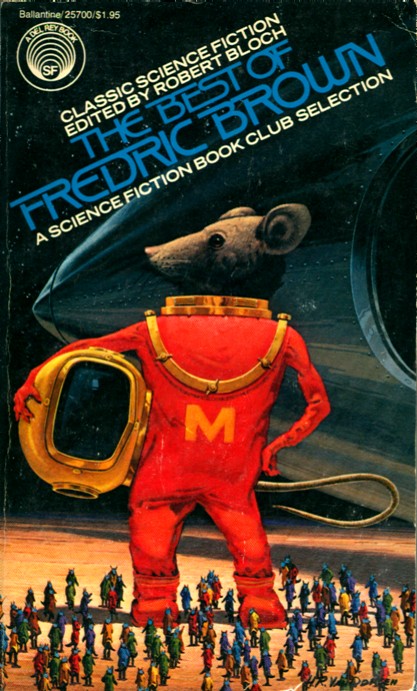
The Best of John W Campbell-smallJohn W. Campbell is one of the most important figures in 20th Century science fiction and fantasy.

If Campbell’s name seems familiar, it’s no accident. He’s come up multiple times in this series so far. In my last article, The Best of Hal Clement, I noted that Clement’s heroes frequently quoted Campbell’s pulp heroes Morey and Wade, and that Clement had been discovered by Campbell in June 1942, when Campbell was editing Astounding Science-Fiction.

In my previous piece, on The Best of Jack Williamson, I also observed that Williamson had “survived the coming of Campbell,” by which I meant that he was one of the few authors talented enough to continue writing SF in the pulps after about 1939, when Campbell had re-made the entire field in his image.

I could go back through all the other articles in this series and see just how often Campbell comes up, but I think you get the point. In the first half of the 20th Century, science fiction existed almost solely in the magazines and Campbell dominated the field so thoroughly that the start of the “Golden Age of Science Fiction” is usually marked by the year he began editing Astounding — the year he discovered writers like Robert Heinlein, A.E. Van Vogt, Isaac Asimov, Theodore Sturgeon, Lester del Rey, and many others.

In his memoir, I, Asimov, Asimov called Campbell “the most powerful force in science fiction ever, and for the first ten years of his editorship he dominated the field completely.”

But we’re not here to talk about Campbell the editor. We’re here to talk about Campbell the writer. And specifically, the eleven short stories he wrote between 1932 and 1939 collected in The Best of John W. Campbell.

Read More Read More

Vintage Treasures: The List of 7 by Mark Frost

Vintage Treasures: The List of 7 by Mark Frost

The List of Seven Inside Spread-small

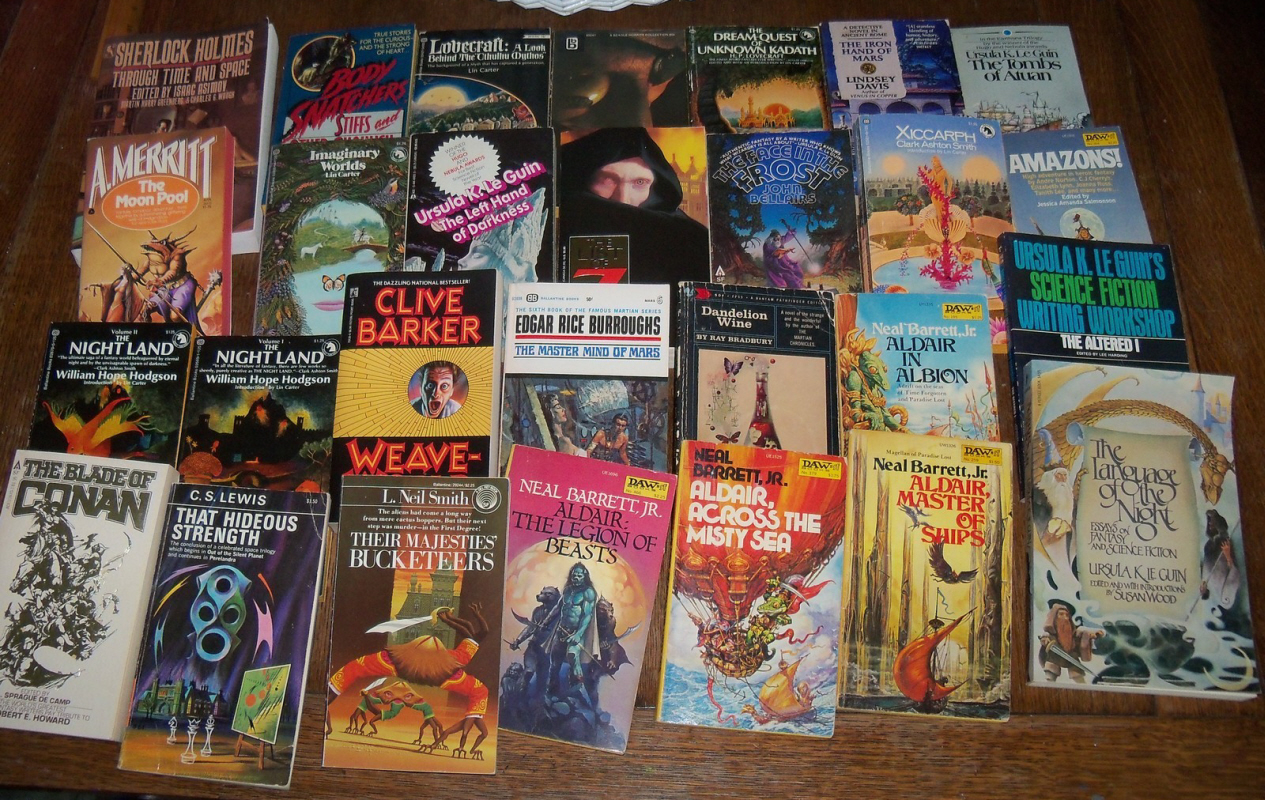
I love buying paperback collections. Like this one, which I  found online last week. Just look at at all those gorgeous vintage paperbacks. Seriously, click on that link and look at them. I’ll wait.

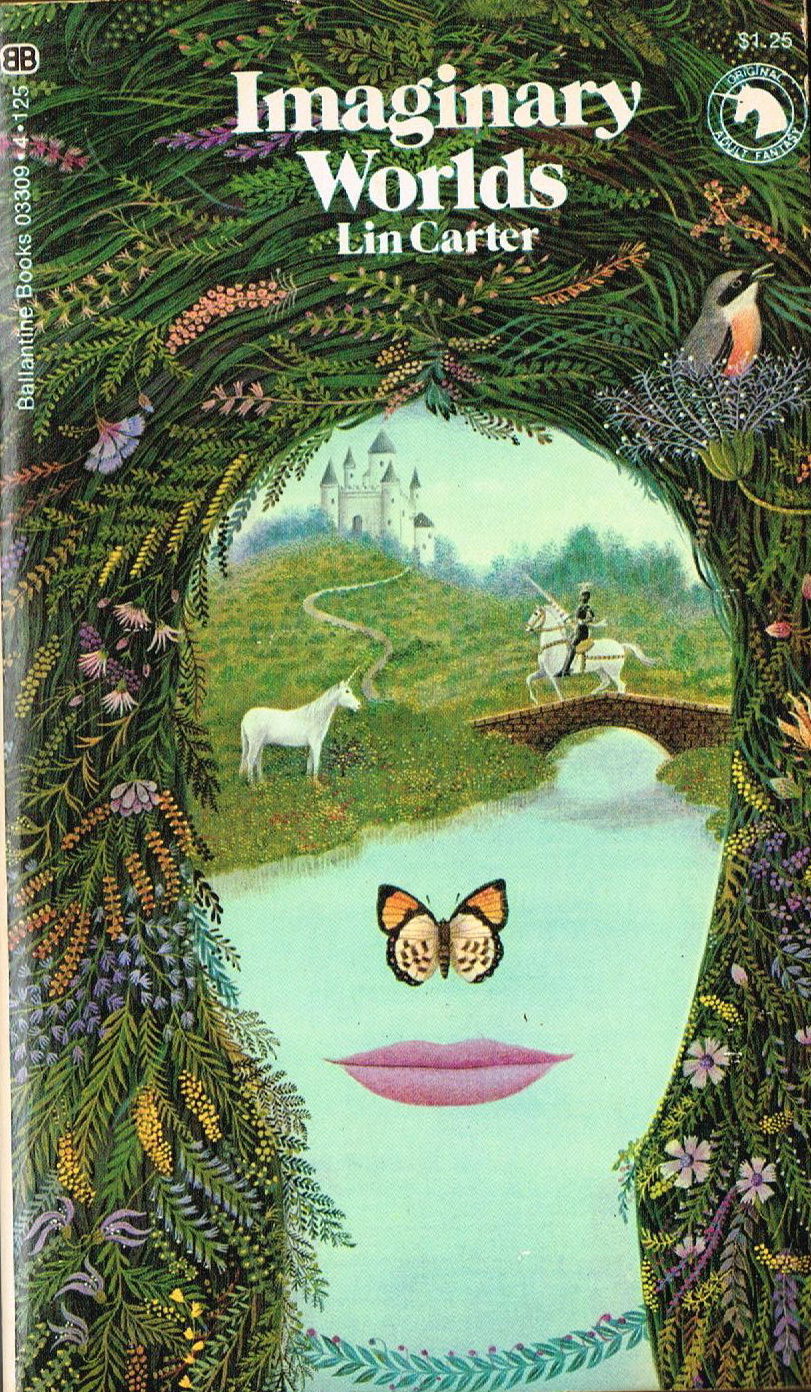
Twenty-eight volumes in terrific shape, for less than twenty bucks. Including four early volumes from Neal Barrett, Jr; three vintage Lovecraft collections (one of them The Dream Quest of Unknown Kadath); both Ballantine volumes of William Hope Hodgson’s The Night Land; one of Lin Carter’s better fantasy collections, Imaginary Worlds; A. Merritt’s The Moon Pool; a smattering of Ursula K. LeGuin, plus C.S. Lewis, Clark Ashton Smith, Ray Bradbury, Edgar Rice Burroughs, John Bellairs, and half a dozen more. There’s even a beautiful copy of Sherlock Holmes Through Time and Space, which I’ve lusted after ever since Violette Malan teased me with the cover in her article on science fiction mysteries last month.

Man, I could just lay these babies down on the floor and roll around in ’em. Except that would probably dog ear the covers.

They finally arrived today, carefully packed in tightly wrapped plastic, and I gently unwrapped them and settled in to examine my new treasures. Many clamored for attention, but the one that practically jumped into my hands was The List of 7, by Mark Frost. That’s the inside front cover above, complete with mummies, gruesome spectres, ghosts, a train chase, and — speaking of Sherlock Holmes — the words “The Game’s Afoot” scrawled on parchment (click for a bigger version).

Read More Read More

(Not) Recommending SF&F Classics to the Young Person or Novice

(Not) Recommending SF&F Classics to the Young Person or Novice

dunsanyWe’ve all done it: “Oh you want to read some Fantasy or SF? Here, how about some Lord Dunsany or E.E. Doc Smith?”

And the books vanish for months, then get returned by the shamefaced borrower: “Couldn’t really get into them. Sorry.”

I’m probably typical. My much-loved genre classics are the equivalent of a warm bath, not a subject for literary criticism.

Until recently, that is.

My son – “Kurtzhau” – is 9, at the tail end of Middle Grade. He loves some of the rip-roaring YA novels that are knocking around – Percy Jackson and Time Riders, for example (the Pulp tradition is un-self-consciously alive and well in YA). However, he craves proper stories with swords and/or soldiers and lasers in them. Powered armor is also good.

And that’s a problem. Nobody seems to be writing the mainstream subgenres for YA.

Helpful mates recommend all sorts of adult novels, but often forget that the dénouement – say – takes place in a brothel staffed by surgically modified aliens and that the antagonists are incestuous twins.

That leaves the classics; either mid-20th century YA such as Andre Norton or earlier “Pulp” yarns which were constrained by pre-WWII decency codes; the stuff I grew up on, the stuff that still crams my shelves…

The stuff of which Kurtzhau inevitably bounces. Here’s why.

Read More Read More

Andre Norton, Michael Moorcock and Appendix N: Advanced Readings in D&D

Andre Norton, Michael Moorcock and Appendix N: Advanced Readings in D&D

stormbringerAnd so we come to two of the most influential and prolific fantasy writers of the 20th Century, Andre Norton and Michael Moorcock, as we follow intrepid literary explorers Mordicai and Tim Callahan on their voyage of discovery through Appendix N at Tor.com.

Tim and Mordicai have been none too gentle to some of the writers in Appendix N, including L. Sprague de Camp, Gardner Fox, and even Roger Zelazny. But in Norton and Moorcock, they find authors they can appreciate.

Here’s Tim on Michael Moorcock:

I read The Swords Trilogy and The Chronicles of Corum early, and they made an impact. They exploded inside my mind in a way I have never forgotten, even if I can’t remember many of the story details from any particular chapter… but I didn’t really feel like I tuned into Elric until halfway through the first reprint volume, when we get the four novellas of Stormbringer

It’s classic Moorcock, in that imaginative and terrifyingly evocative way that I loved all those years ago when I first picked up The Swords Trilogy off a spinner rack in my hometown general store. Stormbringer begins with agents of chaos abducting Elric’s wife, and it takes off into the realm of mass warfare and conflicts with not-quite-dead-gods soon enough.

Moorcock aims for the mythic.

Read the complete article here.

Good to see a little love for classic sword & sorcery, but personally I don’t see a lot of direct influence from Elric on D&D — unless you count the section on powerful artifacts in the Dungeon Masters Guide, which clearly was conceived with weapons like Stormbringer in mind.

Read More Read More